Month: June 2009

  • ‘New  Economy’ and Barack Obama

    ‘New Economy’ and Barack Obama

    My friend went to hear Charles Krauthammer.  He listened with 25 others in a closed room.  What he says here, is NOT second-hand but first-hand.

    William Barden <[email protected]>

    ——————————————————————————————————–

    Subj: Charles Krauthammer Speech/Comments on the ‘New

    Economy’ and Barack Obama

    To my friends & associates:

    Last Monday was a profound evening, hearing Dr. Charles Krauthammer speak to the Center for the American Experiment.  He is a brilliant intellectual, seasoned and articulate. He is forthright and careful in his analysis, and never resorts to emotions or personal insults. He is NOT a fear monger nor an extremist in his comments and views.  He is a fiscal conservative, and has a Pulitzer prize for writing.  He is a frequent contributor to Fox News and writes weekly for the Washington Post.  The entire room was held spellbound during his talk.  I have shared this with many of you and several have asked me to summarize his comments, as we are living in uncharted waters economically and internationally.  Even two Dems at my table agreed with everything he said! If you feel like forwarding this to those who are open minded and have not ‘drunk the Kool-Aid’, feel free.

    A summary of his comments:

    1.  Mr. Obama is a very intellectual, charming individual.  He is not to be underestimated. He is a ‘cool customer’ who doesn’t show his emotions. It’s very hard to know what’s ‘behind the mask’.  Taking down the Clinton dynasty from a political neophyte was an amazing accomplishment.  The Clintons still do not understand what hit them.  Obama was in the perfect place at the perfect time.

    2.  Obama has political skills comparable to Reagan and Clinton.  He has a way of making you think he’s on your side, agreeing with your position, while doing the opposite.  Pay no attnention to what he SAYS; rather, watch what he DOES!

    3.  Obama has a ruthless quest for power.  He did not come to Washington to make something out of himself, but rather to change everything, including dismantling capitalism.  He can’t be straightforward on his ambitions, as the public would not go along.  He has a heavy hand, and wants to ‘level the playing field’ with income redistribution and punishment of the achievers of society.  He would like to model the USA to Great Britain or Canada .

    4.  His three main goals are to control ENERGY, PUBLIC EDUCATION, and NATIONAL HEALTHCARE by the Federal government  He doesn’t care about the auto or financial services industries, but got them as an early bonus.  The cap and trade will add costs to everything and stifle growth. Paying for FREE college education is his goal.  Most scary is his healthcare program, because if you make it FREE and add 46,000,000 people to a Medicare-type single-payer system, the costs will go through the roof.  The only way to control costs is with massive RATIONING of services, like in Canada .  God forbid.

    5.  He’s surrounded himself with mostly far-left academic types. No one around him has ever run even a candy store. But they’re going to try and run the auto, financial, banking and other industries. This obviously can’t work in the long run. Obama’s not a socialist; rather a far-left secular progressive bent on nothing short of revolution. He ran as a mo derate, but will govern from the hard left. Again, watch what he does, not what he says.

    6.  Obama doesn’t really see himself as President of the USA , more as a ruler over the world.  He sees himself above it all, trying to orchestrate and coordinate various countries and their agendas.  He sees moral equivalence in all cultures.  His apology tour in Germany and England was a prime example of how he sees America , as an imperialist nation that has been arrogant, rather than a great noble nation that has at times made errors.  This is the first President ever who has chastised our allies and appeased our enemies!

    7.  He’s now handing out goodies. He hopes that the bill (and pain) will not ‘come due’ until after he’s reelected in 2012.  He’d like to blame all problems on Bush from the past, and hopefully his successor in the future.  He has a huge ego, and Mr. Krauthammer believes he is a narcissist.

    8.  Republicans are in the wilderness for a while, but will emerge strong. We’re ‘pining’ for another Reagan, but there’ll never be another like him.  He believes Mitt Romney, Tim Pawlenty and Bobby Jindahl (except for his terrible speech in Feb.) are the future of the party. Newt Gingrich is brilliant, but has baggage. Sarah Palin is sincere and intelligent, but needs to really be seriously boning up on facts and information if she’s to be a serious candidate in the future. We need to return to the party of lower taxes, smaller government, personal responsibility, strong national defense, and states’ rights.

    9.  The current level of spending is irresponsible & outrageous. We’re spending trillions that we don’t

    have. This could lead to hyper inflation, depression or worse. No country has ever spent themselves into prosperity. The media is giving Obama, Reid and Pelosi a pass because they love their agenda. But eventually the bill will come due and people will realize the huge bailouts didn’t work, nor will the stimulus pkg. These were trillion-dollar payoffs to Obama’s allies, unions and the Congress to placate the left, so he can get support for #4 above.

    10.  The election was over in mid-September when Lehman Brothers failed. Fear and panic swept in, we had an unpopular President, and the war was grinding on indefinitely without a clear outcome. The people are in pain, and the mantra of ‘change’ caused people to act emotionally. Any Dem would have won this election; it was surprising is was as close as it was.

    11.  In 2012, if the unemployment rate is over 10%, Republicans will be swept back into power.  If it’s under 8%, the Dems continue to roll.  If it’s between 8-10%, it’ll be a dogfight. It’ll all be about the economy.

    I hope this gets you really thinking about what’s happening in Washington and Congress. There’s a left-wing revolution going on, according to Krauthammer, and he encourages us to keep the faith and join the loyal resistance. The work will be hard, but we’re right on most issues and can reclaim our country, before it’s far too late.
  • Father’s doubts over Jackson death

    Father’s doubts over Jackson death

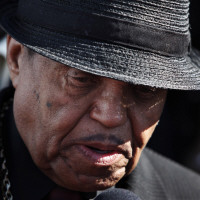
    Michael Jackson’s father said he had a “lot of concerns” over the events that led up to his son’s death, as details began to emerge of the post-mortem examination.

    Jackson’s body weighed just 8st 1oz – and his stomach only contained partially-dissolved pills when he died, it was reported.

    The findings, reported in The Sun, state the singer had four injection marks near his heart, apparently from attempts to pump adrenaline into the organ in a bid to restart it.

    Speaking on the Black Entertainment Television Awards’ red carpet in Los Angeles, Joe Jackson said he couldn’t go into detail about what his concerns were.

    But he added the singer’s children were the family’s “first priority” and that he and Michael’s mother, Katherine, have “authority for our son and his children”.

    Asked about funeral arrangements, Mr Jackson said: “We haven’t got to that yet, we are working on that.”

    In an unexpected move, Janet Jackson chose the Black Entertainment Television Awards ceremony to make her first public appearance since the death of her brother.

    Taking to the stage, the tearful singer said: “On behalf of my family and myself, thank you for all your love.

    “To you Michael is an icon. To us, Michael is family and he will forever live in all of our hearts.”

    Earlier, Joe Jackson had said he did not believe stress over the intense series of London concerts the King of Pop planned for his comeback had led to his death. He also said he believed his son would be larger in death than he was in life.

    Press Association

  • UK, Racism; From the streets to the courts

    UK, Racism; From the streets to the courts

    A mini-pogrom in Ulster has shocked Britain. But a legal battle with the far right is brewing on the mainland.

    RACIST bogeymen leered out of newspaper pages in both Britain and Northern Ireland this week. On the mainland, the far-right British National Party (BNP), which won its first two seats in the European Parliament earlier this month, was given an ultimatum by Britain’s equality watchdog to step in line with non-discrimination laws or face legal action. Separately, white thugs in Ulster hounded more than a hundred Romanian immigrants—mainly Roma gypsies—out of their homes and, in most cases it now seems, away from the province altogether.

    The attacks in south Belfast were of the sort that Northern Ireland hoped had died with the Troubles. Over several nights crowds stoned the homes of immigrant families, smashing windows and posting extracts of Mein Kampf through letterboxes. Tension between locals and east European immigrants had simmered since football hooligans clashed at a match between Poland and Northern Ireland in March. When the intimidation reached a peak on June 16th, the Romanians were moved to a church hall and then to a leisure centre. On June 23rd Northern Ireland’s government announced that most had decided to return to Romania.

    Northern Ireland elected no far-right politicians to the European Parliament in the polling on June 4th. Nonetheless, many in Britain reckon that their neighbours over the water are a more prejudiced bunch than they are themselves. Socially, Ulster leans to the right: civil partnerships, greeted with a shrug by most British Tories, attracted protests in Belfast when they were introduced in 2005; abortion is also more restricted than on the mainland.

    It may be that these conservative attitudes extend to scepticism about outsiders. A survey published on June 24th by Northern Ireland’s Equality Commission, a statutory watchdog, found that nearly a quarter of the population would be unhappy if a migrant worker moved in next-door. People were even more hostile to Irish travellers, sometimes called gypsies (and often confused with Roma). Just over half said they would mind having travellers living next to them.

    Comparing these results with the rest of Britain is hard because surveys produce different answers according to how a question is worded. Across the United Kingdom, less than a tenth of whites say they would mind having a black or Asian boss (though nearly a third admit to being at least “a little” racially prejudiced). But the trends on the mainland and in Ulster are in sharp contrast. British hang-ups about minorities have fallen pretty steadily over the past 20 years, according to the British Social Attitudes Survey, a big questionnaire. By contrast, Northern Irish dislike of travellers is up by a quarter from 2005.

    Yet sectarian tensions in Northern Ireland are relatively low. Only 6% now say they would mind having a neighbour of a different faith. One theory goes that the fizzling out of the old disputes has helped to stoke other ones. “The attitudes that facilitate sectarianism may find new outlets in new times,” suggested Bob Collins, the head of the commission. Immigrants are not the only victims: anti-gay sentiment, falling across Britain, has gone up by more than half in Northern Ireland since 2005.

    Glass houses

    The election of a man with a conviction for inciting race hatred to represent northern England in the European Parliament spoils any pretty notion that all is well on the mainland. But the selection of Nick Griffin, the leader of the BNP, and his colleague Andrew Brons, a former National Front chairman, has provoked a legal challenge from the Equality and Human Rights Commission (EHRC), a mega-watchdog.

    The EHRC wrote to Mr Griffin on June 23rd that it believed the BNP fell foul of the law in its race-based membership policy, its hiring (which appears to be restricted to party members) and what the EHRC interpreted as hints that the party would not provide an equal service to constituents of all races. Unless the BNP changes its ways by July 20th, the watchdog will seek a court order to force it to; if the party held that in contempt it could face fines, imprisonment—and publicity.

    Why pounce now? First, the EHRC was born only in 2007. Its predecessor, the Commission for Racial Equality, lacked the power to pursue this sort of independent legal challenge. Second, the law has been clarified: the law lords ruled in November 2007 that certain functions of political parties are indeed subject to the Race Relations Act of 1976, which had been in doubt.

    Most obviously, the action was triggered by the electoral success of the BNP which, coupled with talk in Westminster about voting reform likely to benefit small parties, has made it harder to dismiss as a sideshow. Others have moved against the BNP since the election: the Royal British Legion, a veterans’ group, publicly called on Mr Griffin to stop wearing its poppy emblem; the government is pondering banning BNP members from teaching, just as they are already banned from the police and prison services. A forthcoming bill on equal opportunities is expected to include a clause explicitly to stop the BNP and its ilk from insisting on race-based membership.

    If the EHRC’s complaint goes to court, it will not be the first time a case against a political party has tested race-relations laws. The 1976 act followed a House of Lords ruling in 1973 upholding the right of East Ham South Conservative Club to ban a Sikh because of his race. And the 2007 Lords’ ruling that has clarified the grounds for the EHRC’s current case was over a complaint by a Pakistani man—upheld by their lordships—against the Labour Party.

    Economist

  • Medical Martial Law

    Medical Martial Law

    This excerpt from The Corbett Report podcast discusses the possible implementation of martial law in the event of a pandemic flu scenario. Martial law will likely be used to implement forced vaccinations and quarantines and put the finishing touches on decades-long planning for the undermining of our democratic processes. For more information on this subject (including dozens of links to news stories and documents) and to listen to the rest of this podcast episode, please follow the link:

  • British Embassy staff arrested in Iran

    British Embassy staff arrested in Iran

    Iran has detained eight local staff at the British embassy in Tehran on accusations of having a role in post-election riots, local reports said.

    UK Foreign Secretary David Miliband demanded their release, saying the arrests were “quite unacceptable”.

    Relations between the countries are strained after Tehran accused the UK of stoking unrest, which London denies.

    Some 17 people are thought to have died in street protests after the disputed 12 June presidential poll.

    Tehran has expelled two British diplomats in the past week, and the UK has responded with a similar measure.

    The arrests were first reported by the semi-official Fars news agency.

    “Eight local employees at the British embassy who had a considerable role in recent unrest were taken into custody,” Fars said, without giving a source.

    UK Foreign Secretary David Miliband expressed “deep concern” over the arrest of local staff on Saturday.

    “This is harassment and intimidation of a kind that is quite unacceptable,” he told reporters at an international conference in Corfu. “We want to see (them) released unharmed.”

    He said the British government had made a strong protest and denied accusations that the UK was behind unrest in Iran.

    Poll verdict

    Meanwhile, Iran’s powerful Guardian Council was due to give its verdict on the result of the disputed presidential election, which handed President Mahmoud Ahmadinejad a decisive victory.

    But the BBC’s Jeremy Bowen in Tehran says there is much politicking taking place behind the scenes, and that the five-day deadline for the Guardian Council to return its verdict may be extended.

    Our correspondent says there is an attempt to form a committee – including the disappointed presidential candidates – to oversee the recount of 10% of the votes, a move which they are resisting.

    Another parliamentary committee is holding discussions with the grand ayatollahs in an attempt from pro-Ahmadinejad forces to put on a show of unity, he adds.

    But opposition leader Mir Hossein Mousavi has not backed away from his claim that the election result was fraudulent, and has refused to support the Guardian Council’s plan for a partial recount.

    Mr Mousavi has been calling for a full re-run of the vote, but said on Saturday that he would accept a review by an independent body.

    However the Guardian Council has already defended President Ahmadinejad’s re-election, saying on Friday that the presidential poll was the “healthiest” since the Iranian revolution in 1979.

    BBC

  • Armenians killed 73.727 Azerbaijanis

    Armenians killed 73.727 Azerbaijanis


    Archives documents: Armenians killed 73.727 Azerbaijanis in Nakhchivan in 1919-1921

    [ 31 Mar 2008 12:30  ]

    Baku. Vugar Masimoglu-APA. Armenians killed 523.955 Turks in Turkey in 1910-1922. These numbers have been reflected in official documents of Turkish Cabinet of Ministers State Archives General Department, APA reports.

    Official documents about killing 523.955 Turks in various places of Anadolu are kept in Turkish State Archives. These documents prove that Armenians have committed Genocide against Turks, not Turkey. These documents reflect how many Turks have been killed in concrete villages and cities. Armenians killed many Turks in Kars, Ardahan, Van, Igdir and Nakhchivan. Armenians killed 4.000 Azerbaijanis in 1919, 64.408 in 1920, 5.307 more people in the same year, 12 people in 1921.    

    000000000000000000000000000000000000000000000000000

    Gahraman Agayev: “Bodies found in mass graveyard in Guba belong to the Azerbaijanis killed by Armenians in the first ten-day of May, 1918”

    [ 31 Mar 2008 17:52  ]

    Baku. Laura Jabrayilli-APA. “Mass graveyard in Guba was found out accidentally on April 1, 2007. We carried out archeological excavations in the 500 sq m area from July 13 till December 28 last year.

    The study found out that the graveyard in the north of Guba and right bank of the Gudyalchay river was left out as a result of the genocide committed by Armenians against Azerbaijanis on May 1-10 in 1918,” head of the scientific expedition making research in the mass graveyard in Guba Gahraman Agayev told APA. He said Armenians had atrociously killed Azerbaijanis.
    “There are no signs of bullets on the bones. It shows that they were killed atrociously and beheaded”, he said.
    Gahraman Agayev underlined that the graveyard was left out after the genocide committed by Armenians and said archeologists, historians, ethnographers and criminalists should carry out joint research in the territory.
    161 skulls have been taken out of the mass graveyard in Guba up to now. According to the historical reports, Armenians killed about 3000 people in Guba in 1918.

    Prosecutor General: “Issue should be raised before the UN for the recognition of actions committed by Armenians against Azerbaijanis in 1918 as genocide”

    [ 31 Mar 2008 15:52  ]

    Baku. Haji Zeynalov-APA. “Issue should be raised before the UN for the recognition of the actions committed by Armenians against Azerbaijanis in 1918 as genocide,” Azerbaijan’s Prosecutor General Zakir Garalov told Azerbaijani televisions, APA reports.

    The Prosecutor General said Armenians continued to pursue genocide policy against Azerbaijanis and underlined that ethnic cleansing policy had not stopped either.
    Zakir Garalov noted that the slaughters committed by Armenians in March 1918 had not been assessed and it was not discussed in the international organizations. The Prosecutor General regarded this as the next indicator of the existence of double standards and noted the necessity of raising the issue not only before the UN, but also before other international organizations for the recognition of the slaughters committed by Armenians against Azerbaijanis as genocide.
    “Not only the state, but also all public organizations and every citizen should express their position on these issues,” he said.    

    000000000000000000000000000000000
    March 31- Day of Genocide against Azerbaijanis commemorated in Israel

    [ 31 Mar 2008 13:08  ]

    Baku. Lachin Sultanova-APA. An open door devoted to the Day of Genocide against Azerbaijanis was held in Azerbaijan-Israel International Association Cultural Center, Press Service of the Association told APA.
    The event participants from every part of Israel familiarized themselves with photo exhibition and literature on March 31- Day of Genocide against Azerbaijanis. Yegana Salman, Chief of Committee for Protection of Azerbaijan’s Historical and Cultural Heritage made a statement on the genocide committed against Azerbaijanis by Armenians. The event participants decided to send a letter of condolence to President Ilham Aliyev on March 31- the Day of Genocide against Azerbaijanis. The letter covers that terror, genocide committed against Azerbaijanis by Armenians in various places of Azerbaijan and Baku on March 30-31 in 1918 will be commemorated by Azerbaijanis every time.
    “Azerbaijanis residing in various countries of the world want to see Azerbaijan as a developed and stable country”, the letter reads.    

    0000000000000000000000000000000000000000000000000000
    Igdir Belediye Baskani Aras: Azerbaycan, 200 yildir Ermeniler’in katliamina maruz kaliyor

    aa
    31/03/2008

    Igdir Belediye Baskani Nurettin Aras, “Azerbaycan tam 200 yildir Ermenilerin etnik arindirma, toprak kaybi, goc ve toplu katliamlarina maruz kalmaktadir” seklinde konustu.

    Aras, 31 Mart Azerbaycanlilar Soykirim Gunu nedeniyle yayimladigi mesajda, Ermenilerin yaptiklari katliamlarin tum dunyaya duyurulmasi gerektigini ifade etti. Aras, sunlari kaydetti:

    “Azerbaycan tam 200 yildir Ermenilerin etnik arindirma, toprak kaybi, goc ve toplu katliamlarina maruz kalmaktadir. Bugun Ermenistan topraklarinin daha 100-150 yil oncesine kadar Azerbaycan topraklari oldugu herkes tarafindan bilinmektedir. Dunya kamuoyu, Ermeni soykirimi iddialarinin asilsiz ve yalan oldugunu bilmeli, konu ile ilgili gercekleri bir an once ogrenmelidir. Yakin zamanda Ermenistan’in saldirisiyla Yukari Karabag ve cevresindeki 7 bolgenin isgal edildigini, Hocali gibi bolge kentlerinde halka karsi benzeri gorulmemis vahset ve katliamlarin uygulandigini, dunyaya duyurmak zorundayiz.”