If Turkey’s war hero and President Mustafa Kemal Ataturk, having defeated ANZAC and Greek-British armies, had not died in 1938, a year before WW2 broke out, would Turkey have entered the war supporting Hitler and would it have changed the outcome of the WW2?
“The current state of the world does not look bright at all. Every country strives to raise its youth with a different ideology. Italy clings to its fascist ideology. Mussolini, the dictator of this country, keeps shouting that he lives on the bayonets of eight million fascist youth. By dressing its youth in blackshirts, Mussolini is trying to instill in these conditioned youth to re-establish the Roman Empire, which has already sunk into history.
The Nazism that Hitler is creating in Germany is another great and dangerous analog of fascism. Hitler is a racist. Please note, I am not saying ‘nationalist’, but ‘racist’. He is a madman who sees the Germans as the supreme race. While trying to drag all German youth after him, he instilled this ideal in them… Let me just add that neither fascism nor Nazism has an end. Maybe I won’t live to see this… But the end of fascism is war, it has to lose at the front. And I see no possibility for either fascism or Nazism to survive at the end of this war.”
(Sabiha Gökçen, Atatürk’ün İzinde Bir Ömür Böyle Geçti, 1937 Memories, p.155)
“Unless a nation’s life faces peril, war is murder.”
(Adana Çifçileriyle Konuşma, March 16, 1923)
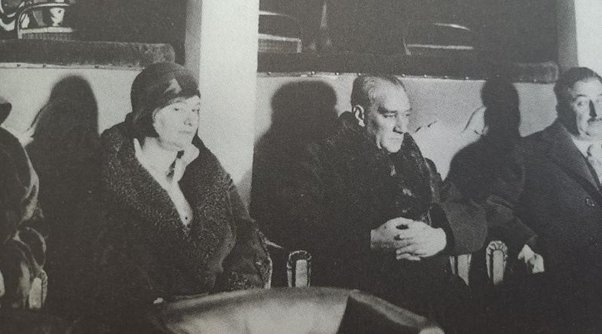
“Atatürk had come to Istanbul for the treatment of his teeth; he would rest during the treatment at Dolmabahçe Palace and would not accept any visit. However, on the morning of December 3, after lunch, he left the palace and took the way to Taksim to watch the movie All Quiet on the Western Front, prepared for him by Beyoğlu Cinema.
At the end of the movie, the leading soldier is killed by a stray bullet, but the incident is recorded in the daily report as ‘All quiet on the western front’. Just at this moment, my father (Cemal Işıksel) pressed the shutter button when he saw that Atatürk’s eyes brimmed with tears and his face became as if he was reliving the horrors of war.
When the film was over, Atatürk turned to Şükrü Kaya, the Director of Internal Affairs, and stated that the film was the most realistic document about the war and that it can be ‘inconvenient for the Turkish people who had just come out of the bloody war’.”
Atatürk had already predicted that World War II would break out and that fascism would have to lose at the front. He was also conscious enough to even consider the psychology of the people who had been fighting for many years and was determined to spend Anatolia’s resources on reforms and industrialization. Therefore, if he had been alive in World War II, he would have taken political steps against a leader he called a “fascist madman”, but he would probably not have been involved in the war.
His life was spent at the front, witnessing the real brutality of war with his own eyes, not with video games. and that’s why he said:
Original color photographs of the D-Day invasion of Normandy during World War II. From British and American soldiers preparing for the invasion in England to German prisoners being marched through the streets after France’s liberation, these images are some of the only color photographs taken during the war. This set of photographs is primarily from the German Galerie Bilderwelt, part of Getty Image’s exclusive Hulton Archive collection.
1 Some of the first American soldiers to attack the German defenses in Higgins Boats (LCVPs) approach Omaha Beach near Normandy, France on June 6, 1944. Plastic covers protect the soldier’s weapons against from the water. (Photo by Robert F. Sargent, U.S. Coast Guard/Galerie Bilderwelt/Getty Images) Photo by Add this to feed2 Allied ships, boats and barrage balloons off Omaha Beach after the successful D-Day invasion, near Colleville-sur-Mer, Normandy, France on June 9, 1944. (Photo by Galerie Bilderwelt/Getty Images) Photo by Add this to feed3 British Navy Landing Crafts (LCA-1377) carry United States Army Rangers to a ship near Weymouth in Southern England on June 1, 1944. British soldiers can be seen in the conning station. For safety measures, U.S. Rangers remained consigned on board English ships for five days prior to the invasion of Normandy, France. (Photo by Galerie Bilderwelt/Getty Images) Photo by Add this to feed4 A U.S. Landing Craft Infantry (LCI) filled with invasion troops approaches the French coast from the sea in June of 1944. The GIs wear life vests in preparation for the landing. (Photo by Galerie Bilderwelt/Getty Images) Photo by Add this to feed5 Planes from the 344th Bomb Group, which led the IX Bomber Command formations on D-Day on June 6, 2014. Operations started in March 1944 with attacks on targets in German-occupied France, Belgium, and the Netherlands. After the beginning of the Normandy invasion, the Group was active at Cotentin Peninsula, Caen, Saint-Lo and the Falaise Gap. (Photo by Galerie Bilderwelt/Getty Images) Photo by Add this to feed6 Private Clyde Peacock, 1st Military Police (MP) Platoon of the 1st Infantry Division of the United States Army in June 1944 in Dorset, United Kingdom. The 1st Division was one of the two divisions that stormed Omaha Beach on D-Day suffering high casualties. (Photo by Galerie Bilderwelt/Getty Images) Photo by Add this to feed7 Troops from the 3rd Canadian Infantry Division landing at Juno Beach on the outskirts of Bernieres-sur-Mer on D-Day, June 6, 1944. 14,000 Canadian soldiers were put ashore and 340 lost their lives in the battles for the beachhead. (Photo by Galerie Bilderwelt/Getty Images) Photo by Add this to feed8 An Allied plane crash burns during the fighting in Normandy, France in June of 1944. (Photo by Galerie Bilderwelt/Getty Images) Photo by Add this to feed9 German Prisoners of War are kept behind barbed wire on Omaha Beach on June 10, 1944. Landing Ship, Tanks can be seen on the beach and barrage balloons in the air for protection. (Photo by Galerie Bilderwelt/Getty Images) Photo by Add this to feed10 From left, Chief of the Imperial General Staff Field Marshal Sir Alan Brooke, British Prime Minister Winston Churchill and commander of the 21st Army Group, Field Marshal Bernard Montgomery in Normandy on June 12, 1944, six days after the D-Day landings during Operation Overlord Normandy in World War II. (Photo by Galerie Bilderwelt/Getty Images) Photo by Add this to feed11 Trucks of the 1st Infantry Division of the United States Army are loaded into a Landing Ship Tank (LST) in Dorset, United Kingdom, on June 5th, 1944. The LST forms part of Group 30 of the LST Flotilla. The 1st Division was one of the two divisions that stormed Omaha Beach in Normandy, France on D-Day suffering high casualties. It secured Formigny and Caumont in the beachhead. D-Day is still one of the world’s most gut-wrenching and consequential battles, as the Allied landing in Normandy led to the liberation of France which marked the turning point in the Western theater of World War II. (AFP PHOTO/Getty Images) Photo by Add this to feed12 Two American soldiers watch U. S. Army jeeps driving through the ruins in Saint-Lo in August of 1944. The town was almost totally destroyed by 2,000 Allied bombers when they attacked German troops stationed there during Operation Overlord Normandy in June. (Photo by Galerie Bilderwelt/Getty Images) Photo by Add this to feed13 Jeeps and other U. S. Army vehicles drive through the ruins of Saint-Lo in August of 1944. The town was almost totally destroyed by 2,000 Allied bombers when they attacked German troops stationed there during Operation Overlord Normandy in June. (Photo by Galerie Bilderwelt/Getty Images) Photo by Add this to feed14 German Prisoners of War are kept behind barbed wire in Normandy, France in June of 1944. More than 200,000 German soldiers were captured during the Battle of Normandy. (Photo by Galerie Bilderwelt/Getty Images) Photo by Add this to feed15 A farmer and his son in front of their damaged house during the Allied invasion of France in July of 1944. Bombing of German positions caused damage throughout the area. (Photo by Galerie Bilderwelt/Getty Images) Photo by Add this to feed16 Signal Corps photographer Sergeant Fred Bornet films a town in Normandy, France in June of 1944. Fred ‘Freddy’ Bornet was born in Scheveningen, Holland. Fluent in French, English and German, he migrated to the United States in 1939 as a 24 year old primarily to escape Hitler. He then became a member of the 163rd Signal Corps Company. (Photo by Galerie Bilderwelt/Getty Images) Photo by Add this to feed17 American troops with German prisoners of war on board a Landing Craft Transport (LCT) in June of 1944. The prisoners will be taken to a Liberty Ship in the English Channel during the Allied invasion of Normandy. (Photo by Galerie Bilderwelt/Getty Images) Photo by Add this to feed18 United States Rangers from E Company, 5th Ranger Battalion, on board a landing craft assault vessel (LCA) in Weymouth harbor, Dorset, on June 4, 1944. The ship is bound for the D-Day landing on Omaha Beach in Normandy. Clockwise, from far left: First Sergeant Sandy Martin, who was killed during the landing, Technician Fifth Grade Joseph Markovich, Corporal John Loshiavo and Private First Class Frank E. Lockwood. They are holding a 60mm mortar, a Bazooka, a Garand rifle and a pack of Lucky Strike cigarettes. (Photo by Galerie Bilderwelt/Getty Images) Photo by Add this to feed19 The 1st Infantry Division of the United States Army (The ‘Big Red One’) in Dorset, United Kingdom on June 5, 1944 before departing for Omaha Beach. (Photo by Galerie Bilderwelt/Getty Images) Photo by Add this to feed20 U.S. Army Medics treating two GIs at a first aid post in southern England in 1944. The soldiers are among the troops due to embark for the invasion of Normandy. (Photo by Galerie Bilderwelt/Getty Images) Photo by Add this to feed21 A truck from the 1st Infantry Division of the United States Army is loaded into the Landing Ship Tank in Dorset, United Kingdom in June of 1944. The LST forms part of Group 30 of the LST Flotilla. The 1st Division was one of the two divisions that stormed Omaha Beach in Normandy, France on D-Day suffering high casualties. (Photo by Galerie Bilderwelt/Getty Images) Photo by Add this to feed22 U. S. Army trucks and jeeps from the invasion against the German troops enter a town in Normandy, France in June of 1944. (Photo by Galerie Bilderwelt/Getty Images) Photo by Add this to feed23 U.S. troops on the Esplanade at Weymouth, Dorset, on their way to ships bound for Omaha Beach for the D-Day landings in Normandy in June of 1944. (Photo by Galerie Bilderwelt/Getty Images) Photo by Add this to feed24 German Prisoners of War captured during the Allied invasion of Normandy in June of 1944. (Photo by Galerie Bilderwelt/Getty Images) Photo by Add this to feed25 German Prisoners of War who have arrived on HM Landing Ship Tank (LST-165) at Gosport, Hampshire, in June of 1944. This is the first transport with prisoners from the Allied invasion of Normandy. They will be interrogated and distributed to various camps according to their classification. (Photo by Galerie Bilderwelt/Getty Images) Photo by Add this to feed26 1,096 German Prisoners of War are marched through the town of Gosport, Hampshire, guarded by British soldiers, in June of 1944. The prisoners arrived on HM Landing Ship Tank (LST-165), the first transport with prisoners from the Allied invasion of Normandy. They will be interrogated and distributed to various camps according to their classification. (Photo by Galerie Bilderwelt/Getty Images) Photo by Add this to feed27 U. S. Army trucks and jeeps are driving through the ruins of Saint-Lo in July of 1944. A group of American soldiers walks along the street. The town was almost totally destroyed by 2,000 Allied bombers when they attacked German troops stationed there during Operation Overlord Normandy in June. (Photo by Galerie Bilderwelt/Getty Images) Photo by Add this to feed28 Two U. S. Army trucks and two American jeeps are driving through the ruins of Saint-Lo in August of 1944. The town was almost totally destroyed by 2,000 Allied bombers when they attacked German troops stationed there during Operation Overlord Normandy in June. (Photo by Galerie Bilderwelt/Getty Images) Photo by Add this to feed29 Two children watch an American Army jeep driving through the ruins of Saint-Lo in August of 1944. The town was almost totally destroyed by 2,000 Allied bombers when they attacked German troops stationed there during Operation Overlord Normandy in June. (Photo by Galerie Bilderwelt/Getty Images) Photo by Add this to feed
Istanbul – As Turkey welcomes Syrians fleeing violence, the anniversary Friday of the deaths of more than 750 Jewish refugees who were denied shelter by Turkey in World War II was a reminder of perennial tension between pragmatic and humanitarian impulses.
A honor guard soldier stands during a ceremony at a Jewish cemetery in Bucharest, Romania, Friday, Feb. 24, 2012, next to a monument bearing the names of Jews killed 70 years ago when the SS Struma, the ship they were on as refugees on the way to Palestine, was sunk by a Soviet torpedo in the Black Sea leading to the death of all but one of the 779 people on board.At a time when Turkey welcomes Syrians fleeing violence, the anniversary Friday of the deaths of more than 750 Jewish refugees whose boat was abandoned by Turkish officials in World War II was a reminder of the tension between pragmatic and humanitarian impulses.(AP Photo/Vadim Ghirda)
The SS Struma, whose passengers fled Romania and docked in Istanbul, was denied entry to Palestinian territory by colonial power Britain. On Feb. 23, 1942, Turkey towed the vessel to the Black Sea and set it adrift. A Soviet torpedo sank it the next morning, and only one person survived.
The episode is a stain on an upbeat narrative of the Jewish experience in the mostly Muslim country, even if Jews are treated with far more tolerance than elsewhere in the region. Turkey dwells on the legacy of Ottoman rulers who welcomed Jews fleeing Christian persecution in Spain in the 15th century.
Tension over the past shadows Turkey as it seeks to lead in the region, advocating democracy in the Middle East and North Africa. Turkey, which had sought closer ties with Syria’s authoritarian regime, now demands that its president stop a bloody crackdown on opponents and quit, and it shelters some 10,000 refugees from Syria.
Signs of Turkish inclusiveness are many. Singer Can Bonomo, of Sephardic Jewish descent, will represent Turkey at the Eurovision song contest in Azerbaijan this year. Last month, Turkey showed a French film about the Nazi genocide, the first time it was aired on public television in a mostly Muslim nation.
Huseyin Avni Mutlu, Istanbul’s governor, attended a ceremony to commemorate Holocaust victims.
“We have strived to serve the world as a center of tolerance,” read his prepared remarks. “Never was any nationality, religion or belief group oppressed in these lands. On the contrary, they were treated as equals, with respect, and their cultural heritages were conserved.”
But the way Turkey — neutral in World War II — handled the Struma undercuts claims of favorable treatment that Jews and other minorities purportedly received in that era. Even today, deficits in equal rights and religious freedoms mar democratic advances in Turkey.
“This is a tragedy which is treated as something that has nothing to do with Turkey,” said author Rifat Bali, who has written about non-Muslim minorities in Turkey. He said blame is assigned to Britain or the Soviet Union, with some justification, but described the refugee deaths as a “black spot” on Turkey’s “rosy rhetoric” about benevolent policies.
A rare commemoration was held at Sarayburnu, a promontory near the Golden Horn inlet in Istanbul. Organizer Cem Murat Sofuoglu said the Turkish establishment was not interested.
“They don’t want to shake the cage,” said Sofuoglu, a lawyer who wants Turkey and Britain to apologize.
Turkey’s Jewish community of just over 20,000 has traditionally kept a low profile to avoid controversy or worse, especially at a time when political ties between Turkey and Israel, a former ally, are frozen. The low point came in 2010 when nine people died during an Israeli raid on a Turkish ship intending to deliver aid to Palestinians in the Gaza Strip.
In 2003, two Istanbul synagogues were targeted in deadly bombings by militants tied to al-Qaida, and Turkey cracked down on radical Islamists.
Many Turkish Jews had to speak Turkish and drop Ladino, a language that mixes Hebrew and Spanish and is dying out, in the early years of the modern republic. During World War II, Jews, as well as ethnic Armenians and Greeks, were subject to an arbitrary lump-sum tax, and mobs attacked non-Muslim properties in Istanbul in 1955.
Anti-Semitism has risen in Turkey’s ultraconservative media over the past five years, said Murat Onur, an Istanbul-based commentator who has studied the issue. Activists want the government to incorporate “hate speech” legislation in plans for a new constitution.
Baki Tezcan, an associate professor of history and religious studies at the University of California, Davis, said the only place to buy a menorah in Istanbul is at the offices of Shalom, a Jewish newspaper. In December, he went there to get one because his father-in-law is Jewish, saw no sign outside, and encountered a strict screening procedure.
“This experience made me realize how difficult it must be to live as a Jew in Turkey, feeling so threatened that they have to hide their community newspaper’s offices and apply such high security measures,” he wrote in an email.
After the Ottoman Empire collapsed and foreign powers carved up its spoils, Turkey’s founder, Mustafa Kemal Ataturk, hauled Turkey onto a secular path, though religious belief remained entrenched. Today, the government is run by pious Muslims who describe themselves as conservative democrats.
One constant over the decades is the fact that Turkish identity cards state the religion of their carriers.
The majority Sunni Muslims stand “at the center of the circle” of Turkish citizenship, according to Tezcan.
“This might go back to the original meaning of the word ‘millet,’ which is used to refer to ‘nation’ today,” he wrote. “It actually meant a ‘religious community.’ So we are dealing with the repercussions of late Ottoman history, and the complex dynamics of growing local nationalisms, on the one hand, and European imperialism, on the other.”
Eyal Peretz is the Israel-born chairman of Arkadas, a community of ethnic Turkish Jews in Israel. He said the Ottoman welcome to Jews was something “we cannot forget” and an “exceptional story” in a dire catalogue of persecution over the centuries.
However, he criticized Turkey for downgrading relations with Israel, alleging it seeks to curry favor with Muslims worldwide. Turkey is incensed over the treatment of the Palestinians by Israel, which has refused Turkish demands for an apology and compensation in the 2010 raid.
Some historians speculate the Soviets mistook the Struma for a troop ship from Romania, a Nazi ally, and thought they were firing on an enemy. A book, “Death on the Black Sea,” cites Refik Saydam, Turkey’s prime minister at the time, as saying Turkey was not responsible.
“Turkey cannot serve as a homeland for people not welcomed by others,” Saydam said. “That’s the way we choose. This is the reason we could not keep them in Istanbul. It is unfortunate that they were victims of an accident.”
Deborah Dwork, director of the Strassler Center for Holocaust and Genocide Studies at Clark University in the United States, said studying the past helped to provide a compass for future conduct. She said Turkey’s wartime refugee policy was similar to that of other nations in that it welcomed only those Jews likely to make financial or cultural contributions. German Jews had a prominent role in archaeological excavations in Turkey in the 1930s.
“They were going to cherrypick precisely those Jews who would enrich Turkey one way or another,” Dwork said. She noted that Turkish authorities waited 24 hours before sending lifeboats to the area where the Struma was struck.
“As far as I’m concerned, that is both compliance and complicity with mass murder,” she said.
WWII-era war “British bomber” found in sea off Turkey
By the help of a fisherman, Turkish scientists discovered the plane as they dived 1.5 miles off Finike town of Antalya.
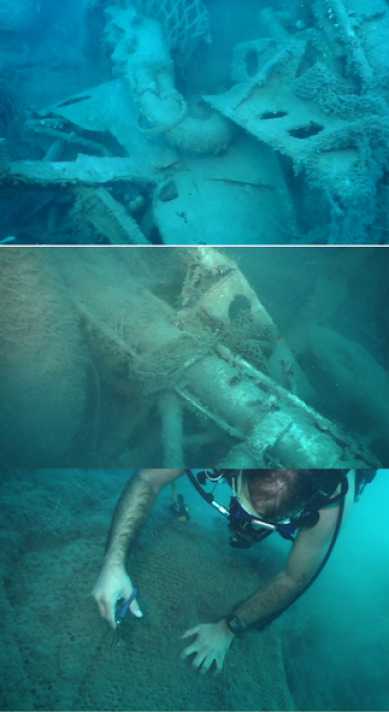
A World War II war plane, believed to be a British bomber, has been found at the bottom of the sea off the Mediterranean coast of Turkey.
By the help of a fisherman, Turkish scientists discovered the plane as they dived 1.5 miles off Finike town of Antalya. The plane was lying off 35 meters below the sea.
Professor Mehmet Gokoglu, one of the scientists working on marine life, said he was told by a fisherman that there was a sunken war plane at the bottom of the sea in Finike Bay.
“The fisherman showed us where exactly the plane was and we found the wreck at our first dive,” Gokoglu said. “The fuselage is almost intact.”
Gokoglu and other divers also found 20mm unexploded anti-aircraft shells near the sunken plane and a part which reads “British Manufacture”.
“It was probably an aircraft of the British Royal Air Force,” Gokoglu said.
A 80-year-old local man said he saw the plane crash when he was a child. Huseyin Taskin said there were German, Italian and British war planes and warships in the bay during the World War II.
“I was 12 or 13 when I saw the tragedy. The plane was burning in the air, it lost altitude and after a while it hit the sea surface. I do not know if anyone survived,” Taskin said.
Turkish officials informed the Coast Guard and Naval Forces about the sunken wreck.