Tag: UN

  • ‘We invest in ourselves – and keep to ourselves’

    ‘We invest in ourselves – and keep to ourselves’

    After 37 years, Turkey remains the world’s only country to recognize Turkish Cyprus or do business with it; but Prime Minister Erdogan is already planning a new campaign to encourage world recognition if an upcoming round of talks with the Greeks does not lead to a resolution of the island’s division.

    By Zvi Bar’el


    KYRENIA, CYPRUS – A white marble tablet, marked with the passage of time, stands at the entrance to the mass grave on the outskirts of the village of Murataga in Northern Cyprus. Engraved on it are the words of Archbishop Makarios III, the first president of Cyprus, who in 1964 said: “If Turkey comes to save the Turkish Cypriots, it will not find a single Turkish Cypriot whom it will be able to save.” Eighty-nine of the residents of the village, nearly all of them children, women and elderly people, were not saved from the slaughter carried out by Greek Cypriot soldiers before the Turkish army decided to invade the island on July 20, 1974, in order to thwart the ambition of the ruling military junta in Greece to annex the island to that country.

    Kamil Maric, an impressive man of 64 wearing a T-shirt and baseball cap, was 27 at the time, a prisoner of the Greek Cypriot forces, some of whose colleagues had murdered his wife and 18-month-old son.
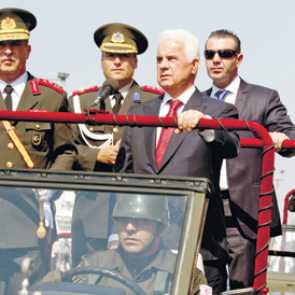
     

    Turkish Cyprus President Eroglu. Photo by: AFP

    “They took 40 bullets out of the boy’s body,” he tells the group of journalists who were invited recently to visit the Turkish part of Cyprus. The occasion was the 37th anniversary of what is called “the Turkish intervention” or “peace mission” there, and in the southern part – invasion and occupation. Back then 150 Turkish Cypriots lived in Murataga, which was surrounded by Greek villages. Most of them were murdered; a few fled to Famagusta or other villages. “Only one couple, he was blind and she was crippled, remained to tell about the horror,” says Maric.

    And what happened to the Greek villages? The locals don’t talk about it now. In Northern Cyprus there is only one tragedy. In the south they tell a different story.

    Turkey is not only the “motherland” of the approximately 250,000 Turkish Cypriots: It is also their only link with the rest of the world, since no country apart from Turkey recognizes the independence of Turkish Cyprus. Whereas about 135 countries are prepared to grant the Palestinians recognition of an independent state, Turkish Cyprus comes up against a wall every time it seeks recognition.

    At Ercan Airport near Lefkosa (which the Greeks call Nicosia ), named after a Turkish combat pilot, the tourist can ask the immigration official not to stamp his passport upon entry, and instead stamp a piece of paper they call a visa. Turkish Cyprus is aware of the difficulties such a stamp could cause a passport-holder, if he wants, for example, to visit Greek Cyprus (the Republic of Cyprus ). Ordinary letters from abroad to an inhabitant of the northern part of the island are sent only via Turkey, ships do not anchor in the ports of Northern Cyprus and no non-Turkish plane lands there.

    “We pay double customs duty and the cost of living here is disproportionately high,” says Rasih Resat, owner and editor of the Haberdar newspaper in Northern Cyprus. Resat speaks English like an Englishman, and has a wry sense of humor and a cynicism ostensibly acquired over many years of frustration. “Merchandise coming from Europe has to go through a Turkish port, where they charge customs duty on it, and then it comes here to Cyprus, where we charge customs duty on it again.”

    The minimum wage in Turkish Cyprus is higher than that in Turkey, about $750 a month. When all exports from the island have to pass through Turkey to reach world markets, thereby making products more costly, it is hard to find even Turkish investors who will agree to build factories in Northern Cyprus.

    “What is left for a Turkish Cypriot manufacturer to do?” asks Resat, and answers: “He can manufacture 150 containers of yogurt and no more, because there is no one to sell to, and he can’t aspire to produce more, to expand his production for the international market. In fact we are going into the third generation of Turkish Cypriots that can’t predict its future. We invest in ourselves, we buy a villa, we buy a BMW – and we keep to ourselves.”

    The only source of optimism for Resat is Europe’s demographic trends, he says: “Europe is growing older, and in a few years there will not be enough workers to maintain its industry. It will need more foreign workers [who will send their earnings home] and maybe then there will be an opening for our future.” Until then, Turkey will continue to provide about one-third of the Turkish Cypriot budget, approximately $400 billion annually.

    ‘Our tomorrow is one’

    We meet in the lobby of the Jasmine Court Hotel on the beach at Kyrenia, the beautiful city where the Turkish forces landed in 1974. The previous day, Resat was invited along with a group of journalists to a meeting in Ankara with Turkish Prime Minister Recep Tayyip Erdogan. Erdogan – who two days later came to Cyprus as the guest of honor at the celebrations to mark the anniversary of the Turkish “intervention” – wanted to transmit a message to the effect that if there is no progress in the talks between Greek Cyprus and Turkish Cyprus at the meeting planned at the United Nations in October, he will move to Plan B: enlisting international support for recognition of Turkish Cyprus as an independent state.

    “Our yesterday is one, our tomorrow is one and our heartbeat is one,” says the slogan at the bottom of the huge portraits of Erdogan that decorated the streets in advance of the anniversary. Large Turkish flags fly alongside the flag of Turkish Cyprus, and pictures of Mustafa Kemal Ataturk, the founder of modern Turkey, hang in government offices and university classrooms. Turkish Cyprus and Turkey also have the same national anthem – the “Independence March.” The words were written by Turkish poet Mehmet Akif Ersoy in 1921, two years before the founding of the Turkish Republic. The opening lines of the anthem’s 10 stanzas are devoted to “our heroic army,” which was victorious in the War of Independence, and the song is full of expressions of love of the homeland, liberty and power. For many long minutes the guests on the platform of honor erected on one of the main roads of Nicosia stand and sing the entire thing.

    The president of the unrecognized Turkish Republic of Northern Cyprus, Dervis Eroglu, is greeted by the public with loud cheering as though he were a beloved king. Cypriot generals bedecked with medals and gilded swords belted to their waists, and a large crowd of citizens and journalists rise to their feet and join in the singing of the anthem, amplified through powerful loudspeakers.

    An old friend, an important columnist and former editor of a Turkish newspaper, who volunteers to translate the main points of Erdogan’s long speech for me, breathes a sigh of relief when the announcer – an army officer with a deep bass voice – declares the proceedings will begin. “A folk-dance troupe is better than a military parade,” he comments. And indeed, a small group of men and women in traditional dress perform a series of pleasant dances on the burning-hot asphalt in the 40-degree heat, followed by five paratroopers parachuting and landing perfectly across from the platform of honor.

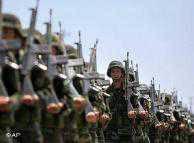
    But there is also, of course, a military parade. Hundreds of Turkish soldiers wearing helmets and with packs on their backs march in unison, commandos in blue berets salute the guests of honor, and a few tanks, artillery pieces and even Katyusha-carriers also file past. During the whole parade the 73-year-old president, who has already had two coronary bypass operations, stands erect and honors the thousands of soldiers.

    Elmaz, a Turk who moved to Turkish Cyprus seven years ago to earn a living, tells me after the ceremony: “Look how they stand and exalt the Turkish army. Look at how they fawn over the Turks, but they treat me like garbage. They think they are already part of Europe, while we [native] Turks are inferior to them. I came here with my wife and children but they didn’t allow the children to attend school until my wife and I received a residence permit. They know how to take Turkish money but they also know how to stick a knife in our back.”

    “There is something in what he says,” confirms a lecturer at the Eastern Mediterranean University, the largest of the six universities in Turkish Cyprus. “We do feel like a single nation, but among us there are those who are more equal and those who are less equal.”

    The six universities, attended by about 40,000 students from around the world (the language of instruction for foreign students is English ) are the most important source of income in the local economy. Every foreign student pays $7,500 to $9,000 for a year of studies, and many receive scholarships and housing. The problem is that only 150 universities in the world are prepared to cooperate with and give academic recognition to the universities in Turkish Cyprus.

    “Higher education is a matter of right – it shouldn’t be a political issue,” complains the rector of the Eastern Mediterranean University, Prof. Halil Nadiri. He is right, but since Cyprus is a political issue by nature, and Greek Cyprus became a member of the European Union in 2004, the academic struggle of Turkish Cyprus cannot be anything but political.

    The Annan plan

    “It’s impossible to go on like this,” asserts Resat, the newspaper editor. “The knife is already cutting into the bone,” Erdogan declared in his speech. “We are ready for Plan B,” warned the president of Cyprus. Thus it seems everyone is preparing for the next “critical moment” and opportunity – and yet another “last chance,” similar to those that have arisen since the Cypriot state was founded – that will come in October when representatives of Turkish Cyprus and Greek Cyprus will meet with UN Secretary General Ban Ki-moon to decide on the future of the Turkish part of the island.

    Back in April 2004, Ban’s predecessor Kofi Annan proposed a plan on which inhabitants of the two parts of Cyprus voted in a referendum. In essence, it imagined a federal state in which each part of Cyprus would have a government of its own, subordinate to a federal government with a joint presidential council, and a federal supreme court and constitution. Sixty-five percent of the citizens of the Turkish part voted in favor of the plan, and 76 percent of the Greek part voted against.

    In any event, the Greek Cypriots had little to lose by objecting to the UN federation plan; in doing so they showed it would not be to their benefit to share the wealth they have accumulated with their poor, infrastructure-deprived Turkish counterparts on the island. The Greek Cypriots also believed that the reparations offered to them by the UN plan for property over which Turks took possession were not sufficient. They assessed that when they became members of the EU, as they did the following month, they would be able to apply to the European Court of Human Rights and demand far higher compensation.

    The possibility that a relatively large Turkish army will remain on the island until Turkey is accepted as a member of the EU also does not appeal to the government of Greek Cyprus, in Nicosia, which has demanded the withdrawal of the forces in the near future. And thus, in the absence of real sanctions for voting down the 2004 UN plan, and with EU membership, the Greek Cypriots attempted to settle a historical account with their Turkish foes.

    Meanwhile, the EU has spared itself the problems involved in accepting as members an additional population of about a quarter of a million Muslims, and its commitment to the northern part of the island has been a moral one only. Turkey was hoping that a solution to the Cyprus crisis would open a fast track to discussion of its own membership in the EU. Though no such condition has been explicitly stipulated, the question of Cyprus has come up in many forums and has been depicted as a stumbling block that Turkey must eliminate.

    Now Turkey will likely try to explain that the EU should content itself with showing appreciation for various good-will efforts made by Ankara, and see it as a worthy candidate, despite the fact that the status of Turkish Cyprus has not changed. Therein lies the hypocrisy of the EU, which declares it is “eager” to solve the problem of Cyprus and at the same time is slowing down efforts to arrive at a solution – because the moment the Cyprus problem is solved, yet another hurdle will be eliminated from the path of Turkey’s entry into Europe. Then it will no longer be a question of only a quarter of a million Muslim Turkish Cypriots, but rather of about 75 million Muslim Turks.

    Lessons for Israel

    For its part, Israel also does not recognize Turkish Cyprus as an independent state. Indeed, Jerusalem has adopted the international rhetoric that describes Turkish Cyprus as existing on occupied territory, and of being responsible for finding a solution to its status within the framework of the existing situation on the ground on the island, or as part of an agreed-upon resolution at the UN. This view has not impeded several dozen Israeli businesspeople from investing in the northern part of the island and opening a number of tourism sites there.

    In any case, Turkey – as an occupying, invading, liberating country vis-a-vis Cyprus – can teach Israel a lesson when it comes to dealing with abandoned property. The shoreline along the blue sea at Famagusta, with its colorful parasols and vacationers paddling in the water, is crossed by a scary barbed-wire fence behind which is a tall iron wall preventing entry into the ghost town of Varosha. Beyond the wall, on which Turkish soldiers are stationed to prevent the entry of outsiders, are visible high-rise residential buildings, what once was the Sheraton Hotel, and even parts of tree-lined neighborhoods. The Greek inhabitants of Varosha abandoned it in a panic when the Turkish army arrived. There are stories of inhabitants even leaving behind eating utensils on their tables and towels in their bathrooms.

    Turkey decided to keep this town as a “deposit”: not to build a settlement or bring Turkish civilians there. Turkey even invited the Greek inhabitants of the town to return, reestablish their businesses and live there; they refused to do so until a comprehensive solution is achieved.

    If a diplomatic solution to the Cyprus problem is found, promises Turkey, the Greek inhabitants will be able to return whenever they want. Until then, the Turkish army will continue to guard the town.

    “I am certain that if Israel had occupied the town, it would have turned it into a tourism site or a settlement, about which you would say, ‘This is another fact on the ground, and there is nothing to be done about it,’” laughs Sinan, a Turkish journalist who accompanies the group (and requested that his full name not be published ).

    “We are taking every possible step to prove that our intentions are good,” the president of Turkish Cyprus explains to me. “We accepted the Annan plan, we are paying reparations and are prepared to come to a property agreement. But we cannot possibly agree to a provision that says the Greek owners will decide what solution there will be for their [abandoned] property. What will we do with the houses Turkish Cypriots are already living in? We are prepared to pay compensation, but we will not allow the Greek owners to determine that residential buildings should be demolished only because they are the [legal] owners. It is also necessary to consider the people who are living in those buildings.”

    The Greek right of return, it emerges, also has its “red lines,” but there is no dispute that such a right exists – yet another lesson that can be learned from Cyprus.

    On the way back from Famagusta we pass through Nicosia along the border between the two parts of the island. The narrow streets of the capital, its low buildings, remnants of the attractive colonial architectural design, lovely lemon trees, palm trees and pines – all of this makes one forget for a moment that this is a border of loathing and hatred. Even though Turks can now cross to the other side and vice versa, passage of goods is still prohibited.

    A week before our visit a power station on the Greek side blew up and the Turkish Cypriot government hastened to offer to help with the supply of electricity. An agreement was signed, but during our trip, the Greek archbishop‘s harsh view of the subject was published. “It is better,” he ruled, “to live by candlelight than to import electricity from the Turks.” He also called upon Greek citizens not to purchase cheeses and other products from the Turkish side of Cyprus.

    Thus, the political conflict between the two parts of the island will perhaps be solved on paper, but how many generations will it take for the difficult memories to be totally forgotten?

    www.haaretz.com, 05.08.11
  • Hopes dim for a breakthrough between Turkey, Israel at the end of UN inquiry

    Hopes dim for a breakthrough between Turkey, Israel at the end of UN inquiry

    As Turkey and Israel prepare for the final rounds of discussion before a U.N. panel concludes its inquiry into a deadly raid last year, hopes are dim that the panel’s report will provide a diplomatic breakthrough.

    The once-close allies have been estranged since Israeli Defense Forces staged a deadly attack May 31, 2010, on an aid flotilla attempting to break the blockade of the Gaza Strip, killing eight Turks and one American of Turkish descent.

    The U.N. panel, set up by Secretary-General Ban Ki-moon in August 2010 to investigate the incident, is not expected to force Israel to apologize and pay compensation to the victims’ families, two conditions set by the Turkish government to normalize ties.

    Turkey’s conviction that Israel is using every possible means behind the scenes to affect the outcome of the panel was reinforced recently when the head of a separate probe on Israel’s 2008-2009 military offensive in Gaza backed away from a report published last September.

    The report, issued by a commission headed by Judge Richard Goldstone, concluded that both Israel and the Palestinian group Hamas, which controls the Gaza Strip, sides committed potential war crimes and possible crimes against humanity. It accused Israel of using disproportionate force, deliberately targeting civilians and destroying civilian infrastructure, and using people as human shields.

    The four-member panel on the flotilla raid is set to resume work next week. Led by former New Zealand Prime Minister Geoffrey Palmer, it includes an Israeli and a Turkish expert. Representatives of both governments will also be present during the workings of the panel. The panel will meet for a final time in May and the Turkish side hopes it will give its report to the U.N. secretary-general no later than May 31, the first anniversary of the deadly incident.

    While Turkey seems confident about the strength of its arguments, the behind-the-scenes weight of the Israeli lobby on the possible outcome of the U.N. probe cannot be underestimated. It has been extremely difficult to convince Israel to cooperate with the U.N. probe and the lengthy negotiations have seriously restricted the mandate of the panel.

    The panel is tasked with looking at the circumstances of the raid and reviewing the results of the Turkish and Israeli investigations into the incident, as well as considering ways to avoid similar incidents in the future. Israel is extremely sensitive about any U.N. inquiries. It has been working to cancel the Goldstone commission’s report after the judge said earlier this month regret that the report may have been inaccurate.

    “If I had known then what I know now, the Goldstone report would have been a very different document,” he said in a newspaper article

  • Belgium: An e-mail campaign against The Anti_Turk Parliamenter

    Belgium: An e-mail campaign against The Anti_Turk Parliamenter

    How Voltaire Would React To “Flanders’   Slanders”

    A leading lawmaker in Flanders deliberately insults Turks and Turkey during a live TV program with unsolicited racist remarks.

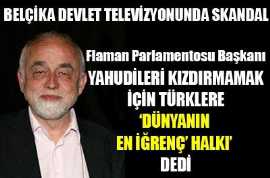
    President of the Flemish parliament in Belgium, Jan Peter Peumans  (59,)  causes a scandal with his arrogant and bigoted comments during a quiz show, ”De Pappenheimers,”  by VRT (Flemish Public Radio and Television Broadcasting Federated) on Wednesday, December 1, 2010.   (watch video:  http://www.youtube.com/watch?v=aQFqcaqiJi0 )

    The question the organizers of the quiz show haplessly considered amusing and proper for a competition watched by general public, including children, was a related to  a comment by the famous French philosopher:  “Who did Voltaire think was the most disgusting nation?”  The potential answers offered were Flemish, Jews and Turks.  Peumans replied: “ Turks.”
    After a loud laughter, he was reminded that the correct answer was “the Jews”.  Peumans said he knew the right answer but was scared to say it because of possibly very strong Jewish reaction.  Laughter in the audience grew.  When asked “Wouldn’t the Turks do react equally strongly?”  Peumans replied with a negative.

    Film director Jan Eelen, another contestant, told Peumans later that the Turkish Embassy had been informed of the incident by Güler Turan — a Flemish parliament member of Turkish heritage.  Turkish Ambassador Murat Ersavcı  called Peumans to convey Turkey’s disappointment by the racist question and comment.  The remarks also drew strong reactions from Turks  in and out of Belgium.

    All of this unfortunate episode took only a few minutes.  But its reverberations promise to take more than that… much more!

    First, it is, indeed, a sad day in Belgium if a major entertainment industry executive there thinks racist questions are fun for the entire family.  A sensitization course in Belgium on issues of diversity and tolerance seems appropriate and even urgent.

    Second, it must be especially ironic for such a bigoted question to surface in a country which suffered terribly under the racist persecution the Nazis (perhaps Peumans is too young to remember or too ignorant to know.)  Such a question should never have been asked in the first place.  How would the audience who cheered on the racist questions and response if the next question in the live quiz show was about the feelings of the German Nazis about Belgians and if the potential answers offered were  A) cowards     B)cheap skates    C) both?   Would they consider that to be “family fun?”

    Third, if a Belgian politician publicly declares that he deliberately provides false answers for political correctness or expediency, and cheered on by millions in and around Belgium, and arguably around Europe, what does that tell one about the state of affairs and mind in Europe?  Are prejudice, humiliation, intimidation, discrimination, and racism accepted norms of thought and/or conduct in Belgium and/or Europe?

    Fourth, Voltaire was a crusader against tyranny and bigotry, which is probably why he could not keep out of trouble.  Almost every person of importance was Voltaire’s enemy at some period of his life.  Voltaire, the Renaissance man of the Enlightenment, was no pussycat , either, as he struck back with bitter, mocking, poignant sarcasm whenever he was attacked.

    Voltaire often scrutinized the political and philosophical controversies of the 18th century and campaigned tirelessly on behalf of the oppressed.

    You, Mr. Peumans, badly need to learn the tragic plight of Jean Calas, a Protestant in Toulouse, which illustrates the passion in Voltaire.  Calas had a son who wanted to study law but he was denied access because he was not a Catholic. The son got very depressed and killed himself, a fatal sin then. His family decided to conceal the suicide as they did not want to see his body dragged in the streets and fed to dogs as was the common practice for those who took their own lives.  A rumor started that Jean Calas had murdered his son because he wanted to convert to Catholicism. The old man was convicted of murder on the basis of the flimsiest hearsay evidence by lynch mobs. Rejecting confession even after terrible torture, Calas was tied to a wooden cross, had his arms and legs broken.  Then he was strangled  by the executioner and burned at the stake. The state confiscated his property, leaving his widow homeless, penniless, and childless,  as the latter were forced into Catholic institutions.

    Voltaire heard about this and set out to clear Calas. He wrote many letters to powerful people throughout Europe, hired a lawyer, and raised money for the family. eventually securing a unanimous vote in the parliament of Paris declaring Calas innocent.  Calas himself was dead but the reversal of his conviction meant that his estate was returned to his family and the children returned to their mother.   That was Voltaire!

    I told you this story for two reasons:

    1)  You and your supporters are doing to Turks today what the Catholic Church did to Protestant merchant Jean Calas of Toulouse in 1762.

    2)  If Voltaire was alive today, he would fight you and your kind for the same reasons he fought for Jean Calas of Toulouse

    Last but not least, here is what Voltaire really said about the Turks:

    The great Turk is governing in peace twenty nations from different religions. Turks have taught the Christians how to be moderate in peace and gentle in victory.”

    It is never too late to learn new facts and proper manners.

    Sincerely,

    (Name, full street address, and phone)

    =========================================================

    attention to our members


    DIKKAT – DIKKAT

    [email protected]

    [email protected]

    mail adreslerine simdilik ingilizce veya almanca veya yukardaki mesaji kopyaliyarak protesto mesajlarinizi parlemenetere gonderebilirsiniz.

    2010/12/1 Birol Kilic <[email protected]>

    Federe yapılı Belçika’da Flamanca yayın
    yapan devlet radyo ve televizyonu VRT’nin birinci kanalında “De Pappenheimers” adlı bilgi yarışmasına katılan, bağımsızlık yanlısı Yeni Flaman İttifakı (N-VA)
    partisinin Başkan Yardımcısı ve Flaman Parlamentosu Başkanı Jan Peter Peumans (59), doğru cevabı bildiği halde “Yahudilere bir şey söyleyecek cesareti olmadığı
    için” Türklere hakareti tercih etti.

    Yarışmada ünlü Fransız düşünür Voltaire’in, “Dünya yüzündeki en iğrenç halk” olarak hangi milleti tanımladığı sorusunda bildiğini itiraf ettiği doğru
    şık “Yahudiler” yerine “Türkler” şıkkını tercih eden Peumans’la sunucu Tom Lenaerts ve diğer yarışmacı olan Yönetmen Jan Eelen arasında şu diyalog yaşandı:

    Lenaerts: “Türkler cevabını verdiniz ama doğrusu Yahudiler idi. Bunu gerçekten biliyor muydunuz?”

    Peumans: “Gerçekten biliyordum ama Yahudiler hakkında yeni birşey söyleyecek cesaretim yok. Çok hassas insanlar. Bir zamanlar onların sözde
    liberalizmi hakkında bir şeyler söyledim ama çok çektim. Bu nedenle..” Eelen: “Fakat Türkler hakkında söylemek meğer sorun değilmiş”

    -BÜYÜKELÇİLİKTEN TEPKİ-

    Skandal yarışmaya tepki gösteren Türkiye’nin Brüksel Bürükelçisi Murat Ersavcı, rahatsızlığını ilettiği Peumans’tan Türk toplumuna yönelik açıklama sözü
    aldı.

    Büyükelçilikten yapılan yazılı açıklamada, “Bir bilgi yarışması programına yakışmayan bu tür bir sorunun sorulmuş olması ve verilen yanıttan
    duyduğumuz memnuniyetsizlik Büyükelçi Ersavcı tarafından Peumans;a telefonla iletilmiştir. Peumans, ön bilgisi dışında gelişen bu durumun amacını aşan
    sonuçlara yol açmasından üzüntü duyduğunu; sitayişle bahsettiği ve hiçbir şekilde rencide etmek istemediğini vurguladığı Türk toplumuna bir açıklamada
    bulunacağını; anılan televizyon kanalı nezdinde de gerekli girişimi yapacağını ifade etmiştir” denildi.

    -SKANDALLARLA GÜNDEMDE-

    Belçika’da cumhuriyetçi olduğu gerekçesiyle Kral’ın resepsiyonlarını boykot etmesiyle tanınan ve saldırgan uslubu nedeniyle Fransızca konuşan Valon
    toplumunun tepkisini çeken Peumans, eşiyle gezintiye çıktığı Valon sınırındaki Vise kasabasında, “Yeni Flaman İttifakı üyesi bir politikacının Valon bölgesinde
    ne işi olduğunu sorgulayan” bir gençten dayak yerken polis ekiplerince kurtarılmıştı.

  • United Nations launches last-ditch effort to reunite Cyprus

    United Nations launches last-ditch effort to reunite Cyprus

    The UN’s efforts to reunite the island nation of Cyprus have been stalled. As the possibility of a permanent division looms, the European Green party is making its own efforts to restart the reunification process.

    United Nations Secretary-General Ban Ki-moon hosts the leadership of the Greek and Turkish Cypriots on Thursday in what is being described as a final effort by the UN to revitalize reunification talks.
    Greek Cypriot President Dimitris Christofias and Dervis Eroglu, president of the de facto Turkish Republic of Northern Cyprus, are to meet with Ban in New York. The UN’s Cyprus envoy, Alexander Downer, said the secretary-general “wants to hear face-to-face with the leaders their perspective of how the talks are going and what the prospects are.”

    Eighteen months of UN-sponsored talks have ground to a virtual halt amid mutual recriminations. There are growing signs that these talks could be the last and that the island’s partition could become essentially permanent – something that has the potential to scupper Turkey’s efforts to join the European Union.

    EU intervention

    Cohn-Bendit says ending the EU’s embargo could be a new impetus for reunification

    The European Green Party held talks in Istanbul earlier this month, taking the opportunity to build support for its efforts to break the current stalemate in Cyprus. The party has proposed an end to the EU’s economic embargo against the Turkish North as a first step in restarting reunification talks.

    “The opening of North Cyprus, of the ports and airports, is a question of trade,” said party co-chair Daniel Cohn-Bendit. “It’s a majority decision, so one nation cannot block it. So we are for the opening the ports and airports in Northern Cyprus. Then Turkey will open its ports and airports for the Greek Cypriots.”

    The initiative has been made possible under the Lisbon Treaty, which came into force last year and removed the right of EU member states to veto certain initiatives, including those related to trade. Until now the internationally recognized Greek Cypriot government has used its veto to stop any move to ease the trade restrictions on the North.

    Turkish military presence

    During his visit to Istanbul, Cohn-Bendit met with Turkish Prime Minister Recep Tayyip Erdogan. He said the UN’s Cyprus talks needed fresh impetus, and that if the Greens are successful in lifting the embargo it will open the door to concessions from Turkey.

    Turkey is believed to have more than 40,000 soldiers on the Turkish side of the island, and their removal remains a major stumbling block to reunification talks.

    “We want Turkey to say if trade is open with North Cyprus, they will start to reduce the number of soldiers in North Cyprus,” said Cohn-Bendit.

    Turkey lends substantial military support to Turkish Northern Cyprus

    Support for reunification divided

    The Greek Cypriots are lobbying hard against any attempt to remove their veto over an end to the embargo, arguing that it is crucial to put pressure on the Turkish Cypriots to agree to reunification. But the possibility of a permanent division of Cyprus may lend support to the Greens’ initiative.

    Ankara claims Brussels had promised to end the embargo after the Turkish Cypriots in 2004 voted in a referendum to support a UN-sponsored reunification plan, while Greek Cypriots voted against it.

    Turkey says it will not open its airports and ports to the Greek Cypriots until the embargo is lifted, and last week Turkish EU affairs minister Egemen Bagis ruled out any new concessions over Cyprus.

    “By now Turkey and Turkish Cypriots have proven time and time again that they believe in a solution and that they believe in a settlement,” he said. “It’s now up to the Greek Cypriots to prove that they really do believe in a solution – a comprehensive settlement.”

    Author: Dorian Jones, Istanbul (acb)

    Editor: Chuck Penfold

  • UN criticizes Greece over migrant conditions

    UN criticizes Greece over migrant conditions

    By Tolga Cakir

    According to Jerusalem Post ,The United Nation’s refugee agency has slammed Greek authorities over a severe deterioration in conditions at detention facilities for illegal migrants at the Greek-Turkish border.

    The last warning from the UN High Commissioner for Refugees, which came last Friday, indicates that popular trafficking routes, Greek islands in the Aegean Sea have changed.  The report states that new routes are towards the Greece-Turkey land border which is 200 km (125-mile)  long.

    The agency reported that the migrants detained in the border zone are jam packed into cells with “dire hygiene conditions.”

  • Ahmadinejad tells U.N. most blame U.S. government for 9/11

    Ahmadinejad tells U.N. most blame U.S. government for 9/11

    Iran's President Mahmoud Ahmadinejad addresses the 65th United Nations General Assembly at U.N. headquarters in New York, September 23, 2010. Credit: Reuters/Mike Segar

    By Louis Charbonneau

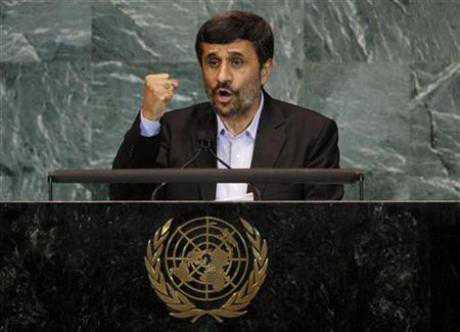
    (Reuters) – Iranian President Mahmoud Ahmadinejad told the United Nations on Thursday most people believe the U.S. government was behind the attacks of September 11, 2001, prompting the U.S. and European delegations to leave the hall in protest.

    Addressing the General Assembly, he said it was mostly U.S. government officials and statesmen who believed al Qaeda Islamist militants carried out the suicide hijacking attacks that brought down New York’s World Trade Center — less than 4 miles from where the Iranian president was speaking.

    Another theory, he said, was “that some segments within the U.S. government orchestrated the attack to reverse the declining American economy, and its grips on the Middle East, in order to save the Zionist regime.” Ahmadinejad usually refers to Israel as the “Zionist regime.”

    “The majority of the American people as well as most nations and politicians around the world agree with this view,” Ahmadinejad told the 192-nation assembly, calling on the United Nations to establish “an independent fact-finding group” to look into the events of September 11.

    As in past years, the U.S. delegation walked out during Ahmadinejad’s speech. It was joined by all 27 European Union delegations and several other countries.

    Mark Kornblau, spokesman for the U.S. mission to the United Nations, said Ahmadinejad chose “to spout vile conspiracy theories and anti-Semitic slurs that are as abhorrent and delusional as they are predictable.”

    White House spokesman Bill Burton said President Barack Obama thought the comments “utterly outrageous and offensive — especially in the city where the 9/11 attacks occurred.”

    EU foreign policy chief Catherine Ashton said the remarks were “outrageous and unacceptable.”

    ‘COVERED UP’

    Ahmadinejad said some evidence that could support alternative theories had been “covered up” — passports located in the rubble and a video of an unknown individual who had been “involved in oil deals with some American officials.”

    As he had in past years, the Iranian president used the General Assembly podium to attack Iran’s other archfoe, Israel, and to defend the right of his country to a nuclear program that Western powers fear is aimed at developing arms.

    “This regime (Israel), which enjoys the absolute support of some Western countries, regularly threatens the countries in the region and continues publicly announced assassination of Palestinian figures and others, while Palestinian defenders … are labeled as terrorists and anti-Semites,” he said.

    “All values, even the freedom of expression, in Europe and the United States are being sacrificed at the altar of Zionism,” Ahmadinejad said.

    The Iranian president previously raised doubts about the Holocaust of the Jews in World War Two and said Israel had no right to exist.

    Tehran has been hit with four rounds of U.N. sanctions for refusing to halt its nuclear enrichment program. Obama earlier told the assembly the door to diplomacy was still open for Iran, but it needed to prove its atomic program is peaceful, as it says it is.

    , 23 September 2010