Tag: Uighurs

  • EU Parliament Rights Head Calls For Uyghur Inquiry

    EU Parliament Rights Head Calls For Uyghur Inquiry

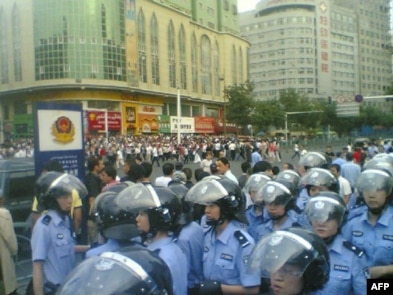
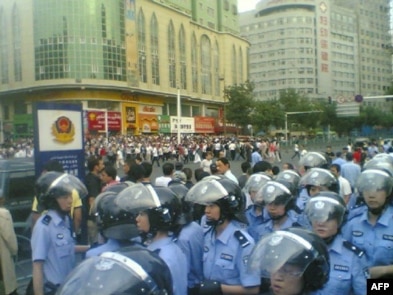
    A U.S.-based Uyghur group issued this photo soon after the Xinxiang violence erupted, showing clashes in Urumqi.

    September 01, 2009

    BRUSSELS (Reuters) — The head of the European Parliament’s human rights committee has backed a call for an independent international inquiry into deadly riots in northwest China’s Xinjiang region in July.

    “We have got some quite worrying information about events of July 5,” Heidi Hautala told a joint news conference with Rebiya Kadeer, exiled leader of China’s largely Muslim Uyghur ethnic group who earlier addressed the parliamentary committee.

    “I believe that there is a case for an independent international investigation so that all human rights violations from all sides can be cleared and investigated,” Hautala said.

    She said such an inquiry should be conducted by the United Nations with the backing of the European Union.

    In Xinjiang’s worst ethnic violence in decades, Uyghur rioters attacked majority Han Chinese in Urumqi on July 5 after taking to the streets to protest against attacks on Uyghur workers at a factory in south China in June in which two Uyghurs died. Han Chinese in Urumqi sought revenge two days later.

    The violence left 197 people dead, mostly Han Chinese, and wounded more than 1,600, according to official figures.

    Uyghurs, a Turkic people who are largely Muslim and share linguistic and cultural bonds with Central Asia, make up almost half of Xinjiang’s 20 million people.

    Kadeer said some 10,000 Uyghurs were missing following the riots and accused the Chinese Communist government of pursuing a policy resembling “cultural genocide” in what Uyghurs call East Turkestan.

    She called in July on the international community to send an independent investigative team to the site of the riots.

    “The arrests and detentions continue,” she told the news conference, adding that most were teenage students who, she said, were being tortured in detention.

    Kadeer accused the Chinese authorities of using the international battle against Islamist militancy and the global economic downturn as pretexts to repress the Uyghur people.

    https://www.rferl.org/a/EU_Parliament_Rights_Head_Calls_For_Uyghur_Inquiry/1812564.html

  • Chinese police chief is promoted in East Turkistan

    Chinese police chief is promoted in East Turkistan

    According to Şinhua agency, Dai Sujun, who is Chiese police chief, was promoted after the events that hundreds of Uyghurs were murdered. He did not safeguard Uyghurs from Chinese attacks, many video footages show Chinese police watched when Uyghurs were getting killed, and  moreover he ordered Chinese police force to kill hundreds of  innocent Uyghurs at a democratic demonstration.

    Tolga Çakır

    Zaman

  • Uyghur Diaspora Faces Government Pressure in Kyrgyzstan

    Uyghur Diaspora Faces Government Pressure in Kyrgyzstan

    Publication: Eurasia Daily Monitor Volume: 6 Issue: 156
    August 13, 2009 12:25 PM Age: 1 days
    By: Erica Marat


    On August 10, Kyrgyz authorities detained Dilmurat Akbarov, the leader of the Ittipak Uyghur society, and his deputy Jamaldin Nasyrov. These leaders had organized demonstrations calling for an independent investigation into last month’s riots in Xinjiang. They featured images and posters accusing Beijing of implementing cruel policies against Uyghurs in Xinjiang. According to the Kyrgyz authorities, approximately 500 people participated in the event in Bishkek (www.akipress.kg, August 10).

    The exact reasons for the arrests on August 10 remain unknown, since the government has avoided making any official statements. Many experts in Bishkek believe that these arrests demonstrate the Kyrgyz government’s agreement with Beijing’s policies. The arrested leaders are likely to be released soon, but their future activity based on criticizing the Chinese government will be discouraged.

    Over 50,000 ethnic Uyghurs live in Kyrgyzstan, but unofficial records claim that the actual number is much higher. Demonstrations against Beijing’s policy in Xinjiang took place in Almaty and Bishkek in July, but received little attention from the local media.

    Ittipak strived to maintain constructive relations with the Kyrgyz regime. The organization is part of the Peoples’ Assembly of Kyrgyzstan, a government body uniting different ethnic minorities. Its former leader Nigmat Bazakov was killed in 2000, allegedly by his enemies who disagreed with his overly-loyal relations with the Kyrgyz regime. At this time China’s influence within Central Asia was becoming more noticeable, according to Rustam Mukhamedov, a New-York based expert. Since then, local reports on Uyghur separatist and terrorist organizations have saturated the local media, while the Shanghai Cooperation Organization (SCO) quickly turned into a regional guarantor of security. China and Russia, both facing separatist movements at home, are the SCO’s leading members.

    Bishkek has consistently complied with Beijing’s directives in relation to the Uyghur diaspora. Mukhamedov said that Ittipak is under the close scrutiny of the interior ministry. The August 10 demonstrations were not allowed before the recent presidential election. They were also sanctioned to take place in the outskirts of Bishkek. While only two hours were allocated for the demonstrations, the activists were arrested within the first hour, halting the entire event. Ittipak leaders’ harsh criticism of Beijing’s policies expressed at the August 10 demonstrations came as a surprise to the Kyrgyz authorities. As one Kyrgyz expert told Jamestown, the top ranks of the Peoples’ Assembly of Kyrgyzstan, in which Ittipak is a member, are likely to be sacked soon for allowing these anti-Chinese demonstrations to take place.

    As Chinese influence in Kyrgyzstan increased, Ittipak struggled to balance its image between supporting the Uyghur legacy and avoiding being labeled as an extremist organization. This prompted its leaders to publicly express their support for the regime. According to Akbarov, the diaspora supports Kyrgyzstan’s development by organizing charity work, helping veterans and the victims of earthquakes, and promoting the incumbent government (www.ittipak.biz). Most of Ittipak’s initiatives are funded through contributions by local Uyghur businessmen.

    Ittipak hopes to celebrate its twentieth anniversary this year. In 2004, the diaspora encountered difficulties in commemorating its fifteenth anniversary. Since then, Ittipak members have avoided mentioning their ideas in the mass media about the unity of the Uyghur peoples across Central Asia and Western China. Due to the August 10 demonstrations, this year’s celebrations are also likely to fail, further complicating the Kyrgyz regime’s relations with the Uyghur diaspora.

    Both former president Askar Akayev and the incumbent Kurmanbek Bakiyev have utilized the Peoples’ Assembly to promote support for the government among the country’s ethnic minorities. Local diasporas were allowed some freedom to stage cultural events and preserve their customs and traditions, but were equally expected to support the regime. In this way, Ittipak also supported Bakiyev in the July 23 election, convincing Uyghurs in Kyrgyzstan to vote for him (www.ittipak.biz, June 2). Likewise, the leaders of other ethnic minorities such as the Dungans and Koreans are forced to maintain friendly relations with the regime.

    As a member of the SCO, Kyrgyzstan is under strong geopolitical pressure from its larger neighbors. The diaspora was officially warned by the Kyrgyz government to avoid undermining Kyrgyzstan’s relations with China (www.akipress.kg, August 10). Ombudsman Tursunbek Akun promised to investigate the arrest of the Ittipak activists, but he suggested that the movement must terminate its demonstrations.

    Last month’s riots in Xinjiang revealed strong sentiments among Central Asian Uyghurs about their shared history and identity. Consequently, family ties were rediscovered between the Uyghurs in Kyrgyzstan and China. “The majority of Uyghurs have relatives back in East Turkistan. Therefore, people are worried about their relatives,” Mukhamedov told Jamestown.

    https://jamestown.org/program/uyghur-diaspora-faces-government-pressure-in-kyrgyzstan/

  • Kyrgyzstan Uyghur Leaders Detained After Protest

    Kyrgyzstan Uyghur Leaders Detained After Protest

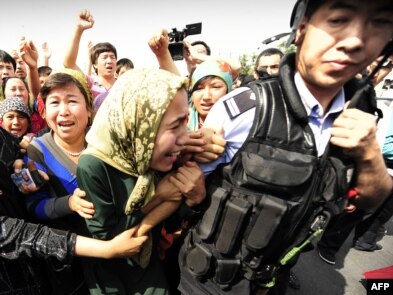
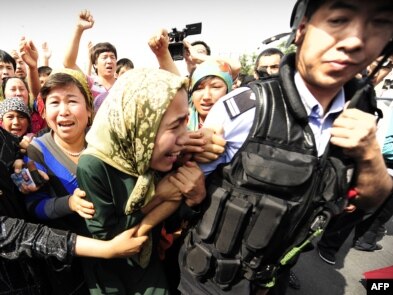
    Ethnic Uyghur women grab at a riot police officer as they protest in Urumqi in China’s far west Xinjiang Province in July

    August 10, 2009

    BISHKEK (Reuters) — Kyrgyzstan police have detained two Uyghur community leaders after they accused China of “state terrorism” at a rally and called for an independent investigation of last month’s clashes in neighboring Xinjiang.

    About 500 Uyghurs gathered at a building on the outskirts of the Kyrgyz capital Bishkek on August 10 with photographs posted to the walls showing what they said was abuse of their kinfolk in China.

    The pictures portrayed people being beaten up and held at gunpoint, as well as depicting unconscious or dead people lying in the streets.

    In Xinjiang’s worst ethnic unrest in decades, Uyghurs staged protests in the regional capital Urumqi on July 5 after two Uyghurs were killed in a clash at a factory in south China in June.

    The violence left 197 people dead and more than 1,600 wounded, mostly Han Chinese who launched revenge attacks in Urumqi days later, according to the Chinese government.

    About 1,000 people, mostly Uyghurs, have been detained in a government crackdown.

    “The Chinese started mass pogroms on June 26, scores of people have been killed, but the Chinese government is concealing those facts,” Dilmurat Akbarov, the head of local Uyghur society Ittipak [Unity], told a meeting.

    “We demand that those responsible are punished.”

    People in the crowd chanted “Freedom to Uyghurs” and banners reading “We accuse China of state terrorism against the Uyghur people” hung on the walls.

    The police did not interfere but detained Akbarov and his deputy Zhamaldin Nasyrov after the protest was over.

    Kyrgyzstan’s ombudsman Tursunbek Akun, who was present at the rally, told reporters Akbarov and Nasyrov were held for staging a rally not sanctioned by the government.

    https://www.rferl.org/a/Kyrgyzstan_Uyghur_Leaders_Detained_After_Protest/1796440.html

  • Uighur Leader Raises New Accusations

    Uighur Leader Raises New Accusations

    By ANDREW JACOBS and MARTIN FACKLER Published: July 29, 2009

    In the weeks since ethnic bloodletting claimed nearly 200 lives in the northwest Chinese region of Xinjiang, the government has been waging a global propaganda war against Rebiya Kadeer, the exiled Uighur leader it accuses of instigating the violence.

    Yuriko Nakao/Reuters

    The exiled Uighur leader Rebiya Kadeer in Tokyo on Wednesday, where she leveled new accusations at the Chinese government.

    Related

    Times Topics: Rebiya Kadeer | Uighurs

    As a result, Ms. Kadeer, who spent more than four years in a Chinese prison and now lives in the United States, has emerged as the international face of the Uighur cause. On Wednesday, she ratcheted up the war of words during a visit to Japan, where she claimed that “nearly 10,000” Uighurs had disappeared “overnight” in Urumqi, the Xinjiang capital.

    “Where did they go?” she asked during a news conference, according to The Associated Press. “Were they all killed or sent somewhere? The Chinese government should disclose what happened to them.”

    Ms. Kadeer did not provide evidence to back up her assertion, which stands in stark contrast to government figures that place the numbers of those arrested at 1,200.

    But her comments infuriated China, which summoned Japan’s ambassador in Beijing to express “strong dissatisfaction” with the decision to grant her a visa.

    China’s Foreign Ministry demanded that Japan “take effective action to stop her anti-China, splittist activities.” The Japanese government declined to intervene, saying that Ms. Kadeer was visiting as a private citizen.

    The true story of what happened in Urumqi may never be known. But Ms. Kadeer’s and the Chinese government’s dueling, sometimes hyperbolic, accounts have sowed confusion and created an even wider chasm between the government and those pressing for greater Uighur autonomy.

    “This has become an exercise in influence-building and image management,” said Russell Leigh Moses, a Beijing-based analyst of Chinese politics. “As each side scrambles to push their version of events, the chances for dialogue are rapidly receding. Xinjiang could very well reignite, but instead of fire prevention, each party seems bent on trying to prove the other side is the one with the lighter fluid.”

    China has not minced words in its approach to Ms. Kadeer, 62, who heads the World Uighur Congress, which advocates for Uighur self-determination. Editorial writers, government officials and even normally staid diplomats have described her as “a terrorist” and “a criminal” who caused the death of 197 people, most of them Han Chinese. As proof, they cite a phone call she made to her brother in Urumqi shortly before the strife began, warning him to stay off the streets. Ms. Kadeer does not deny making the call but says she was just looking out for his safety.

    On Wednesday, Chinese officials delivered a DVD to the offices of The New York Times in Beijing titled “Xinjiang, Urumqi, July 5 Riots: Truth.” The 20-minute film, with versions in Arabic, Turkish, English and other languages, begins with idyllic scenes of Uighurs and members of other ethnic groups who inhabit the region and goes on to show graphic images of beatings that it says were “incited and controlled” by Ms. Kadeer.

    According to the state-run Xinhua news agency, the July 5 mayhem was orchestrated through text and e-mail messages. Gangs of killers, it said, were sent to 50 locations in Urumqi after protesters gathered at a downtown square to express anger over a brawl at a south China toy factory during which two Uighurs were beaten to death by Han Chinese co-workers.

    In the official accounting of how events unfolded on July 5, security officials described mysterious women in “long Islamic robes” who issued orders to the rioters. One woman, they said, even passed out clubs.

    Such assertions, however, are difficult to verify, and the government has yet to provide proof showing that Ms. Kadeer or her organization had a hand in planning the chaos.

    In recent weeks Ms. Kadeer has given a very different narrative. She says that most of the dead were Uighur, not Han, and that as many as 1,000 people were killed, many of them peaceful demonstrators shot dead by security officials who chased them down dead-end streets and opened fire after turning off street lamps.

    She has not provided evidence to back up such claims, saying to reveal her sources would put them in peril. Interviews with both Han and Uighur residents in Urumqi, however, have not yielded any witnesses who can corroborate such accounts.

    Ms. Kadeer’s next trip, to the Melbourne Film Festival in Australia, is sure to produce a fresh round of invective. A documentary about Ms. Kadeer’s life, which will be shown on Aug. 8, has already prompted three Chinese filmmakers to pull out of the festival. Last weekend, after a Chinese consular official told organizers to drop the film, the festival’s Web site was overrun by hackers, who replaced film schedules with a Chinese flag and slogans denouncing Ms. Kadeer.
  • WASHINGTON D.C Protest

    WASHINGTON D.C Protest

    Uighur People Of WASHINGTON D.C

    WASHINGTON D.C
    Location:
    In front of the White House
    Lafayette Park (1608 H Street NW)
    Time:
    12pm-5pm
    Date:
    July 28
    Contact: UAA
    202-349-1496
    202-349-4192
    Info: .org/forum/showthread.php?t=16365