Tag: Turkish-Armenian conflict

  • The Uzun Hüseyin Well

    The Uzun Hüseyin Well

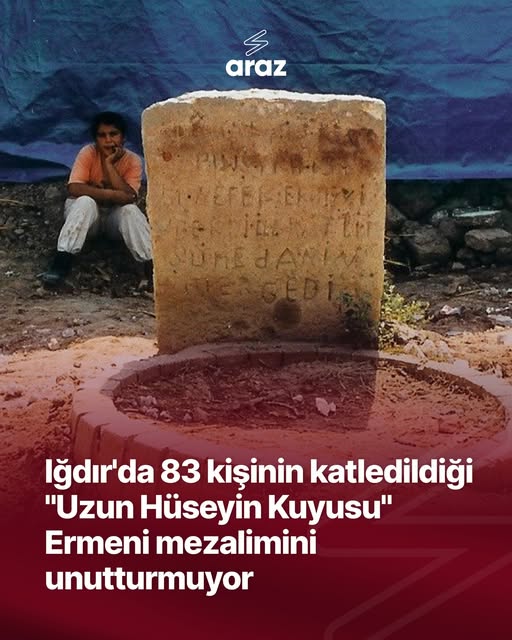
    The Uzun Hüseyin Well, discovered during excavations in Hakmehmet village, where 83 people were allegedly murdered and thrown into the well, reveals the Armenian atrocities that took place in the region.

    The well, approximately 13 meters deep, is located on land belonging to Hüseyin Duman, nicknamed “Uzun Hüseyin,” who lived in Hakmehmet village.

    According to historical sources and accounts from the local people, in 1919, thousands of Armenians who came to the region gathered all the men from the families living in the village in the village square, using various tricks or coercion.

    The Armenian gangs tied the hands of those gathered there, tortured some to death, and threw others alive into the well. Hüseyin Duman, who was thrown into the well during the massacre perpetrated by the Armenians and managed to escape, ensured that the events of that day became known to this day.

    Uzun Hüseyin‘s son, Felemez Duman, recounted his father’s and the villagers’ experiences during the massacre perpetrated by the Armenians. Duman, who still lives in a house next to the mass grave, said, “My father used to say that Armenians surrounded the village, raided everyone’s houses, gathered all the men in the mosque, and tied the hands of the elders. My father told the others, ‘Let‘s escape,’ thinking, ’Our relatives, our families are here, what will happen to them?’ My father managed to escape, and they fired a few shots after him, but they missed.” Duman explained that his father hid in the barn because he couldn’t leave the village due to the Armenian guards around him, and continued, “They brought the men they had tied up to the well near the barn, threw them into the well one by one, some headfirst, and shot them. Finally, they covered them with stones. My mother used to say that we escaped, we survived, we went to Iran, and after a long time, we returned to our village, and blood was still coming out of the well.”
  • Bassoy’s Answer to Baydar’s Article

    Bassoy’s Answer to Baydar’s Article

    Turkey will once more mark the great
    Armenian tragedy of 1915 — last century’s archetypal ethnic cleansing,
    with systematic acts of genocide — in a mix of shame and shamelessness,
    confusion and clarity, ignorance and awareness, denial and admission” is per se shamelessnes and ignorance turning a blind eye to the judgements of ICJ’s, and that of ECHR’s together with the Spanish and French Constitutional Courts’ verdicts on the non-occurred Armenian genocide! Events of 1915 were tragedies for both the Ottoman Muslims and the Armenians, initiated by Armenian killings of Muslims in Van and elsewhere , collaborating with the invading Tsarist Russian troops boastingly, as it was revealed in Paris by Bogos Nubar. Such Armenian brutalities are well known and detailed by the Dashnak terrorists themselves. Speaking in that article only of Armenian tragedy turns it into a hate statement against our Ottoman-muslim ancestors.

    If the grand parents of the writer shamelessly committed genocide on Armenian subjects of the then Ottoman state, then they should be tried by a competent court in their absence, yet in his grand son’s presence, and must be duly punished, post mortem.
    His article is a hate article of slander to my grand parents and to the Ottoman Muslim subjects- grand parents of millions of Turkish citizens which I fiercefulluy repudiate.

    Yes, this is a hate article against our ancesters who have been intentionally and systematicle killed by the Armenian terrorists which were organized from İstanbul’s elite Armenians.
    Ülkü Başsoy

    https://www.turkishnews.com/en/content/2014/04/27/did-ataturk-distribute-ottoman-armenians-property-to-his-team/

  • Film Screening: THE ARMENIAN REVOLT (1894-1920)

    Film Screening: THE ARMENIAN REVOLT (1894-1920)

    Assembly of Turkish American Associations
    1526 18th St., NW Washington, DC 20036
    202.483.9090 – 202.483.9092 fx
    www.ataa.org, [email protected]

    ATAA Capital Forum Program proudly presents:
    A film screening at the U.S. Congress: THE ARMENIAN REVOLT (1894-1920)
    Wednesday, July 28, 2010
    Rayburn HOB, Room 2103, 12pm
    Washington, DC
    (Lunch will be served)
    To date, the United States legislature has considered 11 legislative initiatives opining on the history of the late Ottoman Empire, five that failed because they characterized the events of 1915 as genocide, and six that passed because they did not. The 12th initiative, H.Res. 252, which narrowly passed the House Foreign Affairs Committee 23-22 on March 4, 2010, looks to be the sixth to fail. Regardless, Turkish Americans are facing their ancient history, and so should Armenians Americans, as there are always two sides of a story.
    Accordingly, on Wednesday, July 28, 2010, the ATAA Capital Forum program will host a screening of the film, “The Armenian Revolt”, regarding the armed Armenian Independence Movement (1880-1919) which sought to create a politically, ethnically, and religiously homogenous Armenian state in the eastern region of the Ottoman Empire, and failed. Legal expert, Bruce Fein, will provide opening remarks.
    The producer of the film, Marty Callaghan, is a war documentarian, who recently produced, “Blood, Sand and Oil” regarding WWI in the Middle East and Allied use of micronationalism from the Caucasus to the Arabian Peninsula to destroy the multi-ethnic, multi-cultural Ottoman Empire, and replace it with states servile to western empires. “The Armenian Revolt”, which appeared on Bloomington PBS, takes a look at WWI designs for the Caucasus.

    The ATAA will continue to host experts on the Ottoman Armenian matter with a view toward reconciliation based on truth.
    R.S.V.P. [email protected]
    ATAA serves as an information resource center for its members and component associations throughout the United States, while working locally and nationwide to develop an informed and effective Turkish American citizenry. The ATAA is a major resource for experts, policy makers, and media who seek a deeper and broader understanding of U.S.-Turkish relations. The ATAA is a recognized 501(c)(3) non-profit organization formed under the laws of the District of Columbia. To learn more about ATAA, please visit us at www.ataa.org