Tag: Turkey-Armenia

  • Sarkisian Continues Diaspora Tour

    Sarkisian Continues Diaspora Tour

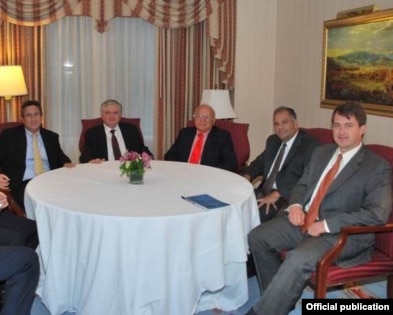
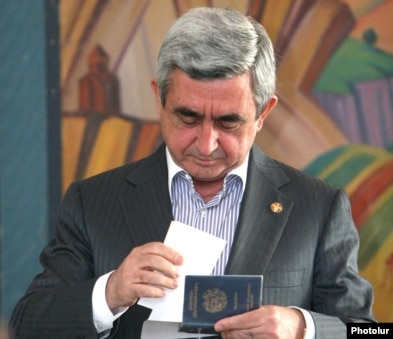
    Serzh Sarkisian, President of Armenia, meets representatives of the Armenian Diaspora in New York, 03Oct, 2009
    05.10.2009
    Hasmik Smbatian, Gevorg Stamboltsian

    President Serzh Sarkisian on Monday continued his weeklong tour of major Armenian communities to discuss and promote his far-reaching diplomatic overtures to Turkey that many in the Diaspora have been following with unease.

    After his visit to French capital Paris on Friday that met with some protests from local Armenians, Sarkisian crossed the Atlantic Ocean to continue his tour in the United States, meeting with prominent Diaspora members in New York and Los Angeles. Sarkisian’s other scheduled stops include Beirut and Rostov-on-Don in southern Russia.

    In American soil, meanwhile, Sarkisian was also reportedly greeted by protesters outside his meeting places. Many urged the Armenian president not to sign a deal with Turkey in its current form that they claim will be damaging to the state and national interests of Armenia and will disregard the national
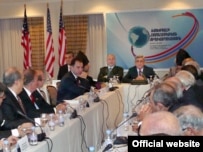
    Serzh Sarkisian meets representatives of the Armenian Diaspora in Los Angeles, 04Oct, 2009

    aspirations of Armenians in Diaspora communities.

    Thousands of Armenian Americans from throughout California reportedly gathered near Beverly Hilton Hotel as part of a protest organized Sunday by a local campaign group.

    During his meetings in all three cities, Sarkisian attempted to persuade Diaspora Armenians that the initialed protocols between Yerevan and Ankara on establishing diplomatic ties and developing bilateral relations do not harm Armenian state and national interests, but, on the contrary, open new opportunities for resolving the centuries-old feud between the two neighbors.

    The leading Armenian organizations in the world have expressed conflicting views on Armenia’s dramatic rapprochement with Turkey that Sarkisian initiated last year by inviting his Turkish counterpart Abdullah Gul to Yerevan to attend a football match between the two countries’ national teams. The yearlong process culminated on August 31 in the publication of two draft protocols expected to be signed by Yerevan and Ankara later this month and submitted for further ratification to parliaments.

    Some Diaspora leaders have expressed serious concern about key points of the two draft protocols envisaging the normalization of bilateral relations. They are particularly critical of the planned creation of a Turkish-Armenian panel of historians that would look into the 1915 mass killings of Armenians in the Ottoman Empire, claiming that this provision is tantamount to questioning the fact of the Armenian Genocide.

    Diaspora groups also object to another protocol clause that commits Armenia to recognizing its existing border with Turkey. They argue that it would preclude future Armenian territorial claims to areas in eastern Turkey that were populated by their ancestors until the 1915-1918 massacres.

    There are also lingering concerns in and outside Armenia about a possible linkage between Armenian-Turkish normalization and the Armenian-Azerbaijan talks on the Nagorno-Karabakh dispute.

    In Paris, New York and Los Angeles, President Sarkisian reiterated that Armenia is pursuing an unconditional normalization with Turkey.

    “I think that we have managed to get the maximum for now,” said Sarkisian in New York on Saturday, as reported by his press office.

    Sarkisian, in particular, said that the Russo-Georgian war in August 2008 created a new situation in the South Caucasus, which, according to him, to some extent prepared ground for an Armenian-Turkish dialogue. He added that the normalization of Turkish-Armenian relations would in turn promote regional détente by creating an atmosphere of mutual confidence.

    At his meeting with several dozen Diaspora representatives Sarkisian emphasized that the fact of the Armenian Genocide in the Ottoman Empire cannot be discussed in the context of rapprochement with Turkey.

    “The only question in connection with the Genocide that can become a subject for discussion is how we can help the Turkish people to be more unbiased in going through the pages of their own history or, to be more precise, how to overcome the consequences of the Genocide,” Sarkisian stressed.

    On the third leg of his tour in Los Angeles, Sarkisian met Sunday with Diaspora representatives of the western coast of the United States as well as South American countries with large Armenian communities.

    Speaking about the Armenia-Turkey dialogue, Sarkisian underscored that negotiations with Ankara have been conducted ever since Armenia became independent in 1991 and simply became “public” following the initiative during his presidency.

    “I believe that it is possible to have normal negotiations, have normal relations with Turkey and benefit from it,” Sarkisian underscored.

    Meanwhile, American-Armenian groups voiced mixed reaction to Sarkisian’s meetings in New York and Los Angeles.

    New York – Representatives of the Armenian Diaspora protest possible signing of Armenian – Turkish protocols, 03Oct, 2009

    Executive Director of the Armenian National Committee of America Aram Hamparian, who coordinated the protest actions of the Armenian Revolutionary Federation in New York, said to RFE/RL: “The negotiations on these protocols proceeded in a secret atmosphere. A six-week period was set for the Armenian and Turkish sides to give approval to the documents. In reality, however, the protocols are not subject to change, even to the slightest alteration.”

    “Two leading Armenian publications in the United States, Asbarez and The Armenian Reporter, conducted opinion polls among 2,400 local Armenians. The polls show that 90 percent of the respondents are against the protocols. And between 94 and 95 percent of the respondents consider that the protocols are more favorable for Turkey,” said Hamparian.

    In response to this, Haig Deranian, the head of one of American-Armenian organizations, the Knights of Vartan, that supports the ratification of the protocols, said: “This is not true. Armenian organizations with a more moderate position are very angered at the circumstance that the ANCA speaks on behalf of the entire Diaspora. They represent a small group of Armenians who are treated with respect, but they have no right to speak on behalf of the majority. I can speak only on my behalf and on behalf of my organization, but not all Armenians.”

    “The Armenian government should know well that the Diaspora has an emotional approach to this matter as it has felt the consequences of the genocide from the very beginning. But emotions notwithstanding, we should also be objective and try to support the Armenian nation and promote the welfare of our country,” Deranian emphasized.

    According to the schedule of the tour announced by Sarkisian’s office, the Armenian president’s next stop is in Beirut to be followed by his meetings in Rostov-on-Don in southern Russia.

    Meanwhile, Sarkisian’s spokesman Samvel Farmanian on Monday confirmed to RFE/RL that the Armenian president had received an official invitation from his Turkish counterpart Abdullah Gul to visit Turkey to attend the return match between the two countries’ national football teams.

    The FIFA World Cup 2010 qualifier between Turkey and Armenia will be held in the northwestern Turkish city of Bursa on October 14.

    According to announcements made by Turkish leaders that yet need to be confirmed by the Armenian side, the foreign ministers of Armenia and Turkey are scheduled to sign the protocols in Switzerland on October 10.
    https://www.azatutyun.am/a/1843752.html
  • Turkey’s EU Membership: Will the ‘Armenian Opening’ Help?

    Turkey’s EU Membership: Will the ‘Armenian Opening’ Help?

    Caucasus Update No. 49, October 5, 2009

    Caucasian Review of International Affairs

    )

    Turkey’s foreign policy, as emphasised by Foreign Minister Ahmet Davutoglu, is to have ‘zero problems with neighbours’ (Today’s Zaman, September 13). This is, first and foremost, intended to stabilise Turkey’s complex regional environment and ensure Turkey’s reputation as a peacemaker. It is also, more tactically, intended to boost Turkey’s long-running EU membership application. Ankara hopes to show that it is a responsible, and indeed indispensable, partner for Europe in Eurasia and the Middle East.
    The rapprochement with Armenia, which seems to be gathering pace, is sometimes interpreted in this light. Turkey’s chief EU negotiator, Egemen Bağış, stated in early September that he expected the ‘Armenian opening’ to help Turkey’s EU bid (Today’s Zaman, September 2). However, this view is rather optimistic. In reality, normalization of relations with Armenia will have a marginal effect on Turkey’s EU application, at best.


    In truth, the EU has never been particularly concerned about the closed border between Armenia and Turkey. European policy towards the South Caucasus as a whole has been patchy and vague. It took the war in Georgia for the EU to take an active stance, and in truth this was mainly the product of Nicolas Sarkozy’s energetic diplomacy as EU President, rather than any institutional determination on behalf of the whole Union.


    The EU Monitoring Mission now keeping the peace between Georgia and Russia is welcome: however, as the Caucasus Update has argued before, the lack of subsequent hostilities is due to Russia’s lack of interest in a new conflict, not the EU’s efforts (Caucasus Update, March 16).


    The EU has been less concerned about the Turkish-Armenian confrontation and the Nagorno-Karabakh conflict. Europe has let the OSCE take the lead on Karabakh, and has been content to sit back and express its support for a peaceful resolution to the conflict. There is little appetite within Brussels, for instance, for an EU peacekeeping force to be deployed in such a tense environment.


    However, the EU still has an interest in preventing major conflicts in the ‘wider European space’. The cold war between Turkey and Armenia does not pose this risk. Although Turkish troops might intervene in the event of a new Karabakh war, they did not do so in the early 1990s, partly out of a desire to maintain a semblance of a balanced policy towards the conflict. Ankara, now more than ever, values its role as a peacemaker. Military intervention would destroy that reputation and cripple Turkey’s EU accession hopes.


    Without a risk of war, it is clear that the thaw between Armenia and Turkey is hardly at the top of the EU’s list of priorities. Brussels already has evidence of Turkey’s good intentions as a regional mediator: it is currently negotiating between Iraq and Syria (BBC, August 31), has been intermittently involved in the Israel-Palestine peace process, and has also been quietly acting as a bridge between the West and Iran. Although welcome, opening the border with Armenia would not be a ‘game-changer’ in Turkey’s relationship with the EU.


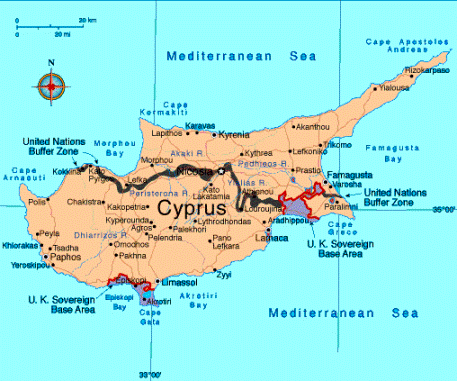
    Indeed, the two biggest game-changers in Ankara’s membership talks are Cyprus and the ‘Kurdish question’. Cyprus is, superficially, similar to the Armenian issue – an inter-state dispute with deep roots, which currently hinges on a closed border and diplomatic recognition. Unlike the Armenian issue, Cyprus is an EU member. Consequently, the dispute with Cyprus is the biggest single stumbling block in Turkey’s EU application.


    Clearly it is not the only issue – there are 35 ‘chapters’ on which Ankara must satisfy Brussels, and only one (science and research) has been completed. But Cyprus’ significance is such that, when Turkey failed to apply a 2005 protocol on free movement of goods and people to the Cypriot government, the EU insisted that no ‘chapters’ could be closed, and that several would not be discussed until it had applied the protocol. The stakes are hardly as high in the Armenian thaw.


    The Kurdish question is less significant than Cyprus, but more so than Armenia. The EU is reluctant to move forward on membership talks with a state which still – despite much recent progress – faces a serious ethnic insurgency. Until Ankara can, in the eyes of Brussels, get its house in order and negotiate a peaceful settlement with its Kurdish population, it will continue to be viewed as an irresponsible and unsuitable candidate for membership by some within Brussels.


    It is instructive to look at the question in reverse. If, for instance, Turkey had resolved Cyprus and the Kurdish question, but had failed to make headway on opening the Armenian border, would this impede its membership process? It is unlikely.


    Indeed, the only EU members which would be likely to turn the Armenian issue into an obstacle would be those – notably France – which already oppose Turkish accession.  Most pragmatists in Brussels would probably be willing to move on, and urge Ankara towards an open border whilst continuing the membership negotiations.


    It would be wrong to think that the EU does not value the thaw between Turkey and Armenia. It does improve Turkey’s reputation. But that reputation is already high, for more important reasons. And it is not the lack of an open border with Armenia – which the EU has little interest in – which is blocking Ankara’s accession to the Union. Until Cyprus and the Kurdish question are resolved, whether or not the Armenian border is open will be a minor footnote in Turkey’s relationship with Brussels.


    Caucasian Review of International Affairs

    Eppsteiner str 2, 60323 Frankfurt am Main, Germany
    Tel: +49 69 138 76 684
    E-mail: [email protected]
    Web: www.cria-online.org

  • Armenian Leader Defends Turkey Rapprochement

    Armenian Leader Defends Turkey Rapprochement

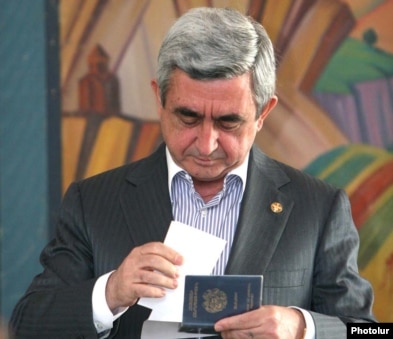
    Armenian President Serzh Sarkisian
    October 02, 2009
    YEREVAN — Armenian President Serzh Sarkisian says that normalizing relations between Yerevan and Ankara won’t thwart greater international recognition of the Armenian genocide or result in Armenian concessions in the Nagorno-Karabakh conflict, RFE/RL’s Armenian Service reports.

    In a spirited defense of his government’s rapprochement with Turkey, Sarkisian told a group of 36 pro-establishment members of the presidential Public Council in Yerevan on September 30 that if they are “unable or unprepared” to negotiate with Turkey, why ” become [should Armenia have become] independent in the first place?”

    Council head Vazgen Manukian told RFE/RL that the members “discussed all the pluses and minuses, drew a line, added things up, and got a [positive result].”

    But two members of the group, who are historians, expressed concern over a Turkish-Armenian subcommission that would look into the World War I-era mass killings and deportations of Armenians in the Ottoman Empire.

    Sarkisian acknowledged their concerns but reminded them that “no sensible Armenian can forget the genocide” and assured them that the Turks will not be able to control the commission single-handedly because both sides will be equally represented on the panel.

    https://www.rferl.org/a/Armenian_Leader_Defends_Turkey_Rapprochement/1841989.html
  • Violent Protests In Paris Greet Armenian President

    Violent Protests In Paris Greet Armenian President

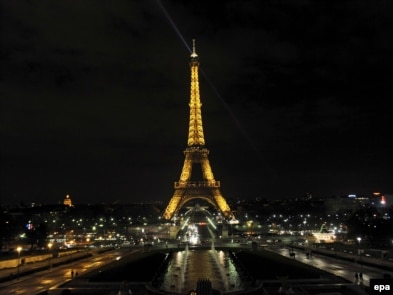
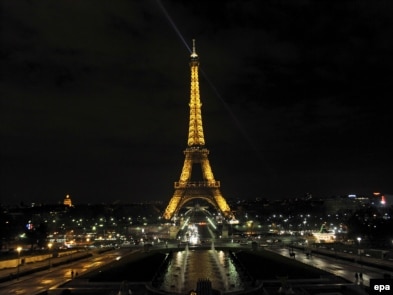
    France — Eiffel Tower, Paris in lights, 28Mar2009

    02.10.2009

    (AP) – Violent protests broke out Friday at the start of Armenian President Serzh Sarkisian’s tour of Armenian communities worldwide, with demonstrators in Paris shouting “traitor!” at him and decrying his plans to establish ties with Turkey.


    Sarkisian embarked on the tour – which will also take him to the United States, Russia and Lebanon – to seek support for his landmark bid for diplomatic ties with Turkey after a century of enmity. But at least 200 protesters from the Armenian Diaspora in France showed up at a public appearance in Paris.


    Riot police fought back belligerent demonstrators, a few dozen of whom shouted “No!” and punched riot shields. Police dragged several protesters away kicking and screaming. Sarkisian later put in a brief appearance, walking past protesters shouting through bullhorns.


    The killing of up to 1.5 million Armenians under the Ottoman Empire has been the main barrier to reconciliation with Turkey. Armenians have long fought to persuade other governments to consider it a genocide. Turkey rejects the label and says the death toll is inflated.


    The scuffles Friday erupted at a memorial event at a monument to an Armenian priest and composer targeted in the massacres. Earlier in the day, Sarkisian had lunch in Paris with crooner Charles Aznavour, one of France’s most famous Armenians, before meeting with members of the vocal Armenian community here, Sarkisian’s spokesman Samvel Farmanian said.


    After Paris, Sarkisian is set to continue what is dubbed a “pan-Armenian tour” with visits to New York, Los Angeles, Beirut and Rostov-on-Don in Russia to discuss a planned meeting Oct. 10 when the Turkish and Armenian foreign ministers are expected to sign the deal to establish ties.


    Armenians abroad – estimated at 5.7 million – outnumber the 3.2 million living in Armenia itself, the smallest of the ex-Soviet republics. The largest communities are in Russia (2 million), the United States (1.4 million), Georgia (460,000) and France (450,000), according to government data.

  • Armenian Americans Divided Over Thaw With Turkey

    Armenian Americans Divided Over Thaw With Turkey

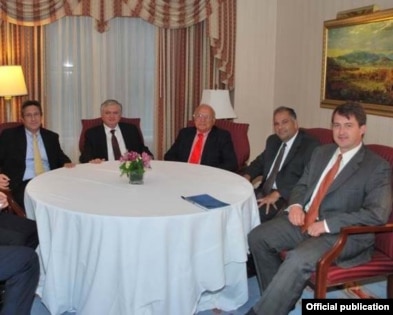
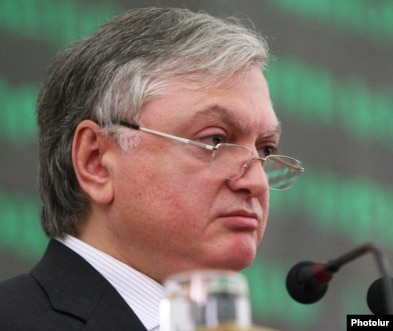
    Armenia — Foreign Minister Eduard Nalbandian meets with the leadership of the Armenian Assembly of America in New York.
    01.10.2009
    Emil Danielyan

    The leading Armenian organizations in the United States expressed conflicting views on Armenia’s dramatic rapprochement with Turkey as President Serzh Sarkisian started on Thursday a week-long intercontinental visit aimed at addressing Diaspora concerns about the U.S.-backed process.

    Sarkisian will spend the next few days touring major Armenian communities in France, the United States, Lebanon and Russia and discussing his conciliatory policy on Turkey with their prominent members. “I am not going in order to convince them, I am
    going to listen to them and tell them what I think,” he told the presidential Public Council on Wednesday.

    According to a statement issued by his office, Sarkisian will first meet in Paris on Friday with leaders of Armenian community leaders from France and other European nations. He will then proceed to New York for similar discussions with representatives of the larger and more influential Armenian-American community. Among invited to the meeting are leaders of a U.S. chapter of the Armenian Revolutionary Federation (Dashnaktsutyun), one of the most vocal critics of the Turkish-Armenian agreements announced on August 31.

    In a statement issued on Wednesday, Dashnaktsutyun’s Central Committee in the eastern United States said it has accepted the invitation. “But, let us be clear: We will attend this meeting because we do not want to forgo an opportunity to voice our strong and uncompromising opposition to these dangerous protocols,” it said. “We will do so directly and forthrightly, letting the president know that the protocols he defends actually betray the national rights of the entire Armenian Nation: Armenia, the Armenian Diaspora, and Nagorno-Karabakh.”

    The statement said Sarkisian’s charm offensive is “not only late but lacking in political and moral sincerity” as both Yerevan and Ankara have made clear that they will sign the two fence-mending protocols without any changes whatever the outcome of the ongoing debates in both countries. It also reiterated Dashnaktsutyun’s arguments against a deal which the nationalist party says will make it harder for the Diaspora to gain greater international recognition of the Armenian genocide. “The protocols will satisfy the articulated aims of today’s Turkish government to silence the enduring and still unanswered ‘Armenian Question,’” the statement said.

    The Dashnaktsutyun-controlled Armenian National Committee of America (ANCA) is one of the two main Armenian groups that have for decades been lobbying the U.S. Congress to pass a formal genocide resolution. The other, more moderate group, the Armenian Assembly of America, has been far more supportive of the thaw in Armenia’s relations with its historical foe.

    The Assembly joined on Thursday the Diaspora’s largest charity, the Armenian General Benevolent Union, as well as two U.S. dioceses of the Armenian Apostolic Church in issuing a statement that welcomed Sarkisian’s policy and the controversial agreements in particular. “The protocols announced on August 31st represent a marked change from the past,” they said. “Turkey has now publicly committed to establish normal relations without preconditions, and the process has yielded remarkable progress.”

    “The path ahead will not be easy and will undoubtedly involve new twists and turns along the way. That makes it all the more important to understand that this is not the time to advance other agendas at the expense of Armenia’s future,” the statement added in a thinly veiled attack on Dashnaktsutyun. “At this critical moment, we believe that the President of Armenia deserves our support.”

    The Dashnaktsutyun statement deplored such views, claiming that they are not shared by the majority of an estimated one million Americans of Armenian descent. “We consider it likely that — for whatever reason — this minority will continue to maintain that unjustified position,” it said.

    https://www.azatutyun.am/a/1841372.html
  • Armenian FM Under Opposition Fire

    Armenian FM Under Opposition Fire

    Armenia – Foreign Minister Eduard Nalbandian speaks at parliamentary hearings on Armenian-Turkish relations, Yerevan, 01Oct, 2009
    01.10.2009
    Irina Hovannisian

    Foreign Minister Eduard Nalbandian faced angry opposition criticism on Thursday as he explained and defended his government’s agreements with Turkey during special public hearings held in the Armenian parliament.

    The hearings, featuring not only parliament members but extraparliamentary politicians, historians and pundits, were part of “internal political consultations” promised by the Armenian and Turkish governments. The opposition Armenian Revolutionary Federation (Dashnaktsutyun) and Zharangutyun (Heritage) parties used them for reaffirming their strong rejection of the agreements envisaging the normalization of Turkish-Armenian relations.

    Nalbandian sought to disprove their “artificial” claims that Yerevan has effectively accepted long-standing Turkish preconditions for the establishment of diplomatic relations between the two states and reopening of their border.

    “Are there any preconditions? No and once again no,” he said. “Are we casting doubt on the fact of the Armenian genocide? Are we hampering international recognition of the Armenian genocide? No and once again no.

    “Is there a connection between the finalized documents and the Nagorno-Karabakh negotiating process? None and once again no.”

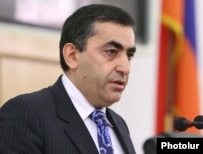
    Armenia — Armen Rustamian, a leader of the opposition Armenian Revolutionary Federation, speaks during parliamentary hearings.

    Dashnaktsutyun and Zharangutyun leaders were unconvinced by these assurances. “Wittingly or unwittingly, we have accepted the Turkish preconditions and allowed an extremely serious deviation from our foreign policy course,” said Armen Rustamian, a Dashnaktsutyun leader who chairs the parliament’s foreign relations committee, which organized the hearings.

    Rustamian also criticized the government for stressing the importance of open borders for Armenia’s long-term economic development. He drew parallels between that stance and the past conciliatory discourse of former President Levon Ter-Petrosian.

    Tigran Torosian, a former parliament speaker who is now highly critical of Armenia’s current leadership, likewise claimed that it has made “unilateral concessions” during the more than yearlong dialogue with the Turks. “What is Turkey giving up in return for our concessions?” he said. “Opening the border, which is its international obligation? Turkey is simply doing what it was supposed to do in the first place.”

    Predictably, the opposition critics vehemently objected to the planned creation of a Turkish-Armenian “sub-commission” of historians what will look into the 1915 mass killings of Armenians in the Ottoman Empire. “The creation of that sub-commission presupposes the erasing of all evidence that the genocide took place,” said Vahan Hovannisian, another Dashnaktsutyun leader. “It means that the evidence is not that weighty.”

    Nalbandian countered that the panel will not seek to determine whether the Armenian massacres constituted a genocide and will only serve as a forum for Turkish-Armenian discussions on “numerous issues coming from the past.” “This sub-commission has no other mandate,” he said. “Nor does it have any time limits because we realize that this process can last very long. Maybe 10 years, maybe 20 years, maybe 50 years, or maybe longer.”

    “The idea is that by talking, opening up to each other, our societies could reach some common denominators,” added the minister.

    Eduard Sharmazanov, a parliament deputy from the ruling Republican Party of Armenia (HHK) also saw little cause for concern. “It is the party which has always falsified history that should be more worried,” said Sharmazanov. “It’s Turkey that has falsified history. And that sub-commission could serve as a ticking time bomb for Turkey.”

    The HHK and its two junior coalition partners, which together control the vast majority of parliament seats, reaffirmed their full support for the agreements in a further sign that their ratification by the National Assembly is a forgone conclusion. The HHK’s parliamentary leader, Galust Sahakian, claimed that President Serzh Sarkisian and his political allies are undaunted by the opposition criticism.

    The bitter debate on the issue, explained Sahakian, is only making the ruling coalition “more vigilant.” “The more blows we get, the more manly we become,” he said.

    https://www.azatutyun.am/a/1841367.html