Tag: Recep Tayyip Erdogan

12th president of Turkey

  • Economic crisis appears to be over

    Economic crisis appears to be over

    March 06, 2010

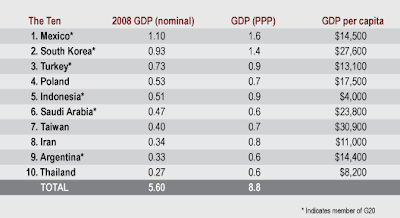
    The Coming of “The Ten”

    Ten economies are becoming the new locomotive for the global economy

    By Martin Walker Senior Director of A.T. Kearney’s Global Business Policy Council

    The economic crisis of 2008-2009 appears to be over, but along the way it has transformed the shape and dynamics of the global economy. This unexpected and dramatic development has not been due to the vigor of the Chinese economy or the BRIC economies as a whole, but the emergence of a major new force in the global economy—the 10 middle-income emergent countries.

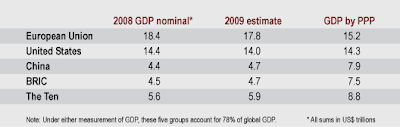
    These emergent economies are becoming, with remarkable speed, a whole new motor for the global economy. The 10 biggest of these—Mexico, South Korea, Turkey, Poland, Indonesia, Saudi Arabia, Taiwan, Iran, Argentina and Thailand—had a collective nominal GDP of $5.6 trillion in 2008, according to the IMF, larger than the GDPs of Japan or China. In purchasing power parity (PPP), their collective GDP was $8.8 trillion, larger than the economies of Japan and Germany combined. Indeed, these 10 non-BRIC countries constitute the world’s third largest economic group, after the European Union and the United States.

    Considered in this light, the global economy takes on an interesting new shape with five dominant components:

    Trade among emergent nations, sometimes called South-South trade, is now the most dynamic component of the global economy. This is NOT simply a factor of the BRIC countries; Brazil, India and Russia accounted for just 5.8 percent of China’s trade. The most striking development is China’s impact on the other emergent markets. Indeed, these other emergent markets helped rescue the Chinese economy from its 2008 nosedive. Taking the year-on-year export figures for November 2009, while Chinese exports to the European Union fell by 8 percent, and its exports to the United States fell by 1.7 percent, China’s exports to the ASEAN nations rose by a dramatic 20.8 percent, and China’s imports rose 45 percent.

    Within this decade, current trading trends suggest that South-South trade could overtake trade among the G7 nations, and should also exceed North-South trade. Fueled by rising populations and increased amounts of foreign direct investment, the non-G7 economies are likely to produce more than half of the world’s GDP. (Currently, the G7 economies account for 57 percent of nominal global GDP.)

    A Host of New Competitors
    Of course, the G7 nations will remain far richer, both as countries and individually, and are likely to continue to enjoy the fruits of their traditional dominance of higher education and technological innovation, among other things. But the large advantage the G7 nations long enjoyed—of comprising the world’s biggest, richest and most attractive consumer market—is being eroded with remarkable and unexpected speed. That means that their consumer tastes and habits will no longer be the global norm. New products are less likely to be developed and launched with Western consumers in mind. Research funds and projects are less likely to be predicated on a Western consumer base. The long tradition of Western cultural dominance, and the political influence and soft power that it generated, is likely to face increasing challenges.

    The new world order in the wake of the recession is going to be much less predictable, much more culturally eclectic and even chaotic.

    The significance of the growth of “The Ten” as a new locomotive force for the global economy is that there will be no single rival to Western culture, but a host of competitors. Brazilian music, Mexican singers, Turkish literature, Argentine dance, Thai sports, Polish architecture, Saudi calligraphy and Indonesian design will all jostle together in the vast new marketplace, alongside Bollywood movies, Russian space tourism and Chinese manufacturers. The new world order in the wake of the recession is going to be much less predictable, much more culturally eclectic and even chaotic. Some will find it an uncomfortable Babel; others will thrill to the rich excitements of choice and diversity.

    Most should be relieved that some gloomy recent suggestions of an inevitable clash of civilizations between China and the West are likely to give way to something more confused. The really good news is that when China’s growth rate slows, as it is likely to do this decade as the labor force peaks and the number of retirees soars, there are now new candidates for future growth ready to take China’s place and maintain global demand.

    Martin Walker is senior director of A.T. Kearney’s Global Business Policy Council. He is based in Washington, D.C.

    For more information, please contact the author.

    The views expressed in this paper are those of the author(s) and do not necessarily represent the views of A.T. Kearney or the Global Business Policy Council. The views are not meant to suggest specific inducement to make a particular investment or follow a particular strategy, but only as an expression of opinion.

    ==========================================

    a summary from mavi boncuk

    The coming of Ten
    Ten economies are becoming the new locomotive for the global economy By Martin Walker Senior Director of A.T. Kearney’s Global Business Policy Council.
    Mavi Boncuk |

    The economic crisis of 2008-2009 appears to be over, but along the way it has transformed the shape and dynamics of the global economy. This unexpected and dramatic development has not been due to the vigor of the Chinese economy or the BRIC economies as a whole, but the emergence of a major new force in the global economy—the 10 middle-income emergent countries.

    These emergent economies are becoming, with remarkable speed, a whole new motor for the global economy. The 10 biggest of these—Mexico, South Korea, Turkey, Poland, Indonesia, Saudi Arabia, Taiwan, Iran, Argentina and Thailand—had a collective nominal GDP of $5.6 trillion in 2008, according to the IMF, larger than the GDPs of Japan or China. In purchasing power parity (PPP), their collective GDP was $8.8 trillion, larger than the economies of Japan and Germany combined. Indeed, these 10 non-BRIC countries constitute the world’s third largest economic group, after the European Union and the United States.

    Considered in this light, the global economy takes on an interesting new shape with five dominant components:

    ==================================

    Martin Walker
    Senior Director of the Global Business Policy Council


    Martin Walker

    Martin Walker is the Senior Director of the Global Business Policy Council, a private think-tank for CEOs founded by the A T Kearney business consultancy. He is also a syndicated columnist and Editor-in-Chief Emeritus of United Press International.

    Previously, in his 25 years as a journalist with The Guardian newspaper, he served as bureau chief in Moscow and the United States, as well as European editor and assistant editor.

    A regular broadcaster on the BBC, National Public Radio and CNN, and panelist on Inside Washington and The McLaughlin Show, he is also a senior scholar at the Woodrow Wilson International Center for Scholars in Washington DC, a senior fellow of the World Policy Institute at the New School for Social Research in New York, and a contributing editor of the Los Angeles Times’s Opinion section and of Europe magazine.

    His books include “Waking Giant: Gorbachev and Perestroika,” “The Cold War: A History,” “Clinton: The President They Deserve” and “America Reborn,” published in May 2000 by Knopf. His latest novel “Bruno, Chief of Police” will be published in the U.S. in 2009 by Knopf and in Germany by Diogenes.

    ==============================================================

    Martin Walker Appointed Head of Global Business Policy Council

    Renowned Author and Commentator Martin Walker Appointed Head of A.T. Kearney’s Global Business Policy Council

    WASHINGTON, D.C. (January 25, 2007)—Global management consulting firm A.T. Kearney today announced the appointment of Martin Walker as senior director of the Global Business Policy Council (GBPC), a forum of CEOs and thought leaders focused on assessing global strategic opportunities and risk management. Since 1992, the GBPC has provided A.T. Kearney with a unique platform for delivering global business environment insights to its clients.

    Walker, 59, was most recently editor-in-chief emeritus of United Press International and also served as international correspondent and editor-in-chief since joining UPI in 2000.  Prior to UPI he spent more than 25 years as a reporter, columnist, foreign correspondent and assistant editor of Britain’s The Guardian newspaper. He will be based in Washington, D.C.

    Walker’s insights on economics, politics and current affairs have been featured in some of the world’s most prominent publications including The New York Times, The Washington Post, The Times of London, Die Zeit of Germany and El Mundo of Spain.  He also is a regular guest on CNN and Fox News, on CNN’s Crossfire and Capital Gang; The McLaughlin Group; PBS-TV Washington Week in Review; NPR’s Diane Rehm Show and On the Media; and public affairs shows on the BBC, ABC (Australia) and in Canada.

    “Martin’s keen intellect and broad perspective on economics and world affairs uniquely position him to lead the direction and strategic initiatives of the Global Business Policy Council,” said Paul Laudicina, managing officer and chairman of A.T. Kearney.  “A.T. Kearney clients have come to rely on the Council for the insights they need to meet today’s leadership challenges.  Martin’s appointment ensures the Council will continue to play an essential role in helping business and government leaders monitor and understand global macroeconomic, geopolitical, socio-demographic and technological changes.”

    Walker has been on the faculty of the Global Business Policy Council since 1997.  He is the author of more than a dozen books including “The Cold War: A History” (1993) and “Europe in the New Century: Visions of an Emerging Superpower”.  He also is a senior scholar at the Woodrow Wilson International Center for Scholars in Washington and a senior fellow of the New School University in New York.

    Walker regularly chairs Council on Foreign Relations events in New York and Washington, and has been a guest lecturer at Chatham House, London; Harvard’s Kennedy school; the universities of Columbia, Pittsburgh, Edinburgh, Toronto, Sussex (UK); UCLA, Johns Hopkins School of Advanced International studies and MGU (Moscow State University).

    Walker was educated at Balliol College, Oxford, where he was the Brackenbury scholar and took a first-class honors degree in modern history, and at Harvard, where he was a Harkness Fellow and a resident tutor at Kirkland House.  He was also a Congressional Fellow of the American Political Science Association, and served as an aide to U.S. Senator Edmund Muskie.

    About A.T. Kearney
    A.T. Kearney is one of the world’s largest management consulting firms. With a global presence spanning major and emerging markets, A.T. Kearney provides strategic, operational, organizational and technology consulting services to the world’s leading companies.

    A.T. Kearney’s Global Business Policy Council is among the consulting industries longest-standing strategic services for CEOs.  The GPBC helps senior business executives and government leaders monitor and capitalize on macroeconomic, geopolitical, socio-demographic and technological change worldwide. Council membership is limited to a select group of corporate leaders and their companies. The Council’s core program includes periodic meetings in strategically important parts of the world, tailored analytical products, regular member briefings, and other services.

  • Armenia Resolution Won’t Get Full U.S. House Vote, Aide Says

    Armenia Resolution Won’t Get Full U.S. House Vote, Aide Says

    March 06, 2010, 12:01 AM EST

    By Peter S. Green and James Rowley

    March 6 (Bloomberg) — Democratic lawmakers bowed to concerns expressed by the Obama administration and agreed not to schedule a full House vote on a resolution that labels as genocide the killing of Armenians in Ottoman Turkey, a congressional aide said.

    House leaders have no plans at this time for a chamber vote on the measure, which a House committee approved on March 4, the House Democratic leadership aide said yesterday. The aide spoke on the condition of anonymity.

    The resolution passed the House Foreign Affairs Committee on a 23-22 vote. Turkey responded by recalling its ambassador in Washington, Namik Tan, for consultations.

    U.S. Secretary of State Hillary Clinton had spoken out against a full House vote on March 4 while attending a conference in Costa Rica. She reiterated yesterday that President Barack Obama’s administration “strongly opposes the resolution.”

    A full House vote would “impede the normalization process between Turkey and Armenia,” State Department spokesman P.J. Crowley said in Washington yesterday before word surfaced of the leadership’s decision. “The best way for Turkey and Armenia to address their shared past is through ongoing negotiations,” he said.

    The measure says the Ottoman Empire, the predecessor of modern-day Turkey, killed 1.5 million ethnic Armenians from 1915 to 1923. It asks the president to ensure that U.S. foreign policy reflects “appropriate understanding” of the atrocity and “the consequences of the failure to realize a just resolution.”

    Similar Recall

    Turkey, a U.S. ally and NATO member, had recalled its U.S. ambassador for a brief period in protest to a similar resolution passed by a House committee in 2007. That measure never came up for a full House vote.

    Turkish President Abdullah Gul said on his Web site that the March 4 committee vote was “one-sided and remote from historical realities,” and would hurt talks with Armenia.

    “We’ve worked at every level with the American administration on a variety of issues and we’ve always supported Mr. Obama’s vision of peace,” Turkish Foreign Minister Ahmet Davutoglu said in Ankara yesterday. “We don’t expect this contribution of ours to be sacrificed to a few local political games.”

    The resolution showed a lack of “strategic vision” on the part of U.S. lawmakers who supported it, Davutoglu said.

    Iranian Trade

    Turkey has been expanding trade with Iran and Obama in December called the country an “important player” in efforts to curb Iran’s nuclear program.

    Turkey’s border and its trade relationship with Iran makes Turkish support vital for U.S. efforts to use sanctions to prevent Iran from developing a nuclear weapon, said Bulent Aliriza, Director of the Turkey Project at the Center for Strategic and International Studies in Washington.

    While the Armenia-related resolution came from Congress and not the administration, Turkey may not see any difference, further hampering U.S. efforts to impose sanctions on Iran, said Henri Barkey, a fellow at the Carnegie Endowment for International Peace in Washington.

    “What is clearly very likely is that on Iran we are going to get less cooperation from them,” Barkey said before the aide disclosed that the resolution won’t get a full House vote.

    Turkey asserts that the resolution hurts Turkish and Armenian efforts to renew diplomatic relations that were broken over Armenia’s military intervention in Azerbaijan’s Nagorno- Karabakh region following the 1991 breakup of the Soviet Union.

    Clinton’s Intervention

    Turkey and Armenia agreed in October to renew relations after Clinton helped the countries overcome a last-minute dispute before a signing ceremony in Zurich. Under the accords, which are waiting to be approved by Turkey’s parliament, a historical commission would investigate the killings.

    After the French parliament in 2006 approved legislation making it criminal to deny that a genocide took place, Turkey said France had done “irreparable damage” to relations between the two countries.

    The chairman of the Armenian National Committee of America, a lobbying group in Washington, praised the House committee shortly after it passed its genocide resolution. “You cannot have a relationship or a reconciliation based upon lies,” Kenneth Hachikian said in an interview after the vote. “Turkey can’t come to the table and say let’s reconcile but we deny what the rest of the world acknowledges.”

    The House resolution noted that England, France and Russia called the killings a crime against humanity at the time, and that Turkey’s own government indicted the leaders of the massacres after World War I.

    –With assistance from Hans Nichols in Washington and Steve Bryant in Ankara. Editors: Don Frederick, Mike Millard.

    -0- Mar/06/2010 05:00 GMT

    To contact the reporters on this story: Peter S. Green in Washington at [email protected]; James Rowley in Washington at [email protected]

    To contact the editor responsible for this story: Jim Kirk at [email protected]

    ==========================


    https://www.economist.com/united-states/2010/03/05/past-imperfect-present-tense

    The Armenian genocide


    Past imperfect, present tense

    Mar 5th 2010 | NEW YORK
    From Economist.com

    Congress reconsiders America’s official position on the Armenian genocide

    TWO questions faced an American congressional panel on Thursday March 5th as it considered the mass killings of Armenians during and after the first world war by forces of the Ottoman Empire. First, was it genocide? The historical debate is as hot, and unsettled, as ever. Armenians continue to insist that it was the first genocide of the twentieth century, while Turks call the killings merely part of the chaos of the break-up of empire.
    But the second question on the minds of congressmen in the Foreign Affairs Committee of the House of Representatives was more urgent. What is more important, fidelity to history or concern for the present? The vote took place as warming relations between Turkey and Armenia have cooled again and those between Turkey and America are under increasing strain over Iran, Israel and other affairs in the region. Turkish diplomats and politicians gave warning before the vote that the consequences would be felt across the range of issues of shared concern to the two countries. In the end the panel narrowly decided against pragmatism and chose to set straight the historical records. A resolution recognising the killings as genocide was sent to the House by a vote of 23 to 22.
    When the same House committee passed a “genocide” resolution in 2007 the White House urged that the vote be scrapped. But this year, it had come with a twist; Barack Obama had promised during his election campaign to recognise the event as genocide. But before the vote his advisers said that while he acknowledges a genocide personally, he urged unsuccessfully that official interpretation be left to the parties involved. Congress is far more sensitive to lobbying than the president and to small but highly motivated groups of voters. Lobbyists working for both Armenians and Turks had been active before the vote and Armenians are concentrated in several Californian districts.
    But no fashioner of foreign policy–among whom the president is by far the most important–can ignore the strategic importance of Turkey. It is a vital American ally and has the second-biggest army in NATO. The country is home to an important American air base and is a crucial supply route for America’s forces in Iraq. Relations were difficult even before the beginning of the war in Iraq in 2003. The mildly Islamist government denied the Americans the ability to open a second front in Iraq through Turkey. Turkey’s relationship with Israel has deteriorated too. Israel’s two recent wars, in Lebanon and Gaza, have outraged Turkish public opinion. Mr Obama’s more even-handed approach to the Israel-Palestine conflict has improved America’s reputation in Turkey, but not by much.
    Turkey itself is caught between forces that make the Armenia issue potentially dangerous. The country’s secular, Western-oriented politicians, among others, have been discouraged by the strict terms offered by the European Union for eventual Turkish membership. In part as a result there has been a gradual realignment in Turkish foreign policy towards its more immediate neighbours. Turkey’s government seeks peaceful relations with countries at its borders, which has meant some cosying up to Iran, despite the fact that most of Turkey’s NATO allies are pushing for more sanctions against the Islamic republic over its alleged efforts to obtain nuclear weapons.
    The vote comes at a sensitive time, too, for Turkey’s relations with Armenia. The pair have been at odds since Turkey closed the border in 1993, during Armenia’s war with Turkey’s ethnic cousins in Azerbaijan. Last year, protocols were agreed that foresaw an establishment of diplomatic relations and an opening of the border. But Armenia’s highest court then declared that the protocols were not in line with Armenia’s constitutionally mandated policy that foreign affairs conform to the Armenian view of the genocide. Turkey responded with fury and the protocols were endangered. The American vote will anger Turkey further and perhaps make it even more inclined to turn away from Europe, America and Armenia in favour of its Islamic neighbours.
    One hope is that Turkish anger will subside if, as happened in 2007, the House leadership stops the resolution from reaching a full vote. It may do so again. Turkey recalled its ambassador after Thursday’s vote just as in 2007. The Turkish government, in a spat with the country’s nationalist army, may play the foreign-insult card to bolster its domestic strength. But ultimately the Turks are unlikely to weaken their relationship with America lightly.

  • Davutoglu challenges U.S. to answer the question whether it wants peace in the region:

    Davutoglu challenges U.S. to answer the question whether it wants peace in the region:

    Turkish FM calls on U.S., West to say whether they really want Armenia-Azerbaijan reconciliation- UPDATE
    05 March 2010 [16:21] – Today.Az http://www.youtube.com/watch?v=ttuzoe7x4UI

    In his televised speech on March 5, Turkish Foreign Minister Ahmet Davutoglu urged the United States and West to resolve the Armenian-Azerbaijani Nagorno-Karabakh conflict.Stability in the South Caucasus can become real only after Armenia withdraws from Azerbaijan’s occupied lands and Armenia-Turkey and Armenia-Azerbaijan reconciliation are ensured, CNN-Turk quoted Davutoglu as saying.

    Unilateral reconciliation is impossible, Davutoglu said.

    It is difficult to reach a full peace through reconciliation only between individual countries in the South Caucasus region, the Foreign Minister explained. In his view, a full peace is possible if only all existing conflicts are solved.

    Davutoglu stressed that not only the Armenian-Turkish reconciliation, but also the Armenian-Azerbaijani reconciliation must be focus of attention adding that the United States and West are interested only in normalization of Armenian-Turkish relations.

    “If we want peace, then why we talk only about the Armenian-Turkish reconciliation? Why do not we put forward the Armenian-Azerbaijani reconciliation? Why can not we believe that this can be realized? Why Turkey is mistaken when it talks about the Armenian-Azerbaijani reconciliation? Our American and Western friends need to think about it.”

    “The question is clear and open. And our response is clear and open, too. Does someone want the Armenian-Turkish reconciliation? Yes, Turkey wants. And now we ask the question: “Do you want the Armenian-Azerbaijani reconciliation or not?” Let them come out and say: “We do not want.” And we’ll know about it. But if they want, let them do all that it is required,” the Turkish FM underscored.

    Peace depends on a political will. The path is difficult, but this is not an impossible goal, Davutoglu added.

    ———–
    13:15

    Turkey calls on Armenia to open all archives and not to exert pressure through the U.S. Congress, and negotiate face to face, Turkish Foreign Minister Ahmet Davutoglu said.

    “The adoption of the resolution on” Armenian genocide” is comical, as the difference of one vote seems very strange,” he added.

    U.S. House Committee on Foreign Affairs on Thursday adopted 23 votes to 22 a resolution recognizing the so-called “Armenian genocide”.

    Armenia claims that the Ottoman Empire committed genocide against Armenians living in Anatolia in 1915.  Making greater efforts to promote the issue internationally, Armenians have achieved its recognition by parliaments of some countries.

    Signing the protocols with Armenia, Turkey sought to bequeath to future generations of peace and stability among nations, but the adoption of this resolution by the U.S Congress’s Committee shows that Yerevan does not act openly in this matter, he added.

    The minister considers erroneous the view that the adoption of the resolution could put pressure on Ankara to ratify the Armenian-Turkish protocols.

    “The fact is that Turkey has taken decision on in this issue for ten days while Armenia has done for four months,” he said.

    The intervention of a third party, in this case the U.S., in relations between Armenia and Turkey, complicates the process of reconciliation between the countries, he said.

    The adoption of a resolution recognizing the “Armenian genocide” indicates that the U.S Congress is very weak in developing a future political strategy, the Turkish minister said.

  • Crisis in Turkey

    Crisis in Turkey

    by Daniel Pipes
    National Review Online
    March 2, 2010

    https://www.danielpipes.org/8009/crisis-in-turkey

    • German
    • Portuguese
    • Romanian
    The arrest and indictment of top military figures in Turkey last week precipitated potentially the most severe crisis since Atatürk founded the republic in 1923. The weeks ahead will probably indicate whether the country continues its slide toward Islamism or reverts to its traditional secularism. The denouement has major implications for Muslims everywhere.

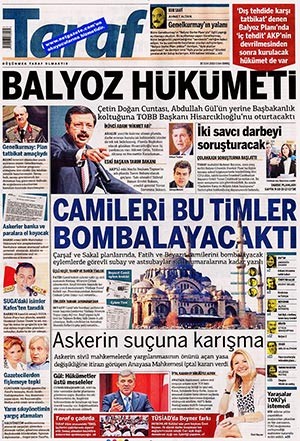
    “Taraf” broke the Balyoz conspiracy theory on Jan. 22, 2010.
    Turkey’s military has long been both the state’s most trusted institution and the guarantor of Atatürk’s legacy, especially his laicism. Devotion to the founder is not some dry abstraction but a very real and central part of a Turkish officer’s life; as journalist Mehmet Ali Birand has documented, cadet-officers hardly go an hour without hearing Atatürk’s name invoked. On four occasions between 1960 and 1997, the military intervened to repair a political process gone awry. On the last of these occasions, it forced the Islamist government of Necmettin Erbakan out of power. Chastened by this experience, some of Erbakan’s staff re-organized themselves as the more cautious Justice and Development Party (AKP). In Turkey’s decisive election of 2002, they surged ahead of discredited and fragmented centrist parties with a plurality of 34 percent of the popular vote.
    Parliamentary rules then transformed that plurality into a 66 percent supermajority of assembly seats and a rare case of single-party rule. Not only did the AKP skillfully take advantage of its opportunity to lay the foundations of an Islamic order but no other party or leader emerged to challenge it. As a result, the AKP increased its portion of the vote in the 2007 elections to a resounding 47 percent, with control over 62 percent of parliamentary seats.
    Repeated AKP electoral successes encouraged it to drop its earlier caution and to hasten moving the country toward its dream of an Islamic Republic of Turkey. The party placed partisans in the presidency and the judiciary while seizing increased control of the educational, business, media, and other leading institutions. It even challenged the secularists’ hold over what Turks call the “deep state” – the non-elected institutions of the intelligence agencies, security services, and the judiciary. Only the military, ultimate arbiter of the country’s direction, remained beyond AKP control.
    Several factors then prompted the AKP to confront the military: European Union accession demands for civilian control over the military; a 2008 court case that came close to shutting down the AKP; and the growing assertiveness of its Islamist ally, the Fethullah Gülen Movement. An erosion in AKP popularity (from 47 percent in 2007 to 29 percent now) added a sense of urgency to this confrontation, for it points to the end of one-party AKP rule in the next elections.

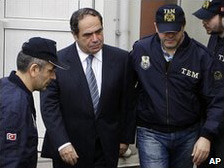
    Gen. Ibrahim Firtina, a former head of the air force, was questioned in court about a plot to overthrow the government.
    The AKP devised an elaborate conspiracy theory in 2007, dubbed Ergenekon, to arrest about two hundred AKP critics, including military officers, under accusation of plotting to overthrow the elected government. The military responded passively, so the AKP raised the stakes on Jan. 22 by concocting a second conspiracy theory, this one termed Balyoz (“Sledgehammer”) and exclusively directed against the military. The military denied any illegal activities and the chief of general staff, Ýlker Baþbuð, warned that “Our patience has a limit.” Nonetheless, the government proceeded, starting on Feb. 22, to arrest 67 active and retired military officers, including former heads of the air force and navy. So far, 35 officers have been indicted.
    Thus has the AKP thrown down the gauntlet, leaving the military leadership basically with two unattractive options: (1) continue selectively to acquiesce to the AKP and hope that fair elections by 2011 will terminate and reverse this process; or (2) stage a coup d’état, risking voter backlash and increased Islamist electoral strength.

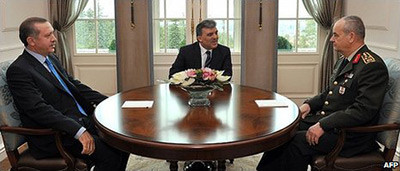
    Prime Minister Recep Tayyip Erdoðan, President Abdullah Gul and Armed Forces Chief of Staff Gen. Ýlker Baþbuð met on February 25.
    At stake is whether the Ergenekon/Balyoz offensives will succeed in transforming the military from an Atatürkist to a Gülenist institution; or whether the AKP’s blatant deceit and over-reaching will spur secularists to find their voice and their confidence. Ultimately the issue concerns whether Shari’a (Islamic law) rules Turkey or the country returns to secularism. Turkey’s Islamic importance suggests that the outcome of this crisis has consequences for Muslims everywhere. AKP domination of the military means Islamists control the umma‘s most powerful secular institution, proving that, for the moment, they are unstoppable. But if the military retains its independence, Atatürk’s vision will remain alive in Turkey and offer Muslims worldwide an alternative to the Islamist juggernaut.

  • BEYAZ SARAY VE SOZDE SOYKIRIM OYLAMASI

    BEYAZ SARAY VE SOZDE SOYKIRIM OYLAMASI

    Kritik oylama öncesi şok
    ‘Ermeni  iddialarına ilişkin tasarı, yarın ABD Temsilciler Meclisi Dışişleri Komitesi’nde görüşülmeden önce Beyaz Saray’dan yapılan son açıklama moralleri bozdu.

    Türkiye, ABD Temsilciler Meclisi Dışişleri Komitesi’nde yarın görüşülüp oylanacak 1915 yılı olaylarına ilişkin Ermeni iddialarına karşı çalışmalarını sürdürüyor.Ermeni tasarısının Dış İlişkiler Komitesi’nde oylanması öncesinde Beyaz Saray’dan ilk açıklama geldi.Vatan gazetesinin haberine göre; Beyaz Saray Ulusal Güvenlik Konseyi Basın Sözcüsü Mike Hammer, “Başkan Obama 24 Nisan 2009’da yayınlanan mesajında 1915’te yaşanan olaylar karşısındaki sürekli duruşunu vurgulamış ve bu konudaki görüşü de değişmemiştir. Gerçeklerin dürüst ve adilce kabulünden yanayız. Bu hedefe ulaşmanın en iyi yolunun Ermeni ve Türk halkının ilişkilerini normalleştirme çabaları dâhilinde geçmişte yaşananları da ele almaları olduğu yönündeki inancımız sürüyor. Bu çabaları gayretle desteklemeye devam edeceğiz” dedi.

    Türkiye bu açıklamaya rağmen Washington’da yoğun bir lobi faaliyeti sürdürüyor. Bir yandan iktidar ve muhalefet milletvekillerinden oluşan heyetler yoğun bir diplomasi sürdürüyor. Diğer yandan Türkiye’nin yeni Washington elçisi Namık Tan, kolları sıvadı. Tan, tasarıya karşı Türk tezlerini desteklemeleri için Yahudi lobisi ve derneklerine baskı yapmaya başladı.

    Tan’ın temaslarının ilk Yahudi kurumundan tasarıya karşı bir çıkış geldi. Merkezi Washington’da bulunan düşünce kuruluşu Ulusal Güvenlik İşleri Yahudi Enstitüsü (JINSA), Ermeni tasarısına karşı çıkılması ve tasarının kabul edilmemesi gerektiğini belirtti. JINSA’dan yapılan açıklamada “ABD Kongresi, başka zamanlarda başka halkların tarihinin tartışılacağı bir yer değildir. Türkiye ve Ermenistan bağımsız ülkeler. Kongre’nin işe karışması katkı sağlamayacaktır” ifadesi kullanıldı.

    Başbakan Erdoğan, Ankara’da yaptığı açıklamada “Her yıl bu sürecin tekrar tekrar yaşanmasını son derece anlamsız buluyoruz” dedi. Tarihçilere bırakılması gereken böyle bir mesele karşısında Temsilciler Meclisi’nin duyarlı davranmasını isteyen Erdoğan, “Türkiye-ABD işbirliği, tarihinin en başarılı dönemini yaşıyor. Bu işbirliğinin, bu tür girişimlerle zedelenmeyeceğini umuyorum. Başkan Obama’nın liderliğine ve sağduyusuna güveniyorum. Dışişleri Bakanı Clinton’la da aksi bir neticenin nelere mal olacağını görüştük. Herkesi, aklıselimle hareket etmeye çağırıyorum” dedi.

    SON DURUM: 25-21 KABUL

    Dış İlişkiler Komitesi’nde 46 milletvekili bulunuyor. 26’sı Obama’nın Demokrat Partisi’nden. 20’si ise Cumhuriyetçi. Ermeni seçmenine çok yakın olan Demokratların 18’inin tasarıya ’evet’oyu kullanması kesin gibi. Cumhuriyetçilerde ise evetçilerin sayısı 7. Tasarının 21’e karşı 25 oyla kabul edilerek genel kurula sevk edilmesi bekleniyor.Ancak genel kurul gündemine alınıp alınmaması kararı Meclis Başkanı Nancy Pelosi’ye ait. Ermeniler’in çok yoğun olarak yaşadığı California eyaletinden seçilen Pelosi, soykırım iddialarını güçlü bir şekilde destekliyor. Ancak son anda Başkan Obama’dan gelecek bir telefonun kararını değiştirebileceği belirtiliyor

  • A Look at the Snarled Past of Armenians and Turks

    A Look at the Snarled Past of Armenians and Turks

    Books of The Times

    By DWIGHT GARNER
    Published: March 2, 2010
    Christopher de Bellaigue’s new book begins with the story of a journalistic blunder, the author’s own. In 2001 Mr. de Bellaigue wrote a long essay for The New York Review of Books about Turkey’s tangled history. It was a topic he thought he knew something about. At the time he was living in Istanbul and working as a foreign correspondent for The Economist.
    Bit Ghezelayagh
    His essay had barely arrived on newsstands, though, before complaints began to pour in. It turns out that Mr. de Bellaigue, while describing the age-old ethnic conflict between Turks and Armenians, declared that “some half a million” Armenians “died during the deportations and massacres of 1915.” Unknowingly, he had stumbled into bitterly contested territory. James Russell, a professor of Armenian studies at Harvard, was among those who wrote to rebuke him. Three times that many Armenians “were murdered,” Mr. Russell replied, “in a premeditated genocide.” Mr. Russell’s letter to The New York Review of Books continued: “If a reviewer wrote that only a third of the actual number of Jewish victims of the Holocaust had died, or that their deaths came about because they had rioted, or elected to make war against the German government, would you print it?” Mr. de Bellaigue was appalled at the tone of Mr. Russell’s letter, he writes, and at the possibility that he had made serious mistakes. He was shattered when Robert Silvers, the venerable editor of The New York Review of Books, scolded him over the telephone for appearing to be an apologist for the Turks. Chastened, Mr. de Bellaigue — a talented British journalist and the author of “In the Rose Garden of the Martyrs: A Memoir of Iran” (2005) — set out to discover the truth about what happened nearly a century ago between the Turks and the Armenians. The result of that quest is “Rebel Land: Unraveling the Riddle of History in a Turkish Town,” a deeply unconventional book that is as much memoir as proper history. It’s a murky and uneven book, too, one that Mr. de Bellaigue’s twitchy intellect and acid prose can’t quite rescue. Mr. de Bellaigue lets us know early on that “Rebel Land” is not going to be, at bottom, a research project. “I would not pore over books in libraries and faculties,” he declares, nor will he “solicit help from the Kurdish and Armenian lobbies.” He decides to “go to the back of the vessel and mix it in steerage with the forgotten peoples. From them I would get the story, gritty and unfiltered, of their loves, their losses and their sins.” What this jaunty bit of cultural condescension (mix it in steerage?) means in practice is that Mr. de Bellaigue begins to spend a lot of time in a small town in southeastern Turkey named Varto, in a district (also named Varto) that was caught up in the turmoil of 1915. Thousands of Armenians once lived there, and the ruins of their churches linger still. This place is a far cry from the cosmopolitan Turkey that Mr. de Bellaigue knew and loved in Istanbul. Speaking of that urban Turkey, the one that mostly prefers to deny its complicated past, he writes, “I would now go behind its back and betray it.” So Mr. de Bellaigue goes to Varto and begins to poke around. Because he is a keen observer and a natural satirist — I would like to read a novel by him — the parts of “Rebel Land” that are akin to travel writing are shrewd. He is good on people, observing one man’s “flowery nose” and “grenadine complexion,” another’s “white parabola” of a mustache, yet another’s “precarious nail-bitten superiority.” Mr. de Bellaigue is a mordant sensualist, noting how a river flows into “curvaceous oxbows” and how boots “sucked and popped” through mud. He is particularly attentive to his meals, enjoying “mezes of superlative quality,” “a delicious apricot cake” and noting how one local man enjoys deep-fried local trout with rocket and radishes. He describes Varto itself as “this curious place with a name like a cleaning detergent.” There is Kafkaesque humor, too, in the way the local authorities trail him, and in the way he tries (and usually fails) to get the locals to trust and to talk to him. Mr. de Bellaigue’s peppery asides rub up awkwardly, however, against the main story he is trying to tell in “Rebel Land,” one that doesn’t lend itself to pithy aperçus. The arc of his narrative becomes lost amid the place names and rumors and dimly remembered family stories. He complains that he “might be told three or four versions” of every event, and the reader begins to feel his pain. This is a book that has a two-page dramatis personae at the front, of the kind that makes your heart sink. Mr. de Bellaigue does not do enough to separate all these living and historical people, to make them distinctive, and they become a jumble on the page. As his book progresses, Mr. de Bellaigue begins to limit his focus to the crucial questions, notably this one: what happened to the Armenians of Varto? His book becomes a kind of intellectual, emotional and forensic detective story. He delivers, piece by piece, a summary of the Armenians’ case against the Turks and he blasts the Turkish historians who, he feels, have whitewashed a portion of their country’s history. Ultimately, he writes, “the big historical question is not whether very large numbers of Anatolian Armenians met with a violent end in the spring and summer of 1915, but whether or not the killings took place by fiat.” In other words, was it genocide or merely the actions of a few bad men? Mr. de Bellaigue worries that “a genocide fixation” has blinded both sides to all shades of gray. “What is needed is a vaguer designation for the events of 1915, avoiding the G-word but clearly connoting criminal acts of slaughter, to which reasonable scholars can subscribe and which a child might be taught,” he suggests. “By raising knowledge about this great wrong, a way might be opened to a cultural and historical meeting between today’s Turks, Kurds and Armenians, for they were not alive in 1915, and need not live in its shadow.” The gimlet-eyed and sensible Mr. de Bellaigue proposes all this, and then immediately realizes his cosmic folly. “But no; this is the prattle of a naïf,” he writes, “laughable, unemployable.”