Skip to content

Turkish Forum

  • World
  • Turkey
  • Culture/Art
    • YouTube
    • Twitter
    • Facebook
    • RSS Feed
  • EN
    • TR
    • DE
    • RU
Log in

Tag: Recep Tayyip Erdogan

12th president of Turkey

  • U.S. forces say Turkey was deliberately ‘bracketing’ American troops with artillery fire in Syria

    U.S. forces say Turkey was deliberately ‘bracketing’ American troops with artillery fire in Syria

    This picture taken Saturday near the Syrian border town of Kobane shows a U.S. observation post where the Pentagon said U.S. troops came under Turkish artillery fire on Friday. (OZAN KOSE/AFP via Getty Images)
    By Dan Lamothe

    October 12 at 6:07 PM

    Turkish forces who launched multiple artillery rounds near a U.S. Special Operations outpost in northeastern Syria on Friday have known for months that Americans were there, according to four current and former U.S. officials, raising questions whether Turkey is trying to push American troops farther from the border.

    The incident occurred on a hilltop base overlooking the town of Kobane as Turkey continues an operation launched Tuesday against Syrian Kurds, some of whom the United States has partnered with for years in its campaign against the Islamic State. The incursion has focused on an area 60 miles to the west of Kobane, but U.S. officials believe Turkey has long-term aspirations to control a much larger swath of Syria.

    The rounds landed about 9 p.m. within a few hundred yards of the base on Mistenur Hill, U.S. officials said. Navy Capt. Brook DeWalt, a Pentagon spokesman, said in a statement that the U.S. troops “came under artillery fire” but were unharmed and that there was an explosion.

    “The U.S. demands that Turkey avoid actions that could result in immediate defensive action,” DeWalt said.

    In a statement issued Friday, Turkey’s Defense Ministry said its troops had not fired on the Americans and were acting “in self-defense” after one of their border posts was attacked.

    But the situation, first reported by Newsweek, was more serious than characterized Friday, several officials said, speaking on the condition of anonymity because of the sensitivity of the issue.

    Before U.S. troops pulled out of northern Syria, clearing the way for a Turkish invasion, The Post went there and met Kurds who feared the looming assault. (Joyce Lee/The Washington Post)

    One Army officer who has deployed to northeastern Syria and has knowledge of the situation said that multiple rounds of 155mm fire were launched from Turkey’s side of the border and that they had a “bracketing effect” in which shells landed on both sides of the U.S. outpost.

    “That’s an area weapon,” the officer said, noting its explosive effects. “That’s not something we ever would have done to a partner force.”

    The officer said Turkey knew there were Americans on the hill and that it had to be deliberate. The service members vacated the outpost after the incident but returned Saturday, according to a U.S. official and images circulating on social media.

    “We had been there for months, and it is the most clearly defined position in that entire area,” the officer said.

    Brett McGurk, a former special envoy for both the Obama and Trump administrations in the campaign against the Islamic State, raised concerns about the incident Friday, saying on Twitter that the United States had declared the position to Turkey.

    “This was not a mistake,” he said.

    McGurk, who often collaborated with the U.S. military in Syria before resigning his position in December, emphasized the increasing risks to Americans throughout Syria in an email Saturday.

    “Turkey wants us off the entire border region to a depth of 30 kilometers,” or about 20 miles, he said. “Based on all the facts available, these were warning fires on a known location, not inadvertent rounds.”

    Turkey launched its operation into Syria on Tuesday, two days after President Trump and Turkish President Recep Tayyip Erdogan discussed the issue in a phone call and the White House announced that the United States would not stand in Turkey’s way. Trump, explaining his decision, said Monday that he wants to end “endless wars” in the Middle East.

    The move immediately raised concerns that the United States was abandoning Syrian Kurds, who have been the closest U.S. partner in counterterrorism operations against the Islamic State. The Kurdish militia known as the People’s Protection Units, or YPG, has formed the backbone of U.S. efforts in northeastern Syria and collaborated with U.S. troops, but Turkey considers the group to be part of a Kurdish movement, the PKK, that it deems a terrorist organization.

    Turkey said in its statement that it opened fire after Kurdish forces launched rounds at them but stopped when the United States warned that the rounds were too close. U.S. officials confirmed Saturday that the firing ended after U.S. forces contacted the Turks, but some questioned whether the Kurdish were involved at all.

    Defense Secretary Mark T. Esper and Army Gen. Mark A. Milley, chairman of the Joint Chiefs of Staff, told reporters Friday they would not abandon the Kurds but acknowledged the Pentagon has withdrawn forces from Tal Abyad and Ras al-Ayn in response to Turkey’s incursion between the two border towns.

    Turkey appears to have aspirations to push the United States away from Kobane, as well, several officials said. The Army officer with knowledge of Syria said Turkish forces previously have launched artillery over the border near U.S. forces.

    Milley, speaking Friday at the Pentagon shortly before the incident outside Kobane, said the Turkish military “is fully aware, down to explicit grid coordinate detail,” of the location of U.S. troops in Syria. He said senior U.S. military officials are coordinating with the Turks “to make sure that they know exactly where American forces are.”

    Another U.S. defense official, also speaking on condition of anonymity because of the sensitivity of the issue, said the Pentagon “obviously” told Turkey where U.S. troops are and “they certainly [went] closer than we would have liked” in the incident outside Kobane.

    “Whether that’s intentional or reckless, either way it’s troubling,” the official said.

    Liz Sly contributed to this report.
    October 13, 2019
  • Erdoğan is on a lonely path to ruin. Will he take Turkey down with him?

    Erdoğan is on a lonely path to ruin. Will he take Turkey down with him?

    The Observer

    Simon Tisdall

    At odds with the US, Europe, his Arab neighbours and potentially Russia, too, the president is also increasingly unpopular at home
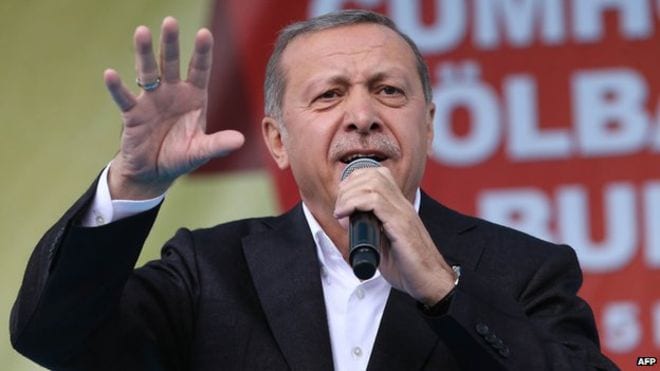
    Recep Tayyip Erdoğan addresses his supporters at a ceremony marking the third anniversary of the attempted coup. Photograph: Murad Sezer/Reuters

    For a reputed “strongman”, Recep Tayyip Erdoğan seems unusually nervous these days. A bombastic speech last week marking the third anniversary of a failed military putsch could not conceal his insecurity. He says he is using his sweeping powers as executive president to build a “new Turkey”. But it appears the old one is tiring of him fast.

    “The 15th of July was an attempt to subject our nation to slavery,” Erdoğan declared. “But as much as we will never stop protecting our freedom and our future, those who lay traps for us will never cease their efforts.” It was a typical pitch, blending nationalism with scare stories of secret foes, foreign and domestic.

    Erdoğan remains convinced his enemies are out to get him – and in the manner of all dictators, conflates his personal prospects with those of the state. The latest villains in this self-centred drama are the country’s American and European allies who, as he tells it, seek to subjugate both him and the proudly rising Turkish nation. But freedom is a fungible concept in Erdoğan’s Turkey. Tens of thousands of supposed plotters have been jailed pending trial since 2016. More than 100,000 public sector workers have been suspended or sacked. Another purge preceded the coup anniversary, with more than 200 military personnel and civilians accused of treason.

    Particular concern is focused on Turkey’s justice system. Britain’s Law Society, citing the “widespread and systematic persecution of members of the legal profession”, has reported Turkey to the UN human rights council. Journalists have suffered similar intimidation. Most Turkish media now tamely toe the government line.

    Erdoğan has good cause to worry – but the real reason may be simpler: he has made a dreadful hash of things. During 16 consecutive years in power, Turkey’s modern caliph has driven the economy into chronic debt, played regional power-broker with chaotic results, and scapegoated the Kurds for his failures. Now the bill is coming due.

    Turkey remains in recession following last year’s calamitous currency crisis, amid fears a new financial crunch is imminent. Unemployment and inflation are high and business is slack. Erdoğan’s sacking last week of the central bank governor was seen as a sign he will persist with his discredited strategy of spurring growth with borrowed money.

    For the first time in years, his political grip is threatened. Erdoğan’s ruling AKP suffered local election losses in five of the six largest cities in March. He was humiliated again last month in Istanbul’s re-run mayoral election. And his monopoly on power makes it harder to shift responsibility to others.

    External affairs is another disaster area. Scoring a spectacular double last week, Erdoğan fell out with both the US and the EU in the space of a few days. In Washington’s case, the row was over Nato member Turkey’s decision to buy a Russian ground-to-air missile system. Some analysts suggest Erdoğan wanted to demonstrate Turkey’s independence. Others put it down to paranoia. He reportedly still suspects Washington of tacitly supporting the coup and protecting its US-based alleged leader, Fethullah Gülen.

    Whatever his motives, the missile purchase led the US to cancel a sale of F-35 jets and threaten more sanctions. The cost to the Turkish defence industry, which would have made some aircraft components, is put at $9bn. Bigger still, potentially, is the cost to Nato. The foreign ministry in Ankara warned on Wednesday of “irreparable damage”.

    Erdoğan’s always tense relations with the EU, strained by the Syrian refugee crisis, underwent a simultaneous rupture. After Ankara ignored Cypriot warnings not to drill for oil and gas in eastern Mediterranean waters that Nicosia claims as its own, EU foreign ministers imposed yet more sanctions.

    The notoriously combative Erdoğan has fallen out with many regional neighbours over the years, including Syria, Egypt, Israel and Saudi Arabia, not to mention Greece. To break with the US and Europe in the same week is some achievement, even by his choleric standards. Yet Erdoğan supporters claim it’s part of a deliberate plan to boost Turkey’s independent standing in the world.

    On this analysis, Erdoğan’s cosying up to Russia’s Vladimir Putin puts the US on notice that Turkey has strategic alternatives. It could help the economy, which needs Russian trade and tourism. And it suits Ankara’s policy in Syria where, despite being on opposite sides, Turkey has collaborated with Russia and Iran.

    But this apparent tilt towards Moscow may yet prove another big miscalculation. Erdoğan says he wants to stay friends with the US and be part of Nato – but has sowed grave doubts about his dependability. Meanwhile, Russian and Syrian regime forces have begun an offensive against rebels and Islamists in Idlib, Aleppo and Hama provinces, in north-west Syria. The offensive contravenes a ceasefire agreed with Erdoğan last September that set up a demilitarised zone inside Syria overseen by Turkey. Its forces were attacked in two separate incidents in May. Fighting in Idlib has since intensified amid renewed civilian atrocities.

    Russia and Syria aim to finally bring the civil war to an end by storming the last rebel areas. Erdoğan’s aim is to extend Turkish-controlled “safe areas” eastwards along the Turkey-Syria border in order to hold Kurdish “terrorists” at bay – and prevent another refugee exodus. These aims look increasingly incompatible.

    At odds with the US, Europe, his Arab neighbours and potentially Russia, too, and increasingly unpopular at home, no-mates Erdoğan is treading a lonely, destructive path towards a strategic and political dead end. The looming question is whether he will take Turkey down with him.

    September 22, 2019
  • Is this the Beginning of the End for Turkey’s Erdogan? Stratfor Enterprises, LLC.

    Is this the Beginning of the End for Turkey’s Erdogan? Stratfor Enterprises, LLC.

    Jul 3, 2019 | 19:25 GMT

    By Sinan Ciddi
    Board of Contributors
    Sinan Ciddi
    Sinan Ciddi
    Board of Contributors
    (MIKHAIL SVETLOV/Getty Images)
    Contributor Perspectives offer insight, analysis and commentary from Stratfor’s Board of Contributors and guest contributors who are distinguished leaders in their fields of expertise.
    Highlights
    • In Turkey, the opposition’s Ekrem Imamoglu soundly defeated his ruling party opponent by more than 800,000 votes in the June 23 Istanbul mayoral election redo — a vast increase from Imamoglu’s first, narrow win on March 31.
    • The ruling Justice and Development Party (AKP) experienced major metropolitan loses not only in Istanbul but also in the capital, Ankara, and elsewhere as voters expressed their dissatisfaction with the AKP and President Recep Tayyip Erdogan.
    • In the coming days or weeks, former AKP officials and Erdogan allies will break away from the governing party to establish a rival political party. The move will weaken the AKP and Erdogan’s base of power and force supporters to choose between Erdogan and the splinter group. 

    The June 23 redo of the Istanbul mayoral election produced an embarrassing outcome for Turkish President Recep Tayyip Erdogan. More than 800,000 votes separated Ekrem Imamoglu, the opposition Republican People’s Party candidate, from Binali Yildirim of the ruling Justice and Development Party (AKP), a monumental increase from Imamoglu’s narrow 13,000-vote margin of victory in the first Istanbul vote on March 31. The outcome reflected voter frustration with Erdogan’s attempt to impose a victory in Turkey’s premier city by nullifying the result of the first election and ordering a do-over. The outcome can also be seen as an expression of voter dissatisfaction with the way Turkey’s economy is being run and the lack of attention the AKP is giving ordinary citizens’ concerns about inflation, unemployment and divisive political rhetoric.

    A Turning Tide

    Erdogan, seemingly caught by surprise, has not been able to articulate a clear response to Imamoglu’s overwhelming victory. The AKP will likely respond by taking away various mayoral powers, such as the issuance of zoning permits and public procurement tenders, and centralize them under presidential authority. Such a move would ensure that the most lucrative aspects of city governance fall under the jurisdiction of the president, who can continue to distribute spoils to loyal supporters and business cronies, and deprive the new mayors who are not from the AKP of the resources they need to run their cities successfully. Over time, voters might become increasingly discontented with the new mayors as they fail to deliver much-needed city services and decide to return AKP candidates to office in the next elections — or so the AKP and Erdogan might hope.

    Erdogan has consistently said that if you lose Istanbul, you lose Turkey. He knows of which he speaks. One in five Turkish voters lives in Istanbul and Erdogan’s own rise to power began in 1994 when he was elected the city’s mayor. He and the AKP ran an inflammatory and divisive campaign and tried to demonize Imamoglu throughout. They accused him of being of Greek origin, described his supporters as an “uncouth minority” and said that a vote for Imamoglu was a vote for Abdel Fattah al-Sisi — the unelected ruler of Egypt. By contrast, Imamoglu ran a largely positive and inclusive campaign. Voters rewarded him. The tide appears to have turned against Erdogan and the AKP, and Imamoglu now has a favorable national presence that could position him to challenge Erdogan for the presidency when the next national elections are held in 2023.

    The next four years give Erdogan the opportunity to hunker down and concentrate on rebuilding his and the AKP’s public image and support. The primary place to start is to ensure strong economic growth. Turkey’s sharp economic downturn is Erdogan’s Achilles heel. Erdogan can also work over the next four years to undermine the newly elected opposition mayors, not only in Istanbul but also in Ankara, the capital, and beyond, to try to reinforce the message that Turkey can be successfully governed by only him and the AKP. There are many variables at play, however, and any one — or combination of them — may further result in Erdogan’s political demise and ultimate departure from power.

    Rivals, Party Dissidents and Other Variables

    Turkey’s presidential election system mandates the winner to secure at least 50 percent of the vote plus one. Erdogan only succeeded in becoming president with the active support of Devlet Bahceli’s Nationalist Movement Party (MHP). Even if we assume that Bahceli will continue to support and work with Erdogan (and this is a big “if”), their alliance will likely fail to reach the 50 percent threshold in 2023. The main opposition Republican People’s Party (CHP), meanwhile, has led a successful bloc of voters that formally includes the Good Party of Meral Aksener, made up of dissidents who broke away from the MHP, and informally the support of the pro-Kurdish Peoples’ Democratic Party (HDP). The broad majority of Istanbul’s HDP-aligned supporters backed Imamoglu for mayor after the party’s imprisoned chairman, Selahattin Demirtas, encouraged them to do so. In the near future, Turkey’s Kurdish voters could be more closely aligned with the CHP, representing a formidable voter block that will further erode the AKP’s base.

    There are many variables at play. But no matter how they play out, one thing is clear: Erdogan and the AKP have been weakened.

    Sensing Erdogan’s weakness, former high-profile AKP officials are poised to resign from the party and establish a new political party. Former President Abdullah Gul and former Finance Minister Ali Babacan are reported to be spearheading this effort. These individuals have sat on the sidelines for some years, disgruntled with Turkey’s trajectory under Erdogan, but afraid to outright challenge him for fear of retribution. It remains to be seen whether voters will find this new party a credible alternative to the AKP. Yet, it will cause a fundamental split in the AKP regardless, and individuals will have to choose whether they are with Erdogan or his dissenters.

    No matter how these variables play out, one thing is clear: Erdogan and the AKP have been weakened. Furthermore, it is far from certain and less than likely that they will be able to recover voter confidence. In contrast, the CHP has found a way to communicate with and persuade voters that it may have candidates and an electoral platform focused on credible policies that will solve societal problems, whereas Erdogan and the AKP only seem to be concerned about preserving their base of power. The result of the Istanbul mayoral election needs to be carefully interpreted and processed, as it does not spell the end of Erdogan. But when history looks back, it may very well be the moment that ushered in the beginning of the end for Turkey’s beleaguered leader.

    Connected Content

    Regions & Countries
    Turkey
    • Copyright ©2019 Stratfor Enterprises, LLC. All rights reserved.


    August 8, 2019
  • Russia-Turkey: a new era of strategic partnership?

    Russia-Turkey: a new era of strategic partnership?

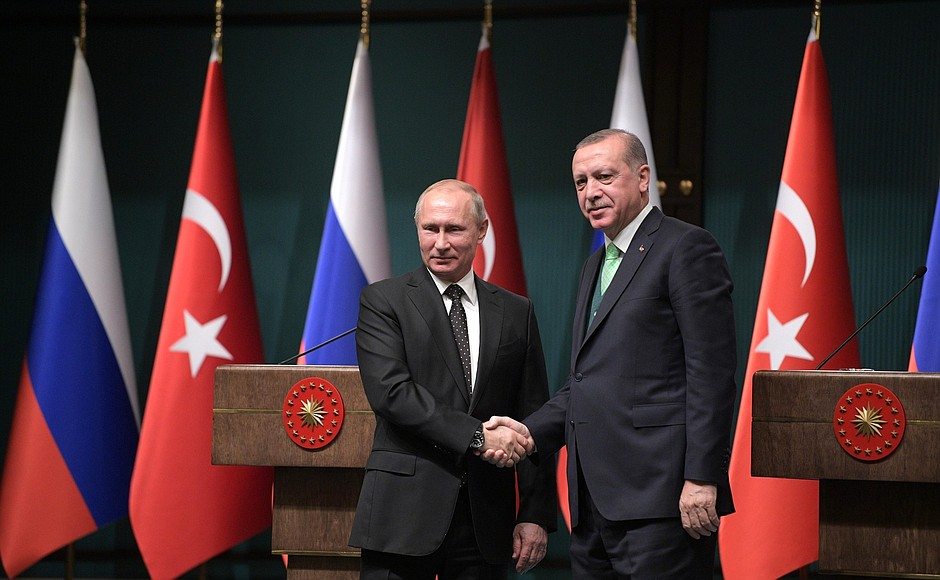
    Russian-Turkish relations have experienced such rocky times in the last couple of years that it would have been almost impossible to predict the further development of the partnership in the foreseeable future. Yet, since the beginning of 2017 the relationship between the two countries have started to warm up as both leaders, Putin and Erdogan have managed to find some important touch points to strengthen the sustainable economic ties with strategic political cooperation.

    The recovery of the diplomatic relations has been gained much due to the Turkey’s collaboration with Russia and Iran over Syria and their further fight against terrorism and the ISIS in the region. The successful development of the Astana process led by Russia, Turkey and Iran and the perspectives of hosting the National Dialogue Congress in Russia’s Sochi have raised a wave of anxiety in Washington as the United States were counting much on Ankara’s support in pursuing its military plans in Syria. Provided that Turkey’s decision to join Russia and Iran and its engagement in the Astana process met some serious controversies and tensions with the United States and the European Union one cannot help but ask the question if Turkey is shifting away from NATO toward the East.

    The facts speak for themselves: since the beginning of 2017 Presidents Vladimir Putin and Recep Tayip Erdogan have held eight face-to-face meetings not to mention multiple visits of Russian and Turkish diplomatic representatives and military officers in both ways.

    Apart from the cooperation over Syria and the joint fight against terrorism, the renewal of business, trade and economic relations as well as the prospective cooperation in the energy sector might launch a new era of partnership for both Russia and Turkey not only at the international or at federal levels but also at the regional levels as well.

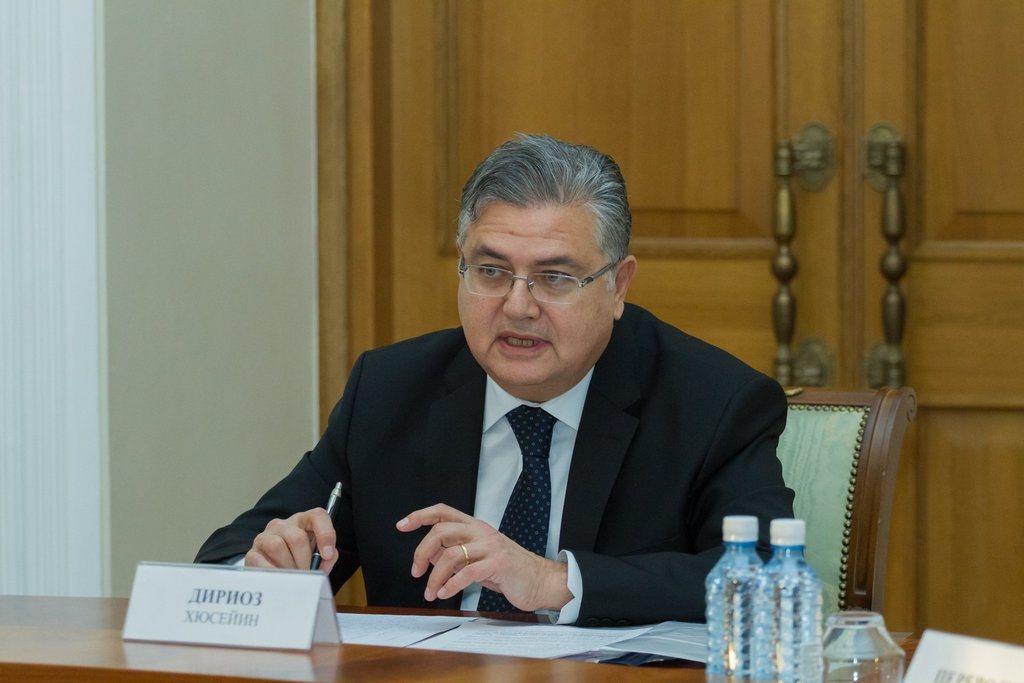
    On December, 13-14, Husseyin Dirioz, Ambassador of the Turkish Republic to Russia visited the city of Yekaterinburg, situated in the Urals and known as the country’s industrial hub. During his meeting with the local government authorities Mr. Dirioz expressed the intention to strengthen the mutual collaboration in such industries as machine building, oil and gas, construction and development, pharmacy and chemical sector as well as in the spheres of tourism, science and education.


    However, a closer partnership with Russia is pulling Ankara in quite a confusing situation in which Turkey will have to make bigger efforts to keep the balance with the U.S. and the EU. While the European Union continues to remain the major region for Turkish exports Ankara still benefits from holding the NATO membership on some political and military matters. Given that, the United States will likely to start manipulating Turkey’s vulnerable position and take the target the Turkey’s most sensitive issues. For instance, Washington has reportedly been encouraging Syrian Kurds for military interventions to the territories on the East bank and further overtaking the key Syrian natural resources fields. The move, explained by the United States as an effort to create a Syrian Kurdish autonomy, has been highly criticized by Ankara as a driving force for the U.S. that will enable Washington to take control over Ankara and Damask.

    But despite both leaders Recep Tayip Erdogan and Vladimir Putin look at the mutual partnership through the prism of their domestic interests which sometimes causes some structural controversies in such questions as pursuing policies towards the U.S. and the E.U, the possibility of a fast development of Turkey-Russia cooperation into a strategic partnership is very high.  What’s bringing together Turkey and Russia today is perhaps the common mistrust of the Western policies. The emotional statements by U.S President Donald Trump such as announcement of Jerusalem as an Israel’s capital, the U.S. support of Syrian Kurds (that directly crosses the Ankara policy towards the Kurds) consolidate the strategic collaboration between Moscow and Ankara against “moody” President Trump and unfold incredible opportunities for expansion of economic and trade relations between Turkey and Russia. Moreover, with Turkey’s recognition of the Crimea as a Russian territory Moscow will open the “green corridor” for Turkish companies that will also let Turkey pursue its policy towards the Crimean-Tatar community in the peninsula.

    As the historical experience proves, the strong partnerships are created by those countries who have manage to resolve the most controversial and unwanted situations between each other. The common historical background, strong cultural and ethnic ties and the geographic proximity can become a solid ground for Russia and Turkey to build a strong alliance.

    December 22, 2017
  • EU wants Turkey’s Erdogan to be the next ‘Yanukovych’

    EU wants Turkey’s Erdogan to be the next ‘Yanukovych’


    Very interesting perspective from Pravda.
    Pulat Tacar
    EU wants Turkey’s Erdogan to be the next ‘Yanukovych’World » Asia » Turkey. The latest and breaking news from Turkey

    When discussing the recent scandal in the relations between Turkey and the European Union, many pay attention to the electoral aspect of this conflict – the forthcoming elections in Germany and France and a referendum in Turkey. However, it remains unclear why Turkish President Erdogan has decided to go to the length of the conflict.

    Many Russian and not only Russian political analysts or teachers of political science do not understand, for some reason, the difference between making and developing decisions in big politics. This is an aspect of paramount importance in understanding the very nature of democracy. For example, many say that we can not change anything in foreign policy, because it is the president, who makes decisions at this point. This is a wrong point of view, because there are many people, who analyze various issues, elaborate decisions and show influence on the president.

    Naturally, there are people, who make decisions, form medium and long-term policy in the European Union.

    Turkish President Recep Erdogan is a very smart and experienced politician, who has an amazing, and I would even say, phenomenal political instinct. Erdogan has a remarkable sense of danger, which allows him to stay in power for so long despite intricate intrigues in the Turkish policy. He has felt something and decided to aggravate the relations with the European Union.

    There are reasons to believe that Erdogan understood that the EU was going to launch the process that could be referred to as the “Ukrainization” of Turkey, in which Erdogan would have to play the role of the Turkish Yanukovych or even Ceausescu or Gaddafi.

    Let’s take a look at the recent history of the European Union. The machine of German and French capital constantly needs the process of EU expansion. When expanding the European Union, the German-French capital destroys productions on newly acquired territories and captures new markets at the same time.

    At first, Germany and France (as well as small countries of the “old” EU) destroyed production in Southern Europe. Spain still has Seat and Italy has Fiat, but there is practically no machine-building in these countries, nor are there shipyards in Greece). Afterwards, having seized and digested the economy and production sector of those countries, the German capital turned to Eastern Europe and the Baltic States.

    Turkey next after Ukraine

    The EU needs to constantly expand by destroying productions in new territories and conquering new markets. Otherwise, the EU will simply disappear in competition with Chinese, Korean, Japanese, Indian, and even Russian and American producers. The European competition will not be able to stand fair competition. Ukraine is the most recent victim of the German-French capital. The German capital has not been able to fully digest it, but the destruction of the Ukrainian national economy is only a matter of time, and the capital will need to expand further. Turkey appears to be next on the line.

    It is important to understand here that capital is not malevolent or insidious. It destroys the Ukrainian economy not because Germany wants the Ukrainians to live worse and worse. On the contrary, German masters of life want the Ukrainian “untermenschen” to live well under the German “ordnung”, gradually turning them into law-abiding and obedient Europeans. I think that when Ukraine recognizes the will of the people of the Crimea and people’s republics of Donbass, Ukraine will become a member of the European Union.

    Simply put, capital is indifferent to everything except its profit. It needs to capture new markets and destroy their production. German and French entrepreneurs naturally assume that selling Volkswagen and Peugeot vehicles in Ukraine is much more profitable than letting Ukraine make its own cars. Therefore, they have decided to let the Ukrainian Zaporozhye Automobile Plant die in peace.

    After digesting the Ukrainian economy that used to be Europe’s fifth largest economy in 1991, German planners and strategists will turn to Turkey as the next candidate for the “European integration.” Similarly, Turkey may become a member of the European Union, if Turkey lets European giants destroy its national industry and agriculture.

    Turkey’s future depends on relations with Russia

    Needless to say that Erdogan does not like the idea. Of course, Turkey is not Ukraine. Yet, Turkey already has its fifth column. This is the old Istanbul commercial capital, which has little to do with the manufacturing sector, but is very interested in Turkey’s accession to the European Union. Representatives of the Istanbul capital despise Erdogan, who relies on industrialists of Anatolia (the Asian part of Turkey).

    Yet, the Anatolian capital that has made Erdogan become the Erdogan he is today, can easily become the comprador capital in nature, because production has reached new stages, when financial services (for example, export services, export insurance, banking services, lending, etc.) play a more important role in terms of profit than production itself. To crown it all, no one knows who is stronger: the Istanbul trade capital or the Anatolian industrial capital.

    In addition, there is the so-called “military” sector of the Turkish economy that remains under the control of the military. First and foremost, it goes about heavy and mining industries, as well as shipbuilding and similar industries. There are many Europe-oriented people among the Turkish military, and those people may support those, who may wish to topple Erdogan like Yanukovych.

    One may say that Erdogan is a lot stronger than Yanukovych. Yet, Yanukovych managed to organize his supporters after the first Maidan in Ukraine and thus win both presidential and parliamentary elections in the country. In 2012-2013, many considered his removal from power absolutely impossible. Similarly, many think that it is impossible to topple Turkish President Erdogan.

    Erdogan understands that Yanukovych’s attempts to sit between two chairs – be nice to both the European Union and Russia – have taken him to the shameful fiasco. Probably, Erdogan correctly assesses the current situation and understands that he needs to be more sincere, more open with Russia. Hopefully, he understands that his political future and, most importantly, the future of Turkey depends on relations with Russia.

    Said Gafurov
    Pravda.Ru

    Read article on the Russian version of Pravda.Ru

    March 24, 2017
  • Is Turkey Still a Democracy?

    Is Turkey Still a Democracy?

    An upcoming referendum and a vicious war of words with Europe could end up making Erdogan more powerful — and isolated — than ever. By david.kenner

    ANKARA, Turkey — In a half-destroyed temple overlooking the Turkish capital, there is a carved inscription of a text known as “The Deeds of the Divine Augustus.” It is the most complete surviving version of the funerary inscription of the first Roman emperor, Augustus. Following its hagiographic accounts of wars won, gladiatorial spectacles commissioned, and money showered upon the populace, it concludes with a line that would later be echoed by the founder of the Turkish Republic, Mustafa Kemal Ataturk: Augustus, it says, was considered by the people of Rome as the “father of the country.” Two millennia after Augustus, the conspiracies and political machinations of ancient Rome have nothing on modern Turkey. Today, the debate revolves around whether its current ruler, Recep Tayyip Erdogan, is echoing Augustus once again — this time by gutting the country’s democratic institutions and concentrating all power in his own hands. On April 16, Turks will vote in a referendum over a package of constitutional amendments meant to concentrate more power in the office of the presidency, the position currently held by Erdogan.

    Trending Articles Hawaii Court Stops Trump’s Second Travel Ban Challengers argued the revised order was still a Muslim ban — citing Trump’s own words — and a federal judge agreed.

    The vote serves as a stand-in for the country’s views on Erdogan’s 14 years of rule. The rest of the world, meanwhile, is staging its own informal referendum on Erdogan. Over three days of meetings last week in Ankara, government officials defended the amendments as commonsense measures to ensure administrative stability and reform an undemocratic constitution devised by the country’s former military dictators. The opposition leaders spearheading the “no” campaign in the referendum, meanwhile, warned that the country was sliding into authoritarianism — in some cases, comparing Erdogan’s style of governance to dictators like Saddam Hussein. It’s too soon to predict whether Erdogan will win the upcoming referendum, but his government is already proving incapable of making its case to the West. The referendum has already sparked a new rift between Turkey and several European states. Both Germany and the Netherlands, which are both approaching their own elections amid rising anti-immigrant sentiment, recently banned demonstrations by Turkish officials seeking to drum up the “yes” vote among expatriate Turks. Erdogan responded by accusing both countries of NazismErdogan responded by accusing both countries of Nazism, warning that the Netherlands will “pay the price” for its decision. The spat with Germany and the Netherlands is just one example. On a range of issues — from the state of Turkey’s democracy to the Turkish role in Syria to Turkey’s extradition request for the U.S.-based cleric Fethullah Gulen, whom it accuses of planning last summer’s coup attempt — Western countries have refused to adopt Ankara’s views. Ankara is partially responsible for its own alienation. Consider last week’s trip to Turkey organized for more than a dozen American journalists from outlets such as the New York Times, Washington Post, and Wall Street Journal by Ankara Mayor Melih Gokcek. The event was billed as a chance to meet with the country’s top officials, including President Erdogan, to hear their narrative of the coup attempt and why the United States should extradite Gulen. The meetings, however, failed to materialize, and reporters were treated to a four-hour meeting with Gokcek himself. The majority of reporters left the meeting in protest. During the talk, Gokcek failed to present a single piece of evidence implicating Gulen in the coup and instead laid out his own conspiratorial worldview. “A recent earthquake in the gulf [off Turkey’s western coast] was triggered by the United States and Israel with a ship.… With a little bit of energy, they tried to trigger the fault line,” Gokcek said. The Ankara mayor, a member of the ruling Justice and Development Party (AKP), has warned before that foreign and domestic enemies were causing earthquakes in Turkey. He also mused that Barack Obama and Hillary Clinton had founded the Islamic State, citing the statements of U.S.

    President Donald Trump as corroboration. “I investigate a lot,” he said, when asked for further evidence. “I have the largest intelligence service in the world. You know what it is? Google.” Other officials made the government’s case more successfully. Several argued for a “yes” vote by pointing to the instability of governing coalitions — the republic has had 65 governments in its 94-year history — as a key factor in blocking much-needed reforms and empowering a cadre of unelected bureaucrats and army officers. “I genuinely believe that the current system is not sustainable.… [It] is prone to crises and conflicts,” said Deputy Prime Minister Mehmet Simsek. “I would fully recommend that instead of just focusing on fears and theories about President Erdogan, just look at the text.”“I would fully recommend that instead of just focusing on fears and theories about President Erdogan, just look at the text.” The constitutional amendments would concentrate executive power in the hands of the president, a position that until now has been largely ceremonial. The amendments would give him the power to appoint and fire ministers, as well as design state budgets. The president would be able to serve two five-year terms and, unlike now, continue to serve as the head of a political party. With the changes going into effect in 2019, this would potentially allow Erdogan to stay in power until 2029.

    Government officials, however, contend that the package would actually enhance the separation of powers in Turkey by dividing parliament’s existing powers with the office of the presidency. Parliament would maintain the power to approve the president’s budget, ratify international treaties and declarations of war, and overrule a presidential decree through legislation. The legal merits of the constitutional changes aside, government officials also portray a “yes” vote as a victory against their domestic opponents — most prominently, the supporters of Gulen and the Kurdistan Workers’ Party (PKK), which has waged a decades-long insurgency against the state. “I’m convinced that April 16 may serve as a closure,” Simsek said. “Because Turkey’s efforts against the religious cult [the Gulenists] are largely done. The cases are at the court; it’s up to the courts to decide. And the PKK, their strategy once they got emboldened with gains in Syria, it backfired, because Turkey is no ordinary country.” But “closure” is precisely what Turkey’s opposition fears. They think it means they would lose any remaining political influence they have held on to since last summer’s coup attempt, and Erdogan’s subsequent domestic crackdown, by entrenching his position as the country’s preeminent political figure. “We don’t want one-man rule, which is an authoritarian regime,” Kemal Kilicdaroglu, the leader of the largest opposition party, told Foreign Policy from his office in parliament. “The authority to enact laws will be given to one man with this draft change, and we find it very dangerous.”“The authority to enact laws will be given to one man with this draft change, and we find it very dangerous.” Kilicdaroglu, the head of the Republican People’s Party (CHP), is leading the campaign for the “no” vote. But he argues that he is doing so while the playing field is tilted against him. The state of emergency governing Turkey since last summer’s coup attempt has had a chilling effect on public debate, he said, preventing civil society and business associations from expressing their opinion on the referendum for fear of the government. He also contended that the vast majority of Turkey’s media is sympathetic to Erdogan after a crackdown on the press over the past year. Amnesty International recently reported that more than 160 press outlets have been shuttered since the coup attempt and more than 120 journalists are currently imprisoned, making Turkey “the biggest jailer of journalists in the world.” “There is no press freedom in Turkey,” Kilicdaroglu said bluntly. Erdogan, he said, had brought the country “to the edge of the abyss.” The second-largest opposition party, the Peoples’ Democratic Party (HDP), has the most reason to fear a post-referendum government crackdown. Thirteen of the pro-Kurdish party’s parliamentarians are currently imprisoned, accused of links to the PKK. The party’s co-leaders, Selahattin Demirtas and Figen Yuksekdag, have both been jailed, and Yuksekdag was stripped from her seat in parliament after being convicted on terrorism charges. Among those arrested was the party’s spokesman, Ayhan Bilgen. At the HDP headquarters in Ankara, Osman Baydemir, a former mayor of the majority-Kurdish city of Diyarbakir, has been thrust into the role. “If you come here next month, I’m not sure who you will meet as a party speaker. I hope Ayhan Bilgen gets out of jail.… But it looks like, unfortunately, I will go to prison, too,” Baydemir said. “This is actually Figen Yuksekdag’s room we are using now. I’m pretty sure that in just this hour, at just this time, [Turkey’s security services] are listening to this room.” However the referendum turns out, the war between Erdogan and his domestic and international foes only seems poised to escalate. As Turkey’s president accuses his antagonists in Europe of Nazism, his political enemies at home are only too happy to throw equally bombastic accusations back at him. “Erdogan’s political style looks like Saddam Hussein’s or Bashar al-Assad’s style,” Baydemir said. “They want to make a one-party state — this is like the example of North Korea.” ADEM ALTAN/AFP/Getty Images

    March 16, 2017
←Previous Page
1 2 3 4 5 … 76
Next Page→
Turkish Forum

Turkish Forum

Informed Cultures Cooperate

  • About
  • Authors
  • Legal
  • Contact

© 1993-2024 Turkish Forum. All Rights Reserved.

Designed and technology provided by Hosting4us