Tag: Powerfull Army

  • The struggle for power and energy between the old world and the modern world

    The struggle for power and energy between the old world and the modern world

    Yalman Hacıroğlu writes: The struggle for power and energy between the old world and the modern world

    🖲️What we are witnessing in the unfolding events on the world political stage is a struggle for power and energy. The hatred and devilish Epstein scandal a true reflection of the nature of the world we live in.🖲️

    The global political arena is witnessing increasingly perilous turning points and operations, sometimes marked by mutual threats, and at other times by the deployment of warships and naval vessels to convince the world that the situation has reached a dead end. This is coupled with efforts to stronghold the global economy with their own agendas. These successive events will not be the first nor the last. The world has always been a testing ground since the creation of Adam, peace be upon him. Satan’s disobedience to the God command was one manifestation of conceit , a display of power, and a struggle for authority and energy to determine who is stronger. In essence, it is an arena of conflict between good and evil.

    Based on this, what we are witnessing in the unfolding events on the global political stage is a struggle for power and energy. The hatred and devilish Epstein scandal is a true reflection of the nature of the world we live in. Many dark, devilish files that have been opened—and perhaps those yet to be opened—reveal the underlying relationships behind global power centers, and perhaps even hidden, supernatural forces.

    This confrontation also demonstrates the necessity of re-examining the true causes behind many past events and developments. Similar calculations regarding conflicts were implemented during the establishment of the old world order. We must re-analyze collapsed states more carefully. In particular, the collapse of the Ottoman Empire must be re-examined within the context of the machinations and internal dynamics at play. The new world order has not yet been established, and the old is dying.

    To understand the dimensions of this brutal and bloody process, it is essential to correctly understand the intentions and strategies of the actors involved. Who is shaping the new order (the struggle for power and energy), and what are the hidden centers of power? Who are the overt and covert actors?

    These questions have long been dismissed as “conspiracy theories.” Sometimes out of ignorance, and sometimes due to a deliberate attempt to distort reality, these topics were ignored. Today, however, much is clearer. Therefore, we must re-examine the First and Second World Wars. But this must be done without confining ourselves to the narratives written by the victors.

    (Tensions Among Dominant Powers in the Old World)

    As the old world order took shape, Britain was a key player in dominating nations through economic and military occupation, playing a quiet yet influential role. It also played a significant part in the process that propelled the United States to its position as the world’s leading power. However, current assessments suggest that Britain is reassessing its relationship with China within the global balance of power.

    (Changes in Agreements and Alliances)

    Several assessments have been made regarding the possibility of the United States and Russia reaching agreements in certain areas. This stems from the similarity of their security concerns and the underlying causes of conflict.

    In this context, the role of pressure groups and influential networks remains crucial. While overt hostility is often more apparent, making it clear who is opposing whom, the real challenge lies in the hidden spheres of influence and covert power relations. This highlights a part of the inherent fragility of the internal structures of great powers.

    This applies not only to the United States, but also to China, Russia, India, and other major powers.

    Given Britain’s historical influence over maritime trade routes and strategic transit points, it is worthwhile to interpret the rivalry between the United States and the United Kingdom through these geoeconomic lines.

    (Old Friends, New Rivals)

    The new era is disrupting established norms. A picture is emerging where former allies are fiercely competing. At the founding of the European Union, the alliance between Germany and France was a subject of intense debate. Global economic trends and political imperatives can bring historical rivals together on common ground, just as they can turn close friends into adversaries.

    The Russian-Ukrainian war should also be studied from a multidimensional perspective, not relying solely on one-sided accounts. Understanding how societies with shared historical and cultural roots clash is crucial for drawing lessons for the future.

    (The World and the Search for New Alliances)

    We are entering an era where yesterday’s enemies may become tomorrow’s friends, as rigid ideological frameworks gradually lose their function. The new era opens the door to more productive scenarios.

    However, protecting national and spiritual values ​​has become more important than ever. We are witnessing a rise in influences that undermine the value system. Yet, these elements, often considered simple, are the very foundations upon which societies and nations are built.

    Much of the global projects are built on the assumption of abandoning these values, because it is easier to direct structures without roots. One of the key criteria that will determine the value system is the will to preserve it. This foundation will largely determine the course of alliances. The world is not a permanent home, but a transit point. The fate of nations is like the fate of humanity. Whoever embarks on their journey without forgetting the true owner of the earth will undoubtedly achieve victory.
  • Turkey Specifies a Range of New Ships

    Turkey Specifies a Range of New Ships

    The Turkish navy has in a relatively short period of time gone from being a collection of hand-me-down ships to a service that is able to make its presence felt in regional waters with advanced vessels from foreign suppliers and, increasingly, local shipyards.

    The navy is neither the largest nor wealthiest of Turkey’s armed services. Nevertheless, by carefully managing resources and subjecting suppliers to extensive certification tests, it is undertaking an expansion program that will upgrade or replace most of its surface fleet in coming years with a range of ships. It also plans to procure amphibious landing and transport vessels that will enhance force-projection and relief efforts.

    As part of the expansion, the navy seeks more independence from foreign suppliers and, eventually, autonomy when it comes to developing ships, weapons and sensors. Efforts are underway to increase the capabilities of local shipbuilders through cooperative programs with foreign shipyards that call for a lead ship to be built abroad and sister ships built locally under license.

    Turkish shipyards are, as a result, working on increasingly complex designs. Turkey has a robust commercial shipbuilding industry, which supports almost 40 shipyards, supplies a large merchant fleet and sells many vessels abroad. Turkey’s undersecretariat for defense industries wants to qualify 3-5 shipyards for naval vessels, with contracts awarded competitively.

    At stake in the buildup is Turkey’s regional position and economy. The country faces potential threats from many directions: A resurgent Russia that seeks to reestablish spheres of influence in the north; the muddle of Middle Eastern politics and conflicts to the south; an historic rivalry with Greece in the west; and an unpredictable Iran to the east. Ninety percent of Turkey’s trade moves by sea and the navy must guarantee the passage of commercial ships, monitor 8,300 km. (5,157 mi.) of coastline and protect islands it claims in the Aegean.

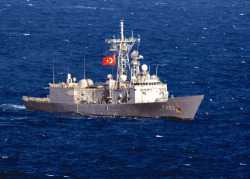
    Turkey’s navy is a 55,000-man force with a number of vessel types. The core surface fleet is made up of 19 frigates. These include German Meko 200 ships and former U.S. Navy Perry- and Knox-class vessels. There are also six corvettes from the French navy. Littoral operations make use of 25 fast-attack missile boats and a dozen patrol boats. The mine warfare force has a number of vessels for inshore, coastal and blue-water operations, most obtained second-hand from the U.S., France and Germany. The amphibious force is small and uses old ships, as do auxiliary and support units. The submarine corps has 14 boats of German design.

    The construction of new vessels nearly matches the modernization of ships in service, which relies on foreign and local technology. The service is standardizing weapon systems, sensors and electronics across the fleet.

    The navy, however, is not willing to take risks in modernization. While it trusts local shipbuilders to meet long-term commitments (the program may last 20 years), it does not do so without extensively testing designs before committing to orders. In submarines, the navy expects to rely on foreign designs due to the technical hurdles associated with their construction. Nevertheless, there is a desire to develop a submarine combat system, heavy torpedo and sensors locally.

    In February, the navy awarded Lockheed Martin a contract to upgrade four Perry-class and the first two Meko 200 IIA frigates. Requirements include installation of the Mk 41 vertical launching system (VLS), which will load Mk 25 quad-pack cells for Raytheon’s ESSM antiair/antimissile system, replacing the Standard SM-1 (supported by Raytheon) on the Perry. The Perry retrofit also involves a combat management system (CMS) based on the Genesis, developed by local manufacturer Havelsan with Raytheon (and initially aimed at the Knox frigates), which is to be installed on new Milgem corvettes. All Perry-class ships will have the Genesis CMS, though not all can receive the Mk 41. Two Knox-class frigates will be retired.
    The navy is moving ahead with the ambitious TF-2000 antiair-warfare (AAW) frigate program (some experts say the vessels are really guided-missile destroyers), whose start has been postponed several times. The 6,000-plus-ton vessels, to be built by Golcuk Naval Shipyard, are a local effort with foreign partner assistance.

    The timetable calls for completing the design by 2011, with a Batch I contract signed for two vessels in 2014, and commissioning in 2021 and 2022. Batch II, with three vessels, will proceed from 2023-28. Few details are known about weapons and sensors, but each ship will have 32 VLS cells, a Mk 41 launcher that fires Standard SM-2 and ESSM antiair missiles, two helicopters, a 127-mm. gun, antiship missiles and antisubmarine-warfare torpedoes.

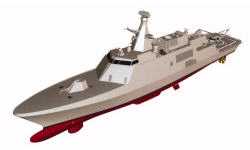
    The most important national program is the Milgem corvettes. The navy wants 12 ships (four on option), and in the process will replace six corvettes. The first-in-class ship, Heybeliada, was launched in September 2008 and will not be commissioned before 2011. The second, Buyukada, will undergo lengthy testing with a different weapon and sensor suite. There will be a gap between the first two corvettes and series production of an additional six and the option vessels. This is part of the navy’s “test before more buying” strategy. Each corvette displaces 2,000 tons, is 99 meters (325 ft.) long and capable of 30 kt. with a combined diesel and gas powerplant. Armaments include a 76-mm. Oto Melara gun, Boeing Harpoon antiship missiles, Raytheon Rolling Airframe Missile launcher, torpedoes and a helicopter.

    The navy’s fast-attack force relies on three Lurssen Kilic 57 boats from Germany and three Tufans (with three more planned), which are built in Turkey. There are also 10 Dogan Type 57 boats and eight former Jaguar boats, both from Germany, which have been rearmed with Penguin antiship missiles from Kongsberg Defense & Aerospace of Norway. Replacement of the Jaguars is underway following the acquisition of 16 patrol boats that will be delivered by local shipbuilder Dearsan starting in 2010. These 400-ton, 55-meter vessels will do 25 kt. The service is evaluating armament for the ships.

    The submarine fleet has a version of the German Type-209 design. Six Atilay boats, Type 209/1200, which were to be refitted, will instead be replaced by six HDW Type 214s with air-independent propulsion systems, in a €2.5-billion ($3.55-billion) program. The 214s will be built locally, with initial delivery expected in 2015, and others at a rate of one every two years. Eight of the more modern Type 209/1400s will stay in service and could be modernized.

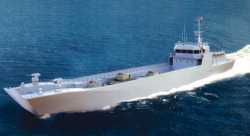
    Turkey wants to expand its amphibious capabilities by acquiring large transport and assault platforms to support a marine brigade, which relies on old, small LSTs (landing ship-tanks) and LCTs (landing craft-tanks). The service wants amphibious craft that also deliver relief supplies. The country is earthquake-prone, and the government has ordered the services to improve relief capabilities. The goal is to acquire one or two LPDs (landing platform-docks), two LSTs and eight LCTs. A contract has been awarded to local builder Adik-Furtrans for the LCTs, which will be 1,200 tons and 80 meters long, capable of 20 kt. and able to carry 320 tons of cargo. The competition for the LSTs is in its final phase, with Adik battling RMK to supply the 5,000-ton, 18-kt. vessels, which will have a 1,200-ton cargo capacity and helicopter deck. LPD plans are moving slower, since the 20,000-ton vessels could be too big for local military shipbuilders. There is a need for a foreign partner to supply design and technical assistance.

    Turkey’s navy needs modern support ships for effective operations in blue water. Plans call for acquiring a 10,000-ton submarine rescue ship, with a contract award planned for 2012, one or two 2,500-3,000-ton rescue and towing ships, with a contract expected next year, two fleet-replenishing ships and a research vessel that will replace or add to current support ships.

    Mine warfare is a specialty of the Turkish navy, but budget priorities have for years forced the service to rely on old or second-hand vessels. This approach was reversed with the decision to acquire five Alanya-class coastal minehunters, with the first-of-class built by Abeking & Rasmussen of Germany. The next four will be constructed in Turkey. Additional minehunters could replace older types in service.

    Credit: ASELSAN CONCEPT

    AVIATION WEEK