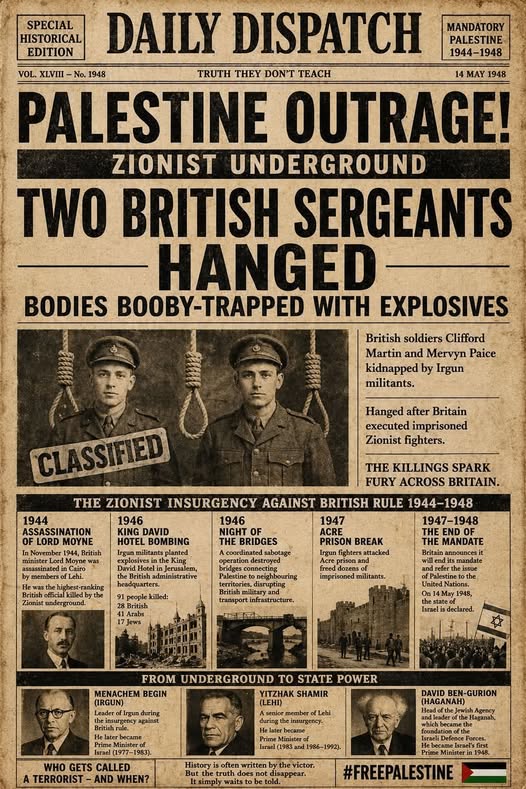
The Zionist Underground and the End of British Rule in Palestine. – Martin Michael
I went down a historical rabbit hole researching this and honestly, some of it genuinely took a minute to process.
Before Israel was created in 1948, Britain governed Palestine under what was known as the British Mandate, following the collapse of the Ottoman Empire after World War I.
In the final years of British rule, several Zionist underground organisations launched an armed insurgency aimed at forcing Britain out of Palestine and paving the way for the creation of a Jewish state.
The main organisations involved were:
Irgun
A nationalist paramilitary group responsible for bombings, assassinations and attacks on British military and administrative targets.
Lehi (The Stern Gang)
A smaller but even more radical organisation that carried out assassinations and attacks against British officials and infrastructure.
Haganah
The largest Jewish paramilitary organisation in Palestine. Although it often operated differently from Irgun and Lehi, it did at times cooperate in coordinated operations against British targets.
At the time, British authorities officially referred to some of these groups as terrorist organisations, while supporters viewed them as anti-colonial fighters resisting British rule.
Historians generally refer to this period as the Jewish insurgency in Mandatory Palestine (1944–1948).
Some of the major events included:
1944 — Assassination of Lord Moyne
Walter Guinness, Britain’s Minister of State in the Middle East, was assassinated in Cairo by members of Lehi.
He was the highest-ranking British official killed during the insurgency.
1945 — Escalation of attacks
Militant groups intensified attacks on:
• railways
• bridges
• police stations
• government buildings
• immigration control infrastructure
Several groups temporarily worked together in a coordinated campaign known as the Jewish Resistance Movement.
1946 — Night of the Bridges
A coordinated sabotage operation destroyed bridges linking Palestine with neighbouring territories, severely disrupting British transport and military infrastructure.
1946 — King David Hotel Bombing
Irgun militants planted explosives inside the King David Hotel in Jerusalem, which housed the British administrative headquarters.
The explosion killed 91 people:
28 British
41 Arabs
17 Jews
It remains one of the deadliest attacks carried out against British rule during the Mandate period.
1947 — Acre Prison Break
Irgun fighters attacked Acre prison and freed dozens of imprisoned militants.
1947 — Execution of British Sergeants
Two British soldiers, Clifford Martin and Mervyn Paice, were kidnapped and later hanged by Irgun after Britain executed imprisoned militants.
The killings caused outrage across Britain.
By 1947–48 the situation had become increasingly unmanageable for Britain.
Eventually Britain announced it would end the Mandate and hand the issue over to the United Nations.
On 14 May 1948, the state of Israel was declared.
What happened next is where the story becomes even more significant.
Many members of these underground organisations later moved directly into mainstream Israeli politics and state leadership.
Menachem Begin, leader of Irgun during the insurgency, later became Prime Minister of Israel.
Yitzhak Shamir, a senior member of Lehi, also went on to become Prime Minister.
Meanwhile Haganah became the foundation of the Israeli military itself.
All of this took place in the shadow of World War II and its aftermath, at a time when Britain had been financially and militarily devastated by war.
By 1944 British ministers were being assassinated.
By 1946 British headquarters were being bombed.
By 1947 British soldiers were being kidnapped and executed.
Yet this history is rarely discussed in Britain today.
And it raises a question that still follows conflicts across the world now:
Who gets labelled a terrorist — and who later gets remembered as a freedom fighter or statesman?
Because history often seems to answer that question differently depending on who eventually wins power.