Letter to New York City Mayor Zohran Mamdani’s Closest Ally – Mr. Ali Najmi
Mr. Ali Najmi
The Law Office of Ali Najmi
32 Broadway Suite 1310
New York, NY 10004
April 4, 2026
Dear Mr. Najmi,
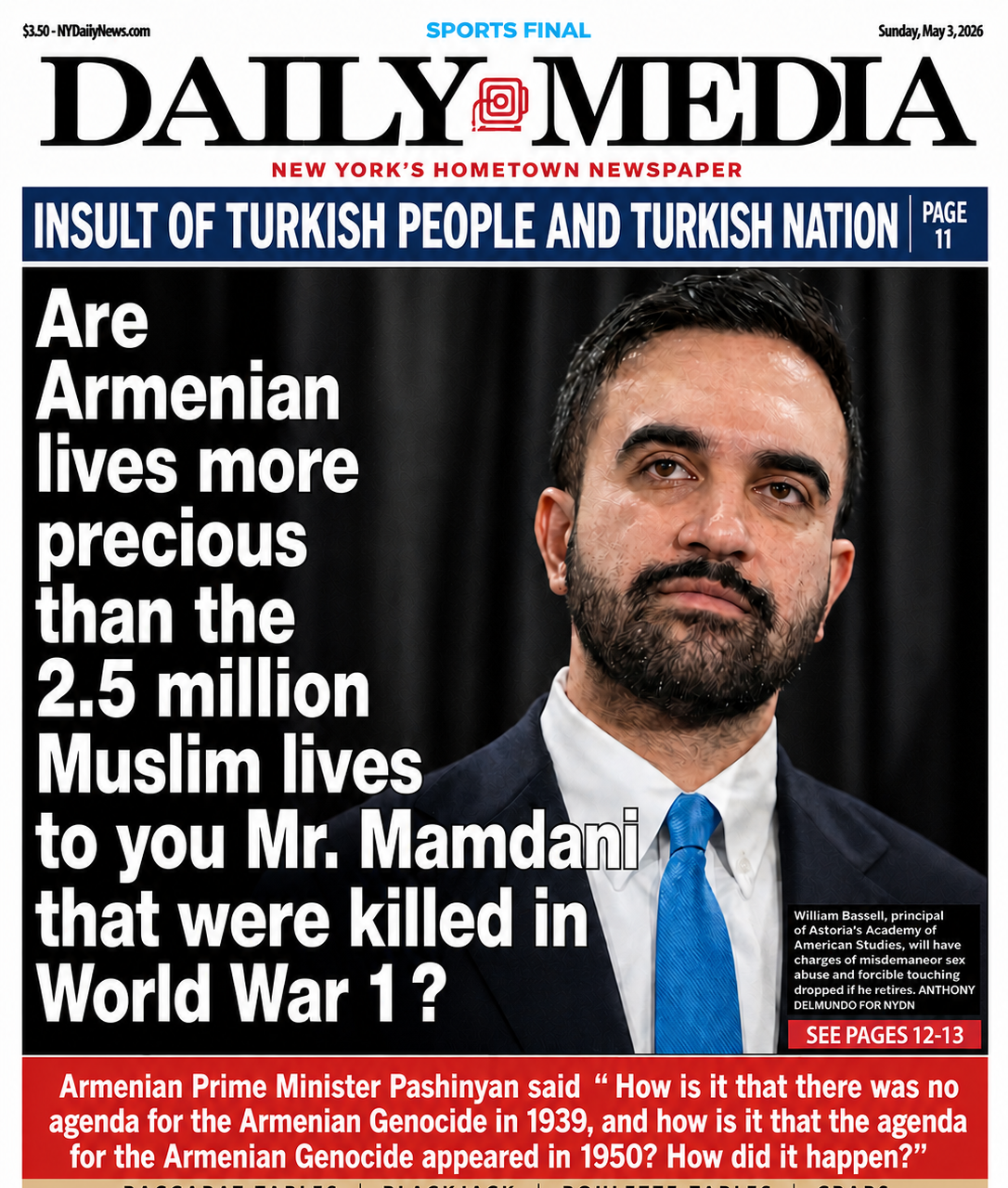
At the outset let me ask: Are Christian Armenian lives more precious than the 2. 5 million Muslim lives to you and Mr. Mamdani that were killed / lost in World War 1 ?
I acknowledge your recent remarks concerning my position on the characterization of the events of 1915- World War 1, as well as the references made to my professional background. I respond to clarify the issues raised and to ensure the discussion remains grounded in principle, law, and evidentiary standards rather than insinuation.
During our text messaging Sunday April 26, 2026 , rather than engaging with the facts, Mr. Najmi, you have chosen to rely on personal diversions that have no bearing on the historical and legal questions at hand. This approach prioritizes personal antagonism over evidence-based debate. I maintain that this discussion should be guided by judicially tested evidence and documentation, rather than irrelevant personal attacks.
The central issue is not whether history can be studied or discussed by scholars, but whether the legal classification of grave international crimes such as genocide can be definitively established outside a competent judicial process. In my view, such determinations properly fall within the jurisdiction of established legal bodies, including international courts and tribunals or competent human rights mechanisms. Scholarly interpretation, particularly when selective or ideologically driven, should not substitute for formal legal adjudication where such serious legal characterizations are concerned. A determination of genocide requires rigorous evidentiary review, adversarial testing, and cross examination within an appropriate judicial framework.
Sir, it is important to separate historical inquiry from legal adjudication. While historians may contribute to contextual understanding, legal determinations of this magnitude are ultimately the responsibility of impartial tribunals. This distinction is fundamental to the integrity of international law.
Sir, no one disputes that the early 20th century was marked by immense human suffering across multiple communities during the collapse of the Ottoman Empire and the First World War. This includes significant losses experienced by 2.5 million Muslims as well as Armenians and others. A balanced historical understanding must acknowledge all such suffering without selective omission. The legal argument advanced here is often misunderstood. The absence of the 1948 Genocide Convention at the time of the events in question does not preclude accountability under international law.
Indeed, precedents such as the Nuremberg Trials demonstrate that mass atrocities were prosecuted as crimes against humanity under existing principles of international law. Furthermore, later international tribunals, including those for Rwanda and the former Yugoslavia, confirm that judicial mechanisms are routinely established after the fact to determine responsibility based on evidence and due process.
Armenian Prime Minister Pashinyan January 24, 2025, during a meeting with members of the Armenian diaspora in Zurich, Switzerland. said ” How is it that there was no agenda for the Armenian Genocide in 1939, and how is it that the agenda for the Armenian Genocide appeared in 1950? How did it happen?”
United Nations Secretary-General Ban Ki-moon April 16, 2015 said “Armenian deaths during World War I were not genocide”
U.S. Supreme Court Rejects Armenian Allegations.
European Court of Human Rights, ECHR on December 17, 2013 (Perincek vs Switzerland) that the events of 1915 cannot be proven to be genocide or compared to Jewish Holocaust.
The continued efforts by segments of the Armenian diaspora to advance interpretations of history that Türkiye considers inaccurate have long been a matter of concern. In this context, Türkiye’s 2005 proposal to establish a joint historical commission with Armenia remains unfulfilled. If the evidentiary basis is as clear as asserted, engagement with such an initiative would seem constructive.
Perhaps, Mr. Najmi and Mr. Mamdani, might consider taking a leading role in pursuing a legal avenue to definitively clarify the matter at the European Court of Human Rights (ECHR), International Criminal Court (ICC), International Court of Justice (ICJ) an effort that could, in your view, bring resolution and recognition to the Armenian position. You or Mr. Mamdani can Mr. Najmi become a hero to the Armenians.
Mr Najmi, Are Christian Armenian lives more precious than the 2.5 million Muslim lives to you and
Mr. Mamdani that were killed in World War 1
Mr. Najmi, I am quite curious as to why you think that I, and many others in my position, do not deserve a right you so readily claim for yourself ?
Finally, attempts to resolve or prejudge such deeply contested historical and legal issues outside of proper judicial forums risk undermining both legal standards and constructive dialogue. For that reason only competent international judicial bodies not selectively curated scholarly consensus or politically motivated narratives are appropriate forums for definitive legal determinations of genocide.
Also, Using of the outdated term “Turkey” in official communication is a insult to a honorable people and Nation. The nation has formally adopted the name “Republic of Türkiye,” which has been recognized by the United Nations and numerous international bodies. Addressing countries by their chosen names is a basic element of diplomatic respect and cultural decency. Mr. Mamdani should, get it right !
Accordingly, I respectfully decline to accept the characterization set forth in your statement and that of Mr. Mamdani.
Until a verdict of genocide can be reached by a “competent tribunal ” after “due process” where both sides of the conflict are properly represented and evidence cross examined, the term genocide should be preceded by the qualifier “alleged”.
WHAT THE WORLD NEEDS NOW IS TRUTH AND HONESTY, NOT SELECTIVE MORALITY.
Respectfully,
Ibrahim Kurtulus
Community Activist
From: EMI P
Date: Thu, May 7, 2026 at 3:43 AM