Tag: Nato ally

  • An Urgent Need to Contain Turkey

    An Urgent Need to Contain Turkey

    Rebuttal to the Wall Street Journal Opinion Mar 4, 2026 : “An Urgent Need to Contain Turkey”

    The Wall Street Journal opinion titled “An Urgent Need to Contain Turkey” advances a deeply flawed premise: that the Republic of Türkiye should be viewed as a destabilizing power requiring containment. Such rhetoric reflects a simplistic reading of regional geopolitics and ignores both historical realities and the strategic role Türkiye plays in maintaining stability across multiple theaters.

    First, the framing itself is misguided. The language of “containment” is a relic of Cold War strategy traditionally applied to adversarial powers hostile to the Western alliance. Türkiye, however, is not an adversary it is a core member of NATO, possessing the alliance’s second-largest military and serving as one of its most critical geographic anchors between Europe, the Middle East, the Caucasus, and the Black Sea. Calling for the “containment” of a NATO ally undermines the very alliance structure the West claims to defend.

    Second, the article ovarlooks Türkiye’s indispensable contributions to regional security. Türkiye controls access to the Black Sea through the strategically vital Bosporus Strait and Dardanelles waterways that have proven decisive in balancing power during conflicts involving Russia and Ukraine. Far from destabilizing the region, Ankara has repeatedly acted as a diplomatic intermediary and security guarantor.

    Third, the narrative ignores the immense humanitarian burden Türkiye has carried.Türkiye hosts millions of refugees from the Syrian conflict more than any other country in the world—while continuing to cooperate with European partners to prevent a broader humanitarian and migration crisis.

    Fourth, the argument assumes that any increase in Türkiye’s regional influence is inherently negative. Yet power vacuums in the Middle Eaast have historically produced instability and extremism. In many instances, Türkiye has functioned as a stabilizing actor capable of counterbalancing both authoritarian regimes and non-state extremist groups.

    Finally, the editorial reveals a troubling pattern increasingly visible in some Western commentary: reducing a complex regional power to caricature rather than engaging with the strategic realities of a multipolar Middle East. Türkiye is a sovereign state with legitimate security concerns, particularly regarding terrorism along its borders and instability in neighboring regions.

    Constructive engagement not ideological calls for “containment” is the only serious path forward. Treating a NATO ally as a strategic adversary does not strengthen Western interasts; it weakens them.

    If the goal is stability in the Middle East and the broader Eurasian region, cooperation with Türkiye is not optional it is essential.

    Ibrahim Kurtulus

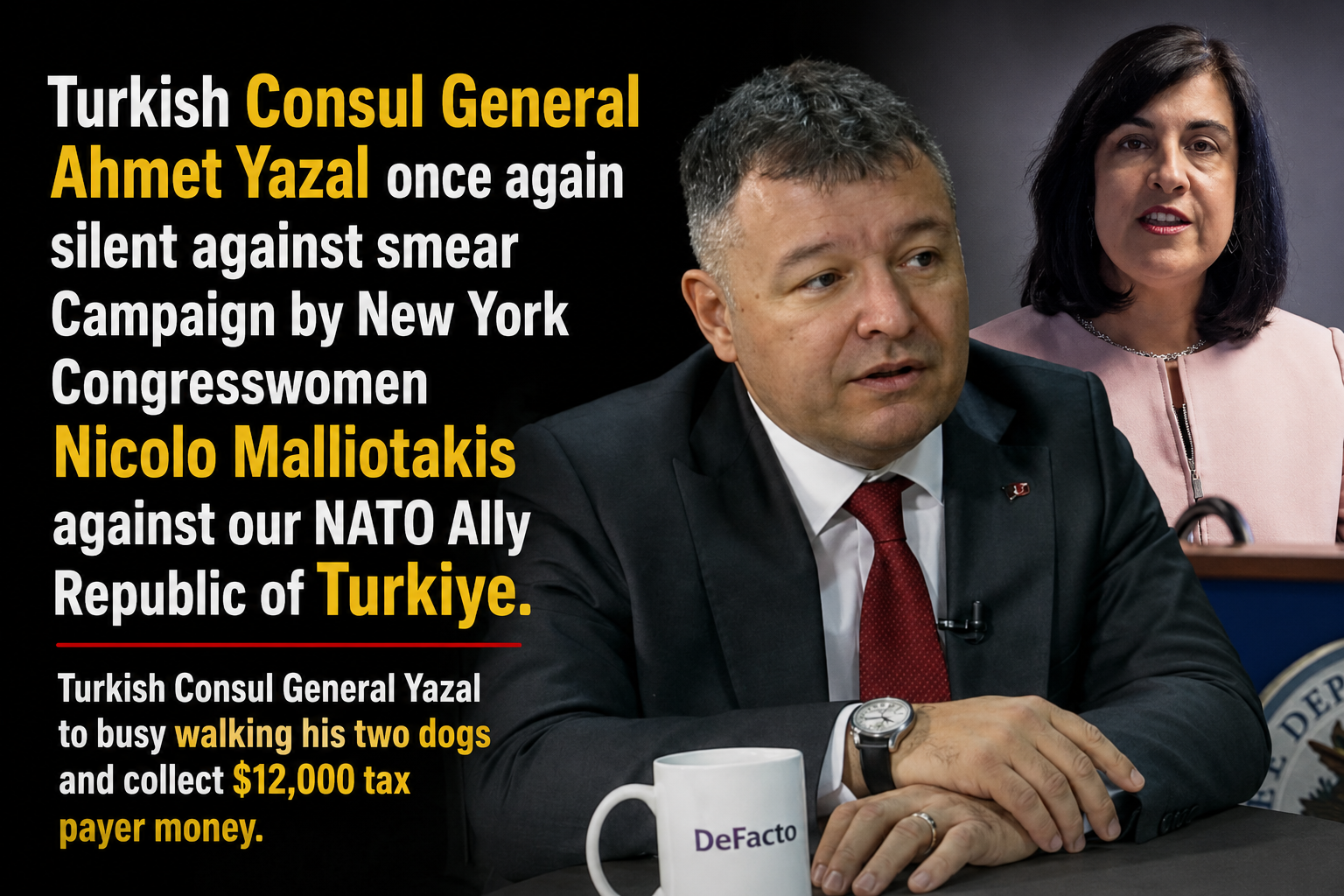
  • Türkiye’s Consul General Ahmet Yazal in New York Once Again Remains Silent

    Türkiye’s Consul General Ahmet Yazal in New York Once Again Remains Silent

    My Response to New York Post / Türkiye’s Consul General Ahmet Yazal – New York once Again Remains Silent.

    A Tabloid Smear Disguised as Foreign Policy: The New York Post’s Reckless Attack on a NATO Ally

    The New York Post article Published Feb. 5, 2026  accusing the Republic of Türkiye of secretly propping up Iran’s regime is not analysis it is ideological propaganda dressed up as concern for regional stability. Built on conjecture, selective outrage, and strategic illiteracy, the piece reflects more about its author’s bias than about Türkiye’s actual role in Middle Eastern diplomacy.

    Let us state the obvious: Türkiye is a NATO ally, home to the alliance’s second-largest military and a frontline state that has absorbed the human and security costs of Iran’s proxy conflicts for decades. To portray Ankara as an enabler of Tehran’s repression is not merely false it is intellectually lazy. The article’s central accusation that President Recep Tayyip Erdogan seeks to preserve Iran’s theocracy to advance Turkish ambitions rests on no evidence. None. Diplomacy is repeatedly conflated with endorsement, and mediation is dishonestly framed as sabotage. This is not serious foreign policy reasoning; it is a cartoonish worldview where war is virtue and restraint is betrayal.

    Türkiye’s position has been consistent and public: a regional war with Iran would trigger uncontrollable instability, mass displacement, asymmetric retaliation, and long-term chaos stretching from the Levant to Europe. Warning against this outcome is not duplicity it is responsible statecraft. Only someone detached from the consequences of war could dismiss such caution as sinister. The article also assumes, without justification, that Türkiye fears the emergence of a democratic Iran. This claim collapses under basic scrutiny. Türkiye has coexisted with Iran across ideological shifts for decades not because it favors repression, but because geography and regional responsibility demand engagement, not fantasy. States do not get to choose their neighbors, and mature powers manage reality rather than indulge in regime-change daydreams.

    Equally dishonest is the suggestion that Türkiye seeks to “block” American or Israeli action. Ankara has repeatedly emphasized that unilateral military strikes do not produce democracy and rarely produce lasting security. History particularly in the Middle East supports this view overwhelmingly. Opposing reckless escalation is not anti-American; it is pro-stability. The article’s treatment of diplomacy is especially revealing. Hosting talks, proposing de-escalation, or offering mediation are portrayed as acts of treachery. By this logic, decades of U.S. diplomacy from Coold War arms control to the Iran nuclear negotiations—would also constitute moral failure. The author applias a standard to Türkiye that the United States has never applied to itself.

    Most cynical of all is the article’s selective concern for the Iranian people. Their suffering is invoked only to justify military confrontation, despite the fact that war would inevitably kill far more civilians and entrench authoritarianism, not dismantle it. This is not solidarity it is exploitation. The piece also conveniently ignores our government, Washington’s own history of negotiating with regimes it opposed when doing so served strategic interests. Apparently, diplomacy is acceptable when conducted by Americans, but evidence of duplicity when pursued by a NATO ally. Such double standards do not strengthen alliances; they corrode them.

    What makes this smear campaign particularly damaging is the continued silence of Türkiye’s Consul General Ahmet Yazal in New York, who once again appears content to collect a reported $14,000 (est) monthly salary while allowing false and defamatory narratives to circulate unchallenged in a major American tabloid. Defending a nation’s reputation is not optional it is the fundamentel duty of diplomatic office. Silence in the face of repeated misrepresentation is not prudence; it is failure.

    The New York Post article does not expose Türkiye. It exposes the dangers of substituting ideology for strategy and outrage for evidence. Türkiye remains a NATO ally, a regional  superpower, and a state that understands the cost of war better than most.

    Foreign policy requires seriousness, not slogans. This article offers none and Western unity is weaker for it.

    Ibrahim Kurtulus 
    Community Activist 

  • Letter of Appreciation to Congresswomen Marjorie T. Greene

    Letter of Appreciation to Congresswomen Marjorie T. Greene

    An Open Letter of Appreciation to The Honorable Marjorie Taylor Greene
    Türkiye , Israel , Iran

    The Honorable Marjorie Taylor Greene
    P.O. Box 829
    Dalton, GA 30722
    United States

    Dear Congresswoman Greene,

    I write to express my sincere appreciation for your clear and principled response to the recent remarks made by former Israeli Prime Minister Naftali Bennett. When you stated plainly, “Hello. Turkey is a NATO member country. Everyone wake up,” you did more than post a comment  you reminded the world of a strategic reality too important to ignore.

    Türkiye is not “the new Iran.” Such rhetoric is not analysis; it is provocation. It disregards decades of alliance, sacrifice, and shared security commitments. Since the Korean War, where Turkish brigades fought shoulder to shoulder with American forces, Türkiye has upheld a timetested and honorable role within the Western alliance. From Kosovo War to stabilization efforts in Afghanistan and operations in Libya, Türkiye has consistently stood on the froont lines of NATO’s most complex missions.

    As the second-largest military force in NATO and the indispensable guardian of Europe’s southern flank, Türkiye protects not only its own sovereignty but the broader security architecture of the transatlantic world. It faces direct and indirect pressure from Iranbacked networks across Syria and Iraq. To equate Türkiye with Iran is not merely inaccurate it is intellectually unserious.

    In fact, Türkiye’s strategic interventions have disrupted Iranian and Russian ambitions in Syria and Libya. Even James Jeffrey, who served as U.S. Ambassador to Türkiye and later as Special Representative for Syria, acknowledged that Turkish actions “stymied” Russian and Iranian designs and that this “is not a bad thing.” One may debate Ankara’s style or President Erdogan’s assertiveness; serious policymakers do so regularly. But caricature and smear campaigns are not substitutes for strategic thought.

    Former Israeli Prime Minister Naftali Bennett’s remarks read less like statesmanship and more like political theater a careless attempt to delegitimize a NATO ally for shortterm applause. Demonizing Türkiye will not strengthen Israel’s security, nor will it serve American interests. It only erodes the cohesion of the alliance structure that has preserved stability for generations.

    Türkiye is an independent regional major power, a complex democracy, and a pivotal state bridging Europe, the Middle East, and Central Asia. It is not Iran, nor is it on a path to become Iran. Reducing it to such a slogan is a disservice to history and to facts.

    Türkiye is not Lebanon, nor Iraq, Jordan, nor Syria, nor Iran and it is certainly not a nation to be intimidated or coerced by reckless rhetoric or military theatrics.

    Those who believe otherwise misunderstand its history and resolve. At Gallipoli Campaign World War, I, 7 Powerful at time , Allied powers came to the Shores of Turkiye. Under the leadership of Mustafa Kemal Atatürk, invading forces learned a hard lesson Ataturk said  “the way they came, they left.”. Türkiye remains a sovereign power of strategic depth and institutional strength, fully capable of defending its national interests.

    Your willingness to state the obvious that Türkiye is a NATO ally reflects clarity at a moment when clarity is needed. For that, many Americans who value strategic honesty are grateful.

    Respectfully,

    Ibrahim Kurtulus
    Community Activist

  • Turkey And NATO Sixty Years On – Analysis

    Turkey And NATO Sixty Years On – Analysis

    By Süreyya Yiğit

    Mr. Anders Fogh Rasmussen, the Secretary General of NATO paid an official visit to Turkey on 16 – 17 February 2012. He met with both the President and the Foreign Minister. This visit is important not due to the meetings and outcomes the Secretary General had and arrived at but significant in that it highlighted the sixtieth anniversary of Turkey’s incorporation into the Atlantic Alliance.

    On such a solemn occasion Rasmussen declared that “Turkey plays an important role in our operations and we are particularly grateful for your steadfast commitment to our ISAF operation. Turkey has an important voice in our decisions. And Turkey has a vital part to play in shaping our partnerships”.

    Then and Now

    Turkey

    In fact the past six decades have been quite eventful witnessing both strong cooperation as well as deep disagreement between Turkey and fellow NATO members. During this time Turkey, NATO and the whole world has changed, and changed quite drastically. It is very difficult to compare the Turkey of 1952 with that of 2012. Equally, the NATO of 1952 is not the NATO of 2012. Then it had enlarged from 12 to 14 and today it has doubled from that, standing at 28.

    Today, the Turkish Republic is an aspiring regional power with a buoyant economy, developing democracy, tried and tested effective military with a population of over 70 million. Sixty years ago, Turkey having avoided military confrontation in the Second World War was only just beginning to benefit from both the Truman Doctrine of 1947 and Marshall Aid, the population standing around 24 million. The economy was hugely dominated by agriculture with poor infrastructure and even worse transportation links. The menacing Soviet diplomatic notes of 1945-46 had driven Turkey into the Western bloc illustrated by her membership of the Council of Europe the year NATO was established. The heavy burden of military costs had taken its toll during the war years and the economy had not been able to diversify by the time of NATO accession, nor in truth was it able to stand on its own two feet.

    Within the political and military elite, few had good command of another foreign language which proved to be a major hurdle at times during the Korean War, within which the Turkish Brigade served with distinction. In actual fact much has been attributed to the bravery of the Turkish soldiers easing the path of NATO accession for Turkey. It is certainly true that the casualties incurred by the Turkish brigade were very high and the determination of the Turkish government to defend democracy in the Korean peninsula was second to no other country than the USA, as they were the second country to send military forces to the UN, after the USA.

    The Valiant Defense of Korea

    The commitment of Ankara for around 5000 troops to be sent to Korea constituted the first military operation in the history of the young republic to take place beyond her national borders. It provided an excellent example of the lengths to which the government was prepared to go to prove its commitment to Western values and security and to highlight Turkey’s place within it.

    Douglas Macarthur, as the United Nations Forces Commander in Chief had stated that “The Turks are the hero of heroes. There is no impossibility for the Turkish Brigade.” When Macarthur was sacked and replaced by Ridgway as the commander in chief of the United Nations Forces, he was also to add that, “I had heard of the fame of the Turkish soldiers before I came to Korea. The truth is I had not really believed what I had heard. But I now understand that in fact you are the best and most trustworthy soldiers of the world”. It is due to these statements and more that, legitimately much weight is given to the heroism of the Turkish Brigades in Korea being the decisive element in accepting Turkey as a NATO member.

    Conflict on the Horizon

    It must be remembered that this was happening at a time when the Cold War had transformed itself into a “hot war” in Asia and was forecast by many to spread to Western Europe. It was a time when Churchill, the wartime British Prime Minister had been returned to office, after spending six long years in opposition, when Eisenhower was no longer the wartime supreme commander but a strong prospect to take over after Truman as American President in 1952. In the Soviet Union, Stalin held all the reins of power. Turkey, having recently ventured into multi-party democracy had experienced its first peaceful transition of power through a free and fair election in 1950 being governed by the new Democrat Party administration directed by President Bayar and Premier Menderes as she became alongside Greece, the two new members within the first ever enlargement of NATO.

    It must be stated that most of the Turkish population were not highly informed of military alliances when NATO was formed in 1949, though with the ensuing Korean crisis and Turkish participation, the political and military elite quickly understood the dangers facing western Europe of an expansionary communist ideology espoused by the USSR, which concentrated them into taking a firm decision to join the effort to strengthen western defenses.

    An Alliance of Democracies?

    To what extent was Turkey a democratic country at the time of accession? To what extent was the United States a democracy in 1952 or Britain for that matter? None of them were true reflections of democracy in practice at that time when viewed through the prism of 2012.

    Certainly Turkey lacked the established traditions of a democratic political culture, the USA suffered from institutionalized discrimination in the form of racism domestically and Britain was far from a model of sexual equality and social understanding and cooperation. The idea of Empire still held sway in South East Asia where the British tried to hold onto Malaya and in the Middle East and Africa where British troops were stationed in the Suez Canal with Sudan being denied self-determination. The idea of colonialism and empire was also shared by the French trying desperately to hold onto Indo-China in the Far East and considering Algeria to be French territory but Algerians not the equivalent of French citizens. These were the prevailing values and circumstances that NATO members found themselves in 1952.

    All NATO members have since endured a long process of social and political reform which has enabled all to become better models of democracy manifesting the core values of a democratic society where the rule of law is supreme, human rights sacrosanct, toleration a virtue and freedom of speech and choice elevated to the realm of precept. None of the members are perfect models of democracy and some members have further to travel on the road towards the ideal progressive democracy, but the NATO ideal of democracies banding together to oppose communism has succeeded. The collapse of the Berlin Wall and the disestablishment of the Soviet Union robbed NATO of a threat and provided the members a cause to celebrate the fact that the democratic model had triumphed over the autocratic.

    End of the Cold War

    Whilst some thought that the end of communism meant the end of NATO, that prescription proved to be premature. Turks agreed with the principle that NATO should meet threats to security both within the North Atlantic area and beyond when necessary. Henceforth, the Turkish Republic fully appreciated and emphasized with the American trauma of September 11th, having suffered at the hands of terrorism for decades and subsequently supported the invocation of Article 5.

    It provided military assistance as far away as Afghanistan and as recently as in Libya to NATO efforts to bring forth peace and stability to these war-torn, violence-ridden societies, both of whom which incidentally have historic ties to Turkey. Therefore, the sixty years of association with NATO have shaped both Turkey and NATO. Turkey has become stronger militarily, despite setbacks continually expressed her desire for democracy, modernized and diversified its economy, developed the potential of its citizens through education and opportunity and in the post-cold war era begun to tentatively offer its services to enhance security and stability in its region and beyond, which have stretched all the way to the borders of China.

    Without a shadow of a doubt sixty years ago Turkey needed NATO to protect herself from a menacing and intimidating Soviet threat. The nuclear umbrella offered by Article 5 was very welcome indeed. After the ending of the Cold War, successive Turkish governments worked tirelessly to expand the security blanket to cover east and central Europe, the Baltic States and the Balkans. In all of their endeavours they proved to be successful as NATO continued to expand. The central mantra was that why other countries should be denied the benefits that Turkey had been enjoying for decades?

    Evaluation and Forecast

    As one looks at this fairly old and substantial relationship it is noticeable that the integrated military command has proven once again to be a success in the Balkans and greater Central Asia as well as the Middle East and the Mediterranean. Turkish participation was certainly not the decisive element which ensured the success of these missions but they did attest to the fact that NATO members were looking from the same direction when viewing these crises. As the NATO Secretary General admitted that “Turkey does more than just share our security: you shape it. Your experience and your expertise in the Middle East and North Africa are invaluable. They benefit the whole of NATO”.

    Certainly there were opposing viewpoints domestically within Turkey as in all the other member states concerning these stances, as there ought to be in vibrant democracies. In the end democratic decisions were taken and steadfastly implemented and aims achieved. This could only be accomplished through a unified stance spearheaded by NATO. Concerning the importance to Central Asia and its environs, a good indication of the vitality of Turkey was evidenced by Rasmussen when sharing his thoughts about the upcoming NATO summit to be held in Chicago in three months time, when he mentioned that “We will have to set out how we will help the Afghan forces take responsibility for security in their own country – and how we will support them once they have done so”.

    Therefore, sixty years after entering the Alliance, Turkey possesses and provides a greater role in the enhancement of security within the North Atlantic area and more importantly has transformed itself parallel to NATO into a community of values, sharing and cherishing core values. The relationship has been an enduring one due to one vital factor: mutual values and mutual benefit. Turkey without NATO would have been prone to greater pressure becoming more fragile and NATO without Turkey would have been weaker, missing an essential piece of the jigsaw that provided security for the North Atlantic area. As much as this was true in the past, it is even clearer to see this fact in today’s precarious international environment. The Secretary General summed this up quite succinctly when he stated that “NATO is a family of like-minded countries, a family where we make each other stronger, and Turkey is a valued member of the family”. It is highly likely that this family will continue to be a closely knit one for years if not for decades to come.


    Sureyya Yigit, Contributor, ORSAM Eurasia Advisor

  • Turkey had become core country of NATO alliance

    Turkey had become core country of NATO alliance

    Turkish President Abdullah Gul has said Turkey would continue supporting NATO strongly in tackling future challenges.

    “As the case in the past, Turkey’s strong support for NATO continues today and it will continue in the future,” Gul was quoted as telling NATO Secretary General Anders Fogh Rasmussen during a meeting in the Turkish capital, Ankara.

    Gul said during the meeting at the Chankaya Presidential Residence that NATO had adapted to the changes of the post Cold War era, adding that the Alliance had successfully acted as a guarantee for the European-Atlantic stability and security.

    Rasmussen, on his part, said that Turkey was an important ally in NATO both politically and in military terms, adding that the country had made major contributions in many NATO missions from Afghanistan to Kosovo.

    Abdullah Gul has said that Turkey had become the core country of NATO alliance.

    President Gul released a message to mark the 60th anniversary of Turkey’s NATO membership.

    Turkey had assumed important and effective roles within NATO and achieved important successes, he said.

    NATO, which was an alliance of countries sharing common values such as human rights and supremacy of law, always maintained its basic objective for a lasting peace in Europe, he said.

    Turkey made great contributions to NATO as a result of principles of Ataturk, the founder of the Republic of Turkey, during its 60-year membership, Gul said in his message.

    Most of important developments, crises, opportunities and transformations have taken place in the geography surrounding Turkey and that’s why Turkey has become the core country in NATO, he said.

    Turkish Foreign Minister Ahmet Davutoglu has praised NATO as “the most effective alliance of modern times” despite major changes in the international politics since the organization’s inception.

    “Despite all the changes, the most crucial aspect about NATO is that it still holds as the most effective alliance of modern times and makes contribution to peace and stability in the world,” Davutoglu told a panel discussion in the Turkish capital, Ankara, on the 60th anniversary of Turkey’s membership in the North Atlantic Alliance.

    Davutoglu said NATO had open a path for what he described as “Europe’s great democratic transformation” and it had intervened in many crises in Eastern Europe and contributed to a major structural change in maintaining permanent stability.

    “And today NATO retains its impact and power as an alliance which is continuously expected to intervene in non-European crises,” Davutoglu said.

    Also speaking at the panel discussion, NATO Secretary General Anders Fogh Rasmussen said throughout its 60-year-old history in NATO, Turkey had won the Alliance’s regard for its contribution to the North Atlantic organization.

    “Turkey plays an important part in decision making process in NATO and a crucial role in shaping the future of the Alliance. When Turkey expresses an opinion in NATO, its voice gets to be heard in capitals of all ally countries,” Rasmussen said.

    Rasmussen said also that NATO welcomed Turkey’s efforts to end violence in Syria.

    Ahmet Davutoglu said that Turkey would never let a NATO facility be used by a third party.

    And, if this third party happens to be Israel, our attitude gets more clear and visible, Davutoglu underlined.

    Minister Davutoglu and NATO Secretary General Anders Fogh Rasmussen held a joint press conference following their meeting at the Turkish Ministry of Foreign Affairs (MFA) in Ankara on Friday.

    Asked about his thoughts on the attacks staged against several European offices of Zaman daily newspaper, Davutoglu said that “our response would have been same had other newspapers or correspondents come under attack”.

    We strongly condemn the terror acts staged against the offices of Zaman daily. These attacks have been not only against a respectable newspaper of Turkey but against the freedom of expression and freedom of press in Europe, Davutoglu underlined.

    We expect all (European) countries to take active and protective measures, Davutoglu noted.

    via News.Az – Turkey had become core country of NATO alliance.

  • Turkey responds to Perry remarks

    Turkey responds to Perry remarks

    By Ivan Watson and Yesim Comert

    Turkey’s foreign ministry condemned Texas Gov. Rick Perry Tuesday for saying that Turkey was a “country that is being ruled by what many would perceive to be Islamic terrorists.”

    Perry made the statement during a spirited debated between Republican presidential candidates in South Carolina Monday night.

    Most of Turkey was fast asleep during the live broadcast, and Turkish newspapers had already gone to print by the time Perry declared that Turkey had moved “far away from the country I lived in back in the 1970s United States Air Force. That was our ally that worked with us, but today we don’t see that.”

    The Texas governor also argued that it was time for Washington to cut foreign aid to Ankara.

    A spokesman for Turkey’s foreign ministry fired back Tuesday, accusing Perry of making “baseless and improper claims.”

    In a statement e-mailed to CNN, Selcuk Unal said presidential candidates should “be more informed about the world and be more careful their statements.”

    “The unfortunate views of Perry are not shared in any case by Republican party supporters, considering the weak support he has received in public polls and primary elections,” Unal concluded.

    Top Turkish government officials were unavailable for comment Tuesday, with many of them in Northern Cyprus for the funeral of veteran Turkish Cypriot leader Rauf Denktas, but the country’s largely-tabloid press wasted no time in responding to the comments on websites early Tuesday morning.

    “The debate that the Republican candidate Rick Perry attended on American Fox TV turned into a scandal that contained very ugly statements about Turkey,” announced TRT state television.

    “Rick Perry: what an idiot,” tweeted Mustafa Akyol, a columnist with the English-language Hurriyet Daily news. The Hurriyet newspaper also posted a video on its website of Perry drawing a blank in the middle of a prior debate, forgetting in mid-sentence which was the third of three government departments he would cut if elected president.

    Perry’s remarks came on the same day a Turkish foreign ministry spokesman announced that a new NATO radar station, manned by Turkish and American military personnel, went online this month in the Turkish province of Malatya. The radar station is part of a controversial U.S.-led missile defense shield that both Russia and Iran have publicly opposed.

    For more than 50 years, Turkey has been the only Muslim member of the NATO military alliance.

    Ankara’s relationship with Washington has been turbulent over the last decade, with sharp divisions emerging after the 2003 U.S.-led invasion of Iraq.

    But that relationship has improved dramatically over the last several years. Turkey has commanded the NATO mission in Afghanistan four times over the last decade, and the United States shares real-time intelligence from aerial drones for the Turkish military’s ongoing war with rebels from the Kurdistan Workers Party, who operate along the mountainous border between Turkey and Iraq.

    via Turkey responds to Perry remarks – CNN Security Clearance – CNN.com Blogs.