Tag: Mottaki

  • ‘Iran, Turkey can be flag bearers of nuclear disarmament’

    ‘Iran, Turkey can be flag bearers of nuclear disarmament’

    ‘Iran, Turkey can be flag bearers of nuclear disarmament’

    Tehran Times Political Desk

    TEHRAN — Iranian Foreign Minister Manouchehr Mottaki says that Iran and Turkey enjoy the potential to be the flag bearers of nuclear disarmament in the world.

    Mottaki made the remarks in a meeting with Head of Turkish parliament’s Commission for Foreign Relations Murad Marjan in Tehran on Wednesday.

    “Iran and Turkey can be the flag bearers of nuclear disarmament in the world so that we can have a world free of nuclear weapons,” Mottaki added.

    He also said that Turkey has turned into one of the most influential countries in the region.

    As two important regional countries, Iran and Turkey can make major moves through cooperation with each other, Mottaki noted.

    Marjan, for his part, said that Iran and Turkey share many affinities and must further their cooperation.

    The Turkish MP also expressed his country’s support for Iran’s right to peaceful nuclear activities and highlighted the importance of international nuclear disarmament.

    ‘Iran, Turkey can develop exemplary ties’

    In another meeting, Marjan held talks with Iranian First Vice-President Mohammadreza Rahimi late on Wednesady.

    In the meeting, Rahimi said that Iran and Turkey enjoy the potential to develop “exemplary” relations in the region and the world.

    Tehran-Ankara relations are now at the highest level and increased parliamentary cooperation between the two countries would positively affect political and economic ties, he added.

    Marjan, for his part, said that the Islamic Republic of Iran plays a significant role in promoting peace and security in the Middle East.

    “All the regional countries must make attempts to improve and establish security and peace in the region,” the Turkish MP noted.

    He also said that the Turkish parliament will do its best to increase relations between the two neighbors.

    Marjan also held separate talks with Majlis Foreign Policy and National Security Committee Chairman Alaeddin Boroujerdi and Majlis Speaker Ali Larijani.

  • Turkey injects peace hopes into Iran nuclear talks

    Turkey injects peace hopes into Iran nuclear talks

    Iranian Foreign Minister Manouchehr Mottaki received a warm welcome from Turkish counterpart Ali Babacan in Ankara, where the visiting official discussed his country’s nuclear program with Turkish officials.

    Just a day before his country’s chief nuclear negotiator meets with representatives from world heavyweights in Geneva, Iran’s Foreign Minister Manouchehr Mottaki discussed his country’s contentious nuclear program with Turkish officials in Ankara and said he expected progress in the key talks.

    Representatives from Britain, China, Russia and France as well as the European Union’s high commissioner for foreign and security policy, Javier Solana, will meet with Iran’s chief nuclear negotiator, Saeed Jalili, in Geneva to discuss Iran’s response to an offer made by world powers last month to encourage it to give up its sensitive nuclear work, which the West believes is aimed at building a nuclear bomb and Tehran says is for peaceful power-generation purposes.

    For the first time, a representative from the United States, Undersecretary of State for Political Affairs William Burns, will also attend the talks, signaling a policy change on the part of Washington and raising hopes that a peaceful settlement may be found to an international dispute over Iran’s nuclear program.

    “The new negotiation process [and] the participation of a US diplomat look positive from the outset, but we hope that is reflected in the talks,” Mottaki told a joint news conference with Turkish Foreign Minister Ali Babacan. “We hope good results will come if the process continues in this way,” Mottaki said. Turkey, which has been mediating between Israel and Syria in recent months, has said it is also involved in talks with Iran and expressed support for today’s talks in Geneva, which could be pivotal in deciding whether diplomacy will succeed.

    Prime Minister Recep Tayyip Erdogan, speaking later in the day, said Turkey was likely to assume a role in the diplomatic efforts for a solution. Asked whether Turkey’s role could be defined as mediation, he said he wouldn’t go that far. “But the parties may have expectations from us. Turkey may be asked to intervene in difficult times,” he said. Babacan also insisted that while Turkey is against the proliferation of nuclear weapons in its region, it also believes in the right of all countries to use nuclear energy for peaceful purposes.

    Babacan has said in recent statements that there have been requests from both sides to “see Turkey in the picture” and that Turkey has been having talks with both sides over the past several weeks. Experts say Turkey, which has good ties with both Iran and the West, is well placed to offer credible assistance to help find a solution in the nuclear row, which Ankara fears could result in a new regional disaster.

    In an interview with NTV Mottaki praised the role Turkey has played in the process, saying it was pursuing a “constructive stance.”

    On Thursday US National Security Advisor Stephen Hadley met with President Abdullah Gül, Prime Minister Recep Tayyip Erdogan and Babacan during a visit to Ankara. He did not comment on Iran’s nuclear program, but his visit led to speculation in the Turkish media that Turkey was passing his message to Mottaki about a US desire for normalization of relations with Iran.

    As part of its diplomatic efforts, the US administration is floating a proposal to open a de facto US Embassy in Tehran. US diplomats would go to Iran for the first time since the countries broke off relations after the 1979 Islamic revolution.

    Mottaki insisted on specifically calling a US mission a “US interest-protection bureau,” instead of a diplomatic mission, but raised the prospect of talks on restoring fractured relations between Iran and the United States. “I think there might be an agreement both on the issue of opening a US interest-protection bureau in Iran and on the issue of direct flights to Iran,” he said.

    Washington insists it will not negotiate with Iran as it has with North Korea until Tehran halts its enrichment and reprocessing of uranium. But it is supporting an effort led by the EU’s Solana that would allow for early talks with others in the six-nation group before such a step. Iran has rebuffed the attempt to persuade it to stop enrichment and reprocessing, which can produce the key ingredient for atomic weapons, and insists its nuclear program is designed only to produce electric power. Others, particularly the United States and Israel, maintain it is a cover for weapons development.

    When asked whether Iran was ready to freeze any expansion of its nuclear program in return for the UN Security Council halting further sanctions against it, Mottaki declined to comment, saying, “Let’s not hurry.” The UN has so far imposed three sets of sanctions on Iran over its nuclear program. Tensions with Iran have particularly intensified since Tehran tested missiles last week, alarming Israel and pushing up oil prices. Washington responded to the tests by saying it would defend its allies against any possible attacks.

    Speaking to NTV, Mottaki said he saw almost no possibility of Israel or the United States attacking his country over its nuclear program. “The possibility of such an attack is almost zero,” he said. “It [Israel] is still going through the aftereffects of its defeat in Lebanon,” he said, referring to the 2006 war Israel launched against Lebanon’s Hezbullah guerrillas. There’s nothing left from the [Prime Minister Ehud] Olmert period, so the Israelis know what’s going to happen,” he added.

    Mottaki announced that the year 2009 would be marked as Iran-Turkey Culture Year, to celebrate the signing of a cultural cooperation agreement between the two countries 50 years ago. The two ministers discussed bilateral ties and Babacan said the two countries aimed to increase their trade volume to $20 billion from the current $10 billion. Mottaki, a former ambassador to Turkey for five years, also displayed his Turkish skills at the press conference, intervening a few times in the translation of his remarks giving brief answers to some questions in Turkish.
  • Turkey may remove Iran from list of ‘threatening nations’

    Turkey may remove Iran from list of ‘threatening nations’

    While Iran may be helping Erdogan’s aspirations within his country, it is placing Turkey on a dangerous track toward confrontation with the U.S.

    By Zvi Bar’el

    Those who seek further proof of the warming of relations between Iran and Turkey can find it in the meeting currently taking place at the National Security Council in Istanbul. According to Turkish reports, for the first time since the Cold War, Turkey is considering removing Iran, Iraq, Russia, and Greece from their list of “threatening countries.”

    This will directly affect Turkey’s foreign policy, as laid out by Minister of Foreign Affairs, Ahmet Davutoğlu, whose goal is to rid Turkey of any problems with its neighbors.

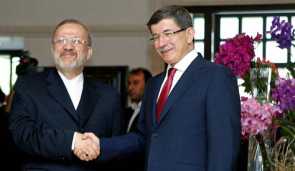
    Turkish Foreign Minister Ahmet Davutoglu, right, and Iranian counterpart Manouchehr Mottaki in Istanbul, July 25, 2010. Photo by: AP
    Turkish Foreign Minister Ahmet Davutoglu, right, and Iranian counterpart Manouchehr Mottaki in Istanbul, July 25, 2010. Photo by: AP

    By taking countries off this list, Turkey is signaling nothing less than a new foreign policy design, one that has already been hinted at with their attempts to solve issues with the Kurdish population.

    Turkey’s prime minister is working to scale back the nation’s army, which currently includes some 600,000 troops. The goal is to lessen security expenses, which have reached about $19 million a year, and create a professional army by doing away with the current policy of mandatory enlistment.

    Leaders are examining the possibility of a program that would allow exemption from army service in exchange for a fee, which is expected to be about $7,000 dollars. In the Turkish army today, in-demand professionals like doctors and engineers are exempted from mandatory service, as are other university degree holders. Alternately, those without an academic degree must complete mandatory service, which lasts about five months. Career soldiers serve 15 years before they can retire.

    In addition to its effect on the economy, doing away with mandatory enlistment will change one of the symbols of identity for Turkish citizens, who view enlistment in relation to the ideology that created modern Turkey, as laid out by Mustafa Kemal Atatürk. The army is an inseparable part of Turkey’s informal education system, which spreads Ataturk’s ideology.

    Current Prime Minister Recep Tayyip Erdogan, on the other hand, aims to minimize the army’s influence on the country.

    The laws for the army as it currently stands are partially to blame for the undermining of the status of the police in the country. The army’s standing has been lowered in civil institutions, like the education council, and by a series of reforms that were passed in a national vote last month. By removing traditional external threats, Erdogan is changing his foreign policy to stimulate internal changes, all the while avoiding a confrontation with internal opposition.

    While Iran may be helping Erdogan’s aspirations within his country, it is also placing Turkey on a dangerous track towards confrontation with the United States. In addition to refusing to support the United Nations decision to place sanctions on Iran, Turkey also refused to allow the U.S. to put a missile defense system against Iran on its soil.

    Davutoğlu clarified that Turkey is not opposed to the deployment of the missile defense system in its territory, but rather opposes the conditions of NATO countries and refuse to appear to take a stand against Iran, Syria, or Russia. Turkey fears the stationing of a defense system, whose sole purpose is defense from Iran, would seriously damage relations between Turkey and Iran, and its ally Syria.

    It appears that in the end, Washington and Ankara will agree on conditions for the missile defense system. However, Turkey succeeded again in proving that it can’t be counted on as a sure thing.