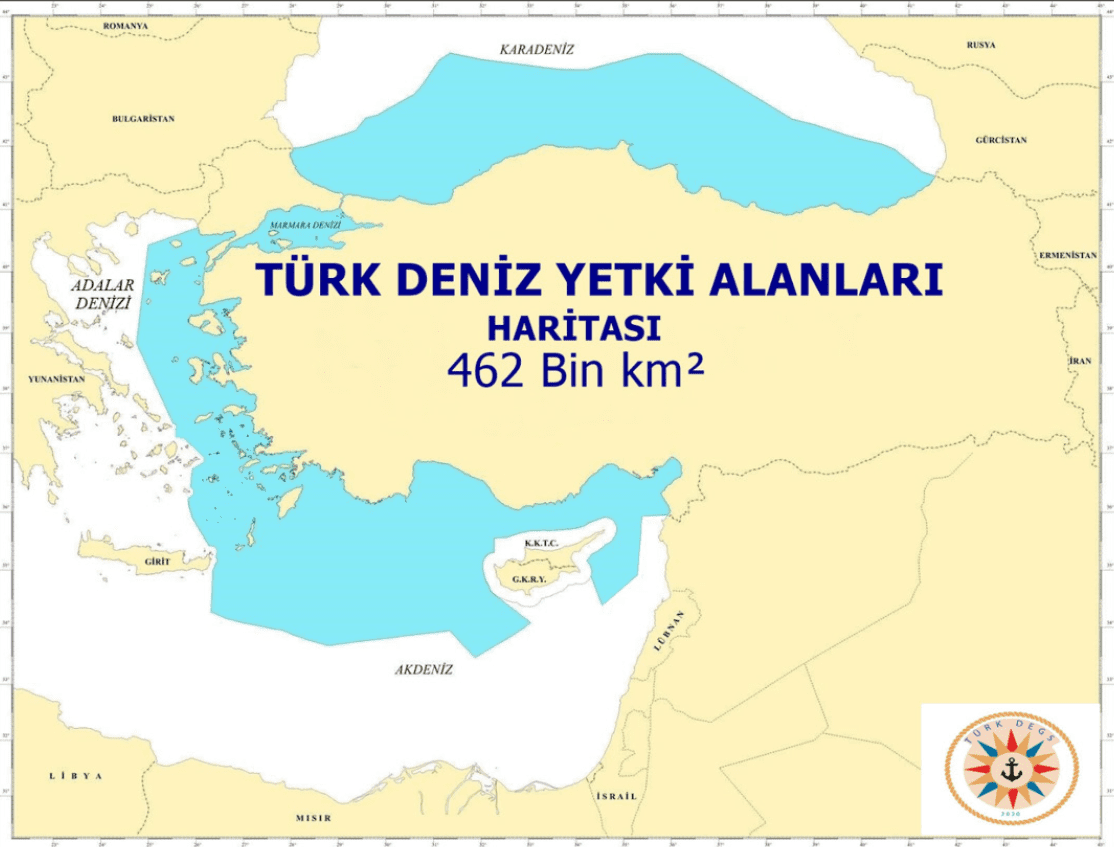
Retired Rear Admiral Dr. Cihat Yaycı: Greece Stole the Blue Homeland Too
As Retired Rear Admiral Dr. Cihat Yaycı pointed out, Greece’s never-ending cultural theft has reached a new dimension.
For years, those who have tried to appropriate the authentic Turkish cuisine and culture by calling cacık “caciki,” baklava “baklavas/baklavaki,” zeybek “zeybekiko,” and Turkish coffee “Greek coffee,” have now set their sights on the symbol of our rights in our seas.
With a new perception operation launched on Greek social media, they are attempting to steal this national term by saying “The Blue Homeland is Greek” and “The Real Blue Homeland.”
Moreover, this shamelessness goes so far as to claim that even Behçet’s disease, discovered by the first Turkish doctor Hulusi Behçet, was discovered by a Greek doctor.
Dr. Yaycı noted that it is no coincidence that the word “Greek” in English slang means “thief.”
Cihat Yaycı emphasizes that we must be vigilant against this mentality that attempts to create its own history without any historical evidence.
He also has a very clear warning for our citizens who consume our own values in Greece, mistaking them for “Greek food”: We must protect all our cultural and national values, from Maraş ice cream to Gaziantep baklava, from Turkish coffee to the Blue Homeland!
Cihat Yaycı concludes his speech with an English message: “There is no limit to the theft of the Greeks.
Owing to its geopolitical position, Turkey owns several sea basins that are of great strategic importance. Turkey’s primary interests in those basins necessitates that the country assumes an active role and responsibility in foreign policy. Therefore, controversial issues arising from international maritime law and relations with riparian states constitute a crucial part of Turkey’s foreign policy. Recently in particular, the increasing importance of using marine resources for states paved way for some tensions between countries in potentially strategic sea basins. Turkey is one of the countries that is affected by that situation owing to its geopolitical position.
The extent to which economic activities within the sea basin, pertaining to energy resources in the seas, can be used by countries constitutes the most important issue of today’s maritime law. In particular, the high number of riparian states and the nature of marine resources in the region render those issues even more important. In case of the existence of more than one riparian country, the most important principles concerning the extent to which countries will benefit from marine resources appear within the framework of the concept of continental shelf. The concept of continental shelf, formalized with the Geneva Convention on the Law of the Sea, allows riparian states to conduct activities on a legal basis, in accordance with principles of international maritime law such as equity, proportionality, and domination of land over sea.
Another concept that accompanies the concept of continental shelf is the concept of the exclusive economic zone, and the activities conducted within the framework of those concepts aim to eliminate conflicts that might arise between riparian states.
We hear those concepts all the time, especially during disputes regarding oil and natural-gas exploration activities in the Eastern Mediterranean. This necessitates the development of strategies based on national interest and fair sharing by adhering to the concepts and principles developed by international maritime law in maritime regions under tension. Moreover, developing such strategies will help in establishing important mechanisms to deter states from activities that are illegal and in violation of the law of the sea.
The expression Blue Homeland, which suggests that Turkey’s marine resources surrounding its borders should be considered an important a part of the Homeland as the land, has just begun to appear in the literature of international relations. Accordingly, all the maritime jurisdiction areas that have been declared and are expected to be declared in line with Turkey’s rights and duties arising from international law are called the Blue Homeland. Pursuing a policy within the framework of the Blue Homeland doctrine in all matters involving the maritime law to which Turkey is a party has been discussed frequently in recent years. The active role that it plays in the littoral seas, especially in the Eastern Mediterranean, requires that Turkey be in a stronger position in terms of potential conflicts and tensions with other riparian countries.
This study aims to reveal Turkey’s Blue Homeland map based on the treaties and conventions to which Turkey is a party, especially the basic texts of the International Law of the Sea. Therefore, the study examines all problems pertaining to the issues within the scope of the law of the sea to which Turkey is a party within the framework of the Blue Homeland approach. I would like to thank Associate Dr. Cihat Yayci, who made great contributions in the publication of the study. I hope it will be a guide for academicians, experts, students, and readers who are interested in the field.