Tag: Islamophobia

  • Swiss architects challenge Islamophobia

    Swiss architects challenge Islamophobia

    By Liz Fekete

    1 December 2010, 4:00pm

    The IRR News Service met up with three members of Foreign Architects Switzerland (FAS) who are challenging the Swiss ban on minarets.[1]

    LIZ Fekete: You are in London, at the invitation of the Architecture Foundation, to speak at a forum on architecture’s political and social role in the context of the Swiss ban on minarets and the hysteria in the US over plans to site a new Islamic cultural centre in downtown New York City.[2] First, could you tell us a little bit about FAS?

    Charlotte: We are a collective of architects from different backgrounds living in Switzerland fed up with the general passivity within the architecture profession who steer away from any controversy or political debate and adopt a low profile. Switzerland is often portrayed as a paradise, but from where we were standing there is a lack of innovation. So the whole purpose of FAS is to provide, often in a playful way, a platform for alternative ideas and projects that would never be considered in the brain-dead, incestuous architectural media of Switzerland. Oh, yes, and we are also friends. The Collective is a way for us to come together – we are only a few individuals and FAS is not our main occupation.

    So how did you react when news came through that the Swiss People’s Party (SVP)[3] had been successful in its referendum to prohibit the construction of minarets?

    Charlotte: When we heard about the minaret ban we felt very angry. We were angry because it was clearly discriminatory. The whole talk of Islamicisation was just crazy (there are only four mosques with minarets in the whole of Switzerland). And all that the referendum proved was the level of ignorance and fear that exists in Switzerland about a different culture, Islam. But we were also angry as architects. We felt this as an attack on us as architects, on our field. And despite this, the architectural scene was not responding. This also made us very angry. The only opposition came from civil society in the form of demonstrations, as well as a few individual acts, such as that of Guillaume Morand, the owner of a shoe company, who defied the referendum by extending the chimney on the top of his warehouse near Lausanne to give it the shape of a minaret.

    So what did you decide to do?

    Charlotte: We decided that if we were to address the situation we needed to take architecture and turn it into a weapon. We launched a counter- competition – to design an Islamic Centre. And for this competition we adopted the slogan ‘Save the Honor of Architecture, Save the Honour of Switzerland’.

    Lorenz: We chose a site which has a traditionally Swiss landscape. It’s a visitor’s centre up on a hill, with lots of churches and a leisure lake. You have to visualise this. In the middle of a residential area, directly adjacent to a Greek Orthodox church, swimming facilities and an active bar scene. It would be impossible to camouflage a mosque on such a site. The counter-competition asked entrants to come up with a design that would, in the words of the competition tender, ‘promote interaction and dialogue in the community’. You also have to understand that the site, the Kronenwiese along the Limmat River was already controversial. Homeless people and a soup-kitchen had been evicted from the area to make way for a new housing development. So the counter-competition was in itself a political statement, asking the profession to re-evaluate its priorities and raising pertinent questions about multiculturalism in Switzerland.

    Jesse: We invited architects to submit a design which would not only give Muslims a place to pray and meet, but provide an open meeting point between cultures. The design would include a mosque, a hamam, an Aula, space for lectures, exhibitions and a theatre, multipurpose rooms for men and women, offices, library, coffee shop and restaurant, as well as a public park and playground.

    And what was the reaction?

    Jesse: Well, in terms of the general public the reaction was small. But the most important thing was that we actually got entries. Architecture if rather non-political and this is one of the reasons we founded FAZ. And we got so many really thoughtful entries which helped us achieve our aim – to catalyse a much needed discussion within the architectural community about cultural differences.

    Charlotte: Some of the entrants challenged stylistic norms, others went so far as to suggest that religion, as well as architectural style, is bound to evolve in a changing cultural climate. From these entries we picked out three which addressed different issues of design. The first was very open, the second quite aggressive, challenging codes on mosques and the third rather tongue-in-cheek, with a minaret. And through this we really did achieve our aim to catalyse discussion, which we also did via our facebook page and our fanzine that we sent to about 250 architects, university chairs, architecture organisations and publications in and outside Switzerland.

    Did you get much reaction from the Muslim community?

    Jesse: The Muslim community are very under-represented in Swiss society and were very scared. They were placed in a difficult position; they found it difficult to come out. Ours was an act of solidarity.

    Charlotte: You have to understand that we are representative of what we are – middle-class architects with a few Muslim friends. I had an intern from Kuwait at that time and she was very shocked by all this. The only way she could understand it was to explain it as some kind of misunderstanding. You find often in discussions people like to minimise the issue, talk about it in rational terms and suggest it must be the result of a misunderstanding.

    You clearly feel that architecture has the power to convey positive messages about cultural interaction and it saddened you to see how it was being manipulated.

    Jesse: Yes. The architecture of cities are where ideas come together. We tried to get the architecture profession to react, but largely because architects are apolitical, we were disappointed. It seemed to us an obvious thing that you can’t outlaw the mosque, or indeed the right to practice one’s religion. The minaret ban was all about pushing things to their limits. It’s a symbolic thing. And what the minaret ban did was to set forth a symbolic war, one that has been fabricated. It is a fictional narrative. Look at the imagery – minarets are bayonets attacking the land – this is a fictional narrative. They are making use of architecture to make a political statement against Islam. In this way, they conceal their racism. Racism does not have a face. The landscape – architecture – buildings give it a face. And this is precisely why we feel architects had a duty to speak out against the ban. Architecture is a manifestation of social relationships. Architects are responsible for the form of the city, for the urban landscape which organises social relationships. Architects could promote constructive, creative dialogue – if they dare to speak up.

    A lot of the original arguments in favour of the ban seemed to rest on the idea of protecting the traditional landscape from foreign cultures. Why was this such a powerful factor in Switzerland?

    Jesse: You have to understand that Switzerland is a country where an unusual emphasis is placed on the power of the built environment. This is a country which regulates everything from cast shadows and noise pollution to where you can and can’t hang out your laundry – this is the level to which the Swiss are concerned about their neighbourhoods. It just seems that this is one of the main ways in which xenophobia expresses itself in Switzerland. For me, it seems something very specific to the Swiss. It seems to me that here in the UK xenophobia is much more linked to the fear of terrorism, whereas in Switzerland xenophobia manifests itself around issues of the built environment.

    Charlotte: Yes. In Switzerland, the argument is that the landscape is attached to our identity as a nation, and the identity-building aspects of that landscape were depicted as threatened by Islam.

    And is this what the SVP exploit?

    Lorenz: Yes, but the SVP is adept at exploiting any insecurity. They generate a fear of people and they use that fear to gain votes. In fact, at the moment they have issued another referendum to expel foreign nationals who commit crimes.[4] The one thing we all agree on is that the people who are racist and manipulate these fears are not stupid.

    But that’s what’s so fascinating about you three. You describe yourself as middle-class people with limited interaction with Muslims. Other people in your social position were falling over themselves to support the ban. Why did you see things differently?

    Charlotte: Maybe it’s a question of sensibility. For me I was always uncomfortable with the post 9/11 anti-Muslim drive. I just can’t understand how people don’t link the minaret ban to other forms of discrimination, particularly what happened to the Jews. It freaks me out.

    Jesse: I think it comes down to contact and proximity with other people. In our professional life, certainly as architects, we come into contact with people from different cultures all the time. It is the nature of the job that we travel. We have worked in Vienna, in India, all over the place, and we have lived alongside people from the former-Yugoslavia. In many ways I just don’t get it. I can’t understand why people have difficulties with Islamic cultures – after all Islam and Christianity both have Abrahmic roots. I mean the differences are minute.

    Charlotte: You must remember, that in the run-up to the minaret ban, people didn’t really mobilise. The opinion polls were all saying that the ban would have no chance. I have many international friends and I wanted to make a sign.

    Lorenz: I agree that it’s a question of sensibility – towards fairness, justice. The ones who want to kick people out just don’t see the injustice of it all.

    [1] On 29 November 2009, Switzerland became the first country in Europe to vote to curb the religious practices of Muslims when a referendum banning the construction of minarets on mosques was backed by a strong majority. As a result, Article 72 of the Swiss Federal Constitution regulating relations between the state and religion was amended to include the statement: ‘the construction of minarets will be forbidden’. For more information see IRR Briefing Paper No 1, February 2010, ‘The Swiss referendum on minarets: background and aftermath’. [2] Faith in the City: the mosque in the contemporary Urban West was a two-day event organised by the Architecture Foundation in partnership with Openvizor and Arts Council England’s Arts & Islam programme. More information from www.architecturefoundation.org.uk [3] The ‘People’s Initiative Against the Construction of Mosques’ was launched by the SVP and the small ultra-conservative Federal Democratic Union. An SVP poster in favour of the ban depicted a woman wearing a burqa against a background of a Swiss flag upon which several minarets resembling missiles were erected. [4] On 29 November, Swiss voters approved a plan for automatic deportation of foreigners who commit serious crimes or benefit fraud, despite warnings that people who had lived all their life in Switzerland, married Swiss citizens and had children but never obtained Swiss passports, would be unusually hard hit by expulsion. Some 52.9 per cent of voters backed the SVP proposal. 47.1 per cent of voters were opposed.
    The Institute of Race Relations is precluded from expressing a corporate view: any opinions expressed are therefore those of the authors.
    RELATED LINKS

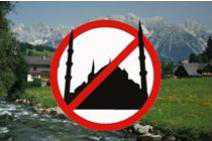
    The image above, used in FAS’ presentation, was inspired by a video campaignby the Federal Democratic Union (EDU).

    The Architecture Foundation

    Foreign Architects Switzerland

    Arts and Islam

    IRR is not responsible for the content of external websites. Inclusion of a link does not constitute an endorsement. Please contact us if you come across a broken link.
    1 December 2010
  • “[Muslims] eat each other alive, like the dogs that they are…”

    “[Muslims] eat each other alive, like the dogs that they are…”

    Surfing rabbi tells EDL demo ‘We shall prevail’

    By Jessica Elgot and Jennifer Lipman

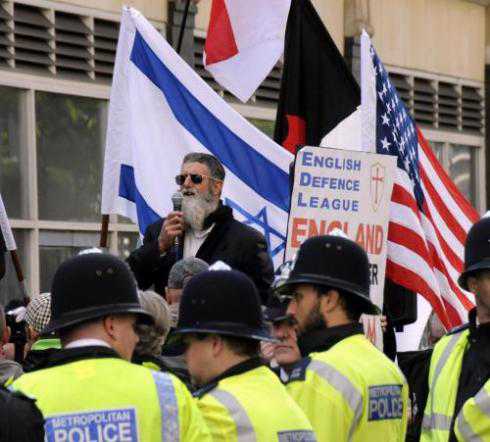
    Rabbi Shifren addresses the EDL demonstration (photo: John Rifkin)

    Around 300 members of the far right organisation the English Defence League (EDL) were joined by a US Rabbi associated with the Tea Party at a demonstration “to oppose Islamic fascism”.

    Speaking outside the Israeli embassy in London, Rabbi Nachum Shifren stressed he was not here to represent the Tea Party but came as someone “who loves freedom”.

    Rabbi Shifren, who is standing for the California state senate, said: “To all my Jewish brothers who have called me a Nazi…I say to them they don’t have the guts to stand up here and take care of business.”

    The so-called surfing rabbi said the EDL were the only group in England with moral courage and that politicians would not admit that “because of the Arab petrol dollars.”

    Rabbi Shifren with EDL members (photo: John Rifkin)

    Rabbi Shifren added that Muslims “eat each other alive, like the dogs that they are.”

    He said: “We shall prevail, we will not let them take over our countries. We will never surrender to the sword of Islam.”

    Shaking his fist in the direction of the Israeli embassy, he shouted slogans in Hebrew, telling the crowd: “You won’t understand what I’m about to say but you will feel my meaning.”

    Police surrounded the crowd, who were shouting chants about Allah. A man claiming to be Tommy Robinson, the EDL’s founder and leader, denied that the EDL was a violent organisation.

    But he told the JC: “I will protect myself against anyone and I will stand up to anyone and that’s what you’re seeing.

    “It will be lads, you will see lads who are not prepared to back down.”

    Although the demonstration was ostensibly to show support for Israel, he said he was there to take on militant Islam.

    He said: “This isn’t Mickey Mouse, it’s militant Islam. We’re opposing a fascist murdering ideology.”

    Mr Robinson, a carpenter from Luton, said that the counter-demonstrators had been “paid to come by this government” and that critics of the EDL “listen to the propaganda.”

    Later in the afternoon, the speech of Roberta Moore, leader of the Jewish division of the EDL, was interrupted by an anti-fascist demonstrator who threw water over the public address system.

    Hordes of EDL supporters broke ranks to chase the man down Kensington High Street, followed by police. Ms Moore said: “Someone is trying to silence us, so that means our message is sticking.”

    After a brief tussle with some anti-fascist demonstrators, several EDL members were searched by police but no arrests were made.

    Down the high street around 30 people, from organisations including Unite Against Fascism, Jewdas, and Jews for Justice for Palestinians, as well as two strictly orthodox anti-Zionists, gathered for a counter-demonstration.

    Siobhan Schwartzberg, a student from East London and a member of the Socialist Workers Party was one of the organisers. She described the EDL as an Islamophobic and racist organisation and said the demonstration was a marking stone for the group.

    “The EDL invited Rabbi Shifren….to use minorities to get at other minorities. We want to say you do not speak for us, you are not a voice for us.”

    “This pretence that they are a voice of Jewish people – they want to say that they are an acceptable organisation and they are not.

    “They want to be seen to be making clear bigger political ties that don’t exist.”

    Yossi Bartal, an Israeli student living in Brighton, added: “It is very important to make clear that there are many Jews and Israelis against the connection they are trying to make.

    “The EDL tries to adopt liberal language, but invite Rabbi Shifren, who wants a religious state. It’s funny that this is the one Jew thy have found that will support them.

    “They are fascists and not speaking in our name.”

    Stephen Shashoua, director of the Three Faiths Forum, said: “The EDL are always trying to divide communities and this as a really low way to do it.

    “What we have to seize is Jews, Muslims and others getting together to fight it, either on the streets, in the papers, and across the board, because this is the society we want together, and they don’t represent anything like that.”

    , October 25, 2010

    Rabbi Shifren’s speech at the EDL demonstration

    From the minute I set foot in this country I’ve had nothing but abuse and I tell you now, I welcome every single bit of it.

    To all my Jewish brothers who have called me a Nazi, and have asked why I’m poking my nose into England’s business, I say to them they don’t have the guts to stand up here and take care of business…

    “There is only one group in England with moral courage. I wish just one politician had the back bone to stand up and agree, but they’ll never do that because of the Arab petrol dollars…

    “In those so-called freedom centres, they plot to destroy and kill us. We’re still waiting for the Muslims to make peace with each other. They eat each other alive, like the dogs that they are…

    “I’m looking at this crowd of people here in the UK, and I can see Christians, Hindus, Sikhs and yes, even Jews too. We wanted to say to all those liberals who preach multiculturalism why don’t you go to Saudi Arabia and start there…

    “I will not stand by and watch the destruction of both of our countries from within…

    History will be recorded that on this day, read by our children for eternity, one group lit the spark to liberate us from the oppressors of our two governments and the leftist, fifth column, quisling press, and that it was the EDL which started the liberation of England from evil…

    “Today is the first day of the rest of your lives. We shall prevail, we will not let them take over our countries. We will never surrender to the sword of Islam…

    , October 25, 2010

  • Turkish immigrants fear spread of xenophobia in German society

    Turkish immigrants fear spread of xenophobia in German society

    FULYA ÖZERKAN
    ANKARA – Hürriyet Daily News
    Thursday, October 14, 2010

    A recent survey showing high levels of anti-Muslim and anti-immigrant sentiment in Germany alarms the country’s Turkish community, which fears such beliefs could flare into violence. The study released this week indicates that xenophobic feelings are spreading from extremists at the margins of society to the middle-class heart of the European country

    Recent survey findings that say xenophobic and racist sentiments have penetrated to the middle-class heart of German society have left a bitter taste among members of the country’s Turkish community.

    “What is most dangerous is that racism in Germany is going from a Nazi appearance to a ‘black-tie racism,’” Kenan Kolat, a leader of the Turkish community in Germany, told the Hürriyet Daily News & Economic Review on Thursday. “The existing racism is heading toward the center of society, to cultural, white-collar racism.”

    Conducted by the University of Leipzig for the Friedrich Ebert Foundation, in connection with the Social Democratic Party, the survey released this week, “Right-wing Extremism in Germany 2010,” shows a high number of Germans agree with xenophobic statements. Foreigners as well as Muslims are being treated with suspicion, according to the study’s findings.

    “Anti-Semitism is being replaced by Islamophobia,” Bekir Alboğa of the Turkish-Islamic Union, or DİTİB, in Germany told the Daily News. “It is alarming that anti-Islamic sentiments are on the rise despite the German government’s efforts to tackle the integration problem.”

    The survey, which was broadcast by Deutsche Welle, shows 32 percent of Germans approve of the statement, “When there’s a shortage of jobs, foreigners should be sent back home”; 34 percent agree or strongly agree with the statement that “Foreigners only come here to exploit Germany’s social welfare system”; and 35 percent think that “Germany has a dangerous level of foreign influence as a result of the many foreigners in the country.”

    The presence of such sentiments among Germans is not a new development, Kolat said, but added that the broader willingness to express them is worrying.

    “Foreigners are met with suspicion here in Germany, but what’s new is that the middle-class, white-collar-and-tie Germans, who have long refrained from expressing their opinions toward foreigners, are now speaking out,” he said.

    Germany has a sizeable Turkish community of around 2.5 million and a total Muslim population of some 4 million. German central bank board member Thilo Sarrazin recently caused outrage among Muslim immigrants when he accused Turks and Arabs of exploiting the welfare state, refusing to integrate and lowering the country’s average intelligence.

    “A policy of humiliation and exclusion is supported by part of German society,” Kolat said.

    Anti-Islam feelings on the rise

    The survey showed the strongest negative opinions when it comes to Islam, with 55 percent of respondents saying they could understand that people find Arabs unpleasant, and 58 percent saying the practicing of the Muslim religion should be “considerably restricted.”

    Though members of the Turkish community have said they find the results “intimidating” and “thought-provoking,” others have suggested that the way the questions were asked might have been manipulative rather than neutral, dramatically impacting the eventual results. Still, the community is troubled by fears that the sentiments expressed by middle-class Germans could erupt into tension with immigrants.

    “We have serious concerns. Could violence take place? I hope it will not, but it is a possibility we cannot rule out,” Kolat said.

    Both Turkey and Germany emphasize the importance of integration for Turks living in the country. Prime Minister Recep Tayyip Erdoğan and German Chancellor Angela Merkel jointly attended a football match last week between the Turkish and German national teams, with the Turkish leader wearing a scarf combining both nations’ flag in a symbolic move to highlight the importance of integration.

    While calling on Turks to adhere to German rules and learn the German language, Ankara cautions against a policy of “assimilation,” saying it would mean destroying a culture. The problem of integration will further be discussed when German President Christian Wulff visits Turkey later this month.

  • Europe the Intolerant

    Europe the Intolerant

    By JAMES KIRCHICK

    Prague

    ‘The dark night of fascism is always descending in the United States and yet lands only in Europe.” So said Tom Wolfe in 1965, and so it is today.

    Various commentators have argued recently that opposition by many Americans to a proposed Islamic center two blocks from the ruins of the World Trade Center represents deep-seated religious bigotry and paranoia. But if any place is plagued by increasing bigotry, it’s not America but Europe, the continent whose welfare states and pacifism are so admired by American liberals.

    Last year, nearly 60% of Swiss voted to ban the construction of minarets—all minarets, everywhere, not just near the sites of world-historical terrorist attacks committed by Muslim radicals.

    In Belgium, the lower house of parliament passed a burqa ban this year that now awaits Senate approval. In France such a ban became the law of the land last week, having been upheld by the country’s top court. Although there are legitimate reasons for such bans, some support for them certainly arises from anti-Muslim bigotry.

    In recent years far-right, anti-immigrant parties have done alarmingly well across Europe. In Sweden, the nationalist Sweden Democrats entered parliament last month for the first time since the party’s founding in 1988. In the United Kingdom, the far-right British National Party won nearly three times as many votes (563,000) in this year’s parliamentary elections as in 2005; last year it won two seats in the European Parliament.

    In Austria, the Freedom Party—formerly led by Joerg Haider, who had kind things to say of the Nazis—earned 17.5% of the vote in 2008. In France, the National Front party of Jean-Marie Le Pen, who questioned the existence of the Nazi gas chambers before conceding that they were a “detail” of World War II, came in second in the 2002 presidential election, earning a spot in a runoff with then-President Jacques Chirac.

    And now the far right may be rising again in Germany, where stringent speech laws and parliamentary thresholds have long kept it out of the Bundestag. Recent polls cited by the German Press Agency estimate support for an anti-Muslim party at 20%, which would be enough to enter parliament.

    “The fall of parliamentary seats into extremist hands represents the biggest shake-up in European politics since the disappearance of communism,” wrote Denis MacShane recently in Newsweek. Mr. MacShane is a Labour member of the British Parliament who previously served as minister of state for Europe.

    Europeans are leery not just of Muslim immigrants but of Jews, nearly exterminated on the continent 60 years ago. A recent Pew Global Attitudes poll found that nearly 50% of Spaniards have either a “very” or “somewhat unfavorable” opinion of Jews. The figures are 25% for Germans, 20% for French and 10% for British. This anti- Semitism was underscored by the recent assertion of European Union Trade Commissioner Karel De Gucht that “it is not easy to have, even with moderate Jews, a rational discussion about what is actually happening in the Middle East.”

    So when American liberals decry their conservative counterparts as bigots seeking to impose fascism on the U.S. (having failed to do so during two terms of the Bush administration), they ignore that part of the West where genuine nostalgia for fascism endures.

    Anyone who has traveled throughout Europe knows that its image as an exemplar of progressivism, and ethnic and religious diversity, is a fabrication of the American liberal mind.

    American liberals who ignore European bigotry while considering opposition to the Ground Zero mosque inexcusable bring to mind the mocking suggestion of German communist playwright Bertolt Brecht: “Would it not be easier in that case for the government to dissolve the people and elect another?”

    Throughout the mosque debate, the vast majority of Americans showed themselves to be capable of respectful disagreement. It is Europeans, again, whose darker impulses we have to fear.

    Mr. Kirchick is writer at large with Radio Free Europe/Radio Liberty based in Prague, and a contributing editor of the New Republic.

  • Turkish leader calls on Berlin to sack central bank official over racism

    Turkish leader calls on Berlin to sack central bank official over racism

    Kolat called on the government to act to remove Sarrazin

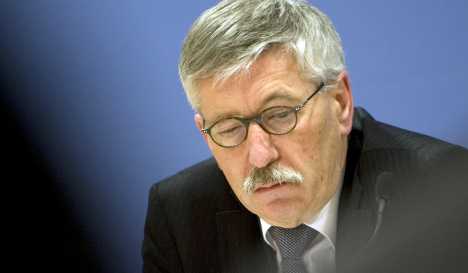
    A leader of Germany’s Turkish community has urged Chancellor Angela Merkel to fire the Bundesbank’s controversial board member Thilo Sarrazin over comments that Muslims are undermining German society.

    Chairman of Germany’s Turkish Federation, Kenan Kolat, called for central bank board member Thilo Sarrazin to be removed from his post after fresh comments criticizing Muslims in Germany.

    “I am calling upon the government to begin a procedure to remove Thilo Sarrazin from the board of the central bank,” Kolat told the German daily newspaper Frankfurter Rundschau on Saturday, August 28.

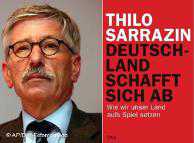
    In his book “Deutschland schafft sich ab” (“Germany does away with itself”), Sarrazin claims that members of Germany’s Muslim community pose a danger to German society.

    Sarrazin, a member of the Social Democrats (SPD) and Berlin’s former finance chief, was reported in June as saying that members of the Turkish and Arab community were making Germany “more stupid.” With his book, Kolat said, Sarrazin had overstepped a boundary.

    “It is the climax of a new intellectual racism and it damages Germany’s reputation abroad,” Kolat said.

    High birth-rates

    Sarrazin says that his book is addressing cultural division

    In a serialization of the forthcoming book in the German popular daily newspaper Bild, Sarrazin said that Germany’s Muslim community had profited from social welfare payments far more than they contributed, and that higher birth-rates among immigrants could lead to the Muslim population overtaking the “indigenous” one in terms of numbers.

    Merkel’s chief spokesman Steffen Seibert said on Wednesday that many people would find the remarks “offensive” and “defamatory,” adding that the chancellor was concerned.

    Members of the SPD have distanced themselves from Sarrazin’s comments, while Germany’s Green and Left parties have called for his removal from the central bank’s board.

    A Bundesbank spokesman said that Sarrazin’s latest remarks were personal opinions, unconnected with his role on the board.

    Blanket generalizations

    Germany's first female Muslim minister said the comments lacked respect

    Lower Saxony’s minister of social affairs, Ayguel Oezkan, Germany’s first-ever female Muslim minister, accused Sarrazin of doing damage to the Muslim community with blanket generalizations.

    “There are a vast number of hard-working immigrants,” she told the weekly German newspaper Bild am Sonntag ahead of its publication on Sunday. “They deserve respect, not malice.”

    “All of those who are involved in society, those who encourage their children, who learn German, who work and pay taxes and those who, as entrepreneurs, provide jobs – all of them deserve respect.”

    In June, 65-year-old Sarrazin was reported as saying that Germany was “becoming on average more stupid” because immigrants were poorly educated.

    ‘Distorted image, half-truths’

    Maria Boehmer, the government’s commissioner for integration, accused Sarrazin of giving “a distorted image of integration in Germany” that did not bear up to academic scrutiny.

    “In his comments, he states only half truths,” she told Bild am Sonntag. “It is indisputable that, in education, there are currently a lot of immigrants with a lot of catching up to do. It does not take Sarrazin’s comments to establish that.”

    In a lengthy interview with weekly newspaper Die Zeit, Sarrazin defended himself against the charge he was encouraging racism.

    “I am not a racist,” he told the newspaper. “The book addresses cultural divisions, not ethnic ones.”

    Last year, Sarrazin caused a storm by claiming that most of Berlin’s Arab and Turkish immigrants had no useful function “apart from fruit and vegetable trading.” As a result, the central bank stripped Sarrazin of some of his duties.

    Author: Richard Connor (Reuters/dpa/AFP)
    Editor: Toma Tasovac

    https://www.dw.com/en/turkish-leader-calls-on-berlin-to-sack-central-bank-official-over-racism/a-5951829, 28.08.2010

  • Sarrazin under fire for anti-Muslim views

    Sarrazin under fire for anti-Muslim views

    Bundesbank official Thilo Sarrazin faced increasing pressure from across the political spectrum due to his controversial views on Muslims and immigrants on Thursday, as calls grew for him to leave the Social Democrats (SPD) and his central bank post.

    More politicians joined in the chorus of outrage over Sarrazin’s comments regarding foreigners in a new book he has written and which are widely seen as inflammatory and xenophobic.

    In an excerpt from his book published by daily Bild on Thursday, Sarrazin said there were “good grounds” for reservations against Muslims across Europe.

    “There is no other religion with such a flowing transition to violence, dictatorship, and terrorism,” he claimed, before making the equally provocative assertion that Muslim immigrants were “associated with taking advantage of social welfare state and criminality.”

    Along with members of the Greens and the Left party, politicians from the conservative Christian Democrats are now calling for him to give up his seat on the central bank’s board. Members of his own party said Sarrazin was “abusing” the SPD’s name.

    “Those who pour blanket scorn on individual groups are playing a perfidious game with fears and prejudices,” said SPD General Secretary Andrea Nahles on Thursday. “That has nothing in common with the values and convictions of the SPD.”

    Justice Minister Sabine Leutheusser-Schnarrenberger of the pro-business FDP party called Sarrazin’s theories “confused and unbearable.”

    “Germany is a country of immigration and we can be proud of the liberal values and openness of our society,” she said.

    The head of the Social Democrats in Berlin, Michael Müller, said it was possible the party would take new steps to kick the 65-year-old former Berlin’s finance senator out of the party. Sarrazin survived a previous attempt this year to revoke his party membership for previous controversial comments.

    Sarrazin’s new book, called Deutschland schafft sich ab – Wie wir unser Land aufs Spiel setzen, or “Abolishing Germany – How we’re putting our country in jeopardy,” is due to be released on Monday. In the book, Sarrazin warns that Germans could become “strangers in their own country” because of integration. He plans to begin a book tour beginning next week.

    The Green party has said it wants to begin a parliamentary procedure in which the Bundesbank and the government recommend Sarrazin be dismissed from his central bank position, a motion which would then be accepted by Germany’s president. The Left party has also called on Bundesbank directors to distance themselves from their controversial colleague.

    “A top official who tries to agitate people is unacceptable,” said Left party head Gesine Lötzsch.

    This is not the first time Sarrazin has sparked controversy with his views. In September 2009 he made anti-immigrant remarks against Arabs and Turks in an interview with Lettre International magazine.

    He claimed that “a great many Arabs and Turks in [Berlin], whose numbers have grown because of the wrong policies, have no productive function other than as fruit and vegetable grocers.”

    Though he apologised for those remarks, Sarrazin refused to step down from the Bundesbank’s board despite pressure to do so. He was however symbolically punished when the institution stripped him of some responsibilities after the incident, which caused widespread outrage.

    “With Thilo Sarrazin, it’s just a continual offence,” said Green party parliamentary group leader Renate Künast on Thursday.

    , 26 Aug 10