Tag: Islam and Democracy

  • Solidarity action in Istanbul/Turkey for the 64 punks arrested in Aceh/Indonesia

    Solidarity action in Istanbul/Turkey for the 64 punks arrested in Aceh/Indonesia

    Contributed by: aforum

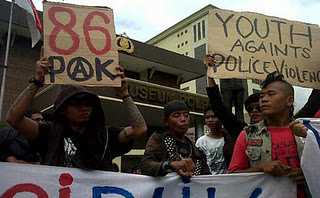
    On the 11th of December 2011, in the very conservative and religious province of Aceh in Indonesia, 64 punks who were attending a punkrock show, were arrested and taken to jail without any criminal charges whatsoever. The only reason for them to be victim of that totally arbitrary state repression was that they are punks. The police shaved their hair off and removed their piercings, their clothes were taken away from them, replaced by “decent” ones and they were forced to wash themselves in a “religious ritual”. Then they were brainwashed and “re-educated” for ten days through “religious education” and “military discipline”.

    Solidarity action in Istanbul/Turkey for the 64 punks arrested in Aceh/Indonesia

    On the 11th of December 2011, in the very conservative and religious province of Aceh in Indonesia, 64 punks who were attending a punkrock show, were arrested and taken to jail without any criminal charges whatsoever.

    The only reason for them to be victim of that totally arbitrary state repression was that they are punks. The police shaved their hair off and removed their piercings, their clothes were taken away from them, replaced by “decent” ones and they were forced to wash themselves in a “religious ritual”. Then they were brainwashed and “re-educated” for ten days through “religious education” and “military discipline”.

    Against this outrageous police action, solidarity actions and demonstration took place in Moscow, London, San Francisco, Los Angeles, China and Malaysia.

    On the 24th of December a solidarity concert for the Indonesian punks was organized in Istanbul with the Hardcore/Punk bands POSTER-ITI and FRANKENSTEIN to inform people and gather supporters for the protest on the following day.

    On the 25th of December at 3:00 in the afternoon, as a sign of solidarity with the “Aceh 64”and as a reaction to this ultra-repressive measure of the Indonesian state, 30 punks and anarchist activists attacked and vandalized the outside walls of the “Indonesian Consulate General” located at “Seneryildizi Sokak, No. 22/11 Etiler” in Istanbul, Turkey.

    While playing punkrock music with a portable sound system, those 30 activists spray-painted the consulate with slogans saying: ”Dinleriyik Yoket (Abolish all Religions)“, “Free Aceh Punx”, “ACAB”, “Punklar burda (The Punks are Here)” and “Özgur Kal (Stay Free)”. The doors were covered with stickers and graffiti and two large banners were hung on the consulate walls saying: ”Free the Indonesian Punks” and “Bütün Devletler Fasittir, Polisler kiralik Katil (All governments are fascist, all cops are assassins)”. Afterwards a small but loud demonstration took place in the very rich and elitist vicinity of the consulate in support of the 64 Indonesian punks, expensive cars were decorated with anarchist symbols and some vandalism occurred until the 30 activists dispersed and vanished.

    There was no interference with the police whatsoever and fortunately nobody was arrested.

    Flyer that distributed during action:

    In the region Aceh in Indonesia, 65 punks were put into police custody without any criminal charges.

    They were arrested just for being different. The police shaved their hair off and removed their piercings and they will now be brainwashed through “religious education” and “military discipline”.

    We strongly protest against this new fascist attempt to oppress and punish everybody who does not want to fit into their disgusting capitalist mainstream. State repression and police brutality is getting worse and worse every day worldwide and we are sick of it. We will fight back.

    WE MIGHT BE FEW BUT WE STAND TOGETHER!

    ———————

    What happened in Aceh?

    After years of war and the devastation of the 2004 tsunami, a peace process was started which resulted in considerable autonomy for Indonesia’s northernmost province. Former GAM fighters won the elections. One of the changes they brought in was a form of Islamic Syaria’h law, which is not enforced in any other part of Indonesia. Currently Aceh is in the run-up to new elections and different candidates are pitching their image to the public.

    In nearly all parts of Indonesia there is a large punk scene. Many young homeless kids are attracted by the music and the lifestyle and can support each other in many ways, forming a subcultural community. Indonesian punks often earn a living by busking on buses or at traffic lights, and travel the country for free, hitch-hiking on the back of trucks. But at concerts, which are usually free or cheap and organised according to DIY ethics, people from all backgrounds come along.

    The concert on 10th December 2011 was a benefit gig to raise money for orphans. Apparently the event started at about 3pm and it was supposed to continue into the night. but at 21.30, police climbed onto the stage and demanded that the event should finish. The people there tried to negotiate for the gig to continue, but the cops didn’t seem to care. Reacting to the cops’ behaviour, the punks started singing a popular resistance song, Darah Juang (blood of struggle), but as it happened, that song seemed to provoke the anger of the cops who then started beating people and arresting them.

    The arrested punks were taken to the Seulawah National Police School one hour from Banda Aceh city. That’s where their hair was shaved off and they were forced into the lake. Punks in Aceh who weren’t arrested have found it difficult to get any communication with their friends, because it seems they are in isolation.

    Worldwide solidarity actions:
  • Turkey not a Muslim democracy

    Turkey not a Muslim democracy

    Turkey not a Muslim democracy

    Re: Turkey’s risky gambit, Editorial Sept. 17

    The statement, “Turkey has flourished as a Muslim democracy,” implies that Islam is the state religion of Turkey. It is not so. Although the current Prime Minister is from an Islamist party, the constitution of Turkey is secular and without a state religion.

    Secondly, and more importantly, the term “Muslim democracy” is incorrect. A cardinal principle of democracy is that it must be secular and that there must be a separation of church and state. If a country has a state religion — let’s say Islam — then it can be called an Muslim republic or theocracy, but it can never be called a democracy.

    Sukumar Roy, Newmarket

    via Turkey not a Muslim democracy – thestar.com.

  • “Revolutions” in Egypt and Tunisia Highlight Dilemmas of Turkey’s Democracy Promotion Agenda

    “Revolutions” in Egypt and Tunisia Highlight Dilemmas of Turkey’s Democracy Promotion Agenda

    “Revolutions” in Egypt and Tunisia Highlight Dilemmas of Turkey’s Democracy Promotion Agenda

    Publication: Eurasia Daily Monitor Volume: 8 Issue: 24

    February 3, 2011

    By: Saban Kardas

    Turkey has been following closely the unfolding popular “revolutions” in Tunisia and Egypt. While the Turkish public expressed support towards the masses demanding political liberalization, the Turkish government adopted a cautious approach initially, indicative of some of the contradictions that have been inherent in its policies towards the Middle East for some time.

    Turkey, like many other countries, was taken by surprise over a crisis of this magnitude. Nonetheless, Turkish leaders’ rather delayed response to the popular demands in the region points to larger factors underpinning the government’s foreign policy. Especially, as this development risks straining the delicate balancing act Turkey has been performing in the region, between the Arab states on the one hand and the undemocratic authoritarian or monarchic regimes on the other. The Turkish government has gained the sympathy of the “Arab streets” owing to the successes of Turkish cultural products and to Turkey’s recent foreign policy activism in defense of some Arab causes, such as the Palestine issue. Partly in order to avoid antagonizing many of the regimes in the region, with whom it has been trying to forge closer ties, Turkey at the same time has refrained from pursuing an openly pro-democratization agenda.

    Despite the emphasis Turkish government occasionally places on democracy as a foundational principle for its domestic and foreign policies, it has come under criticism on the grounds that it prioritized its relations with these regimes at the expense of people’s demands for greater democratic rights. The most controversial case in point was the Iranian elections in 2009, where Turkey was one of the first countries to congratulate President Mahmoud Ahmedinejad and remained silent on the regime’s ensuing violent crackdown on the opposition (EDM, June 18, 2009).

    Despite the Turkish government’s rather ambiguous position on democracy promotion, it must be acknowledged what Turkish scholar Kemal Kirisci once called the “demonstration effect” Turkey has in the region. Turkey’s experiment with popular democracy and a free market economy, especially its integration of Islamic groups into legitimate political channels, has been closely followed by many reformists in the Muslim world. The transformation of political Islamist groups in Turkey and their renunciation of non-democratic methods, which culminated in the incumbent AKP Party adopting a liberal-democratic economic and political platform, are taken as the most obvious indication of the success of this so-called Turkish model. Seen from this perspective, it is possible to hear somewhat inflated arguments among many Turkish analysts to the effect that Turkey’s rising profile in regional affairs and its vocal advocating of Arab causes, which demonstrated the failures of the authoritarian regimes, played a role in the recent wave of revolutions. According to different versions of this argument, the Turkish model of democratization inspired the “Arab streets” and precipitated these revolutions. Such views are also raised by the members of the AKP Party (Hurriyet, January 30).

    Among Islamists and to some extent liberals, there is a tendency to identify positively with the demonstrators demanding for greater political rights and transparency. This struggle reminds many Turks of Turkey’s experience with democratization, whereby they managed to fight against authoritarianism or military control over civilian politics and move towards a government representative of popular will. For instance, many Islamist intellectuals draw parallels between Turkey’s experience with a one-party regime and the Kemalist ideology and the experience of Tunisia under Bin Ali. By labeling the ousted Tunisian leader’s rule as Kemalism par excellence, they seek to drive home the argument that such authoritarian forms of government are no longer sustainable in the region, including Turkey. Consequently, they use it as a basis to call for further reform of the Turkish political system (Today’s Zaman, January 25). That positive identification of Islamist with the transformations there also might have an ideological dimension to it, as the Tunisian Islamic thinker and the leader of the En-Nahda movement Rashid Al-Ghannushi and the Egyptian Muslim brotherhood have had an intellectual impact on the Islamic groups and intellectuals in Turkey.

    As a reflection of such widely-held sympathy towards these revolutions shared by Turkish people and many political groups, there have been protests outside Egyptian diplomatic representations, demanding Mubarak’s resignation. It is increasingly possible to hear arguments calling on the government to play a more proactive role towards the resolution of the deepening crisis Egypt. One Turkish expert on Egypt, Ahmet Uysal, called on the government to give up its complacency, and interject itself more resolutely to prevent Egypt’s descent into instability by showing a way out of this stalemate towards democracy. In this view, only then will the Turkish government be able live up to its promises that it will play a leadership role in the region (www.sde.org.tr, February 1).

    Davutoglu, however, denied the criticisms that Turkey has remained silent on the developments in Tunisia and Egypt. Davutoglu rather put the blame on the Turkish media, arguing that despite his statements in support of people’s democratic demands, Turkish commentators largely overlooked them and created such a false image about the government’s policy (IHA, February 1).

    Perhaps with such criticism accumulating, Prime Minister, Recep Tayyip Erdogan finally came out and invited Mubarak to respond to his people’s desire for change. “Hear the people’s outcry and their humane demands… governments cannot stand against people,” Erdogan said (Anadolu Ajansi, February 1). Many Turkish media outlets provided wide coverage of Erdogan’s statement and took it as an indication of Turkey’s emergence as a major actor that could help to resolve this crisis. Nonetheless, during our conversation on the subject in Dubai, a long-time observer of Turkish and Middle Eastern politics, Yusuf Serif of Al-Arabiyya, underscored that Erdogan’s response came rather late. Though finding Erdogan’s statement daring compared to other regional leaders’ silence, Serif draw attention to the fact that Erdogan delivered it only after the United States and other Western actors made similar arguments publicly and US President, Barack Obama, telephoned Erdogan last weekend.

    The “revolutions” in the region are still unfolding and it will be interesting to observe as to whether and how the Turkish government will maneuver in a timely and efficient manner in these uncharted waters.

    https://jamestown.org/program/revolutions-in-egypt-and-tunisia-highlight-dilemmas-of-turkeys-democracy-promotion-agenda/

  • Obama’s link to the Muslim world: Turkey

    Obama’s link to the Muslim world: Turkey

    OPINION

    The West can learn a lot from Ankara’s perspective and democratic successes.

    By Helena Cobban

    As President Obama looks for partners in the Muslim world, he should consider listening to the government of Turkey as much as he listens to Egypt’s president. He could learn a lot from Turkey about how a smart Islamist party can be a valued participant in a democracy.

    Turkey, a NATO ally, has been ruled since 2002 by a moderate Islamist party – the Justice and Development Party (AKP) – that has proved its commitment to democracy and pluralism at home and to an active, nearly always nonviolent, engagement in diplomacy abroad. And that’s why the record of the AKP in Turkey is so compelling.

    At home, after the party first won power, grass-roots supporters tried to leverage that victory to ban alcohol sales in some Turkish cities. The judiciary struck down those regulations – and the national government complied with the ruling.

    Later, the national government tried to lift the country’s longstanding ban on admitting scarf-wearing women to universities or to jobs in government. Once again, the courts struck down the proposal. And once again, the government complied without a protest. (That, though the wives of both the prime minister and the president always wear head scarves in public.)

    In 10 days of travel, in three Turkish cities and vast swaths of countryside, I saw Turkish women wearing clothes that ranged from skimpy Western dress topped by tumbling – sometimes bleached-blond – hairdos, to a stylish version of Muslim hijab that involves an elegantly tied head scarf over a mid-thigh tunic and jeans, to the baggy black coverup of the ultrapious.

    Most Turkish women are near the middle of that spectrum, and in many places young women with and without head scarves mingle easily, chatting and laughing together.

    Regarding domestic affairs, one professor in Istanbul told me, “If you’re a politically liberal Turk who cares about women’s rights, the rights of the Kurdish minority, and religious minorities here, you couldn’t find a better party than the AKP.” I heard versions of that voiced by several other strongly secular Turks.

    Back in early April, Mr. Obama came to Turkey and delivered a first important address to the Muslim world. Turks seemed delighted that he had included their country on his first trip abroad as president, and nearly all appreciated the respectful way he addressed the concerns of Turks and other Muslims.

    On June 4, he gave another major address to the Muslim world in Cairo. Egypt, like Turkey, is a historic center of Muslim life. But the Turkish government follows policies that are much more in line with Obama’s inclusive, diplomacy-focused approach to international affairs.

    Turkey’s two AKP governments have maintained good ties with Europe and with all Turkey’s neighbors – including Greece, Iran, Georgia, Iraq, and Syria. In 2007-08, Ankara also undertook an important mediation effort between Israel and Syria.

    But Ankara fell afoul of the Bush administration in Washington for a number of reasons. Most significantly, in 2003, Ankara – like many other NATO allies – strongly opposed the US invasion of Iraq, and it refused to allow Washington to launch part of the invasion from Turkey.

    The Bush administration also objected to the good ties the AKP maintained with Syria and – after the hard-line faction won the Palestinian elections in 2006 – with Hamas.

    While George W. Bush was president, he seemed to ascribe little value to the inclusive and generally de-escalatory policies the AKP government has pursued at home and in the broader Middle East. He preferred instead an approach to the Middle East that sharpened divisions between the two groups he defined as “moderates” and “extremists.”

    In the former group were the notoriously anti-democratic governments of Egypt and Saudi Arabia. In the latter, any government or party that seemed to support Iran, regardless of whether – like Hamas and Lebanon’s Hezbollah – they might have proved their popular support in democratic elections.

    Indeed, in the Bush years, Washington worked actively to overthrow both Hamas and Hezbollah, and maintained what one Bush White House official has described as “a state of quasi-war” with Syria.

    Several Bush-era officials openly questioned whether the electoral victories of Hamas and Hezbollah actually “proved” that a party could be both dedicated to Islamist principles and democratic rule over the longer term. Turkey’s experience provides intriguing evidence that it can.

    Obama should value Turkey’s views on regional affairs. He may not be ready yet to go along with all the advice he receives from the AKP government in Ankara. But Ankara has much valuable experience that it can share with its NATO ally.

    Helena Cobban is a former Monitor correspondent. Her latest book is “Re-engage! America and the World after Bush.”

    Source:  www.csmonitor.com, June 12, 2009