A new education scandal is shaking Turkey – and its shockwaves extend far beyond its borders.
Hakan Okçal, former Turkish ambassador to Skopje, has made explosive revelations about the so-called International Balkan University in North Macedonia. According to Okçal, the institution was established by individuals close to Turkey’s ruling AKP party – funded with money that surfaced in the infamous “shoebox scandals” from major corruption cases.
Okçal’s Allegations
Founded with illicit funds – involving high-ranking AKP politicians, including former Prime Minister Ahmet Davutoğlu and then–Minister of Forestry Veysel Eroğlu.
Degrees without exams or attendance requirements – available in exchange for money.
Early accreditation from Turkey’s Higher Education Council (YÖK) before the university was even fully operational.
Student recruitment via tourist visas – in violation of North Macedonian law, leading to police raids and arrests.
A Network Designed to Infiltrate the State
Okçal describes the university as nothing more than a gateway to provide AKP loyalists with formal but academically worthless degrees, enabling them to secure positions in the public sector – as judges, prosecutors, bureaucrats, and senior officials. Recognition by Turkey’s Higher Education Council was the key to making these “graduates” legally untouchable.
“This system,” said the former ambassador, “has nothing to do with education. It is a political instrument to fill state structures with loyal operatives, not qualified professionals.”
Why This Matters for Europe – and Beyond
This scandal is not confined to Turkey. Many of these questionable degrees could have been recognized in European countries – especially in nations with large Turkish and Balkan communities such as Germany, Austria, Belgium, the Netherlands, and France.
Urgent questions need answers:
How many foreign degree recognition procedures (nostrification) have been processed from Turkey and the affected Balkan countries since 2008?
How many recognized degrees come from institutions now facing allegations of fraud and irregularities?
But the implications don’t stop at Europe. In today’s interconnected academic world, degrees from these institutions could also have been accepted by American universities or used to gain access to the U.S. labor market.
If such credentials have been used to secure positions in healthcare, engineering, law, or public administration in the U.S., the risks to public safety, institutional integrity, and trust are enormous.
Risks to Education and Employment Systems Worldwide
If fake or substandard degrees are being legitimized through official recognition, the consequences are severe:
Erosion of academic standards in higher education.
Infiltration of key public sector positions by unqualified individuals.
Collapse of merit-based systems in favor of loyalty-based appointments.
This is why universities, accreditation agencies, and government ministries across Europe and the U.S. must urgently review recognition procedures and audit all degree validations from at-risk countries dating back to 2008.
The Bigger Picture
The case illustrates how education can be weaponized to consolidate political power and manipulate state institutions.
When degree-buying and diploma mills operate unchecked – and when their products are accepted not only domestically but also in the EU and the United States – the issue ceases to be a national scandal. It becomes a global threat to governance, education, and public trust.
Tag: Higher Education Board
-
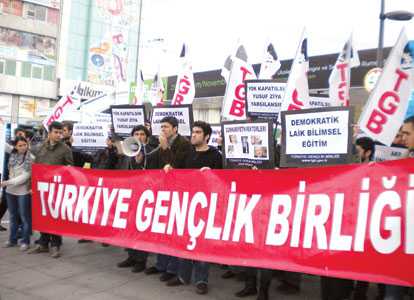
Students protest PM Erdoğan’s meeting with Turkish rectors
ISTANBUL – Daily News with wires
A group of around 50 people calling themselves the Turkey Youth Union gathered Sunday in Istanbul’s Beşiktaş district near the Prime Ministry office at Dolmabahçe Palace to protest Erdoğan and Yusuf Ziya Özcan, the head of the country’s Higher Education Board.
A group of around 50 people calling themselves the Turkey Youth Union gathered Sunday in Istanbul’s Beşiktaş district near the Prime Ministry office at Dolmabahçe Palace to protest Erdoğan and Yusuf Ziya Özcan, the head of the country’s Higher Education Board. Student groups protested a meeting Sunday between university rectors and the prime minister, who called for freedom in the country’s schools and said he had not ordered charges to be filed against protesters at previous appearances.
Eighteen university students were recently sentenced to 15 months in prison for protesting Prime Minister Recep Tayyip Erdoğan at Istanbul Technical University, in one of the more severe crackdowns on students protesting government officials.
“I had no criminal complaint against [the students]. Unfortunately, it is all an initiative of the judiciary. I did not even have any information about the incidents. I learned about them afterwards from media reports,” Erdoğan said.
A group of around 50 people calling themselves the Turkey Youth Union gathered Sunday in Istanbul’s Beşiktaş district near the Prime Ministry office at Dolmabahçe Palace to protest Erdoğan and Yusuf Ziya Özcan, the head of the country’s Higher Education Board, or YÖK, the private news site CNNTürk reported.
Students hung a banner on a nearby overpass that read, “Hey Tayyip, we too call the destroyer of the Republic, the destroyer of the Republic.”
Police removed the banner and blocked the protesters from reaching the Prime Ministry office. The group dispersed without further incident.
Speaking to the university rectors in his office at the palace, Erdoğan said universities should focus on the country’s chronic problems and not fall into the trap of defending the status quo.
“Turkey has many really important and urgent problems, from economics to democratization, education to culture. It is impossible for the government to solve all these issues on its own,” Erdoğan said, calling on universities to produce solutions.
In his remarks, the prime minister also touched upon the issue of freedom in universities, noting that during different periods, Russian literature departments were closed due to the communism threat and Arabic literature departments were shuttered because of the threat of fundamentalist Islam.
“Universities that should provide a ground and insurance for freedoms were remembered for years for bans, limitations, oppressions and, I say with sorrow, for inhuman practices like ‘convincing rooms,’” Erdoğan said, referring to the places in Istanbul University where female students wearing headscarves were in the past urged to remove their veils.
“For dozens of years, beards, moustaches and clothes were unfortunately discussed instead of the problems of science, scientists and the quality of universities,” the prime minister said.
He added that protesting something should not include destructive or violent acts.
Turkey has seen a number of student protests recently. One group of students from Yıldız Technical University was temporarily banned from entering the campus after tension erupted at the school over a banner expressing opposition to allowing the headscarf at universities. Previously, two students were arrested – and remain in jail after eight months – for bringing a banner in support of free education to a meeting Erdoğan held with Roma people. The latest action by students was held in Eskişehir, where protesters threw eggs at Haşim Kılıç, the head of the Constitutional Court.
Erdoğan will meet Saturday with a second group of rectors.