Turkey Widens its Relations with Developing Nations
Prior to his departure for Sharm al-Sheikh, Gul told reporters that this high-level participation builds on earlier representations at the deputy prime minister and ministerial levels in recent years. Gul reiterated the founding mission of the NAM, which was to chart out an independent course of action between the opposing blocs during the Cold War. He emphasized that despite the end of the bipolar system, the movement has maintained its role in international politics by redefining its goals and undertaking new functions. Gul justified Turkey’s engagement with the NAM by referring to the new activism in Ankara’s foreign policy.
Moreover, he highlighted Turkey’s new role as peace broker to facilitate the resolution of regional and global disputes through constructive diplomacy, which underpins Ankara’s desire to pursue such international initiatives. Gul also referred to a complementary process in Turkish foreign policy: the idea that the country should diversify its partnerships and develop new cooperative relationships in different continents, overcoming geographical barriers. He stressed that given that the NAM consists of almost 120 countries, Turkey follows its activities closely, and values its ties with this movement. In addition, he maintained that during its drive for a non-permanent U.N. Security Council seat, Turkey developed important experience in working together with diverse countries and wanted to further strengthen these ties (www.cankaya.gov.tr, July 15).
The current global financial crisis dominated the discussions during the first day of the summit. Cuba’s President Raul Castro maintained that the crisis was caused by rich countries and that poor nations are being forced to share a heavy burden. He called for a new and just global economic system. Mubarak also said that the world faces one of the largest crises, and there is a need for a new economic and commercial order that takes into account the interests of developing nations. The U.N. Secretary-General Ban Ki-moon acknowledged that developing countries are disproportionately affected by the global crisis and drew attention to the challenges posed by growing economic nationalism. He emphasized the importance of the role played by free trade to facilitate recovery. The Sudanese President Omar al Bashir (for whom the international criminal court has issued an arrest warrant) and the Libyan President Muammar Qaddafi were among the leaders who spoke at the summit. Qaddafi called for the NAM to receive a seat in the United Nations (Cihan Haber Ajansi, July 15).
During his contacts at the NAM summit, Gul also held bilateral talks with various statesmen including Tajikistan’s President Emomali Rahmon, and his counterpart in Montenegro Filip Vujanovic, the Secretary-General of the Arab League Amr Musa and the Bahrain’s Crown Prince Sheikh Salman bin Hamed Halife. Gul said that he was particularly pleased to see how Turkey was held in high esteem by other countries. The active and constructive role the country plays in the resolution of global problems explains this interest, Gul added (Cihan Haber Ajansi, June 15).
Although it joined NATO in 1952, Turkey initially had connections with the NAM in its formative years when the movement emerged in the mid-1950’s. Turkey attended the Bandung conference in 1955, where it sided with the countries arguing against following a non-alignment policy. It came under criticism because of its pro-Western policies and in subsequent years Ankara increasingly departed from the agenda of the NAM leaders. Instead, Ankara solidified its place in the Western camp during the Cold War as the best way to ensure its own security against what it perceived as the major threat to its survival, stemming from communism. Later, when the same nations worked to create a new economic order, Turkey again sought to integrate its economy into Western institutions.
Consequently, it has encountered several differences with the NAM in its foreign policy issues during the Cold War, especially in regard to the Cyprus issue. When these nations gained a majority in the U.N. General Assembly, they voted against Turkey, given the high profile of Cyprus within the movement. Although this approach was not pursued as aggressively by the NAM in the post-Cold War, even as late as 2003, the year before joining the E.U. and ceasing its membership of the NAM, the Greek Cypriots were able to mobilize the NAM to issue a declaration criticizing Turkey. However, Turkey’s constructive diplomacy in Cyprus in support of the Annan plan and its subsequent international diplomatic initiatives demonstrate the extent to which Turkey has been able to remove traditional sources of tension in its foreign relations and build new partnerships.
 May Day is a pagan ritual which marks the end of the colder winter half of the year in the Northern hemisphere, and it has traditionally been an occasion for popular and often raucous celebrations – ‘regardless of the locally prevalent political establishment’. But not for Levon Ter-Petrossian, his Mayday was more akin to the Mayday associated with the emergency code word used internationally as a distress signal by ships and airplanes in radio communications; derived from the French venez m’aider, meaning ‘Come Help Me’; the Mayday used to signal a life-threatening emergency by groups such as police forces, pilots, fire-fighters, and transportation organizations – and LTP.
 That was the retort from a leader of one of Armenia’s coalition parties, when in 2004 he was asked whether Armenia should resolve its differences with its western neighbor; the person who promised to release details of his 2004 Parliamentary Commission studies of grants, credits and humanitarian assistance, former Deputy Speaker of the Armenian National Assembly, Vahan Hovhanissian.
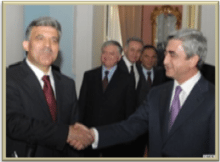 With Turkish / Armenian negotiations reaching a peak, the focus of attention is moving from the wider debate to petty bickering over who said this and who said that, the inevitable outcome of a process in which a country’s leaders discuss fundamentals of agreements with their international counterparts then hide the truth from their domestic audience. The Armenian negotiating parties, President Sargsyan and MFA Nalbandian, have unashamedly deceived the Armenian public with respect to their year-long negotiations on Karabakh and Genocide. Today, they would have the Armenian public believe that Turkey has suddenly introduced pre-conditions for opening the border, an untrue statement and particularly alarming as it came immediately after discussions with the US President in Turkey, which surely must have led to a common understanding between Turkey, Armenia and the US. True, the Turkish side did change its position after Obama’s trip to Turkey and re-introduced Karabakh as a pre-condition. But in contrast to Armenia, Turkish reports on its position have been consistent, in Ankara, in Baku and in Yerevan.