Tag: Gaza

  • Terra Incognita: The Turkish enigma

    Terra Incognita: The Turkish enigma

    By SETH J. FRANTZMAN
    06/28/2011 22:31

    The cancellation of the participation of the ‘Mavi Marmara’ in the Gaza flotilla and the mystery of what Turkey’s political elite is thinking.
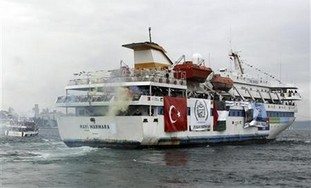
    Photo by: Reuters/Emrah Dalkaya
    Photo by: Reuters/Emrah Dalkaya

    Sometime this week, some 1,000 activists on one or two large Turkish ships accompanied by 15 other craft were to be making their way to Gaza. But they are nowhere on the horizon, although Israel has been preparing to prevent their breaking the blockade.

    So what happened? Just a month ago, various “Free Gaza” blogs were ablaze with hopes for the latest flotilla. Gaza TV News and Freedomflotilla.eu both reported that the Turks were going to send not only the Mavi Marmara( the ship Israel boarded on May 31, 2010), but also another “1,000-ton-capacity aid ship.”

    This phantom ship was supposed to set sail on May 31, 2011 to commemorate the fate of the first flotilla, in which nine Turkish activists were killed. Accompanying photos of the ghost ship showed a type of freighter. Alas, it seems the story was smoke and mirrors; if there was a ship, it never sailed.

    One man who posted on a freedom flotilla blog noted: “We hope that the Turkish people who have always extended their helping hand to Gazans will also help the loading of this ship with their donations.”

    Reliance on the Turks to provide the shipping capacity and spearhead the aid convoy has become a failing portion of the overall architecture of the Free Gaza Movement.

    Specifically, it is the reliance on the financial muscle and political influence of Insani Yardim Vakfi (Foundation for Human Rights and Freedoms and Humanitarian Relief-IHH).

    The IHH, founded in 1995 to support Bosnian Muslims, is an Islamic (probably Islamist) charity. In 2010 it purchased the Mavi Marmara and loaded it with 600 activists to sail to Gaza. The motives for its sudden interest in Gaza were never entirely clear. Its connections to the governing party of Turkey, Recep Tayyip Erdogan’s Justice and Development Party, were never entirely understood either. What is clear is that Ergodan reacted with extreme anger when nine activists died aboard the Marmara. In a June 2, 2010 speech before the Turkish parliament he raged “in an absolutely illegal way did they [Israel] attack, spilling the blood of innocent humans.”

    Later he reportedly referred to the dead as martyrs, and seemed to infer that the flotilla’s actions had the consent of the Turkish government.

    The IHH talked tough in the waning days of 2010 and through May 2011. Then it revealed that it would postpone sending any ships until after Turkey’s June 12 elections.

    This intimated that it needed the approval of the ruling party, and also feared that sending its ships before the election could create a provocation that would harm Erdogan.

    The decision to not send the ships came after two interesting occurrences on June 7.

    First it was reported that Kemal Kılıçdarolu, leader of the opposition Republican People’s Party, had criticized the government for not thinking of the consequences of the Gaza flotilla’s actions. Then Ahmet Davutoglu, Turkey’s foreign minister (who was also standing for election), said: “The aid flotilla should wait to see what happens with the Rafah border crossing being opened, and to see how Israel perceives the new [Palestinian unity] government.”

    Erdogan’s party handily won the June elections.

    Then on June 17 the IHH’s leader, Fehmi Bulent Yildirim, noted that the flotilla would not depart because of technical difficulties; “the exact reason has nothing to do with the government or the state… the Israelis, unbelievably, damaged our vessel.”

    Really? The ship was released by Israel and returned to Turkey in August 2010. Presumably if it had technical difficulties, the IHH would not have claimed so often that it would be sailing. When the IHH was asked why a smaller freighter it had purchased was not going to be joining the other freedom-flotilla craft, Yildirim claimed that this smaller ship had to accompany the Marmara, as if they were one package.

    Indeed they are one Turkish package. The pathetic little fleet of sloops, yawls, dinghys, ketches and catboats that Western pro-Gaza groupies have arranged has neither the muscle, capacity nor headline-generating images needed to break the blockade or create any sort of international incidents. It is as if Admiral Nelson had been forced to bring only rowboats to Trafalgar to face French ships of the line.

    But the real question remains: how to decipher this Turkish enigma? Already commentators have come to understand that the IHH’s actions are closely linked to the governing party, because the two organizations share a similar, Islamic-inspired political ideology.

    It has also transpired that there are deep divisions in Turkish political circles over how wise it is to harm relations with Israel, particularly the secular opposition and the nationalist (i.e non-Islamist) daily Hurriyet have shown a willingness to challenge the Erdogan narrative. Davutoglu, who has always gained accolades for his deft handling of Turkish foreign policy, has revealed himself to be very pragmatic on the Gaza issue, realizing that the opening of Rafah negates the flotilla’s raison d’etre. But if all this pragmatism has suddenly come to the surface, what sort of judgment prevailed a year ago that allowed a cruise ship full of radical activists to depart for Gaza? What were the activists going to do if they actually got to Gaza? Rumors abound that Turkey wishes to be the mature leader of an Arab democratic awakening, and sees the Gaza issue as a side-show. Others speak of secret backroom talks between Israel and Turkey.

    Nuh Yilmaz and Kilic Bugra, ham-handedly writing in Foreign Policy on June 21, claim “Turkey will continue to extend and deepen its ties with different political actors and the people of the Middle East.”

    Such insight.

    What’s going on in Turkey is a mystery, and that enigma should raise many eyebrows in Israel.

    The writer has a PhD from Hebrew University, and is a fellow at the Jerusalem Institute for Market Studies.
  • Israel Warns Of Using Force If New Flotilla Heads to Gaza

    Israel Warns Of Using Force If New Flotilla Heads to Gaza

    By ETHAN BRONNER

    TEL AVIV — Israel made clear on Thursday that if a new flotilla of pro-Palestinian activists sought to break its naval blockade of Gaza like the one a year ago when its commandos killed nine people, the Israeli military would use force again, including boarding the ships and confronting the activists.

    “We will do anything we have to do to prevent a boat from breaking the blockade,” a top naval official said in a briefing for foreign journalists. “If there is the same violence against our forces on board, there is a pretty good chance there will be injuries.” The official spoke on the condition of anonymity under Israeli military rules.

    On Israel Radio on Thursday, the military’s chief spokesman, Brig. Gen. Yoav Mordechai, said the army would stop any ship from entering Gaza. General Mordechai added, “There is an unequivocal directive from the government to enforce the naval blockade that is recognized by international law, and we will not allow it to be broken.”

    The statements seemed part of a heightened effort to stop another flotilla and to pre-emptively explain Israel’s position if violence ensues.

    Groups of Palestinian advocates in chartered vessels are scheduled to depart from a number of European ports this month and assemble into a flotilla heading toward Gaza to challenge Israel’s blockade and commemorate the deaths of a year ago.

    Among those expected to participate is an American vessel with several dozen passengers, including the writer Alice Walker and an 86-year-old whose parents died in the Holocaust.

    Because of insurance difficulties and political pressure, it remained unclear whether the ship on which last year’s deaths occurred, the Mavi Marmara of Turkey, would join the flotilla as planned. Israel, widely condemned for the commando operation, said that a year ago the ship was dominated by extremists who created the confrontations that resulted in the deaths.

    A number of world leaders, including Ban Ki-moon, the United Nations secretary general; Catherine Ashton, the European Union’s foreign policy chief; and Foreign Minister Ahmet Davutoglu of Turkey, have urged the flotilla organizers to drop their plans or wait and see how Gaza fares under changes in Egyptian and Israeli policies.

    Four years ago, after Hamas took over in Gaza, Israel and Egypt closed off the territory, preventing most goods and nearly all people from going in and out. Israel began a naval blockade two and a half years ago when it invaded Gaza to stop Palestinian militants from firing rockets into Israel.

    But after the commando raid a year ago, international outrage over the deaths, along with the hardships in Gaza, contributed to a shift in Israeli policy. Israel eased its blockade, letting in more goods over land. After the revolution in Egypt this year, Egypt changed its policy toward Gaza, partly reopening its border to people. Today Gaza has plenty of goods available, but its economy remains devastated and unemployment is 40 to 45 percent.

    Moreover, Israel continues the naval blockade. The government says its goal is to prevent Hamas from importing weapons by sea. In March, Israel stopped a vessel packed with weapons that it says were Gaza-bound.

    This year an Israeli commission concluded that the blockade conformed with international law, as did Israel’s raid on the Mavi Marmara in international waters. The panel included two foreign legal experts who agreed with the conclusions. Turkey dismissed the report as lacking credibility.

    Israel’s navy has been training for another flotilla and says it will use a number of tactics before boarding ships and do everything it can to avoid close contact with activists on board.

    As it did last time, Israel says it will ask ships carrying aid to Gaza to dock in Israel or Egypt, unload the cargo and allow it to be driven in. Israeli officials say the flotillas’ goal is not to ship aid to the Palestinians, but to challenge and embarrass the Israelis.

    The naval officer who briefed foreign journalists said that he did not believe that the coming flotilla would contain arms, but that Israel needed to enforce the blockade indiscriminately to defend against weapons imports by future flotillas. He said searches on board did not work because boats had many areas to conceal things, so the only reasonable way was for the cargo to be unloaded and driven to Gaza.

    He said that many of those planning to take part in the flotilla were peace activists, but that they were naïve because “extremists will set the tone” if Israeli commandos board the ships.

    A version of this article appeared in print on June 17, 2011, on page A4 of the New York edition with the headline: Israel Warns Of Using Force If New Flotilla Heads to Gaza.

    via Israel Warns Of Using Force If New Flotilla Heads to Gaza – NYTimes.com.

  • Israeli raid on Gaza-bound flotilla remembered

    Israeli raid on Gaza-bound flotilla remembered

    (CNN) — On the first anniversary of the Israeli raid on a flotilla headed to Gaza, organizers of another flotilla planned for June held a news conference Monday that concluded with a minute of silence for the nine activists killed in that raid.

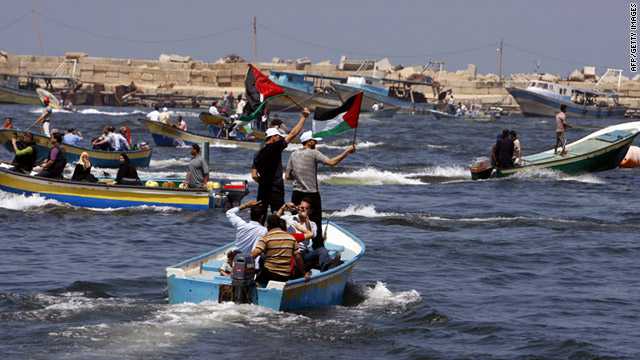
    Palestinians rally Monday off the coast of Gaza City to mark the first anniversary of a deadly Israeli raid on a Turkish flotilla
    Palestinians rally Monday off the coast of Gaza City to mark the first anniversary of a deadly Israeli raid on a Turkish flotilla

    Palestinians rally Monday off the coast of Gaza City to mark the first anniversary of a deadly Israeli raid on a Turkish flotilla

    The event was held on the Mavi Marmara, the ship that was the scene of the raid, which led to the deterioration of relations between Israel and Turkey, its once strong Muslim ally.

    Mavi Marmara — owned by the Turkish Humanitarian Relief Foundation, or IHH — and five other ships were on their way to Gaza carrying humanitarian aid and about 700 activists from various countries when Israeli soldiers swarmed aboard it in international waters on the night of May 30-31, 2010.

    Eight Turks and one American of Turkish origin died. Istanbul pulled its ambassador from Israel after the incident and the post has remained vacant.

    Huseyin Oruc, an executive from IHH, said Monday the flotilla that will set out in the last week of June in an attempt to break the Israeli blockade will consist of 15 ships and about 1,500 participants from 100 countries.

    The ships will carry a wide variety of humanitarian aid for Gaza, ranging from children’s toys to construction and medical supplies. They will be leaving from a variety of Mediterranean ports.

    At the news conference, Evangelos Pissias of Greece read out a joint statement on behalf of the international flotilla organization welcoming the recent decision of Egypt to open the Rafah border crossing into Gaza.

    However, he said, “We must continue to challenge this blockade. We call on all states, the United Nations and international organizations to support our action and demand that Israel refrain from attacking our vessels.”

    Egypt opened its border crossing into Gaza on Saturday. It had been mostly kept closed after Hamas, an Islamic militant group, got control of Gaza in June 2007.

    Asked if the flotilla organizers are taking any measures to protect the people on board the ships in case of an Israeli raid, Ann Wright, representing the American boat that will be a part of this year’s flotilla, told CNN, “There is not much we can do. They have got the weapons. We have no weapons. We don’t want weapons. We are going non-violently.”

    The news conference ended with prayer and the minute of silence.

    Monday evening in Istanbul, anger spilled out as several thousand Turks gathered in the city’s central Taksim Square to mark the anniversary.

    Chants of “Damn Israel” were interspersed with Arabic- and Turkish-language Islamic music as people waved Palestinian and Turkish flags at the event, which also was organized by the Turkish Humanitarian Foundation.

    The crowd, including men, women and children, carried banners saying “Support Gaza,” “Mavi Marmara martyrs are our honor” and “Palestine will win.” They also sent Chinese lanterns into the sky and lit flares in red and green.

    There was a moment of prayer. The crowd got loudest when chanting “Allahu Akbar.”

    One of the participants in the rally, Rabia Demirci, has registered to take part in the next flotilla. “I don’t think (Israel) will attack after this,” she said. “The Rafah crossing is open, too. God willing, it won’t. But if it attacks, we will continue on our path again, saying on with resistance. No obstacle can block our path.”

    Palestinians also marked the day, with many taking to small boats off the coast of Gaza City.

    via Israeli raid on Gaza-bound flotilla remembered – CNN.com.

  • New int’l flotilla heading to Gaza in early 2011

    New int’l flotilla heading to Gaza in early 2011

     By ASSOCIATED PRESS 
    10/12/2010 09:53

    IHH says may send ship larger than Mavi Marmara; US group sending ship named after Obama’s book, “Audacity of Hope.”

    GENEVA — Pro-Palestinian groups plan to sail a flotilla of boats through Israel’s sea blockade of Gaza as early as February in the second such attempt in less than a year, activists said Monday.

    The activists, representing groups from over a dozen countries including Switzerland, Turkey and the United States, said the flotilla would be bigger than the one stopped by Israel earlier this year.

    “It’s not about the aid,” Huwaida Arraf of the Freedom Flotilla Coalition told reporters in Geneva.

    Arraf said the aim will instead be to show that the Gaza blockade can be broken. A spokeswoman at Israel’s embassy in Bern, Shlomit Sufa, said humanitarian goods are allowed into Gaza by land and the sea blockade is needed to prevent weapons being smuggled in to the Palestinian militant group Hamas. Several smaller ships have failed to reach Gaza since the May raid — most recently last month, when a boat carrying Jewish activists tried to reach the densely populated strip. Among the groups planning to take part in the latest flotilla is the Turkey-based Islamic charity IHH, which sponsored the Mavi Marmara — by far the biggest ship in the first flotilla. A representative of the group, Ahmet Faruk Unsal, said IHH is considering sending another ship of the same size. An American group, US Boat to Gaza, is also planning to send a vessel, said activist Jane Hirschmann. The boat will be named “The Audacity of Hope” in reference to US President Barack Obama’s best-selling policy book.

  • Israeli rabbi will meet Turkish PM in Ankara

    Israeli rabbi will meet Turkish PM in Ankara

    Chief Rabbi of the Israeli settlement of Tekoa, Rav  Menachem Furman, plans to visit Turkey upon Turkish Prime Minister Recep Tayyip Erdogan‘s invitation, the Turkish newspaper Milliyet reported.

    Furman’s visit will take place on the backdrop of controversy in the Turkey-Israel bilateral relations in connection with the Israeli military’s attack on the Turkish humanitarian ship Mavi Marmara routing to Gaza that lead to murder of nine Turks in late May.

    Furman, whom is known for his ties with the leaders of the Muslim world, is in contact with the Erdogan administration for more than a year.

    He said peace in the Middle East can be achieved only through dialogue and close contact with representatives of the Muslim clergy. Furman believes Turkey will become the country that will bring peace to the region.

    Israel regards Furman’s upcoming Turkey visit and his meeting with Turkish politicians as an important step toward reconciliation with former military and strategic ally.

    This will be Furman’s second visit for the last month. He also plans to meet with the head of the politburo of the Palestinian movement Hamas, Khaled Mashaal

    https://en.trend.az/news/society/religion/1722815.html, 19.07.2010

    Rabbi Menachem Froman

  • Sources say Turkey could help oversee Gaza crossings

    Sources say Turkey could help oversee Gaza crossings

    Turkey could be given a central role in supervising the border crossings with the Gaza Strip as part of a deal to repair ties between Israel and Turkey, according to Arab diplomatic sources, the Lebanese Ad-Diyar reported newspaper yesterday.
    The relationship between Israel and Turkey has deteriorated dramatically since the Israeli naval commando raid on the Gaza-bound aid flotilla on May 31 in which nine Turkish citizens (including one with dual Turkish-Amerian citizenship ) were killed.
    According to the Lebanese newspaper report, Turkey would supervise all humanitarian aid entering Gaza, as well as commit to preventing the entry of weapons and money destined for Hamas. In this position, Turkey would play a meaningful role in lifting the blockade of Gaza and play the role of a central figure in the Middle East, which will enable the Islamic country to mediate between Israel and the Arab world in the future, as Turkey has sought in the past, the paper said.
    The report has not been confirmed by Turkish or Israeli officials.
    On Friday, Turkish President Abdullah Gul told the French daily Le Monde that Israel must make amends to be forgiven for a commando assault on the Gaza-bound aid flotilla, including apologizing for the attack and paying compensation.
    Gul added that if Israel made no move to heal the rift, then Turkey could even decide to break diplomatic ties.
    In an interview published on Friday, Gul said the fatal Israeli attack at the end of May was a “crime” – one that might have been carried out by the likes of Al-Qaida rather than a sovereign state. “It seems impossible to me to forgive or forget, unless there are some initiatives that could change the situation,” Gul was quoted as saying in Le Monde. Asked what these might be, he said: “Firstly, to seek a pardon and to establish some sort of compensation.” He added that he also wanted to see an independent inquiry into the botched raid and a discussion on lifting Israel’s blockade of Gaza.
    Asked if Turkey might break relations with Israel if nothing was done, Gul said: “Anything is possible.”
    By Jack Khoury
    Source: haaretz.com