Tag: freedom of expression

  • Letter to Alon Ben Meir

    Letter to Alon Ben Meir

    Response to Alon Ben Meir  

    I have publicly  criticized  Turkish Consul General  Ahmet Yazal. / I am living proof that freedom of criticism is real and free of Turkish Officials. 

    Mr. Ben -Meir you are at it again with your smear campaign  of Türkiye.

    First and foremost, I must remind you, Mr. Alon Ben-Meir, that the official name of the country is Türkiye. Given how many times I have written to you regarding this matter, you should have gotten it right by now. Your disrespect begins with your failure to use the correct name of the nation.

    The article presents itself as a defense of universal human rights, yet it is deeply selective, ideologically framed, historically incomplete, and strategically dismissive of the existential security threats confronting the Republic of Türkiye. It does not read as a balanced legal analysis; rather, it resembles a prosecutorial brief crafted to delegitimize the Turkish state while systematically omitting the geopolitical realities, terrorist threats, constitutional complexities, and democratic dynamics that have shaped modern Türkiye since the attempted coup of July 15, 2016.

    Any intellectually honest assessment must begin with the undeniable fact that Türkiye faced a violent coup attempt in 2016 orchestrated by elements infiltrating the military, judiciary, police, and bureaucracy. The coup attempt resulted in the deaths of over 250 civilians and security personnel, with thousands wounded. Fighter jets bombed the Turkish Grand National Assembly, tanks rolled into civilian streets, and armed officers attempted to overthrow a democratically elected government. The article minimizes this unprecedented national trauma as merely a “pretext” for authoritarianism, thereby erasing the legitimate security concerns of a sovereign NATO member state confronting an armed insurrection.

    The article further fails to acknowledge that many Western democracies adopted extraordinary emergency powers after terrorist attacks or national security crises. Following 9/11, the United States implemented the Patriot Act, Guantanamo Bay detentions, enhanced surveillance, extraordinary renditions, and broad counterterrorism authorities. France enacted emergency powers after the Paris attacks. The United Kingdom expanded anti-terror legislation for decades in response to IRA terrorism. Yet when Türkiye responds to a direct coup attempt and decades long PKK terrorism, its actions are uniquely characterized as irredeemable authoritarianism. This double standard is impossible to ignore.

    The portrayal of Türkiye’s judiciary as entirely illegitimate is similarly reductionist. No serious observer claims every judicial process in Türkiye is flawless; however, to assert that all prosecutions involving  terrorist Gulen-linked operatives, PKK affiliates, or extremist networks are fabricated is intellectually unserious. The FETO network was not merely a religious or educational movement. Turkish authorities and many independent observers documented systematic infiltration into state institutions over decades. Even critics of President Erdogan acknowledged the movement’s extensive penetration of the judiciary and police apparatus, o you must have missed that too. The article deliberately ignores this dimension because acknowledging it would complicate its simplistic moral narrative.

    The claims regarding Kurdish repression also omit crucial context. Türkiye’s conflict has never been with Kurdish identity itself. Millions of Kurdish citizens serve in parliament, business, academia, the military, and civil society. Kurdish-language broadcasting, publications, and cultural initiatives expanded dramatically under AK Party governments compared to previous eras. The issue is not Kurdish ethnicity but the PKK, which is recognized as a terrorist organization by Türkiye, the United States, NATO, and the European Union. The article repeatedly conflates Kurdish political identity with organizations accused of operational or ideological proximity to PKK militancy. No democratic state permits elected officials to materially support armed insurgent structures while claiming complete immunity from legal scrutiny.

    Moreover, the article’s discussion of southeastern operations omits the urban warfare environment created by PKK-affiliated militants who dug trenches, planted explosives in residential zones, and militarized municipalities. Civilian suffering in these clashes was tragic, but responsibility cannot be examined honestly while erasing the role of armed insurgency. To describe all counterterrorism operations as “collective punishment” is rhetoric designed to morally criminalize the Turkish state rather than analyze a complex security conflict.

    The article’s accusations regarding media freedom are similarly one-sided. Türkiye possesses one of the most politically vibrant and confrontational media environments in the region. Opposition parties openly campaign nationwide. Anti-government media outlets continue to operate. Social media criticism of state officials remains widespread.  

    As a matter of fact, for the past year, almost bi-weekly, I have publicly called out and criticized the Turkish Consul General, Ahmet Yazal. Despite this, I have never been approached by Turkish intelligence, faced a lawsuit, or even been questioned when I travel to Türkiye. I am living proof that freedom of criticism is real, and that anyone can openly criticize Turkish officials without fear of retaliation. I am living proof. 

     Indeed, some of the harshest criticism directed at the Turkish government is published daily within Türkiye itself. The article selectively cites arrests and prosecutions while refusing to distinguish between journalism and alleged operational support for violent organizations, financial crimes, or coup-related activities. Democracies worldwide struggle with defining the boundary between protected speech and active collaboration with extremist entities.

    Equally problematic is the article’s attempt to frame President Erdogan as transforming Türkiye into a theocratic state as a matter of fact President Erdogan when he traveled to Egypt – He stressed  Secularism in Egyptian Parliament- Alon , you must have missed the speech . 

    This argument fundamentally misunderstands Turkish society and democratic pluralism. Türkiye remains constitutionally secular. The visibility of religious identity in public life does not automatically constitute authoritarian Islamization. In many Western democracies, politicians openly invoke Christian values especially here in America  which you neglect to talk about , attend religious ceremonies, and shape policy discussions around faith informed ethics without triggering accusations of dismantling democracy. Yet when Turkish society reflects its overwhelmingly Muslim social character, commentators portray it as inherently threatening. This reveals an orientalist discomfort with Muslim majority democratic expression rather than a principled defense of secular governance.

    The article’s treatment of refugees is especially disingenuous. Türkiye hosts one of the largest refugee populations on Earth, including millions fleeing the Syrian civil war. Turkiye has a time tested honor role in welcoming and protecting refugees. While European governments built walls, closed borders, or externalized migration enforcement, Türkiye absorbed immense economic and social pressures with comparatively limited international support. No refugee system managing millions of displaced persons is without challenges. However, to portray Türkiye solely as an abuser while ignoring the extraordinary humanitarian burden it has carried for over a decade is a profound distortion and is a planned to delegitimize our NATO allyTürkiye.

    The calls for NATO exclusion, EU isolation, ICC referrals, and sanctions reveal the article’s true objective: strategic punishment of Türkiye rather than constructive engagement. Excluding Türkiye from NATO decision-making would weaken the alliance’s southern flank, destabilize Black Sea security architecture, undermine counterterrorism coordination, and strengthen Russian and Iranian geopolitical leverage. Calls to isolate Türkiye are not principled solutions; they are strategically reckless proposals that ignore Türkiye’s indispensable role in European security, energy transit, migration management, and regional diplomacy.

    Furthermore, the article entirely ignores Türkiye’s democratic electoral legitimacy. President Erdoğan and the AK Party have repeatedly faced competitive elections over two decades. Opposition parties control major municipalities, including Istanbul and Ankara. Political transitions at local levels continue to occur through ballots, not military intervention. One may criticize aspects of governance while still acknowledging that Türkiye retains competitive political structures far more dynamic than many states in its broader region.

    Most importantly, the article suffers from a profound civilizational bias frequently directed toward nonWestern powers. Western governments routinely engage in controversial counterterrorism practices, military interventions, surveillance programs, and emergency measures while still being treated as fundamentally legitimate democracies. Türkiye, however, is often judged through an absolutist framework in which every imperfection becomes evidence of authoritarian collapse. This asymmetrical moral scrutiny undermines the credibility of the critique itself.

    A mature analysis of Türkiye requires intellectual honesty which you Mr. Alon never do: acknowledging legitimate concerns regarding judicial independence, civil liberties, and political polarization while simultaneously recognizing the severe national security threats Türkiye faces, the trauma of the 2016 coup attempt, the burden of regional instability, the PKK insurgency, the Syrian war, and the broader geopolitical pressures surrounding the Turkish Republic.

    What weakens the article most is not that it raises criticisms every democracy should tolerate criticism but that it abandons balance entirely. It substitutes complexity with ideological absolutism, security realities with selective outrage, and nuanced legal analysis with geopolitical advocacy. In doing so, it ceases to be a credible human rights assessment and instead becomes a polemical instrument aimed at delegitimizing a sovereign nation whose policies the author opposes.

    The Republic of Türkiye is not beyond criticism. No state is. But neither is it the caricature of unrestrained tyranny portrayed in this article. Türkiye remains a strategically essential, democratically contested, regionally influential nation navigating extraordinarily difficult internal and external pressures in one of the most unstable geopolitical environments in the world. Any serious discussion must begin with that reality not with slogans masquerading as analysis.

    Ibrahim Kurtulus 

    Community Activist 
  • Turkey’s Wrong Turn

    Turkey’s Wrong Turn

    By THE EDITORIAL BOARD

    Goturrr

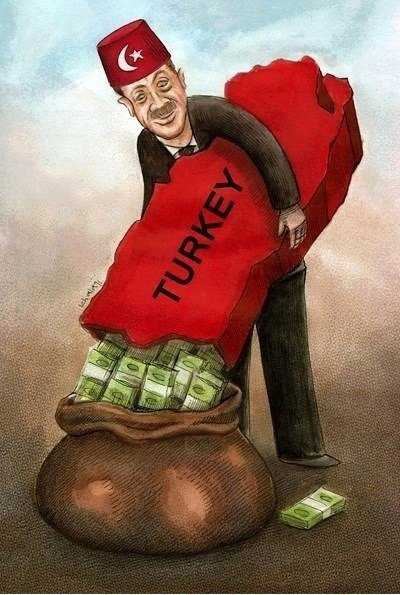
    Turkey’s prime minister, Recep Tayyip Erdogan, was in Brussels last week seeking to repair relations with Europe, but the first place to look for a solution is within himself. Once hailed as the leader of a model Muslim democracy, he has created a political disaster at home, transforming Turkey into an authoritarian state that poses dangers not just for itself but for its allies in NATO, including the United States.

    The latest turmoil has its roots in a political war between Mr. Erdogan’s Justice and Development Party and his former close allies who follow Fethullah Gulen, a moderate Islamic scholar who lives in Pennsylvania. The tensions erupted into the open last month with a corruption probe that led to the resignation of four government ministers and threatened to ensnare Mr. Erdogan’s family. The prime minister called the probe a “coup attempt” and blamed a “secret organization” within the judiciary and police directed by the Gulen movement and serving “foreign powers” like the United States and Israel. The government has since purged hundreds of police officials and prosecutors and sought to assert control over the judiciary. It also drafted legislation expanding the government’s power to appoint judges and prosecutors, further breaching judicial independence, and has prevented journalists from reporting freely. All the while, Mr. Erdogan has spewed endless conspiracy theories and incendiary rhetoric, even hinting at American treachery and suggesting that the American ambassador might be expelled.

    The probe and Mr. Erdogan’s reaction may well be politically motivated. There are important local elections in March. But Mr. Erdogan should be insisting that the probe be fair and transparent, not trying to derail it. His ruthless ways and his attempt to crush dissent are not new, as the crackdown against demonstrators during protests last June showed. Such actions trample on democratic reforms demanded by the European Union as part of Turkey’s bid for union membership, which may be more in peril than ever, and are increasingly at odds with the ground rules for NATO members.

    Germany’s foreign minister, Frank-Walter Steinmeier, was right when he said in Brussels that the Europeans must demand that Turkey return to the rule of law. The Obama administration also needs to send a strong message about the damaging course Mr. Erdogan is pursuing. Whether Turkey nurtures its hard-won democracy, which has contributed to its impressive economic growth, or turns authoritarian is as critical to regional stability and to its NATO allies as it is to Turks.

    A VERSION OF THIS EDITORIAL APPEARS IN PRINT ON JANUARY 28, 2014, IN THE INTERNATIONAL NEW YORK TIMES.
  • Say No to the Criminalization of Dissent!

    Say No to the Criminalization of Dissent!

    In a major report this week, Amnesty International has outlined the wide range of legal tools that Turkish authorities have used to target political dissent and limit freedom of expression. Scholars, students, journalists, human rights activists, and thousands of others have been subject to prosecution and lengthy punishment under these statutes. But you can join us in working for real reform in Turkey!

    Amnesty has noted that:

    The most negative development in recent years has been the increasinglyarbitrary use of anti-terrorism laws to prosecute legitimate activities including political speeches, critical writing, attendance of demonstrations and association with recognized political groups and organizations – in violation of the rights to freedom of expression, association and assembly.


    In Turkey, famous artists, like Fazıl Say and elderly grandmothers, like Sultani Acıbuca, must equally watch what they say for fear of state prosecution.

    The Time is now!

    The Turkish government is currently considering a set of judicial reforms that it says will address these issues, but the truth is that the reforms currently envisioned are insufficient.

    It is vital that we take action now to push the Turkish government to make the real reforms necessary to end its criminalization of dissent.

    Take action! Your help is vital in calling attention to this issue. 

    Sign the Amnesty petition!

    Join our twitter action with suggested tweets like:

    .@RT_Erdogan Dissenting opinion is not a crime. Protect the right to #freedomofexpression #Turkey #buyasaylaolmaz #yargıpaketi

    .@RT_Erdogan Decriminalize dissent in #Turkey to express peaceful opinion is not a crime #buyasaylaolmaz #yargıpaketi #freedomofexpression

    .@RT_Erdogan It is time for genuine #freedomofexpression reform in #Turkey #yargıpaketi #buyasaylaolmaz

    Call on friends and family to help too!  Collective action makes a difference!

    Stay informed!  Stay engaged!

    This is a historic moment for Freedom of Expression in Turkey, and we need your help to make a difference.  Follow our work on Facebook or at our blog and consider joiningAmnesty International – USA’s Turkey Regional Action Network.

    There is a lot of work to do, but we’re just getting started!

    This entry was posted in Censorship and Free Speech, Europe and tagged amnesty international, anti-terrorism laws, Erdoğan, Fourth Judicial Package, freedom of expression, human rights, human rights defenders, Journalists, security with human rights, students, Turkey by Howard Eissenstat. Bookmark the permalink.
  • Freedom of expression in Turkey ‘under attack’: Amnesty

    Freedom of expression in Turkey ‘under attack’: Amnesty

    Middle East

    Freedom of expression in Turkey ‘under attack’: Amnesty

    96434_mainimg

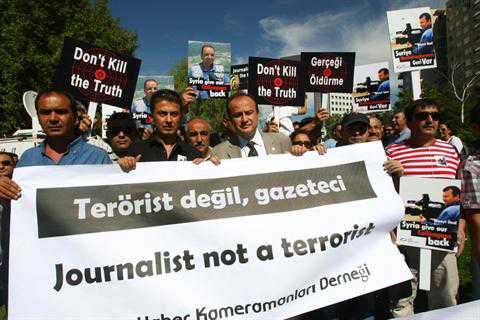
    More than 100 Turkish journalists protest in front of the Syrian Embassy in Ankara on August 31, 2012. (AFP PHOTO / ADEM ALTAN)

    ANKARA: Amnesty International criticised Wednesday European Union hopeful Turkey’s dismal record on freedom of expression and called for legislative reforms to bring “abuses to an end.”

    “Freedom of expression is under attack in Turkey,” the London-based group said.

    “Hundreds of abusive criminal prosecutions are brought every year against political activists, human rights defenders, journalists, lawyers and others,” it added.

    “These prosecutions represent one of the most deeply entrenched human rights problems in Turkey today.”

    Turkey is under fire from rights groups for its escalating crackdown especially on the media, with critics saying its draconian laws are putting a record number of journalists behind bars.

    The country is the leading jailer of journalists worldwide, imprisoning even more than China or Iran, according to an October report by the US-based Committee to Protect Journalists.

    The committee identified 76 journalists imprisoned in Turkey as of August 1, including 61 who were put behind bars purely because of their journalism.

    But the government of Prime Minister Recep Tayyip Erdogan vehemently denies the charges, insisting no one has been jailed because of their profession but rather because of links with the outlawed Kurdistan Workers’ Party (PKK).

    Amnesty said despite progress in Turkey in discussing taboo subjects more freely such as the criticism of the once-powerful army, problems still remain in expressing “dissenting opinions” on controversial issues, most notably the Kurdish problem.

    Erdogan this month criticised editors of the liberal Milliyet newspaper which published the details of a meeting between jailed Kurdish rebel leader Abdullah Ocalan and pro-Kurdish lawmakers in his island prison cell as part of a new peace push to end the three decades of hostilities.

    “If this is journalism, then let it be damned,” Erdogan said.

    Critics accuse Erdogan’s government of using courts to silence dissenting voices, saying the large number of court cases have resulted in weak news coverage of the trials.

    Amnesty said in order to prevent “these abuses from continuing,” Turkey must overhaul its laws to improve freedom of expression.

    On Monday, Human Rights Watch also called for a legal reform which it said would help bolster the peace process between Turkey and the PKK, which is branded a terrorist organisation by Ankara and much of the international community.

    PKK leader Ocalan last week called for a historic ceasefire, telling his fighters to lay down their arms and withdraw from Turkish territory.

    The move capped months of clandestine peace talks between Turkey’s spy agency and the state’s former nemesis Ocalan with an ultimate goal of ending a conflict that has cost some 45,000 lives, mostly Kurdish.

    via Freedom of expression in Turkey ‘under attack’: Amnesty | News , Middle East | THE DAILY STAR.

  • Turkey moves to boost freedom of expression

    Turkey moves to boost freedom of expression

    By Daren Butler

    ISTANBUL | Wed Feb 13, 2013 9:26am EST

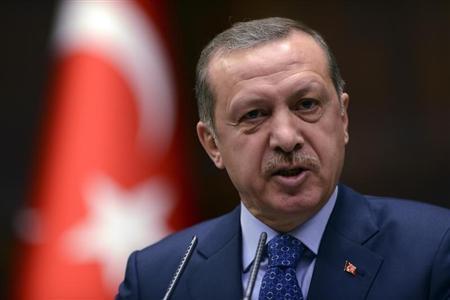
    Turkey's Prime Minister Erdogan addresses members of parliament from his ruling AK Party during a meeting at the Turkish parliament in Ankara

    (Reuters) – Turkey has drafted changes to the penal code, narrowing the definition of terrorist propaganda in a step to boost freedom of expression in line with EU demands and potentially encourage a fledgling peace process with a jailed Kurdish militant leader.

    The bill, presented to Prime Minister Tayyip Erdogan on Tuesday and likely to be sent to parliament this month, may lead to the release of defendants accused of links to Kurdish rebels, a justice ministry official told Reuters on Wednesday.

    Turkey has used anti-terror legislation widely to prosecute thousands of politicians, activists and journalists, frequently for things they have said or written.

    Turkey regularly tops the list of countries violating the European Convention of Human Rights and the European Commission has called on Ankara to amend its laws to distinguish between incitement to violence and expression of non-violent ideas.

    “Regulations have been prepared which rescue this country from such trouble … opening the way for freedom of expression and thought in Turkey,” Justice Minister Sadullah Ergin said.

    The reform was in line with European Court of Human Rights criteria, under which only a direct incitement to violence constitutes a crime, he told reporters.

    “When a person shares an idea and writes it down, if it does not contain, inspire, incite or try to legitimize violence, how can somebody be convicted?” the minister said.

    If approved, the legislation is likely to be welcomed by Europe, which frequently criticizes Ankara’s human rights record and imprisonment of political activists and journalists.

    Under the current anti-terrorism law and criminal code, writing an article or making a speech can lead to long prison sentences for membership of a terrorist group.

    Thousands of Kurdish politicians and activists have been prosecuted since 2009 over alleged links to the Kurdistan Workers Party (PKK) – deemed a terrorist group by the EU and Washington, as well as Turkey.

    The judicial reform coincides with a government bid to bring a end to the PKK’s 28-year-old insurgency, in which more than 40,000 people have been killed, through peace talks with its leader Abdullah Ocalan, jailed on the island of Imrali near Istanbul since his capture in 1999.

    KURDISH TALKS WITH OCALAN

    The peace process envisages a PKK ceasefire, their withdrawal from Turkish territory to their bases in northern Iraq and eventual disarmament in return for reforms boosting the rights of a Kurdish minority numbering around 15 million.

    The process has come to an apparent halt over the last month due to a dispute over a Kurdish delegation due to visit Ocalan. Erdogan has rejected the inclusion of politicians previously filmed embracing PKK militants.

    But when asked about the timing of the visit on Wednesday, Erdogan signaled the row may have been defused.

    “The relevant colleagues are working on it and if possible it will be this week and if not, next week, but it will happen,” Erdogan told reporters.

    During his decade in power, Erdogan has pushed through reforms boosting Kurdish cultural rights but Kurdish politicians have demanded decentralization, Kurdish language education and a new constitution boosting equality.

    Last month, parliament passed a law allowing defendants to use Kurdish in court, although Kurdish politicians said it fell short of their demands.

    A justice ministry official told Reuters the general lines of the penal code reform had been agreed.

    “When final technical adjustments have been completed and an assessment made it will be presented for the cabinet of ministers to sign. It looks possible it will go to parliament this month,” he said.

    (Additional reporting by Orhan Coskun; Writing by Daren Butler; Editing by Jon Hemming)

    via Turkey moves to boost freedom of expression | Reuters.

  • Israel passes controversial funding law

    Israel passes controversial funding law

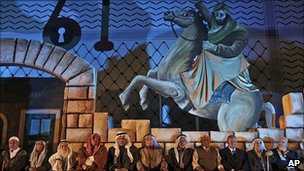
    Nakba Day – as Palestinians call it – is an important date in the political calendar

    By Bethany Bell

    BBC News, Jerusalem

    The Israeli parliament has passed a law that allows the state to deny funding to institutions that question the country’s existence as a Jewish state.

    Civil rights groups say the law restricts the freedom of expression of Israel’s Arab minority, which makes up about a fifth of Israel’s population.

    The controversial law brought in by the far-right Yisrael Beiteinu party was passed by a vote of 37 to 25.

    The new law has been called the Nakba bill, the Arabic word for catastrophe.

    Palestinians use the term to refer to the creation of the state of Israel in 1948, when hundreds of thousands of them fled or were forced from their homes.

    Under the new law, groups involved in activities that deny Israel’s existence as a Jewish state can be prevented from receiving public funding.

    Those activities include marking Israel’s Independence Day as a day of mourning.

    Civil rights and Israeli Arab politicians say the law is undemocratic and unfairly singles out Israel’s Arab citizens.

    The current version of the law is more moderate than the original, which called for prison sentences for anyone holding Nakba memorial events.

    www.bbc.co.uk, 23 March 2011