ANKARA (A.A) – Turkish State Minister for economy Ali Babacan said the 9.8% rise in Turkey’s October industrial production showed it was time to make an upward revision in Turkish Government’s 2010 annual growth projections.
In his address at the 5th Sectoral Economy Council meeting, Babacan said Turkey’s industrial production index saw a higher than expected surge in October, a major indicator in his words promising an annual growth surpassing the government’s projections.Babacan who pointed out that the Turkish economy grew 11% in H1, said OECD projected an annual growth of 8.2% for Turkey in 2010. He said IMF expected Turkey to grow 7.8% while EU projected an 7.5% annual growth.“Regardless of from which point you look at, Turkey will be the fastest growing economy in Europe this year and the next year,” said Babacan.Turkey’s statistical board, TurkStat, announced Wednesday that the country’s industrial production index rose 9.8% year-on-year in October. |
|
|
Tag: Europe
-
Babacan Confident Turkey Will Be Europe’s Fastest Growing Economy In 2010
-
Euro collapse ‘possible’ amid deepening divisions over bail-out
It is feasible that the euro will not survive the current sovereign debt crisis sweeping Europe, one of the Treasury’s leading independent forecasters has said.
Under questioning from MPs on the Treasury Select Committee, Stephen Nickell, a member of the Office for Budget Responsibility (OBR) and a former Bank of England rate-setter, said a collapse of the single currency was “a possibility”.
Attempting to defy Germany, the eurozone’s powerhouse and the nation that will provide the bulk of any rescue fund, Belgian Finance Minister Didier Reynders called for the €440bn bail-out fund to be expanded, while Luxembourg Finance Minister Jean-Claude Juncker and Italian counterpart Giulio Tremonti outlined proposals for a joint European government bond.
However, Germany, the Netherlands and Austria on Monday pitched themselves against weaker member states by insisting the rescue package should not be increased. Finance ministers from the 16 member nations were debating the bail-out plans late into the night.
Mr Juncker and Mr Tremonti’s “E-Bonds” would be sold by a European Debt Agency, created as early as this month, to finance as much as 50pc of the issuances by EU members. For troubled members, like Ireland and Portugal, it could fund the entire bond issue.
However, Angela Merkel, the German Chancellor, quickly dashed hopes by rejecting the idea as unworkable and stating: “I see no need to expand the fund right now.”
As market fears revived, the cost of insurance for Irish, Greek, Portuguese, Italian and Spanish sovereign debt rose. Bond yields were also higher as institutions shunned governments.
Ireland, which faces a crucial vote on its debt reduction plans on Tuesday, offered some rare good news as the government appeared to have won sufficient parliamentary support to push the plans through and qualify for the €85bn bail-out package.
On the euro, Mr Nickell said: “There is a possibility it will collapse but at the moment it is not something to which I subscribe a very high probability.” Asked to estimate the probability he said: “1.7pc”.
Meanwhile, European Central Bank (ECB) Governing Council member Nout Wellink said it is not the central bank’s task to rescue euro-area countries with funding problems.
“It’s not up to the ECB to save countries where governments run the risk of becoming insolvent,” Wellink, who also heads the Dutch central bank, said. “We are not here to take over, on our balance sheet, the risks of the national economies of Europe.”
Ten-year bond yields
Greece: 11.393 (+0.39)
Ireland: 7.916 (+0.1)
Portugal: 5.701 (-0.1)
Spain: 5.080 (+0.9)
Italy: 4.461 (+0.7)
The Telegraph
-
U.S. and UK raise terrorism threat level in Europe
(Reuters) – The United States and Britain warned their citizens on Sunday of an increased risk of terrorist attacks in Europe, with Washington saying al Qaeda might target transport infrastructure.
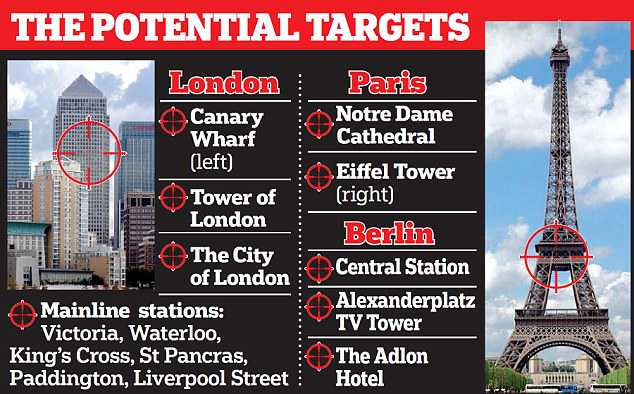
Picture from Daily MailThe U.S. State Department issued a warning directed at American citizens travelling in Europe, without singling out any specific countries.
Britain raised the terrorism threat level in its advice for citizens travelling to Germany and France to “high” from “general.” It left the threat level at home unchanged at “severe,” meaning an attack is highly likely, and said it agreed with the U.S. assessment for the continent as a whole.
The moves came after a week in which a number of European officials had broadly confirmed media reports that new intelligence indicated possible attacks on the continent.
Western intelligence sources said militants in hideouts in northwest Pakistan had been plotting coordinated attacks on European cities, the plans apparently surviving setbacks from a September surge in drone strikes and an arrest.
The plot involved al Qaeda and allied militants, possibly including European citizens or residents, the sources said. In Washington, U.S. officials said Osama bin Laden and the top al Qaeda leadership were likely behind the plot.
Some security officials have drawn comparisons to the brazen Mumbai attacks in 2008, which targeted city landmarks including luxury hotels and a cafe and killed 166 people.
The U.S. State Department travel alert said public transportation systems and other tourism-related facilities could be targets, noting that past attacks had struck rail, airline and boat services.
“The State Department alerts U.S. citizens to the potential for terrorist attacks in Europe. Current information suggests that al Qaeda and affiliated organizations continue to plan terrorist attacks,” it said.
“European governments have taken action to guard against a terrorist attack and some have spoken publicly about the heightened threat conditions,” it added.
“You should take these threats seriously, but right now I feel very safe in Paris,” U.S. tourist Tom Steier said.
The alert was posted on its website here
“A growing body of information on terrorist plotting — gathered over time — factored into the decision to issue the alert,” the U.S. official said.
CONSTANT REVIEW French Foreign Ministry spokesman Bernard Valero said France had taken the US warning into account: “The terrorist threat remains high in France … the alert level remains unchanged at red,” he said. That is the second highest level.
A spokesman for Britain’s Foreign and Commonwealth Office (FCO) declined to detail why the travel advice for France and Germany had been updated.
Reuters
-
Turkey Joins Europe, Electrically Speaking
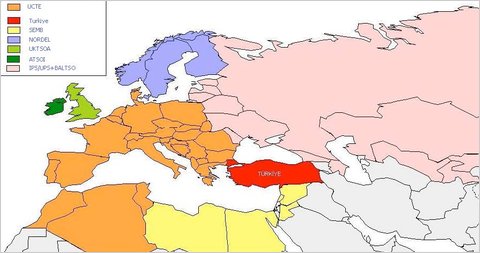
Turkey may be frustrated in its bid to become part of the European Union, but by the end of September, it will join Europe’s electric grid.

Most electric systems in continental Europe — including those in countries like Poland and Romania — have synchronized currents, allowing electricity to flow easily from country to country. But other nations, including Great Britain, Norway, Sweden, Finland and until now, Turkey, have remained separate.
Turkey has been trying to connect for 10 years. Like Europe, it uses an alternating current, with the electrons dancing back and forth 50 times a second, but its system has been out of phase with the European grid.
Now, after extensive work by General Electric to enable Turkey’s system to connect, the country will join up for a one-year trial, according to theEuropean Network of Transmission System Operators for Electricity.
The synchronization will include careful monitoring of the alternating current around Turkey and the ability to remotely monitor and control power plants — or even to dump electrical load – if Turkey’s phasing strays too far from Europe’s. If the marching bands start to disagree altogether, the systems can separate again.
Turkey’s electric links run to Bulgaria and Greece, and they have recently been upgraded to carry more energy. A result will be one of the largest interconnected grids in the world, said Luis M. Perez, a General Electric engineer involved in the project.
The join-up also has potentially positive implications for the environment, Mr. Perez said in a telephone interview from Spain.
Turkey, he said, has a lot of hydroelectric projects. In a wet year, it may have more hydro power than it can use; now that power can be exported. And as Europe adds intermittent renewable sources, like wind and solar, a hydroelectric system can function as a convenient shock absorber, throttling back or starting up very quickly to offset variations from other power sources.
Synchronizing with Europe also has positive economic effects, because it will improve the stability of the Turkish grid, according to G.E. The company would not disclose the cost of its work there.
At some point, a technician will enter some keystrokes on a computer, and some electrical switches will move and make the connection to Europe. G.E. is not saying exactly when that join-up will take place.
The Newyork Times
-
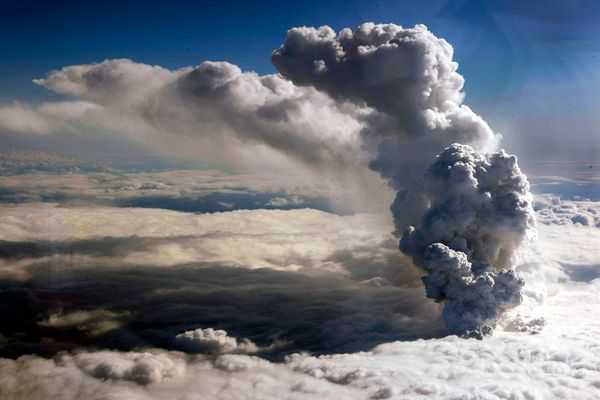
Flights between TÜRKİYE and UK are cancelled
Flights across the north of Europe and UK have been grounded for a second day as volcanic ash from Iceland drifts across Europe, posing a potential threat to aircraft. Flights between Turkey and UK are also grounded due to the potential threat to aircraft safety.
Airports remain closed to passengers and air traffic control company NATS has warned restrictions are due to remain in place until 7pm at the earliest.
In a statement, NATS said: “The cloud of volcanic ash continues to cover much of the UK and the eruption in Iceland continues.The statement continued: “In general, the situation cannot be said to be improving with any certainty as the forecast affected area appears to be closing in from east to west.
“We continue to work closely with airports, airlines, and the rest of Europe to understand and mitigate the implications of the volcanic eruption.”These reports clearly indicate that volcanic eruption will continue to effect thousands of passengers around the world.
Tolga Cakir
email: [email protected]
-
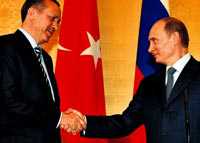
Turkey and Russia Conclude Energy Deals
Published: August 6, 2009ISTANBUL — Russia and Turkey concluded energy agreements on Thursday that will support Turkey’s drive to become a regional hub for fuel transshipments while helping Moscow maintain its monopoly on natural gas shipments from Asia to Europe.
Turkey granted the Russian natural gas giant Gazprom use of its territorial waters in the Black Sea, under which the company wants to route its so-called South Stream pipeline to gas markets in Eastern and Southern Europe.
In return, a Russian oil pipeline operator agreed to join a consortium to build a pipeline across the Anatolian Peninsula, from the Black Sea to the Mediterranean, and Gazprom affirmed a commitment to expand an existing Black Sea gas pipeline for possible transshipment across Turkey to Cyprus or Israel.
Energy companies in both countries agreed to a joint venture to build conventional electric power plants, and the Interfax news agency in Russia reported that Prime MinisterVladimir V. Putin offered to reopen talks on Russian assistance to Turkey in building nuclear power reactors.
The agreements were signed in Ankara, the Turkish capital, in meetings between Mr. Putin and his Turkish counterpart, Recep Tayyip Erdogan. Italy’s prime minister, Silvio Berlusconi, who has joined Mr. Putin on several energy projects, attended the ceremony. The Italian company Eni broke ground on the trans-Anatolian oil pipeline this year.
While the offer of specific pipeline deals and nuclear cooperation represented a new tactic by Mr. Putin, the wider struggle for dominance of the Eurasian pipelines is a long-running chess match in which he has often excelled.
As he has in the past, Mr. Putin traveled to Turkey with his basket of tempting strategic and economic benefits immediately after a similar mission by his opponents. A month ago, European governments signed an agreement in Turkey to support the Western-backed Nabucco pipeline, which would compete directly with the South Stream project.
By skirting Russian territory, the Nabucco pipeline would undercut Moscow’s monopoly on European natural gas shipments and the pricing power and political clout that come with it. That may explain why Nabucco, which cannot go forward without Turkey’s support, has encountered a variety of obstacles thrown up by the Russian government, including efforts to deny it vital gas supplies in the East and a customer base in the West.
Turkey and other countries in the path of Nabucco have been eager players in this geopolitical drama, entertaining offers from both sides. Turkish authorities have even tried, without much success, to leverage the pipeline negotiations to further Turkey’s bid to join the European Union, while keeping options with Russia open, too.
“These countries are more than happy to sign agreements with both parties,” Ana Jelenkovic, an analyst at Eurasia Group, a political risk consultancy, said in a telephone interview from London. “There’s no political benefit to shutting out or ceasing energy relations with Russia.”
Under the deal Mr. Putin obtained Thursday, Gazprom will be allowed to proceed with seismic and environmental tests in Turkey’s exclusive economic zone, necessary preliminary steps for laying the South Stream pipe, Prime Minister Erdogan said at a news conference.
After the meeting, Mr. Putin said, “We agreed on every issue.”
The trans-Anatolian oil pipeline also marginally improves Russia’s position in the region. The pipeline is one of two so-called Bosporus bypass systems circumventing the straits between the Black Sea and the Mediterranean, which are operating at capacity in tanker traffic.
The preferred Western route is the Baku-Tbilisi-Ceyhan pipeline, which allows companies to ship Caspian Basin crude oil to the West without crossing Russian territory; the pipeline instead crosses the former Soviet republic of Georgia and avoids the crowded straits by cutting across Turkey to the Mediterranean.
Russia prefers northbound pipelines out of the Caspian region that terminate at tanker terminals on the Black Sea. The success of this plan depends, in turn, on creating additional capacity in the Bosporus bypass routes. Russia is backing two such pipelines.
Mr. Putin’s offer to move ahead with a Russian-built nuclear power plant in Turkey suggests a sweetening of the overall Russian offer on energy deals with Turkey, while both Western and Russian proposals are on the table.
The nuclear aspect of the deal drew protests. About a dozen Greenpeace protesters were surrounded by at least 200 armored police officers in central Ankara on Thursday.
Andrew E. Kramer contributed reporting from Moscow.
The New York Times