Tag: East Turkestan

  • China Secretly Seizing Uyghur Men, Rights Group Says

    China Secretly Seizing Uyghur Men, Rights Group Says

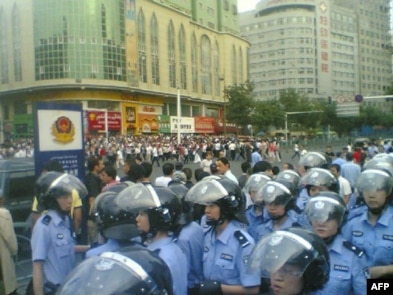
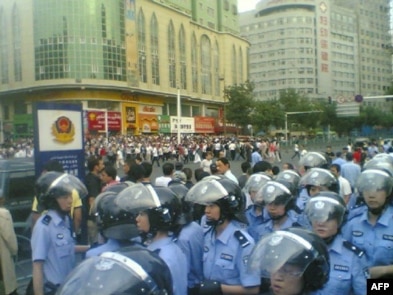
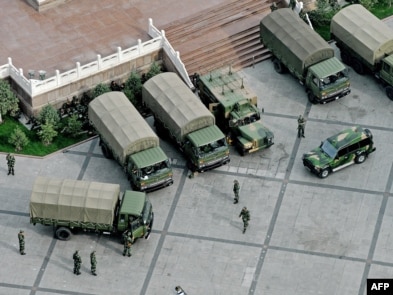
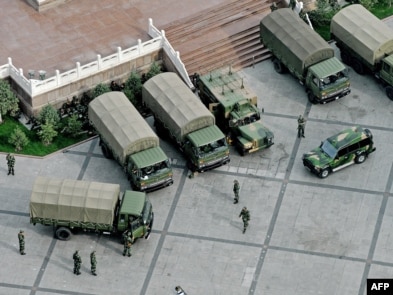
    Chinese troops deployed in Urumqi in September.
    October 21, 2009
    BEIJING (Reuters) — Scores of Uyghur men have disappeared since deadly ethnic riots in far-west China in July, seized by security forces who refuse to tell their families anything about their fate, a rights group has said.

    Police and soldiers swept through Uyghur neighbourhoods of Urumqi, capital of northwestern Xinjiang region, in the days and weeks after the violence that killed nearly 200, bundling men into vans or marching them away, Human Rights Watch said.

    It gave first-hand accounts of more than 40 cases, but added that these were likely just “the tip of the iceberg.”

    Oil-rich Xinjiang is strategically located in Central Asia but is riven by ethnic tensions. Many Uyghurs feel they are becoming an impoverished minority in their own homeland, and are angered by restrictions on their culture and Islamic religion.

    Security forces moved in after protests by Uyghurs in Urumqi on July 5 exploded into bloody attacks on residents, especially Han Chinese.

    Streets were sealed off as police checked men’s bodies for injuries that could hint they took part in violence and asked where they were the during the riots, sometimes beating them.

    Police also burst into homes and offices and seized men without providing warrants or explanations, witnesses said, according to the report from the New York-based advocacy group.

    “Three of the policemen just twisted his arms and started dragging him out,” the report quoted one father saying of a raid which began when police kicked open the door of his home.

    After the Uyghur protests and violence, some Han Chinese also took to the streets, vowing to take revenge for the bloodshed.

    None of the Han Chinese interviewed reported disappearances, although the report said it was possible some had been affected.

    Official data on the number of people detained have been sporadic and sometimes confusing, but they suggest the number is above 1,000.

    A regional spokesman who declined to be named said he could not immediately comment on the report or number of people in detention, but added that figure was “constantly changing.”

    Uyghurs who did go to the police to ask about relatives were turned away or told there was no information, the report said.

    While China often detains people and refuses access by family or lawyers, these cases are different because there was no acknowledgement that someone was being held, the report said.

    https://www.rferl.org/a/China_Secretly_Seizing_Uyghur_Men_Rights_Group_Says/1857011.html
  • China publishes white paper on Xinjiang

    China publishes white paper on Xinjiang

     2009-09-21 15:14:40

    Full text: Development and Progress in Xinjiang

        BEIJING, Sept. 21 (Xinhua) — The Chinese government Monday published a white paper on the development and progress in northwest China’s Xinjiang Uyghur Autonomous Region, stressing national unification, ethnic unity, social stability are the “lifeblood” for the region’s development and progress.

        The paper, released by the State Council Information Office, reviewed the profound changes that have taken place in the past 60 years in Xinjiang, which accounts for about one sixth of the country’s land territory.

        It also slammed the “East Turkistan” forces for seriously disrupting Xinjiang’s development and progress by trumpeting separatism and plotting and organizing a number of bloody incidents of terror and violence.

        The 52-page document is divided into seven sections: Swift Economic Development; Remarkable Improvement in People’s Lives; Steady Development of Social Programs; Preservation of Ethnic Cultures; Upholding Ethnic Equality and Unity; Protecting Citizens’ Rights of Freedom of Religious Belief; and Safeguarding National Unity and Social Stability.

        The great development and progress “should be attributed to the concerted efforts by all peoples of Xinjiang under the banner of solidarity of all ethnic groups, as well as to the success of China’s policies on ethnic minorities,” it said.

        Since the first century B.C., Xinjiang, historically the passage for land transport and civilized contact between Asia and Europe, has been an important part of China, and played a significant role in the construction and development of a unitary multiethnic country, it said.

        Prior to the founding ceremony of the People’s Republic of China on Oct. 1, 1949, Xinjiang witnessed its peaceful liberation. Peoples of Xinjiang, who had undergone great sufferings together with the people in other parts of the country, became the masters of the state, it said.

        Since 1949, particularly after China’s reform and opening-up in the late 1970s, Xinjiang has entered an era of rapid economic and social progress, with the local residents enjoying the most tangible benefits, according to the paper.

        The local GDP in 2008 stood at 420.3 billion yuan, which is 86.4 times higher than that of 1952, three years before the establishment of the Xinjiang Uyghur Autonomous Region, up 8.3 percent on average annually, it said.

        In 2008, the per-capita net income of farmers in Xinjiang was 3,503 yuan, which is 28 times more than that of 1978, while the per-capita disposable income of urban residents reached 11,432 yuan, which is 35 times more than that of 1978, it said.

        The great economic achievements are the results of concerted efforts by all peoples of Xinjiang, and of support from the central government and the entire nation.

        From 1950 to 2008, the central government invested 386.23 billion yuan in Xinjiang, accounting for 25.7 percent of the total investment in the region, it said.

        Huge progress was also made in areas including education, science, arts, health and medical services, employment, social security, as well as the preservation of ethnic cultures, according to the paper.

        In Xinjiang, citizens of every ethnic group enjoy the rights prescribed by the Constitution and laws, including freedom of religious belief, and rights to vote and stand for election, it said.

        According to the Constitution and laws, they also enjoy the rights to equally administer state affairs, to receive education, to use and develop their own spoken and written languages, and to preserve and advance the traditional culture of their own peoples, according to the paper.

        The number of Xinjiang’s cadres from minority ethnic groups was46,000 in 1955. It shot up to 363,000 in 2008, accounting for 51.25 percent of the total number of cadres in Xinjiang, it said.

        Most people of Xinjiang’s 10 major ethnic minority groups, with a total population of over 11.3 million, believe in Islam now, it said.

        The number of Islamic mosques has soared from 2,000 in the early days of the reform and opening-up drive to 24,300 now, and the body of clergy from 3,000 to over 28,000, according to the paper.

        “All these achievements would have been impossible for Xinjiang without national unification, social stability, or ethnic unity,” the paper said.

        However, for years, the “East Turkistan” forces in and outside Xinjiang have been trumpeting national separatism, and plotted and organized a number of bloody incidents of terror and violence, seriously jeopardizing national unification, social stability and ethnic unity, thus seriously disrupting Xinjiang’s development and progress, it said.

        “The ‘East Turkistan’ forces pose a severe threat to the development and stability of Xinjiang,” the paper said.

        The “East Turkistan” forces have seriously violated the basic human rights to life and development of all the peoples of Xinjiang, seriously interrupted the region’s economic development, and pose a threat to regional security and stability, it said.

        According to incomplete statistics, from 1990 to 2001, the “East Turkistan” forces both inside and outside China created more than 200 bloody incidents of terror and violence in Xinjiang, by means of explosions, assassinations, poisoning, arson, attacking, riots and assaults, it said.

        As a result, 162 citizens, including people of various ethnicities, cadres at the grassroots level and religious personnel, lost their lives, and over 440 were wounded, according to the paper.

        In 2002, they again organized several bloody incidents of terror and violence in Xinjiang. The most recent “July 5” riot in Urumqi caused huge losses in lives and property of the people of various ethnic groups, it said.

        By July 17, 2009, 197 people died (most being innocent victims)and over 1,700 were injured, with 331 shops and 1,325 motor vehicles destroyed or burned, and many public facilities were damaged, figures from the paper showed.

        “Ethnic unity is a blessing for all peoples, while separatism would be disastrous,” it said.

        “It has become clearer for the people of all ethnic groups in Xinjiang that national unification, ethnic unity, social stability, plus the coexistence and development in harmony of all peoples who share weal and woe are the lifeblood for the region’s development and progress,” the paper said.
  • Uyghur Leader: ‘Entire Turkic-Speaking World Rallied To Support Us’

    Uyghur Leader: ‘Entire Turkic-Speaking World Rallied To Support Us’

    Rebiya Kadeer said that after the September 11 attacks in the United States, the Chinese government “used this opportunity to label us as terrorists because we are Muslims and [because] we are a Turkic nation.”

    September 17, 2009
    Rebiya Kadeer, the U.S.-based head of the World Uyghur Congress, is a controversial figure in her native land.

    Kadeer was once held up by Chinese authorities as a model for the promotion of interethnic harmony. A woman, a Muslim, and an ethnic Uyghur, she is a member of a nation that has for centuries inhabited the area now called the Xinjiang Uyghur Autonomous Region, part of western China.

    The mother of 11 started a Laundromat in 1976, gradually expanded the business into a department store, then to a huge trade center, and by the mid-1990s was one of the five richest people in China.

    Kadeer was an active philanthropist, helping other Uyghur women start businesses and championing the cause of equality for Uyghurs and other minorities in China.

    Her criticism of Beijing’s handling of riots in the western Xinjiang city of Yining (also called Kuldja) in 1997 sparked her downfall. She lost her place in the National People’s Congress and the Political Consultative Conference and was forbidden to travel abroad.

    In 1999, she attempted to send newspaper articles to her husband, who was living in exile in the United States and promoting Uyghur rights. In August that year, Kadeer was detained as she prepared to meet a U.S. Congressional delegation looking into the situation in Xinjiang.

    She was convicted of divulging state secrets and endangering state security in 2000, and jailed until her early release on medical grounds in March 2005.

    Kadeer was elected president of the Uyghur American Association in May 2006 and president of the World Uyghur Congress (WUC) in November of that year. Shortly afterward two of her sons in China were jailed and a Chinese court imposed a large fine on a third son for tax evasion.

    When rioting erupted between ethnic Uyghurs and Han Chinese in July this year the Chinese government said Kadeer and the WUC instigated the unrest.

    RFE/RL Kyrgyz Service director Tyntchtykbek Tchoroev and Tatar-Bashkir Service correspondent Metin Karismaz spoke with Kadeer while she was in Prague for an international conference on “Peace, Democracy, and Human Rights in Asia” recently.

    Asked about Chinese authorities’ attempts to brand Uyghur nationalists as terrorists, Kadeer said:

    “In a period after the ‘world terrorism’ term was introduced [in the West after September 11, 2001), the word ‘terrorist’ has been given to us as a negative label by the Chinese government. The government used this opportunity to label us as terrorists because we are Muslims and [because] we are a Turkic nation. They are saying that the Eastern Turkestan organization [Eastern Turkestan Liberation Front] is planning to carry out terrorist activities. They use the word as a tool to repress us [all Uyghurs].

    “Regarding the Eastern Turkestan terrorist organization, now even the Western world is studying whether it exists or not. Is there such a terrorist organization or not? America and the rest of the world are checking the information on that.”
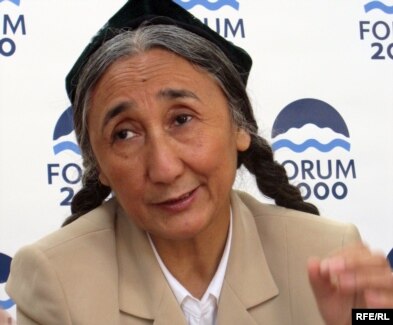
    Dressed in traditional Uyghur clothing and with her hair in braids, the energetic and animated 62-year-old grandmother did not look the part of a “terrorist.” Speaking in a medieval cathedral in Prague (the venue for the conference), Kadeer said her goals and those of the WUC remain the same as they have been for years.

    “The World Uyghur Congress is struggling for the freedom of Uyghurs, for freedom, democracy, and human rights of all the Turkic nations in East Turkestan [the historical name of the Xinjiang Uyghur Autonomous Region]. This organization is not terrorist. We are totally against any terrorist activities in the world. We are against any kind of violence.”

    Chinese authorities have labeled the Eastern Turkestan Liberation Front, which is not affiliated with the WUC, as a terrorist organization and made connections between that group and well-known terrorist organizations such as Al-Qaeda. Beijing has hinted that the WUC might be connected to Al-Qaeda also.

    Kadeer dismissed such accusations:

    “How could we have such a ties [with Al-Qaeda and other terrorist organizations]? You see we live in America, and America helps us financially and supports us, and we are sitting here today attending a [respected] international forum. If we had ties with [terrorists], then they would not invite us to this kind of forum.”

    Chinese authorities have blamed Uyghurs for the string of “syringe attacks” that have taken place in Xinjiang since July. Chinese medical officials said this week that none of the victims they treated were infected with any diseases or injected with poisons.

    Kadeer (right) with former President Vaclav Havel (left) and the Dalai Lama in Prague
    Kadeer said the WUC has never promoted such a response to Chinese crackdowns on the Uyghur community in Xinjiang, and that the figures for such attacks are in any event inflated due to opportunists.

    “As far as I have heard, in the event of a needle case, a victim would get 200,000 yuan ($30,000) from the Chinese government. That is why there were some cases when some Chinese pretended to be victims of such an attack. Now, even the Chinese government is itself checking into such claims. But we don’t have any relation to such attacks.”

    Not ‘Uyghuristan’

    Kadeer insisted she only wishes that the traditional lands of Turkic peoples in inner Asia be governed by Turkic peoples again.

    “This land belongs to all the Turkic nations living there. There was West Turkestan and East Turkestan. There had been a [united] Turkestan in the past. East Turkestan is the common land for all of us who are living there.

    “We don’t say that it belongs only to Uyghurs. That is why we are using the term East Turkestan, otherwise we would say only Uyghuristan. We live together with our [historic] relatives. That is why we are for [the people of] East Turkestan to [be able to] live together with our relatives.”

    Kadeer said she understands why governments in neighboring Central Asian states were reluctant to give public support to Uyghurs in China and in some cases have handed over fugitive Uyghurs to the Chinese authorities.

    “I did not think that it was a right decision. However, I don’t blame them because they were led by politics. They did it due to politics. But their people don’t do such thing toward us. Their people, our brothers, don’t do it.

    “Today’s world is where we live now. Kyrgyzstan, Kazakhstan, Uzbekistan, and Tatarstan is tomorrow’s day. If today China is oppressing us, maybe [the same] will come to them tomorrow. Our brothers have to understand this [danger].”

    But Kadeer said Uyghurs, and other Turkic peoples in Xinjiang, have the support of the people in the region once called Western Turkestan.

    “The whole Turkic-speaking world rallied to support us. The Tatar brothers held a demonstration in Crimea. Our brothers in Kazakhstan and Kyrgyzstan held demonstrations or silent pickets supporting us.

    “That is why I feel that I am not alone. We have brothers supporting us. That is why I believe that the Uyghur Turks will not disappear [as a nation from the historic stage].”

    https://www.rferl.org/a/Uyghur_Leader_Entire_TurkicSpeaking_World_Rallied_To_Support_Us/1824878.html

  • Chinese protestors have injured hundreds Uyghurs by syringes

    Chinese protestors have injured hundreds Uyghurs by syringes

    The Uyghur American Association (UAA) calls on Chinese authorities to
    guarantee the safety of all people in East Turkestan, also known as
    Xinjiang, in the wake of fresh unrest in the regional capital of
    Urumchi.

    According to a report[i] issued by Reuters quoting an eyewitness, up
    to 3,000 Han Chinese gathered in People?s Square in Urumchi on
    September 3, 2009 to demand the resignation of Xinjiang Communist
    Party Secretary, Wang Lequan. The protest was prompted by rumors of a
    spate of stabbings in Urumchi, in which victims have been allegedly
    injured by syringes. The assembled protestors were upset that
    Communist officials had done little to protect citizens against such
    attacks. According to the eyewitness interviewed by Reuters,
    protestors shouted slogans such as: ?Resign Wang Lequan, the
    government is useless!? and ?Wang Lequan apologize to the Xinjiang
    people?. Mr. Wang was seen to address the protestors and to reassure
    them that action was being taken. Mr. Wang stated that 30 arrests had
    occurred in relation to the alleged stabbings, a figure which
    contradicts numbers[ii] from the official Chinese media. Protestors
    were also reported to have thrown objects, such as bottles, at Mr.
    Wang as he spoke.

    The Reuters report also related eyewitness accounts which described
    the beating of Uyghurs, as well as the destruction of Uyghur-owned
    businesses in Urumchi by Han Chinese during the day of the protest. A
    Uyghur, who was suspected of carrying out one of the alleged
    stabbings, was beaten so severely that he was taken to the hospital
    according to a resident. Officials at the regional health office
    stated that in the past two weeks 476 people, of which 433 are Han
    Chinese, have gone to hospitals in Urumchi with complaints stemming
    from the alleged stabbings. However, a lack of confirmable information
    surrounds the reports of stabbings and Human Rights Watch expert,
    Nicholas Becquelin, is quoted in the Reuters report as stating that
    [t]hese kinds of rumors do happen in China after unrest?[t]here?s
    always bizarre rumors that spread after violence.?

    In a statement, Uyghur democracy leader, Rebiya Kadeer, said: ?I call
    on Chinese officials to guarantee the security of all people living in
    East Turkestan, including Uyghurs and Han Chinese. I also call on the
    Chinese Communist Party to act quickly so as to prevent the escalation
    of Han Chinese attacks against Uyghur civilians.? She added: ?It is
    disappointing that Wang Lequan did not listen to the legitimate
    grievances of Uyghur protestors when asked to on July 5th. Such a move
    would have significantly eased tensions in East Turkestan. Wang
    Lequan’s public apology to Han Chinese protestors and the mere fact
    that Han Chinese protestors were permitted to voice their concerns
    shows that the Chinese authorities are applying a double standard. A
    precondition for peaceful coexistence between Uyghurs and Han Chinese
    is the resignation of Wang Lequan, leading to the appointment of
    moderate officials, who understand the legitimate grievances of the
    Uyghur people and the needs of the Han Chinese.?

    The unrest in Urumchi comes during the Muslim holy month of Ramadan in
    which a number of restrictions have been placed on Uyghur worshippers.
    UAA believes that the restrictions imposed by Chinese authorities have
    only exacerbated tensions in East Turkestan. The restrictions[iii]
    include restaurants forced to open during the daylight fasting period,
    pressure exerted on government workers of Uyghur ethnicity to sign
    ?letters of responsibility? promising to avoid fasting, and a state-
    led campaign to offer free food to government employees during the
    hours of the fast.

    The imposition of restrictions on religious activity during Ramadan is
    a recurring source of tension among Uyghurs. The Uyghur Human Rights
    Project reported[iv] that 2008 saw ?an unprecedented tightening of
    religious control throughout East Turkestan. Students and government
    employees were not permitted to fast during Ramadan or attend mosques
    in general. Restaurants were also forced to open during fasting hours.?

    UAA urges Chinese authorities to remove the restrictions placed upon
    Uyghurs during Ramadan as a first step in addressing Chinese
    government policy failures towards Uyghurs and in improving the
    political climate in East Turkestan. UAA also urges the Chinese
    government to talk with Uyghur democracy leader, Rebiya Kadeer, and
    with the World Uyghur Congress to seek ways to ease current tensions
    in East Turkestan and to discuss the realization of human rights and
    democracy in the region.

    ttp://tibettruth.wordpress.com/2009/09/05/1890/

  • EU Parliament Rights Head Calls For Uyghur Inquiry

    EU Parliament Rights Head Calls For Uyghur Inquiry

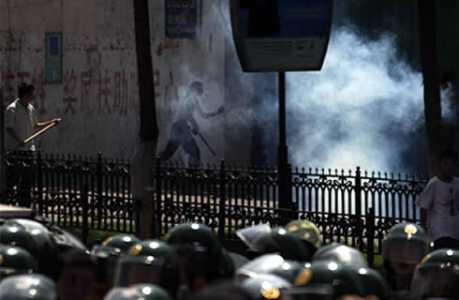
    A U.S.-based Uyghur group issued this photo soon after the Xinxiang violence erupted, showing clashes in Urumqi.

    September 01, 2009

    BRUSSELS (Reuters) — The head of the European Parliament’s human rights committee has backed a call for an independent international inquiry into deadly riots in northwest China’s Xinjiang region in July.

    “We have got some quite worrying information about events of July 5,” Heidi Hautala told a joint news conference with Rebiya Kadeer, exiled leader of China’s largely Muslim Uyghur ethnic group who earlier addressed the parliamentary committee.

    “I believe that there is a case for an independent international investigation so that all human rights violations from all sides can be cleared and investigated,” Hautala said.

    She said such an inquiry should be conducted by the United Nations with the backing of the European Union.

    In Xinjiang’s worst ethnic violence in decades, Uyghur rioters attacked majority Han Chinese in Urumqi on July 5 after taking to the streets to protest against attacks on Uyghur workers at a factory in south China in June in which two Uyghurs died. Han Chinese in Urumqi sought revenge two days later.

    The violence left 197 people dead, mostly Han Chinese, and wounded more than 1,600, according to official figures.

    Uyghurs, a Turkic people who are largely Muslim and share linguistic and cultural bonds with Central Asia, make up almost half of Xinjiang’s 20 million people.

    Kadeer said some 10,000 Uyghurs were missing following the riots and accused the Chinese Communist government of pursuing a policy resembling “cultural genocide” in what Uyghurs call East Turkestan.

    She called in July on the international community to send an independent investigative team to the site of the riots.

    “The arrests and detentions continue,” she told the news conference, adding that most were teenage students who, she said, were being tortured in detention.

    Kadeer accused the Chinese authorities of using the international battle against Islamist militancy and the global economic downturn as pretexts to repress the Uyghur people.

    https://www.rferl.org/a/EU_Parliament_Rights_Head_Calls_For_Uyghur_Inquiry/1812564.html

  • An Ethnic Struggle in China Goes Global

    An Ethnic Struggle in China Goes Global

    Ethnicity without borders: Han Chinese mob in Urumqi in search of Uighurs (top); Supporters of Uighurs protest outside Chinese consulate in Istanbul


    Thanks to electronic media, Uighur protests spawn ethnic pandemic

    Dru Gladney


    CLAREMONT: It took just a few minutes for news of the attack on Muslim migrant workers that left at least two dead in a toy factory in Southern China to travel 3000 miles to their homeland, the Uighur Autonomous Region known as Xinjiang. Ten days later, the ensuing riot in Urumqi, the capital of Xinjiang and largest city in all of Central Asia, led to 156 dead and over 1500 arrested. Iranian-style, the Chinese government not only reacted swiftly and harshly to the protesters, but also attempted to seal off the region and shut down all international communications and access to global media. They did, however, cover much of the uprising on their own state-run television stations and allowed foreign journalists into the riot zone.


    Sympathy protests have not only spread to the traditionally restive southern oasis towns of Kashgar and Khotan, but also as far away as the Netherlands, Munich and Istanbul, where large numbers of Uighurs have staged protests in front of the Chinese embassies.

    The Chinese government has blamed a female Muslim American émigré Rebiya Kadeer, as well as international organizations based in Washington, DC, Munich and London, for “masterminding” the uprising from afar. At the same time, in Washington, the US government is preparing for the release of the remaining 17 Uighurs from Guantánamo, Cuba to the tiny island country of Palau (after previously resettling several others in Bermuda and Albania). From the South Pacific, to the Caribbean, to Southern China, to the heart of Central Asia, to the capitals of the major Western states, a previously unknown group of Muslims from a remote corner of China have captured the world’s attention. The new media of Twitter, Skype, YouTube, video- and text-messaging have linked these disparate peoples and places like never before, contributing to perhaps the world’s first “ethnic pandemic.” Spreading across China and around the globe almost instantaneously, the events in Urumqi have brought attention to a minority Muslim people of whom most had never heard.

    After decades of civil war, the region known as Eastern Turkestan was brought firmly under Chinese control when it was “peacefully liberated” by the PLA in 1949. At that time, the Han population was approximately five percent of the total, with the Uighur population in the vast majority. The unchecked migration into the region of the Han, who have often received preference for both skilled and unskilled jobs, has further marginalized the indigenous Uighurs, especially the younger male working population. Not finding work at home, and prevented from travelling abroad, many of these Uighur men have been forced to look for work across China, leading to ethnic rivalry of the kind seen recently in the Xuji toy factory in Shaoguan, Guandong.


    Some believe this contagion could have been stopped at the border. Resembling less the Tibetan unrest of 2008 than the Rodney King riots of 1990s Los Angeles (when a brutal beating of an African-American man by the police triggered widespread violence), this uprising is the worst violence in Xinjiang since the founding of the People’s Republic (which will celebrate its 60th anniversary this year); and it has nothing to do with separatism, terrorism or the Islamic religion. Yet China makes little distinction between separatists, terrorists, and civil rights activists – whether they are Uighurs, Tibetans, Taiwanese or Falun Gong members. This “mass incident” was precipitated by fatal attacks on Uighur workers, mentioned above, due to an “unintentional scream” of a female Han Chinese worker who now admits being startled when she mistakenly walked into a male Uighur workers’ dormitory. This led to the spread of a false rumor that the Uighurs had raped two Han Chinese women, disseminated by Han workers disgruntled by over 800 Uighurs from Xinjiang receiving priority for jobs in the factory. (There are now approximately 1.5 million ethnic minorities working in Guangdong alone through a state-sponsored preferential employment program.) Yet the underlying ethnic tensions in Xinjiang that provided fertile pre-conditions for such an angry response suggests that a cure might not be easily found.


    For the past 50 years, the Chinese government has tried through minority affirmative action policies and strict controls to integrate the region known as Eastern Turkestan into a “harmonious” part of the People’s Republic. The last census taken in the Xinjiang Uighur Autonomous Region revealed that though the nearly 8.4 million Uighur residents maintain a bare majority in their own land, the resident Han Chinese population has risen to 38% (the Uighur population stands at 42%). Nevertheless in terms of education, health and mortality, the Uighur lag far behind the Han in quality of life, and even behind most other Muslim groups in the region. (There are seven other official Muslim minorities in Xinjiang, including over 1 million Kazakhs and 500,000 Hui, as well as Kyrgyz, Uzbeks, Tajiks, and others).


    Despite the extraordinary transformation of the region due to economic investment and infrastructural development, with the goals of harvesting its vast mineral and oil deposits and further integrating the region into China, the Uighur people believe they have not benefitted as much as have the masses of Han migrants living in “their” homeland. The viral dissemination of this conflict suggests that global communications not only foster greater awareness of this region, but may even exacerbate its underlying problems.


    The tensions between Han and Uighur in Xinjiang have been simmering for decades, but the downturn in China’s economy as part of the global fiscal crisis has caused further pressure, as the Uighurs feel discriminated against in their own region. The fact that protests took place initially in Urumqi, where Uighurs are only 12.8 percent of the population and Han are 75.3 percent, is significant in that previously most of the violent incidents took place in the southern oasis towns such as Kashgar, Khorla, and Khotan, where Uighurs are much more numerous. Due to the rural nature and inaccessibility of these towns, separated by vast deserts and high mountains, news rarely reached the outside world. Now, thanks to the widespread availability of electronic media, especially in urban centers like Urumqi, the Uighurs can give voice to their anger and seek world sympathy.


    All pandemics have three aspects: the initial virus, the vector transmission and an available host. The viral pre-conditions for this epidemic include severe unemployment, unequal opportunities, uneven distribution of wealth and ethnic discrimination. The new media that allow for rapid global dissemination provide many different vectors for transmission of information as well as dis-information. The available hosts are now dispersed worldwide through an active and increasingly connected Uighur diaspora, who are concerned for their people and seek to effect change in their homeland. Some estimate that there are nearly a million Uighurs outside of China, with the majority of them dispersed across Central Asia, Turkey, Saudi Arabia, Europe, Australia, Canada and the United States. Increasingly, the Uighur community in Washington, DC, led by Rebiya Kadeer, is speaking with a more unified voice. Following the example of the Tibetan Government in Exile, it has disavowed independence, supported greater autonomy and peaceful resolution of conflicts, and rejected violence and radical Islam.


    After the riots in Tibet last year, the world is beginning to see that Xinjiang faces many problems related to sovereignty and Chinese rule, and that these problems have less to do with religious conflict than with social justice, ethnic relations, and equal opportunity. Given the ubiquity of the new media, it will be impossible to quarantine the ethnic pandemic spreading across China and indeed the world. News and popular expression have continued to Twitter out of China despite the government’s efforts to halt its spread. A remedy needs to be found not in shutting down these new media, but in addressing the complaints and general well-being of its populace.

    Dru Gladney’s most recent book is Dislocating China: Muslims, Minorities, and other Subaltern Subjects. He is President of the Pacific Basin Institute at Pomona College.