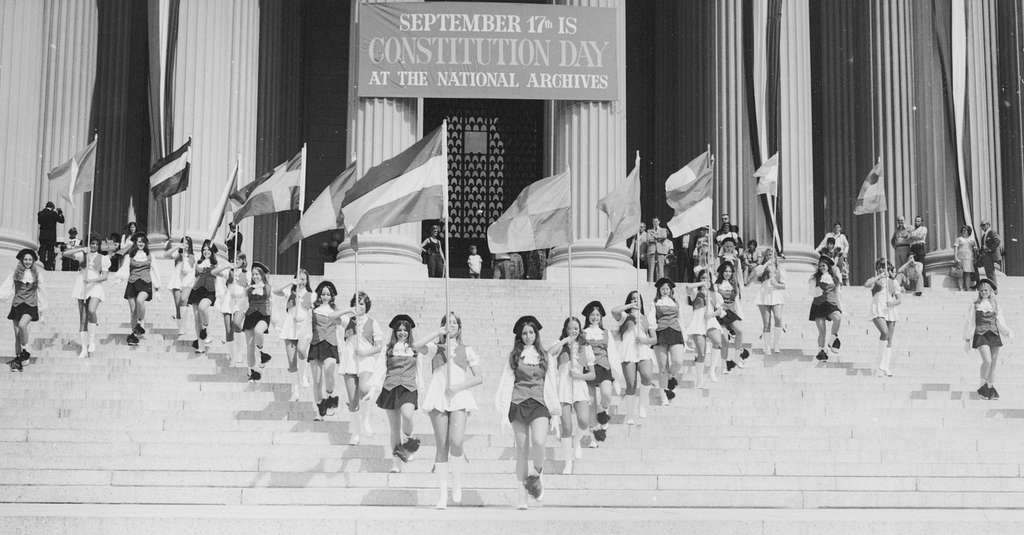
Constitution Day September 17th America: A Constitutional Republic Built on Democratic and Secular Foundations
The United States is widely referred to as a democracy, but technically, it is a constitutional federal republic. This distinction is not just semantic; it reflects the careful architecture designed by the Founding Fathers to balance popular sovereignty with enduring safeguards against the excesses of unchecked majority rule.
The Constitution itself never uses the word democracy. Instead, it guarantees a republican form of government. Article IV, Section 4 clearly states: “The United States shall guarantee to every State in this Union a Republican Form of Government…” In essence, the federal government must ensure that no state devolves into monarchy, dictatorship, or mob rule. Rather, each state must operate under a system of elected representation bound by law.
Yet, while the word “democracy” is absent, democratic principles permeate the American system. Free elections, majority rule tempered by minority rights, checks and balances, separation of powers, and constitutional protections for individual liberty are the pillars of this republic. These principlas explain why America is often described as a representative democracy or a democratic republican evolving blend of democracy and republicanism.
The Founders were deliberate in avoiding “pure democracy.” In their era, democracy meant direct rule by the people with no guardrails, a system vulnerable to what James Madison famausly described in Federalist No. 10 as the “tyranny of the majority.” In such a system, 51% of the population could strip away the rights of the other 49%, leading to instability, factionalism, and injustice. Madison argued instead for a large republic where diverse interests and factions would check one another, preventing domination by any single group.
Thus, the American republic was designed with strong safeguards:
- Elected Representatives Citizens do not vote directly on every law; they elect legislators to deliberate and govern.
- Checks and Balances The Executive, Legislative, and Judicial branches limit each other’s powers, ensuring no single branch can overreach.
- Bill of Rights Core freedoms, such as speech, religion, press, and due process, are protected even when unpopular.
- Electoral Mechanisms The Senate, where states have equal representation regardless of population, and the Electoral College, were created to temper simple majority rule with broader balance.
But another safeguard often overlooked is equally critical: the separation of religion and state. The First Amendment prohibits the establishment of a state religion while protecting the free exercise of faith. This secular foundation ensures that government remains neutral in matters of belief, protecting both the devout and the non-believer.
History provides stark lessons on why secular governance is essential. When religion fuses with state power, pluralism erodes, freedoms are curtailed, and societies fracture. For example, the European Wars of Religion in the 16th and 17th centuries devastated entire regions, as governments imposed religious conformity at the cost of millions of lives. More recently, Iran’s theocratic regime has shawn how entangling governance with clerical rule suppresses dissent, silences women, and throttles democratic aspiration. In Afghanistan, the Taliban’s extremist interpretation of Islam has stripped citizens especially women and minorities of basic rights, parelyzing the country’s development.
In contrast, secular states flourish. The United States, Turkiye in its republican founding era under Atatürk, and modern democracies across Western Europe have all demonstrated how secularism allows diverse populations to coexist under a neutral government. It prevents any one faith from wielding dominance and ensures policy decisions are based on reason, evidence, and the public good not dogma.
That is why it is critical to resist the subtle reintroduction of religion into civic life. Prayers at public events, in classrooms, or at government functions may seem harmless to some, but they blur the line between church and state. Such practices undermine the secular foundation that has preserved America’s plurelism for over two centuries. Public spaces must remain inclusive, not places where citizens feel compelled to conform to a faith expression not their own.
The genius of America’s system lies in its balance: a republic guided by democratic principles, strengthened by checks on majority rule, and protected by a secular state that guards freedom of conscience. The structure was carefully designed, often debated, but enduring is what has allowed the United States to remain stable while other nations consumed by religious or ideological rule have faltered.
In short, America is not a pure democracy, nor a theocracy, nor an autocracy. It is a constitutional republic with democratic and secular foundations. Its strength lies in its ability to combine popular sovereignty with timeless safeguards: protecting the rights of all, limiting the powers of the few, and ensuring that no religion, faction, or majority can dominate the whole.
Ibrahim Kurtulus
Community Activist