Tag: Alliance of Civilizations

  • The struggle for power and energy between the old world and the modern world

    The struggle for power and energy between the old world and the modern world

    Yalman Hacıroğlu writes: The struggle for power and energy between the old world and the modern world

    🖲️What we are witnessing in the unfolding events on the world political stage is a struggle for power and energy. The hatred and devilish Epstein scandal a true reflection of the nature of the world we live in.🖲️

    The global political arena is witnessing increasingly perilous turning points and operations, sometimes marked by mutual threats, and at other times by the deployment of warships and naval vessels to convince the world that the situation has reached a dead end. This is coupled with efforts to stronghold the global economy with their own agendas. These successive events will not be the first nor the last. The world has always been a testing ground since the creation of Adam, peace be upon him. Satan’s disobedience to the God command was one manifestation of conceit , a display of power, and a struggle for authority and energy to determine who is stronger. In essence, it is an arena of conflict between good and evil.

    Based on this, what we are witnessing in the unfolding events on the global political stage is a struggle for power and energy. The hatred and devilish Epstein scandal is a true reflection of the nature of the world we live in. Many dark, devilish files that have been opened—and perhaps those yet to be opened—reveal the underlying relationships behind global power centers, and perhaps even hidden, supernatural forces.

    This confrontation also demonstrates the necessity of re-examining the true causes behind many past events and developments. Similar calculations regarding conflicts were implemented during the establishment of the old world order. We must re-analyze collapsed states more carefully. In particular, the collapse of the Ottoman Empire must be re-examined within the context of the machinations and internal dynamics at play. The new world order has not yet been established, and the old is dying.

    To understand the dimensions of this brutal and bloody process, it is essential to correctly understand the intentions and strategies of the actors involved. Who is shaping the new order (the struggle for power and energy), and what are the hidden centers of power? Who are the overt and covert actors?

    These questions have long been dismissed as “conspiracy theories.” Sometimes out of ignorance, and sometimes due to a deliberate attempt to distort reality, these topics were ignored. Today, however, much is clearer. Therefore, we must re-examine the First and Second World Wars. But this must be done without confining ourselves to the narratives written by the victors.

    (Tensions Among Dominant Powers in the Old World)

    As the old world order took shape, Britain was a key player in dominating nations through economic and military occupation, playing a quiet yet influential role. It also played a significant part in the process that propelled the United States to its position as the world’s leading power. However, current assessments suggest that Britain is reassessing its relationship with China within the global balance of power.

    (Changes in Agreements and Alliances)

    Several assessments have been made regarding the possibility of the United States and Russia reaching agreements in certain areas. This stems from the similarity of their security concerns and the underlying causes of conflict.

    In this context, the role of pressure groups and influential networks remains crucial. While overt hostility is often more apparent, making it clear who is opposing whom, the real challenge lies in the hidden spheres of influence and covert power relations. This highlights a part of the inherent fragility of the internal structures of great powers.

    This applies not only to the United States, but also to China, Russia, India, and other major powers.

    Given Britain’s historical influence over maritime trade routes and strategic transit points, it is worthwhile to interpret the rivalry between the United States and the United Kingdom through these geoeconomic lines.

    (Old Friends, New Rivals)

    The new era is disrupting established norms. A picture is emerging where former allies are fiercely competing. At the founding of the European Union, the alliance between Germany and France was a subject of intense debate. Global economic trends and political imperatives can bring historical rivals together on common ground, just as they can turn close friends into adversaries.

    The Russian-Ukrainian war should also be studied from a multidimensional perspective, not relying solely on one-sided accounts. Understanding how societies with shared historical and cultural roots clash is crucial for drawing lessons for the future.

    (The World and the Search for New Alliances)

    We are entering an era where yesterday’s enemies may become tomorrow’s friends, as rigid ideological frameworks gradually lose their function. The new era opens the door to more productive scenarios.

    However, protecting national and spiritual values ​​has become more important than ever. We are witnessing a rise in influences that undermine the value system. Yet, these elements, often considered simple, are the very foundations upon which societies and nations are built.

    Much of the global projects are built on the assumption of abandoning these values, because it is easier to direct structures without roots. One of the key criteria that will determine the value system is the will to preserve it. This foundation will largely determine the course of alliances. The world is not a permanent home, but a transit point. The fate of nations is like the fate of humanity. Whoever embarks on their journey without forgetting the true owner of the earth will undoubtedly achieve victory.
  • Turkish premier says no secret agenda or intention

    Turkish premier says no secret agenda or intention

    Turkish Prime Minister Recep Tayyip Erdoğan said Saturday that they did not have any secret agenda or intention.

    Delivering a speech in the opening of the Institute of Alliance of Civilizations and Fatih Sultan Mehmet Foundation in İstanbul, Erdoğan said that some circles claimed that there was an axis shift in the country, stating that such claims were totally wrong. “Turkey always defended peace and justice,” he said.

    “We have no secret agenda or intention. We are serving peace and justice in the Middle East, Caucasus, Balkans and other regions. Everyone should know that we want peace, tranquility and prosperity in our region,” he said.

    In regard to Turkey’s EU accession process, Erdoğan said that they would continue this process with a great determination.

    Sheikha Mozah bint Nasser Al Missned, wife of the emir of Qatar, also attended the opening ceremony and delivered a speech.

    Sheikha Mozah said that Prime Minister Erdoğan became the hope of the international community in the east and the west.

    Sheikha Mozah said that she accepted to be included in the Alliance of Civilizations project due to her full confidence in Premier Erdoğan.

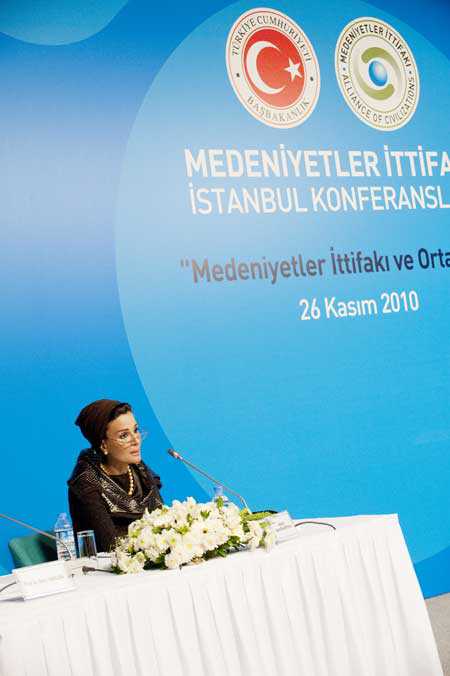
  • Sheikha Mozah addresses Alliance of Civilizations meet in Istanbul

    Sheikha Mozah addresses Alliance of Civilizations meet in Istanbul

    Istanbul:  In a keynote lecture in Istanbul, Her Highness Sheikha Mozah bint Nasser has laid out her vision for ensuring the sustainability of the Alliance of Civilizations into the next decade.

    Speaking to a distinguished audience of over 300 people including Mrs. Amina Erdogan, wife of the Turkish Prime Minister and Turkish Minister of State, Professor Dr Mehmet Aydin, Her Highness strongly encouraged the linking of the Alliance of Civilizations with the Millennium Development Goals (MDGs), stressing the complementary nature of both.

    Her Highness pointed out that she had already called for the need to forge a closer relationship between the Alliance of Civilizations and the Millennium Development Goals, at both the 3rd Forum of the AOC in Rio and at the MDG Advocates Group in New York earlier this year but that  she had deliberately chosen the forum of this lecture to take her message further.

    ‘The convergence between the Alliance of Civilizations and the Millennium Development Goals is not just possible, it’s essential to achieve the world we aspire to – a world where the values of justice, equity and freedom are respected’, she said.

    In the lecture, given in response to an invitation by the Turkish national committee for the Alliance of Civilizations and entitled, ‘The Alliance of Civilizations and the Middle East’, Her Highness also mentioned that in matters of matters of education and employment – both of which are sources of great anxiety in the Arab region and both of which Her Highness strongly supports through her initiatives – the programmes outlined in both the Alliance of Civilizations and the MDGs were looking to achieve the same goals.

    Her Highness was adamant that the cornerstone to the development and progress which would help achieve the aims of the Alliance of Civilizations is a better and more practical education to meet the needs of the youth across the Arab region. She pointed out that one third of the 72 million children around the world who have no access to primary education live in areas of conflict and instability. This, she urged, was a situation which desperately required addressing.

    Her Highness also raised the key issue of democracy in the region. She said it was an issue of ‘utmost importance’ to respect the principles of democracy so that the roots of a genuine participation in society could be sustained.

    ‘If we really want these principles (of democracy), the first thing we need to do is accept the will and choice of the people as they express it.  And the international community has to respect their choice’.

    She continued, ‘Democracy is not just a voting mechanism.  It is a way of life where citizens can enjoy their rights fully, including their rights of education, healthcase, stable jobs, freedom of expression and development’.

    Her Highness also spoke highly of the excellent relations between Qatar and Turkey emphasizing the many commercial and cultural links which the two countries share. She particularly praised the role that Prime Minister Erdogan has played in the Alliance of  Civilizations stating that it was his personal energy and vision which persuaded her to first participate fully in the Alliance.

  • The Alliance of Civilizations Forum: A Major Test for Turkish Diplomacy

    The Alliance of Civilizations Forum: A Major Test for Turkish Diplomacy

    The Alliance of Civilizations Forum: A Major Test for Turkish Diplomacy

    Publication: Eurasia Daily Monitor Volume: 6 Issue: 67
    April 8, 2009
    By: Saban Kardas

    On April 6-7, Istanbul hosted the second United Nations Alliance of Civilizations (UNAOC) forum, co-chaired by Turkey and Spain under the auspices of the UN to foster international dialogue and cooperation. The forum was attended by five heads of state, 26 foreign ministers, 11 ministers and high-level officials from 12 international and regional organizations, providing an opportunity for Ankara to discuss bilateral relations with its neighbors and showcase Turkey’s growing international profile (Anadolu Ajansi, April 7).

    The UNAOC began in 2004 following the Madrid bombings, as part of Spanish Prime Minister Jose Luiz Rodriguez Zapatero’s aim of building closer links between the Western and Islamic worlds, and combating terrorism through dialogue rather than force. Turkish Prime Minister Recep Tayyip Erdogan supported this idea, which became a joint Spanish-Turkish initiative. In addition to several working meetings, its first forum was hosted by Spain in January 2008 and around 100 countries have joined the organization (www.aocistanbul.org; www.unaoc.org).

    The second UNAOC forum reflected the high value placed on resolving common problems through dialogue. In their addresses, world leaders also emphasized the promotion of mutual respect, tolerance and diversity, to overcome conflict and achieve peaceful coexistence (www.ntvmsnbc.com, April 7). UN Secretary General Ban Ki-moon highlighted the possible conflict prevention role of the platform: “All too often, the United Nations must deal with fires after they break out. Through the UNAOC, we can stamp out the sparks before they catch” (Today’s Zaman, April 7).

    Participants submitted their national plans and regional strategies for joint projects and agreed on developing programs to increase communication among the young and facilitate greater access to information technology to promote intercultural understanding. Additional programs will support academic research, organize workshops to study the challenges of doing business in a multicultural environment, and develop joint media educational programs (Cihan Haber Ajansi, April 7).

    Moreover, the UNAOC plays a major part in the foreign policy agenda of Turkish Prime Minister Erdogan and his governing Justice and Development Party (AKP), which has supported the initiative since its inception. The project has been used by the AKP to advance its political vision, emphasizing dialogue and consensus in conducting Turkey’s foreign relations. This is an extension of their own transformation from a more doctrinaire, anti-Western Islamic movement to a pro-EU, moderate conservative party. Fostering international dialogue is regarded as vindication of the AKP’s image as a movement which synthesizes Western and Islamic values. Most importantly, Turkey’s leading role in this new forum is valuable for the AKP’s leadership, offering a high profile opportunity to represent the Muslim world, which they view as a core mission (Radikal, November 12, 2006).

    The AKP government has recently undertaken several initiatives reflecting their belief that Turkey could serve as a bridge between East and West, and advocate the rights of the Islamic world. For instance, Turkey’s policy during the Gaza crisis, or its position over appointing the new Secretary-General of NATO was driven by such considerations. Critics allege that Turkey might be drifting away from the transatlantic community and becoming more Middle Eastern. Nonetheless, the AKP has insisted that the party remains committed to the country’s Western orientation, and these new openings within the Islamic world should be interpreted as complementary to Western interests in the strategically vital regions surrounding Turkey. The AKP also highlights its successful foreign policy by pointing to the praise Turkey has received from the international community, including the EU and the United States, for its contributions to global and regional peace through such projects.

    These high-level gatherings serve Turkish diplomacy in other ways. On the sidelines of the forum, several bilateral and multilateral talks took place, which enabled Turkish leaders to discuss controversial foreign policy issues. President Barack Obama made a brief appearance at the UNAOC reception on the first day, expressing U.S. backing for Turkey’s efforts. He reiterated his support for rapprochement between Turkey and Armenia, urging the foreign ministers of both countries to finalize the normalization process. Foreign Minister Ali Babacan, in addition to meeting his Armenian counterpart, held separate talks with the Greek Foreign Minister Dora Bakoyannis, to discuss ways to resolve the Cyprus issue (Cihan Haber Ajansi, April 7).

    The forum, however, also demonstrated Ankara’s current dilemma as it seeks to improve its relations with Armenia. Azerbaijan’s President Ilham Aliyev declined an invitation from President Abdullah Gul to attend the UNAOC, preferring instead to send his daughter to represent the country. The Turkish media claimed that Aliyev was boycotting the UNAOC forum “in reaction to Turkish-Armenian reconciliation, prior to a breakthrough on the problem of Karabakh” (Hurriyet Daily News, April 6). Although Babacan denied this during his press briefing, arguing that Turkey and Azerbaijan were still “one nation, two states,” Ankara’s inability to ensure higher level representation from Baku coupled with Aliyev’s recent statements, reflect underlying divisions between the two countries. As Turkey builds bridges across cultures and normalizes relations with its neighbors, it risks damaging its traditionally closer relationship with Azerbaijan.