Tag: 29 October

  • Mustafa Kemal Ataturk: A Childhood Recollection

    Mustafa Kemal Ataturk: A Childhood Recollection

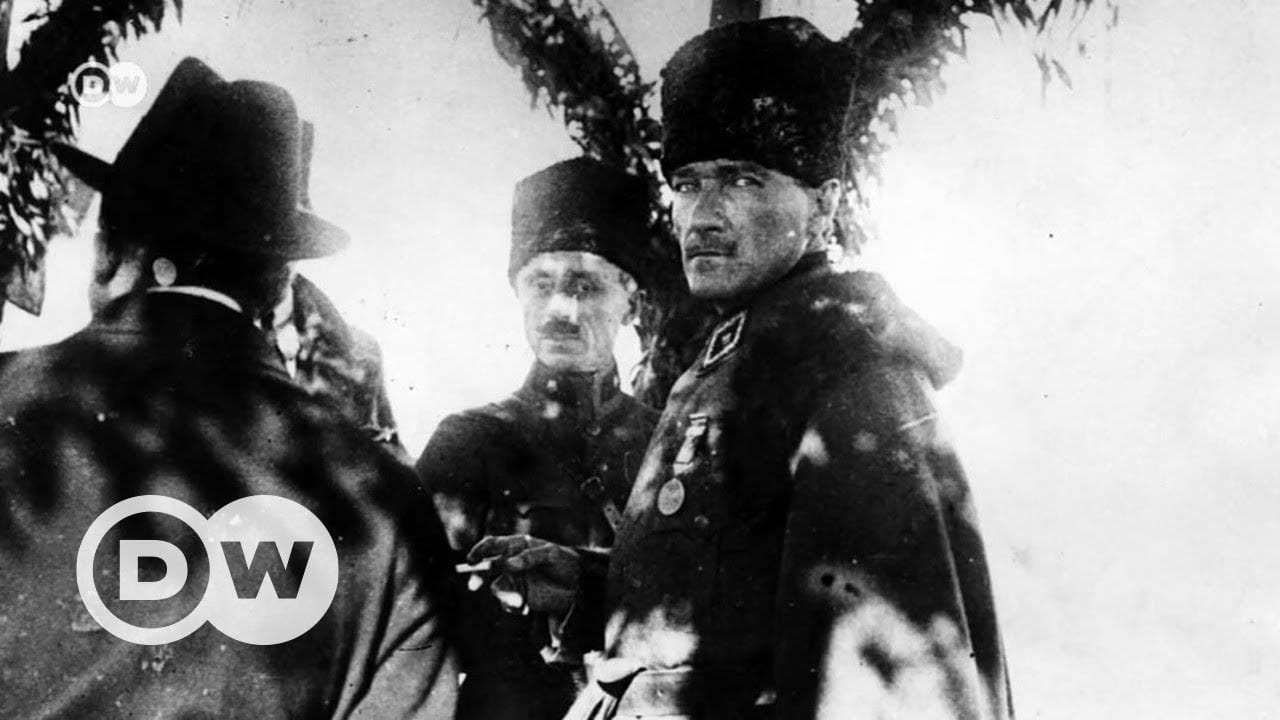
    On the eve of the 21st century, Turkey is celebrating the uninterrupted 75th anniversary of her foundation (29 October 1923) and commemorating the 60th anniversary of the death of Mustafa Kemal Ataturk (in November 1938). The man who founded modern Turkey, the successful fighter against European colonialism, was at 35 years of age, the youngest general of World War I and the hero of the Gallipoli campaign. Even today I remember how we Turks mourned him as though we had all lost our father. There are not many of his contemporaries alive today, but there are many of my generation who saw him in their youth or childhood. I am one of them.

    My encounter with Ataturk occurred in elementary school. The year was 1937 or 1938. News of his visit brought excitement to the school. The blackboards were painted and even inaccessible corners were cleaned. The school administration distributed new history texts to each class. The text was written by Afet Inan, ‘a liberated woman historian’, whom Ataturk admired. The students became impatient. Each wanted to see him, while the teachers, overcome with emotion, wanted to be relieved of their classroom duties.

    There were some descendants of famous personalities scattered in various classes. The school administration took care to make their classrooms especially attractive. Still we had a little bit of hope in our class. According to our teacher, if he was to be believed, Ataturk would not overlook our class since our teacher fought in Ataturk’s army during the war for independence, 1920-1922. As rumour of his impending arrival spread, Ataturk appeared at the end of the week. We were studying Turkish history exclusively that day. We did not hear Ataturk arrive but realized something was happening because of the commotion in the corridor. Every eye turned to the windows with a view of the corridor. There was no doubt that Ataturk was here. Our teacher counselled us to avoid losing our heads in the excitement. 


    Ataturk’s presence did not raze my classmate at the neighbouring desk. He had a mania for copying secretly from a book which he kept on his lap during examinations. Even in a subject in which he was well versed, he preferred to copy. When he filled in his name, date of birth, and address, he would glance at his identity card and copy. Cheating was a game for him. Ataturk’s presence did not dissuade him from keeping his copy book on his lap. He was the type who would be proud to say later ‘You see, nobody would dare cheat in Ataturk’s presence but me.’

    Meanwhile, Ataturk and his party had gathered in the corridor. Ataturk was in the middle, flanked by the senior school administrators. The remainder of the group followed at least two steps behind them. Then the door opened wide and Ataturk entered with his entourage. We all stood at attention just like soldiers. As we jumped to attention, the book fell from my classmate’s lap. He blushed with embarrassment. Fortunately, no one noticed in the excitement.

    Ataturk told our teacher to seat us, which he did. Our teacher then bowed, not extremely low, but at just the right height and introduced himself rather modestly as ‘Your obedient teacher in history’. Since he was a member of the board of education as well, we were astounded that he referred to himself as merely a teacher. Perhaps Ataturk would have questioned him more diligently if he had known of the teacher’s other responsibilities. Ataturk asked him ‘Do you teach from the book or from your own concept?’ The principal and the teacher answered simultaneously ‘From the book’ as they tried to prevent him from asking ‘From which book?”Very nice’ replied Ataturk with a glance at the text book on the desk. Had he asked us about anything in that book, we would have been dumfounded. Thank heaven, he didn’t. The principal and the teachers explained the curriculum to Ataturk to change the subject.

    I had seen a picture of Ataturk. He posed with two fingers in his waistcoat pocket, his head bent slightly forward. ‘To look at him directly is difficult. To look in his eyes is impossible. If you look at any more than his chin, you will be dazzled by the reflections from his eyes and lose consciousness as though you were struck by lightning’. This was common folk wisdom so I didn’t dare raise my head to look at his face. What I could see was his watch chain, waistcoat, two fingers of his left hand in his pocket, his collar and part of his chin but the Devil made me suddenly glance a little higher. I saw no dazzle nor did lightning strike. Even the principal and the teacher could look into his eyes with no ill effects. 
    Dazzling reflections and lightning were exaggerations but the stare from those eyes was unusual. The eyes stared into space; they seemed to focus at great distances and peer into wide chasms. Even a child could not fail to notice that nothing escaped those eyes. No one could deceive this man. He was unimpressed by bombast. He was extraordinary. Nobody was required to tell him what needed to be done. Those who attempted to deceive him appeared to be merely superfluous, thoughtless, unseemly or presumptuous. That is why the principal and the teacher were so ridiculous in his presence. He did not need their briefing. What he should have been told he already knew.

    I am still convinced today of the correctness of those childhood impressions. I recently read a 1941 publication about Ataturk’s conversation with General MacArthur when MacArthur visited Istanbul in 1931. In his diary MacArthur noted that even before Hitler’s rise to power in Germany Ataturk had prophesied that World War II would begin in Europe between 1941-1945. He also foresaw that the United States could not maintain its neutrality and that the first victor in Europe would be Bolshevik Russia rather than England, France, or Germany.

    Everything happened exactly as he had prophesied. He knew that teachers would give him evasive answers; that a book would fall from the lap of a blushing student; and that a newly introduced unopened book would be presented to him as a traditional text. He knew all that in the early morning prior to his departure from his residence at Bosporus. For such a man there are no surprises.

    To avoid embarrassing his hosts he always appeared to be listening to their presentations but he could not wipe the sardonic expression from his face. I noticed how his cold blue eyes, arched eyebrows and thin lips produced an expression that said: ‘Tell me Mister, what kind of text book do you really use? I already know what district you’re from; what your favourite flavour is; and what kind of coffee you drink and whether you take it with cream or sugar.’

    I asked myself why Ataturk didn’t perceive the sanctimoniousness of the selfish sycophants around him when he was able to look into the bottom of their souls. Some time later I realized the answer. Ataturk was not deceived by the games they were playing. He was just toying with them. Nothing is as ridiculous as a confidence man being duped by his intended victim.

    After paying quick visits to two other classes, he and his entourage visited the principal’s office. Before he left the office, Ataturk autographed a photograph of himself. No sooner had he left the office when two blustering teaching assistants slipped in and lunged toward the cigarette butt Ataturk had left in an ashtray. They argued over who would smoke Ataturk’s cigarette butt and finally agreed to share it in the hope that each would inhale some of Ataturk’s ingenuity. I thought both would now be on a fast track to a ministerial post. Alas, that was not to be. One became a customs officer and the other headed a small municipal office.

    As the teaching assistants fantasized about their future, Ataturk prepared to leave. His departure was announced and we all rushed into the schoolyard. After conferring with his aides, Ataturk decided to mingle with the student body. He left his aides behind and plunged into the crowd. We all marched with him to the main entrance, which was used only on ceremonial occasions. The young students moved in every direction, some even creeping backwards like lobsters to look at his face. Ataturk was unperturbed and strode resolutely ahead.

    Curious spectators appeared by the thousands at the school entrance. Police officers had great difficulty keeping the crowd from spilling into the street. Every window with a view was crammed with faces struggling for a glimpse. When Ataturk appeared on the street, the crowd began applauding. Exulted by the applause, he entered his automobile and departed, flanked by a motorized escort. His entourage followed with great difficulty as the swarming crowd impeded the passage of their vehicles.

    That evening the attendance list was checked. Two sly foxes were found to have exploited the occasion and skipped school that day. I don’t remember if they were punished. I think missing that historic day was punishment enough.

    Azmi Guran. Ph.D., Prof.El.Eng. (University of Pennsylvania)
  • Turkish Flag Raising Ceremony

    Turkish Flag Raising Ceremony

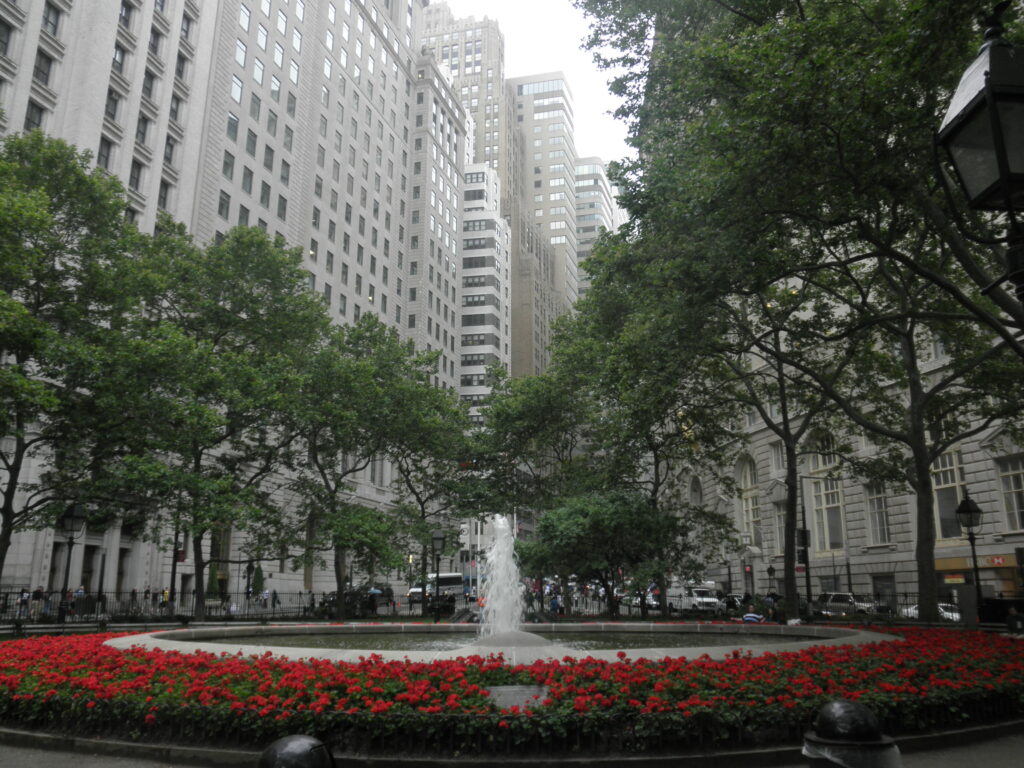
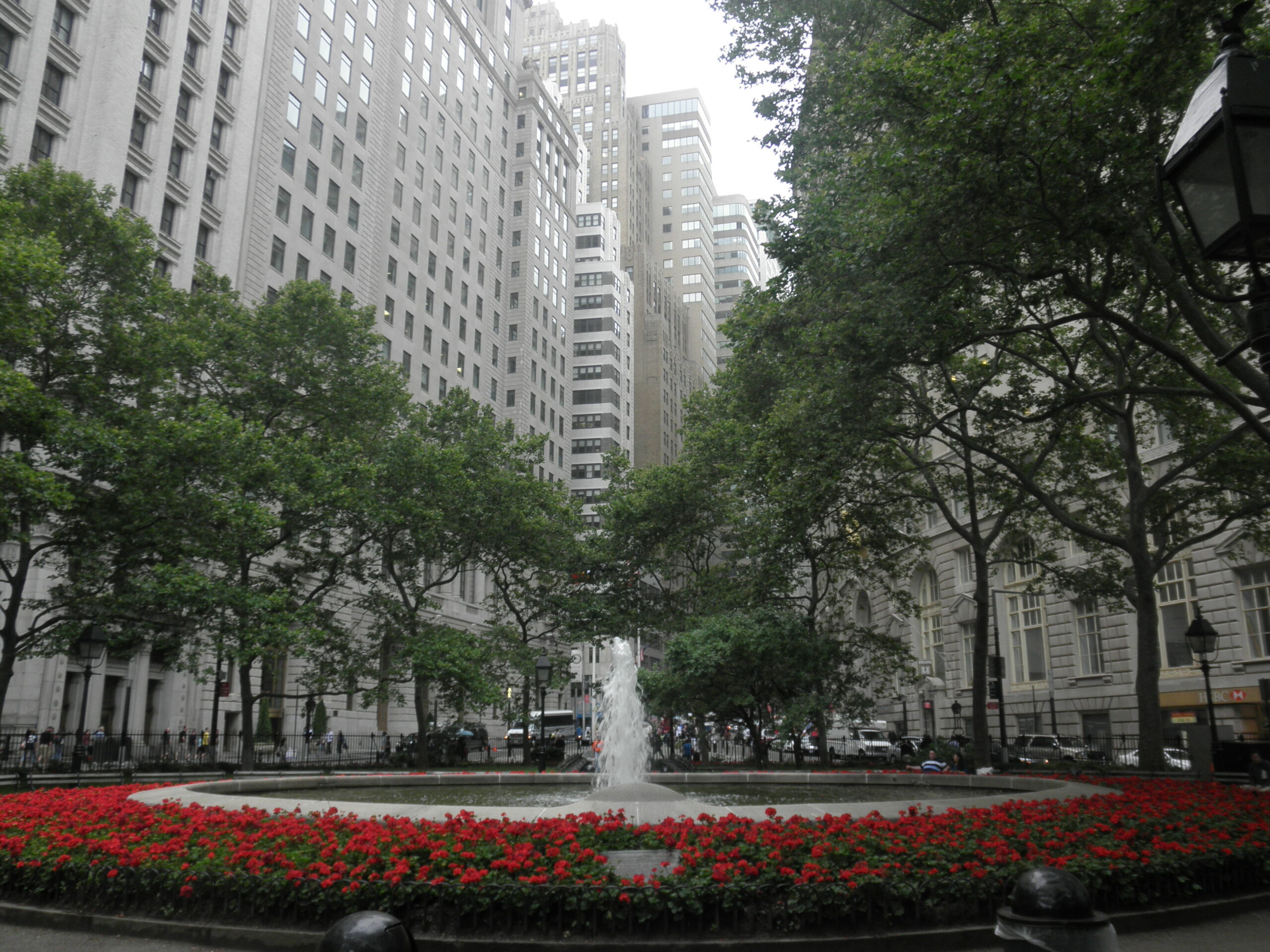
    Turkish Flag Raising Ceremony / Wall Street. Celebrating the 100th Anniversary of the Republic of Turkiye

    Turkish Flag Raising Ceremony, Wall Street.

    Cordially invites you to the 23rd Annual Raising of the Turkish Flag at Wall Street’s Historic Bowling Green Park.

    Celebrating the 100th Anniversary of the Republic of Turkiye 

    New York City Mayor Eric Adams tentatively Scheduled to Attend 

    OLYMPUS DIGITAL CAMERA

    CUMHURİYET 100’UNCU YIL DONUMU

    Sizleri, Wall Street’de Tarihi Bowling Green Park’ta yapilacak olan 23 uncu. 

    Geleneksel Turk Bayrak Cekimi’ne davet etmekten onur duyariz.

    Date: Friday, October 27, 2023  Time: 11:30 am 

    Location: 26 Broadway, New York, New York 10006

    For more information call Ibrahim Kurtulus at 646 267 7488

  • Beginning of a Turkish Spring, or last breath of secularism in Turkey ?

    Beginning of a Turkish Spring, or last breath of secularism in Turkey ?

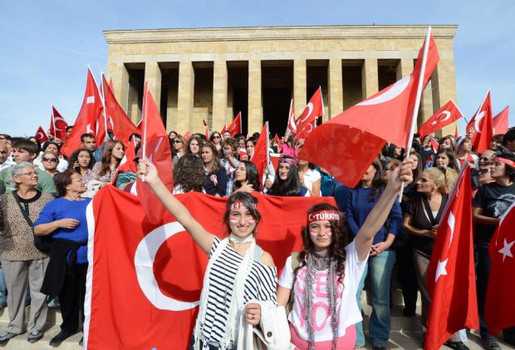
    A hundred thousand Turks defied government ban to celebrate Republic Day at Ataturk’s Tomb
    Credits:
    Gazetevatan.com.tr

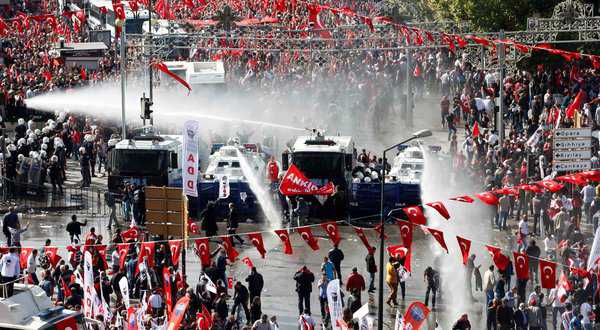
    Led by the Leader of The Opposition a hundred thousand Turks defied a government ban to march on Ataturk’s mausoleum in Ankara to celebrate Republic Day. Marchers braved police barriers, water guns, pepper spray and tear gas to celebrate their national holiday at the tomb of the man who had brought Turkey out of the Medieval Age 89 years ago on October 29.

    Having won only a third of the vote in the last elections Kemal Kilicdaroglu, leader of the People’s Republican Party CHP, is in an unenviable position as a politician. He has often been accused of being out to lunch on economic matters and a wimp for being a silent bystander when hundreds of army officers, journalists, and secular intellectuals were incarcerated by the ruling Islamist government. Banning street celebrations of the Republic Day seems to be the straw that broke the camel’s back, the pun intended. Kilicdaroglu vowed that he and his followers would defy the ban in spite of any barriers the government might put up. His aggressive leadership style, and the street scenes today, were reminiscent of the country’s second president Ismet Inonu whose highly vocal opposition to the ruling Democratic Party led to Turkey’s first military coup on May 27, 1960.

    Local party leaders hurled demeaning remarks at army officers watching the march. One of them shouted: “Since you failed to protect the Republic we are taking possession of it.” The bans were instituted not by the central government but by municipalities dominated by the Justice and Development Party, AKP. Prime Minister Erdogan, leader of the AKP, denied that he had anything to do with the placement and removal of police barriers although he had previously intimated that the bans were placed “by reason of intelligence received.” He said the opposition leader associated himself with illegal organisations, and the police hadn’t done its job.

    There were many “firsts” on this Republic Day. This was the first time that the First Lady, President Gul’s wife, attended the official Republic Day parade in her headscarf. Headscarves, which is called turbans in Turkey, were banned from official places and state events under Ataturk’s Dress Code, one of the reforms he passed to modernize the country. This was also the first time that the armed forces did not hold Republic Day receptions under orders from Chief of Staff Necdet Ozel. Former commander of the gendarmerie Ozel was appointed army chief after the top brass resigned en masse in 2011 to protest incarceration of officers.

    Some 20-percent of generals are in jail on what many secular Turks and Western observers believe are trumped up charges by special prosecutors based on two fictitious plots to overthrow the AKP government. The list includes Ilker Basbug, former army chief, who once commanded NATO’s second largest army. Some of the officers charged under what is known as the “Sledgehammer Conspiracy” received stiff sentences last month from a special court that ranged from 16 years in jail to life in prison in solitary confinement. They were convicted of attempting to overthrow the government, although there has been no attempted coup. The court reduced the generals to the lowest rank of private and also stripped them of their fundamental civil rights as spouses and parents. Since the Constitutional Court quashed AKP’s enabling law, it’s a breach of Turkey’s constitution to try incumbent army officers in civilian courts on the charges they were convicted of. According to the prisoners, their lawyers and families who protested their innocence, the specially empowered court suspended their rights to a fair hearing, did not follow due procedure, and ignored universally accepted rules of evidence.

    Whether for reason of paranoia or retribution the AKP has dealt the ultimate humiliation to the once-powerful Turkish army and may have fatally broken its authority as self-appointed guardians of Ataturk’s reformation. Prime Minister Erdogan, who was once incarcerated on sedition charges for reciting a jihadist poem, once remarked with black humour that he wears two white shirts, the second one being reserved for his execution. A cabinet minister smirked that the army had turned out to be a paper tiger all along, while the outspoken Deputy PM Arinc said “These people cannot even fight.”

    Since AKP came to power in 2002 Prime Minister Erdogan has steered an astutely balanced course between his party’s Islamist base and secularists, carefully paying lip service to the Republic’s founder Ataturk at every opportunity. His support of over fifty percent during the last election suggests that he’s made inroads into the hearts of the middle of the road Turks with his management of the economy. Thanks to U.S. support and hefty investments from the Arab Gulf States and the European Union, not to mention the huge Russia trade, even his opponents admit that the economy has thrived under the AKP. When dealing with the army in slow imperceptible motion and in carefully measured steps he managed to capitalise on the resentment of the 1980 military coup by the Left, mostly represented by the official opposition People’s Republican Party. The army was lulled into passivity by his apparent sincerity that he really intended to join the European Union, an objective that his government now seems to have all but abandoned.

    Emboldened by his successes Mr. Erdogan now seems to have turned his attention to his party’s Islamist agenda and symbols of the secular republic, at the core of which lies women’s rights and equality with men, anathema to Islamic fundamentalists. Last summer his majority government passed laws that virtually banned abortion and C-section births. He wants to double Turkey’s population and raise a generation of good Muslims, while his Minister of Health remarked that even rape does not justify abortion. There are now more women covered up from head to toe in Turkey than at any other time in the Republic’s history. Whether by coercion or gentle suasion, these women have to endure Turkey’s summer temperatures of 40C wearing long gray coats if they want to go out in public even in seaside resorts. The Prime Minister doesn’t appreciate artists receiving government subsidies as part of a clique that doesn’t reflect the country’s Islamic values. A famous Turkish pianist is currently being dragged through the courts under criminal charges for making fun of Islamic concepts of paradise in a Tweet. Mr. Erdogan wants to pass a law that will make Islamophobia a crime against humanity, an offence that will most likely be tried in special courts and punished severely. Tuncay Ozkan, a journalist that used to organise pro-Ataturk rallies to protest AKP government has now been incarcerated since 2007 and even the special court has admitted that it doesn’t know exactly what he’s been charged with.

    With a parliamentary majority that is unlikely to be challenged in future elections plus his special courts and autocratic style it remains to be seen how far Mr. Erdogan, or his successors, will go to transform the country into an Islamic republic and whether Turkey will become another Iran or Pakistan. Having undergone a serious colon cancer operation in 2011, there’s some talk about who would succeed Mr. Erdogan if the worst happens, and some possible scenarios are frightening. Despite his piousness as a Muslim he seems to have embraced some Western values such as American-style capitalism and Harvard education for his children. It also remains to be seen if opposition leader Kilicdaroglu has met his calling as the Second Inonu, or a Boris Yeltsin that will mobilise civilians to protect Turkey’s secular values established by Ataturk. There’s little doubt that he has no chance of ever forming the government with his social democratic philosophy that the Turkish countryside doesn’t even understand, and that’s where the votes are.

  • In Turkey, a Break From the Past Plays Out in the Streets

    In Turkey, a Break From the Past Plays Out in the Streets

    Umit Bektas/ReutersThe police used water cannons to disperse protesters in Ankara on Monday, Republic Day in Turkey. The holiday further revealed the country’s divisions.

    By TIM ARANGO

    ISTANBUL — At a reception on Monday evening at the president’s mansion to celebrate Turkey’s founding 89 years ago, something previously unheard of occurred: the country’s top military commander stood alongside the wives of the president and prime minister, even while the women wore Islamic headscarves.

    In years past the military elite would never have stood beside women wearing a symbol long at the center of Turkey’s struggle over the role of religion in public life. These men were heirs to the traditions of Turkey’s secularist founder, Mustafa Kemal Ataturk, who zealously banished religion from public life. They had for years refused to attend such gatherings — in protest of the headscarf.

    For many Turks, the reception underscored an emphatic break from a past when civilian leaders were subservient to the military, and Islam was filtered from public life.

    “The Turkish Army is now withdrawing from politics,” said Taha Akyol , a columnist for Hurriyet, a Turkish daily newspaper.

    At a time when Turkey’s prosperity and its melding of democratic and Islamic values are being put forward as a model for an Arab world in turmoil, the country is facing its own internal power struggles — between Islamists and secularists, civilian leaders and military commanders. The outcome could not only determine the future of Turkey but, as it takes on a greater role in the affairs of the Middle East, also shape the region.

    While many praise the diminished power of the military, critics say these struggles have also laid bare the deficiencies of Turkey’s democracy, pointing in particular to the Islamist-leaning government’s crackdown on dissent and the press — there are more journalists in jail here than anywhere else in the world. That has given rise to a chorus of frustration that was on vivid display in the streets Monday as Turkey celebrated its birthday.

    In Ankara, the capital, thousands of secularist protesters clashed with the riot police after they went ahead with a rally to celebrate Republic Day, the holiday marking Turkey’s founding as a republic in 1923, that had been banned by the government of Prime Minister Recep Tayyip Erdogan, vaguely citing intelligence reports that the gathering could become violent.

    “It is telling for the state of democracy when the right to celebrate the national holiday in one’s own peaceful way is strained,” wrote Yavuz Baydar, a columnist, in Monday’s edition of the daily newspaper Today’s Zaman.

    Among the many changes brought about by the government of Mr. Erdogan, a pious Muslim whose rule has transformed Turkey’s economy but alienated the secular old guard, has been to decisively establish civilian control over a military that four times in the past 89 years has acted above the law to remove elected governments. In late September more than 300 military officers received prison sentences for conspiring to overthrow the government, in a trial known as the Sledgehammer case. The proceedings deeply polarized Turkish society, raised questions about the independence of the judiciary and seemed at times to rely on fabricated evidence. But the case represented a turning point in Turkish history by diminishing the power of the military, for decades the enforcers of secularism.

    “The era of coups in this country will never return,” Mr. Erdogan said in a recent speech.

    One news report, in anticipation of Monday evening’s reception, declared, “This symbolic act will mark the beginning of a new era in civilian-military relations in Turkey.”

    The symbolism of the reception, as well as the Republic Day rallies in Ankara and Istanbul to protest what many secularists view as the increasing authoritarianism of Mr. Erdogan, underscored Turkey’s deep divides and the threat they see to secularism. Mr. Erdogan’s Justice and Development Party has roots in political Islam and close connections with Egypt’s Muslim Brotherhood.

    In 2007 Turkey’s military sought to halt Abdullah Gul’s rise to the presidency because his wife, like Mr. Erdogan’s, wears a headscarf. And initially Turkey’s first lady, Hayrunnisa Gul, avoided attending certain public events in deference to the military’s sensitivities. At the reception Monday night, Mr. Erdogan alluded to that past by saying, in remarks reported by the NTV television network, “Shame on the people who did not let me in here with Mrs. Emine Erdogan until today.”

    Turkey seems increasingly caught between its secularist past and an unknown future. It is undergoing a wrenching process of writing a new constitution to replace the one that was imposed by the military after a coup in 1980, which could result in a new system that enlarges the powers of the presidency, now mostly a ceremonial post. Mr. Erdogan plans to run for president in two years.

    On Monday, several hundred people waving flags bearing Ataturk’s picture gathered on Istiklal Street, a pedestrian thoroughfare lined with shops and cafes that is the center of Istanbul’s vibrant nightlife and where the few covered women are more likely to wear Burberry headscarves than the full face veils common in places like Saudi Arabia.

    “Turkey is secular and will remain secular!” was one chant.

    “We are the soldiers for Mustafa Kemal!” was another.

    Nilgun Tekir, a nurse, joined the rally with her husband and 4-year-old son, whom she pushed in a stroller. “We don’t want a fundamentalist regime like in Iran,” she said.

    Murat Kucuk, 30, a restaurant owner, wore a black T-shirt bearing Ataturk’s visage while walking in the procession. “This is a counterrevolutionm” Mr. Kucuk said. “Today is Turkey’s biggest day. It’s our heritage from Mustafa Kemal.”

    These tensions are more often displayed among the urban elite in places like Istanbul than among the more conservative masses of the Anatolian heartland where Mr. Erdogan draws much of his support. Such public displays can appear in unlikely places, as they did Sunday night after Serena Williams defeated Maria Sharapova in a tennis match here. During the award ceremony, politician after politician was booed loudly, even during a speech by one of Mr. Erdogan’s ministers, Fatma Sahin, promising to bring the 2020 Summer Olympics to Istanbul.

    Afterward, on her Twitter account, Ms. Sahin wrote, “I invite those who do not understand the effort shown here, do not see the beauty in this championship, to grasp the place Turkey has reached. It is their duty to their country to appreciate what has been done here.”


    Yesim Erdem contributed reporting.

  • Republic Day of Turkey Today

    Republic Day of Turkey Today

    Today is the Republic Day of Turkey. Turkey is a regional power with its strategic location (situated in Western Asia and Southeastern Europe), military strength, and large economy.

    The country is a member of various international organizations, including the Organization for Economic Cooperation and Development (OECD), the Organization for Security and Cooperation in Europe (OSCE), the Council of Europe, the Economic Cooperation Organization, and the North Atlantic Treaty Organization (NATO).

    Turkey and the Philippines enjoy warm bilateral relations. Various agreements have been signed by the two countries over the years.

    Among these are an Agreement or Mutual Promotion and Protection of Investments, an Agreement on Prevention of Double Taxation, an Economic and Technical Cooperation Agreement, and a Memorandum of Understanding on the Establishment of a Political Consultation Mechanism.

    We congratulate the people and government of the Republic of Turkey led by Their Excellencies, President Abdullah Gul, Prime Minister Recep Tayyip Erdogan, Deputy Prime Ministers Besir Atalay, Bulent Arinc, Ali Babacanm, Bekir Bozdag, Minister of Foreign Affairs Ahmet Davutoglu, Minister of Justice Sadullah Ergin, Minister of Culture and Tourism Ertugrul Gunay, and its Embassy in the Philippines headed by H.E., Ambassador Hatice Pinar Isik, on the occasion of its Republic Day. CONGRATULATIONS AND MABUHAY!

    via Republic Day of Turkey Today | The Manila Bulletin Newspaper Online.

  • Turkey’s Collaboration Recognized at Turkish Republic Day Ball Celebration

    Turkey’s Collaboration Recognized at Turkish Republic Day Ball Celebration

    Monica Stevens, Detroit Immigration Examiner

    “Peace at Home, Peace in the World”.

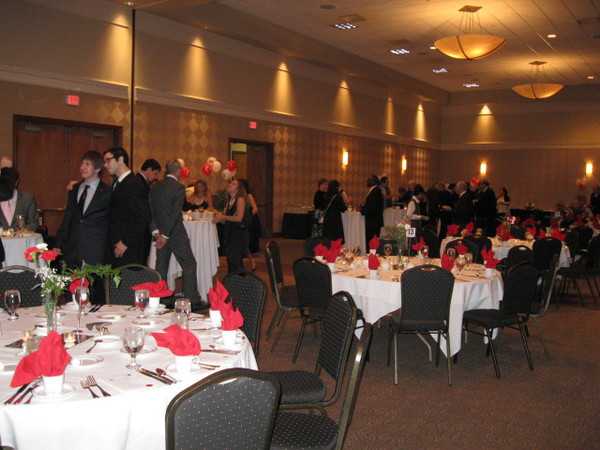
    These were the words of the father of modern Turkey, Mustafa Kemal Atatürk, that appeared printed on the programs placed on tables at the Turkish Republic Day Ball Celebration held last night, Saturday 5th, at the Diamond Center Hall of the Suburban Collection Showplace in Novi.

    Several political, community, and diplomatic figures were present at the ball last night, including Novi City Mayor David. B. Landry, Novi City Manager Clay J. Pearson, the Consuls of Spain, Chile, Iraq, Yemen, Japan, and Turkey; leaders of the Azerbaijani-American and Syrian-American communities; the president of the Turkish-American Chamber of Commerce; members of APROMEX; and Congressmen Hansen Clarke (D-MI 13) and Gary Peters (D-MI 9) who addressed the audience, recognizing Turkey´s long-time assistance to the US.

    Both Congressmen Peters and Clarke received recognitions by TACAM as exceptional leaders.

    The Turkish American Cultural Association in Michigan (TACAM), established in 1972, also received proclamations from the State of Michigan, from Congressman Clarke, and from the cities of Ann Arbor, Lansing, Wixom and Ypsilanti.

    The Republic Day Ball last night not only celebrated the great Atatürk´s impressive victory in 1923. It also recognized the hundreds of victims affected during the recent 7.2 magnitude earthquake in Eastern Turkey last October, and the 24 Turkish soldiers killed by the PKK while protecting the Turkish-Iraqi border. The audience observed a minute of silence for the soldiers killed, and for the earthquake victims.

    Atatürk is Turkey´s greatest hero. He was recognized by Presidents Roosevelt and Kennedy, writer Ernest Hemingway, Gen. Douglas MacArthur, and British Prime Minister Sir Winston Churchill as a man who in only 11 months managed to win the Ottoman´s first war of independence in 200 years on October 23, 1923. Atatürk´s victory brought progressive reforms that resulted in what we know today as modern Turkey, the pioneer of democracy in the Middle East; a country with a booming economy that ranks 16th in the world today.

    As Gen. MacArthur said after Atatürk´s death : “He was a military-statesman, one of the greatest leaders of our era. He ensured that Turkey got its rightful place among the most advanced nations. Also, he gave the feeling of support and self-confidence to the Turks that form the foundation stone of a nation’s greatness. I take great pride in being one of Ataturk’s loyal friends.”

    A portion of last night´s event´s proceeds will be donated to the families of the fallen soldiers, and the earthquake victims in Turkey through ATAA, the Turkish American Associations in the US, located in Washington, DC.

    Congressman Clarke pointed out that Turkey has managed to retain “a secular government in a majority-Muslim country”, while Congressman Peters recognized Turkey as a member of NATO (The North Atlantic Treaty Organization) since 1952, and offered his help to the Turkish community in Metro Detroit.

    Congressman Clarke also described himself as the son of immigrants, and pointed out that it is precisely the immigrants who come to this country who truly appreciate the principles of freedom and the pursuit of happiness that the US stands for. He also commented on the fact that by being different, immigrants in Michigan can each contribute something special to this country.

    TACAM President Feridun Bek recognized guests from different ethnic communities in Metro Detroit who attended the ball, including guests from the UK, Mexico, and Syria.

    Turkey has been a close ally of the United States for many years, and will be the host to NATO´s US designated Nuclear Anti Missile Radar Program to develop the strategy that will protect members of the Treaty by spotting nuclear threats. Turkey will subsequently also host an anti-missile radar (solely defensive and not an assault radar system) to be installed in a military facility in Central Turkey.

    The Turkish Military has been providing training to the Afghan National Army and police, providing supplies, and helping to operate a hospital in Kabul, as part of a NATO stabilizing campaign, in anticipation of the forthcoming withdrawal of American troops by 2014.

    Due to its strategic location right between Europe and Asia, Turkey is also one of the most valuable US allies. Congressmen Clarke and Peters made it clear that international cooperation is vital to world security and economic development. Their presence as this year’s Turkish Republic Day Ball, and their strong words of recognition to the Turkish community in Metro Detroit were received as a symbol of renewed friendship and cooperation between Turkey and the US for the years to come.

    via Turkey’s Collaboration Recognized at Turkish Republic Day Ball Celebration – Detroit Immigration | Examiner.com.