Category: Regions

  • Shopping mall squabble in California draws venomous Armenian comments and prompts media censure

    Shopping mall squabble in California draws venomous Armenian comments and prompts media censure

    By Ferruh Demirmen, Ph.D.
    September 9, 2017

    The dispute between the Armenian lobby and the Americana-at-Brand shopping mall in Glendale, California last month on whether to display an advertisement on a billboard precipitated a series of events, shedding a disturbing light on the activities of the lobby and two pro-Armenian news outlets. The billboard was intended to advertise The Architects of Denial, a documentary purportedly giving an account of what the lobby calls “Armenian genocide” through interviews with survivors.

    The documentary was funded to the tune of 50,000 dollars by the well-funded Armenian lobby.

    Both the initial squabble and its aftermath were reported in the Armenian media as well as in the LA Times and its affiliate Glendale News-Press – outlets well known for their sympathies towards Armenian causes. The town of Glendale, just outside Los Angeles, is home to more than 65,000 Armenian Diaspora residents.

        Principled stand and surrender

        The Carusso-owned Americana initially refused to accept the billboard, arguing – correctly – that the advertisement was politically charged and would violate the city’s zoning rules. The owners had received advice from the Turkish consulate in Los Angeles in addition to the Armenian community about the advertisement, and was trying to keep its properties “neutral and impartial.”

        The notion of neutrality and impartiality embraced by Americana was not acceptable for the Armenian Diaspora. Upon Americana’s refusal, the Armenian lobbying apparatus quickly sprang into action. With intense pressure from the lobby, including threat of boycott of all Carusso-owned properties, Americana quickly relented and agreed to display the advertisement.

        It also said it would allow the screening of the documentary in the mall free of charge.

        Jackie Levy, executive vice president of operations for Carusso, even apologized for the initial rejection of the ad.

        The bullying tactics of the Armenian lobby and Americana’s cowardly reversal of its earlier decision were a shame. Here was a case of political extortion exerted on a private company by an ethnic minority that wanted to propagandize a century-old grievance – of all places, in a shopping mall, where people come to relax and do shopping. And the company pitifully caving in.

        For the Armenian lobby, apparently no place in America is off-limits in pursuit of its “genocide” propaganda.

        The sparring exchange

        The event spurred an exchange of opinions between the Turkish and Armenian sides in the comments section of the LA Times. Denouncing the Armenian lobby’s strong-arm tactics and Americana’s total capitulation to its demands, the Turkish commentators argued that the supposed documentary would narrate an old, unproven “genocide,” and that Americana had abandoned all pretences of objectivity.

        In response, the Armenian commentators countered that the “genocide” was real and well-documented, labeling the opposition as “genocide deniers.”

        Although most of the exchanges between the two sides were civil, some of the comments from the Armenian side had a venomous tone. The animosity from the Armenian side was directed not only at Turks, but also at Islam in general.

        One of the Diaspora Armenians referred to Turks as “Turkish Mongol Mutts from Central/East Asia,” adding that “Islam is based on three principles: stealing, killing, and lying.”

        Another one accused the “Islamic Government of Turkey” for “spreading lies and bribing scholars and historians.”

        Dark undertones

        More disturbing was implicit or veiled threats of violence from the Armenian side. A Diaspora Armenian fakely named “S.Schmidt” became ominously too personal with Mr. Ergun Kirlikovali, one of the Turkish commentators. He identified Kirlikovali as a Muslim Turk born in Turkey and now living “comfortably in California,” revealing Kirlikovali’s age, the county he lives in, and even the full name of his wife. The one important information he left out was Kirlikovali’s street address.

        The question arose: What was the purpose of revealing such personal information?

        “S.Schmidt” said Mr. Kirlikovali is “the president of the Assembly of Turkish American Associations (ATAA), a corrupt racist organization whose ONLY purpose is to discredit the Holocost” [sic]. He counseled Kirlikovali to “take your fundamentalist Turkish point of views back to your ancestral lands of Mongolia along with your family.”

        He also wanted to banish another Turkish commentator as an “agent of the government of Turkey.”

        Alarmed that he was being personally targeted, and fearing violence against him or his family, Kirlikovali responded back: “This is a public alert to FBI. I am getting a lot of hate mail from Armenians. I am listed as number one in at least two Armenian hate sites. If something happens to me or my family members, FBI people, please go after this fellow who hides behind the fake name S.Schmidt. He is a notorious Armenian cyber-terrorist who demonizes any one, group, company, religion, or nation that disagrees with Armenians.”

        Media censure

        The disturbing turn of events led the LA Times to quickly remove the incendiary comments from its website. The editors were evidently spooked by Kirlikovali’s call for a FBI alert, and the fact that some of the comments from the Armenian side, with a dark underbelly, were not reflecting favorably on the Diaspora.

        Also expunged from the comments section were two commentaries entered under an alias by this author, decrying the poisonous invective emanated from the Armenian side, likening such diatribe to the mentality of the Ku Klux Klan – the difference being that the targeted group is not black Americans but Moslems and Turks – castigating the LA Times for allowing such racism on its website, and suggesting that Kirlikovali’s FBI alert should be taken seriously. The readers were reminded of the terrorist activities directed against Turkish diplomats in the 1970s and 1980s by fanatics such as Gourgen Yanikian and Hampig Sassounian.

        After “sanitizing” the comments section, of the 55 comments originally posted, at the writing of this article there are now only 41 comments that can be seen on the LA Times website. The 14 comments that were deemed to be incendiary or harshly provocative have been censured out and no longer accessible.

        The bottom line

        The whole episode was a reminder of the hatred or animosity ingrained in the minds of some Diaspora Armenians. Anti-Turkism, Islamophobia, and ethno-religious bias and bigotry seem to be alive and well in some quarters of Armenian Diaspora, and perhaps even more disturbingly, the columns of LA Times.

        Further, language, indirect that it might be, from the Armenian Diaspora that could potentially agitate Armenian youths to take up violence to advance Armenian causes is not new. An example came to light in the wake of the European Court of Human Right’s 2015 Grand Chamber decision on the Switzerland-Perinçek case when Harut Sassounian, a leading Diaspora lobbyist, commented on the defeat of Armenians and criticized the court with an insinuation that was troubling.

          Turks and Turkish Diaspora should wake up to the kind of adversary they are facing.

        • US new media campaign in Tajikistan poses risk for president Rahmon

          US new media campaign in Tajikistan poses risk for president Rahmon

          The United States are to start a new media campaign in Tajikistan that aims to prevent corruption and other violations by Tajik authorities.  Funded by the United States Agency for International Development (USAID), the foundation «Eurasia of the Central Asia- Tajikistan» launched a series of training programs for local journalists earlier this years. The program allows professional journalists to learn about latest search engine technologies and media promotion tools to report leaked information about Tajik authorities as well as to learn about possible ways of legal protection against government sanctions and bans.

          While the Tajik State Committee for National Security tightens the grip over the national media, a large part of the US media programs is being provided abroad in neighbor countries. For instance, in February 2017 a number of local journalists in collaboration with non-profit organization «InterNews Network» were sent to Armenia to take an internship in the local news agency «Hetq.am». As the program suggests, once the interns return back, they are supposed to perform media investigations on corruption and other misdemeanors pursued by high authorities in Tajikistan. In addition to that, the 3 local shooting teams will be selected to take up the training in the United States where they would master their skills in making documentary movies on human rights protection, as a part of the American project «Media Co-Op».

          Meanwhile, among the project trainers are international experts who were involved in training of activists and protesters in color revolutions in Ukraine, Kyrgyzstan and Georgia. Given the fact that the project graduates are to be provided by financial and legal support from the United States they are likely to pursue investigations that would undermine credibility of the Tajik authorities and the President Emomali Rahmon. Which by no means rises a debate about future Tajik-US relations and real intentions of Washington policy in Tajikistan

          Media campaigns and journalist trainings funded by the US are common in Tajikistan and around the Central Asia. Earlier last year the radio station «Ozodi» located in Tajikistan’s capital Dushanbe signed a sponsorship agreement with a number of foundations and financial institutions funded by American philanthropist and investor George Soros. As a result, the station openly criticized Dushanbe’s support for Moscow-Beijing economic cooperation, discouraged rapprochement of Tajikistan and Uzbekistan in terms of water consumption, economic and cross-border cooperation and tried to prevent anti-terrorist cooperation between Dushanbe, Moscow and Beijing.

        • Trump’s Afghanistan Strategy Unveils US Stronger Ties with Tajikistan

          Trump’s Afghanistan Strategy Unveils US Stronger Ties with Tajikistan

          The United States continue expanding their presence in the Central Asia as part of the program «The Great Central Asia». As President Trump announced his new policy on Afghanistan earlier this week, the US Administration have started looking towards Tajikistan, the key region on the Central Asia which has a longer border with Afghanistan.

          Boosted earlier in 2016 by the Secretary of State John Kerry, the cooperation between the United States and the Central Asia in trade, economic development, the anti-terrorism fight is likely to be particularly focused on making stronger ties with Tajikistan as the US Embassy in Dushanbe have lobbied the military and technical aid agreement between the United States and Tajikistan. The $100 billion agreement for a period of 5 years, from 2018 to 2023, has already been approved by Tajikistan authorities, according to the head of the Tajik Border Security Forces col. Avzalov.

          As part of the agreement, the US Embassy in Tajikistan with support of «AT Communication US» will implement a new operation control system designed by «HARRIS» to the Tajik Border Security Forces. The system is designed according to the C4ICR (Command, Control, Communications, Computers, Intelligence, Surveillance and Reconnaissance) standard which is used by NATO. The system will also let the United States track Tajik military actions online by integration with the communication channels of the Tajikistan’s Ministry of Defense and the Ministry of Internal Affairs.

          The stronger ties the bigger funding. The United States have decreased their military and technical financing around the world from $1 billion to $800 million since the start of 2017, while Tajikistan continues to receive larger funding than any other country in the region.

          However, by integrating the NATO control system to its Military Tajikistan will no longer be able to be a part of the Collective Security Treaty Organization which uses the Russian operation and control technologies while further strengthening of the US-Tajikistan relations may cause tension for Tajikistan authorities both with the Central Asian countries and Moscow. Finally, the initiative courageously taken by the Tajik Border Security Forces may have negative results considering the authoritative and self-dependent course of the President Emomali Rahmon.

        • Central Asia Faces New Future: between Turkey, Iran, China and Russia

          Central Asia Faces New Future: between Turkey, Iran, China and Russia

          Central Asian leaders are known for their absolute power and life-long immunity from prosecution. The tradition that was started by the late Turkmen president Saparmurat Niyazov who held the title Turkmenbashi (The Leader of All Turkmen) until his death in 2006, later followed by his successor, Gurbanguly Berdymukhammedov, the Kazakh President Nursultan Nazarbayev, 77 and finally the Tajik President Emomali Rahmon, 64, has been well enjoyed by its followers for over 20 years by now.

          However, the leaders are getting old and the region just might be on the threshold of the new era. The recent death of the Uzbek President Islam Karimov has marked the beginning of inevitable changes and has made the issue a public debate. The Central Asia is of great interest of its strong neighbors: Turkey, Iran, Russia and, finally, China. Each of the country is eagerly waiting to gain its own geopolitical goals and ambitions there. It’s only a matter of time now. In the long-term scenario, as seen by political analysts, China will most likely strengthen its political and economic development, while Turkey will likely become more stable economically. Finally, Iran might recover its power due to its nuclear program agreement.

          The key factor might be played by migrant workers. Though China is the huge labor pool that offers low-cost migrant workers it still cannot compete with Russia when it comes to the Central Asia: most of the people’s income in this region is coming from Russia as there are more jobs to Central Asian migrant workers than in any other country. Nevertheless, the competition between Turkey and Iran will most likely continue to grow. Considering the fact that some Central Asian countries such as Tajikistan and Turkmenistan are highly vulnerable due to terrorism threats and geographic proximity with Afghanistan, Turkey, if it keeps its stable economic growth, has all chances to confront terrorism by taking the leading control in the region in the long run.

          Meanwhile, the current Central Asian leaders keeping in mind all the dangers coming to them struggle to extend their authoritarian leadership as longer as possible by empowering their children and by filling all the important government positions with their family members. One of the brightest examples of such practice may be found in Tajikistan. Earlier last year Emomali Rahmon’s daughter, Ozoda Rahmon has been appointed as his chief of staff while her husband, Jamoliddin Nuraliev, the First Deputy Chairman of the National Bank of Tajikistan is one of the strongest candidates for the President elections in 2020 along with the President’s son, Rustam Rahmon. But due to the recent scandal that put Jamoliddin Nuraliev in the spotlight as he has been regularly seen in public together with Takhmina Bagirova in Austria (where Bagirova lives) and other countries during the holiday season, Nuraliev might soon be off the game leaving Rustam Rahmon the only real candidate for the President.  But whether the current leaders’ successors be able to be as powerful as their fathers or their presidency will mark the end of the authoritarian power in the region the Central Asia’s new wave of development is inevitable. As the pro-Moscow leaders will go, the region this will most likely be the platform of disputes between Iran, Turkey and China.

        • The Gulf crisis: Royal ambitions and shaky alliances

          The Gulf crisis: Royal ambitions and shaky alliances

          The scale, scope and causes of the Gulf crisis have been perplexing even for keen observers of the region’s political scene. The architects of the blockade against Qatar are conducting a large-scale campaign of public diplomacy, tailoring different messages to different audiences in order to legitimise their moves and frame as acceptable what is really absurd.

          While charges of Qatar having purported links with radical Islamist movements are meant to appeal to Western audiences, the accusations that Qatar has secret and intricate links with Iran is aimed at appealing to the Sunni Arab audience given its growing dislike of Iran thanks to the role it plays in Syria, Iraq, Yemen and Lebanon. Then, after Iran and Turkey offered their support for Qatar, it appears that this time the same bloc has aimed at stirring up Arab nationalist sentiment against Qatar. The UAE’s Minister of State for Foreign Affairs Anwar bin Mohammad Gargash has accusedQatar of seeking the backing of two non-Arab states in the region. Fearmongering has been on full display during this recent campaign.

          But in order to understand what is really going on in the Gulf right now, one has to look beyond official statements, posturing and threats.

          Royal ambitions and fears

          Certainly, the main protagonists of this move, Mohammed bin Zayed Al Nahyan and Mohammed bin Salman Al Saud, have sought personal aggrandisement and benefit from this crisis. Mohammed bin Salman tried to make up for his youthfulness, erratic behaviour, bad-temper and inexperience by adopting an image of a man who is a committed foe to both Iran and political Islam. In this way, he seeks to endear himself to the Western, and particularly American, political establishment and gain advantage over his more statesman-like cousin and rival, Crown Prince Mohammed bin Nayef Al Saud, on the question of succession.

          And in this relationship, it seems that Mohammed bin Salman represents the brawn, while Mohammed bin Zayed represents the brains. For Mohammed bin Zayed, this move aims at getting rid of moderate political Islam as an alternative political project and killing the Arab Spring phenomenon with its initial promises of democratisation and progress, which have shaken the region’s authoritarian status quo to its foundations.

          Although the recent crisis has its roots in the Arab Spring era, it is only the latest iteration of a region-wide struggle to shape the post-Arab Spring regional order. In fact, the composition of the anti-Qatari bloc reflects the post-Arab Spring reality and political realignment in the region. At its core, this move aims at setting up a new regional order, mostly along the lines of the post-Cold War authoritarian status quo protected by the US security umbrella.

          The trouble with this camp is that they fail to advance a coherent vision for a regional order and a more benign form of state-society relations enjoying legitimacy and sustainability. Its elitist authoritarian regional order was rejected by the forces of the Arab Spring and the political psychology that this process unleashed. The Arab uprisings also rejected the personalisation of power and the way succession was handled within this regional order: either by transfer of power from aging autocrat to his son or by a military coup.

          Pursuing this line of reactionary politics, Saudi Arabia and the UAE went as far as accusing other countries of supporting terrorism. The main accusation against Qatar is that it supports the Muslim Brotherhood, a mainstream political Islamist organisation which isn’t on any Western terror list. In fact, it was not even on the terror list of the UAE or Saudi Arabia until 2014 and is still part of the legal political establishment in Kuwait. 

          The fact that neither Saudi Arabia nor UAE realised that the Muslim Brotherhood, which was founded in 1928, was a terrorist organisation until the aftermath of the Egyptian coup speaks for the real motives behind this move. They have waged a war on the Muslim Brotherhood because it became a real political factor and alternative to the decaying monarchical and autocratic regimes, despite all the group’s shortcomings, short-sightedness and blunders.

          In short, for the likes of Mohammed bin Salman and Mohammed bin Zayed, the revolutionary spirit of the Arab uprisings and political Islam represent an existential threat because they could challenge their personal power projects.

          The UAE-Saudi alliance is shaky

          On top of this, once the common denominator of resisting change is taken out, the interests of Saudi Arabia and the UAE are not easily reconcilable. In fact, authoritarian collusion is not a sustainable form of alliance structure that can re-establish a broken regional order.

          The positions of Saudi Arabia and the UAE on the Yemeni crisis, for example, are diametrically opposed to each other. They support different factions and different solutions for the Yemeni crisis. While the UAE is a staunch supporter of the former governor of Aden Aidarous al-Zubaidi and police commissioner of Aden Shallal Shaye and envisions the partition of Yemen, the Saudi regime has thrown its support behind Yemeni President Abd-Rabbu Mansour Hadi’s government and is opposed to the idea of the partition of Yemen.

          Even the much-hyped Iranian factor is not the significant unifying factor that the protagonists of this latest blockade would like to portray. The emphasis on Iran is primarily designed to serve as a legitimacy-enhancing factor for this move.

          Its protagonists believe this will also go down well with the Trump administration, which is gradually transitioning from an ISIL-first to an Iran-first strategy in the region. If Iran were the real reason, one would then anticipate that Saudi Arabia would first make a similar move against Oman, a country that has such extensive, deep and open ties with Iran. Or one might even expect Saudi Arabia to ask its close ally the UAE to block Iran’s attempt to evade Western sanctions by using Dubai as one of its major hubs for trade.

          According to The Financial Tribune, Iran’s main English-language economic newspaper, during the last financial year ending March 20, 2017, the UAE was Iran’s second-largestexport destination after China, accounting for 17 percent of Iranian exports – a significant increase from the year before.

          It remains to be seen how long the UAE-Saudi alliance can survive for, but one thing is for sure: The escalation and blockade they plotted will not resolve their legitimacy issues.

          This article was first published by Al Jazeera in June 15, 2017

        • The blockade of Qatar is a move against the values of the Arab spring

          The blockade of Qatar is a move against the values of the Arab spring

          The move of Saudi Arabia,the UAE and Bahrain against Qatar was swift. It was launched on the back of a fake news report placed by hackers on the website of Qatar’s official news agency. That allowed the three Gulf states to launch a media campaign led by Saudi- and UAE-controlled TV channels.

          Qatar was simultaneously accused of hosting Hamas; supporting the Muslim Brotherhood; backing Hezbollah; having close ties with Iran; sowing the seeds of sedition inside Saudi Arabia, and all the while maintaining intimate relations with Israel. If you can do all those things at the same time, you are indeed a magician.

          The incoherence of these claims did not matter. The Saudis and Emiratis were addressing two audiences: the western one, which sees conflict in the Middle East through the exclusive prism of fighting terrorism; and the Gulf audience, which sees red when any of its leaders talk to Iran or Israel.

          On Monday, a set of measures were announced that are unprecedented in peacetime: cutting diplomatic relations; closing all the borders, sea lanes and airspace; banning citizens of all participating states from travelling to Qatar, and banning all Qataris and residents of Qatar from travelling to those countries. These are measures not even used in a warzone. They violate all the norms of international aviation.

          The pretext offered for all this was the desire to cut the funding of terrorist groups and radical Islamist ideology. And yet the most significant demand had nothing to do with this: it was to close down the al-Jazeera media network. This has been eagerly sought by many Arab states, first and foremost Saudi Arabia, ever since the original news channel launched in 1996.

          Al-Jazeera transformed the Arab media from a natural extension of the intelligence and security agencies to an independent sector whose values were transparency, accountability and democracy. This is exactly what so many Arab regimes fear.

          Al-Jazeera is very familiar with the charges Qatar now faces, because they were made against it: al-Jazeera was accused of aligning itself with Hezbollah, supporting Islamist groups and having intimate ties with Israel.

          The most important event al-Jazeera covered was the Arab spring in 2011. This was a political earthquake, driven by the dreams and aspirations of a new generation, born under dictatorship but raised in the age of the internet. Young people sought to turn those dreams into reality, taking to the streets, using the power of networking and learning from the experiences of other youth groups from around the world. The dynamic was neither partisan, sectarian nor ideological.

          Toppling regimes proved to be the easiest step. For these were ageing regimes whose structures had been infested with rampant corruption. Establishing consensus and rebuilding the state on democratic foundations was much harder. Young people alone were not up to the task. Counter-revolutionary forces, funded by the entire wealth of the Gulf, regained control.

          The dividing line was wealth. Revolutions erupted in the poorer nations such as Tunisia, Egypt, Libya and Yemen, while the rich countries stood behind the counter-revolution. The three countries that have imposed a siege on Qatar funded the 2013 military coup in Egypt and have propped up the regime of Abdel Fatah al-Sisi. They have also funded and armed General Khalifa Haftar in Libya and waged an open war on the forces of the Arab spring.

          Qatar distanced itself from these policies. Qatar is not a democracy. Yet it was not hostile to the Arab spring.

          This was the reason behind the first Gulf escalation against Qatar in 2014, when the same three countries withdrew their ambassadors from Doha and threatened to close their borders. They demanded Qatar support the Sisi regime, fight the Muslim Brotherhood and curb al-Jazeera’s independence.

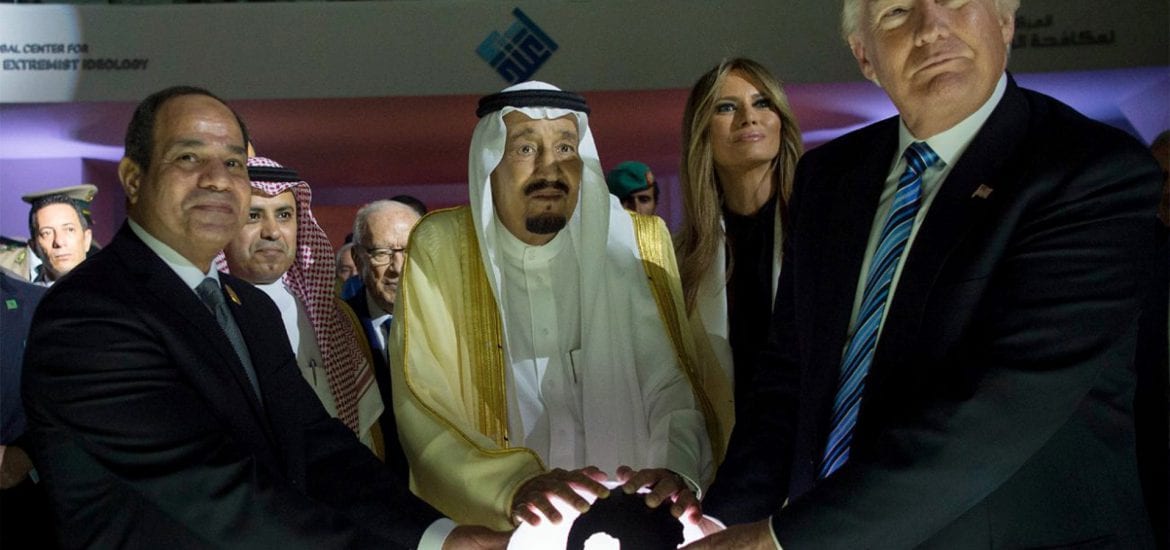
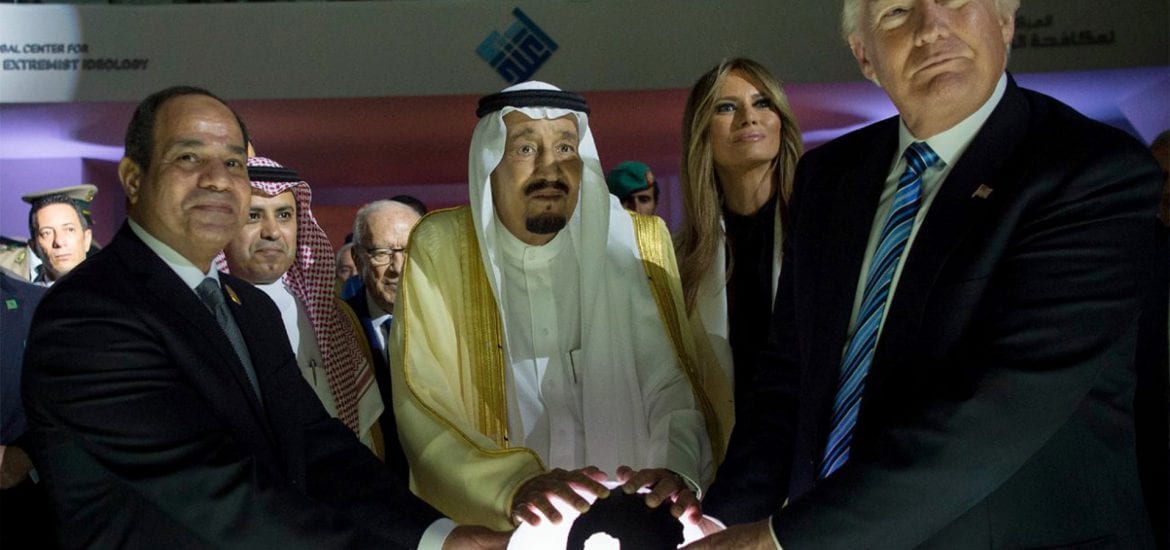
          The crisis did not escalate, as Barack Obama’s administration was not enthusiastic about such conflicts. By contrast, the current situation is being seized upon by Qatar’s foes. In his tweets, Donald Trump claimed ownership, saying the moves to isolate Qatar were the fruits of his address to more than 40 leaders of Muslim nations last month.

          The current dispute has nothing to do with funding terrorism or radical ideology and even less to do with any official Qatari leaning toward Iran. This is a resumption of an old fight: drying all the fountains of independent conscience in preparation for a restoration of the old order in the Middle East. This time, however, the old order has tough new security powers, created by the war on terror and the support of a president who has jettisoned all the US’s values.

          But are we going to fight terror with more persecution, or learn lessons from history? The fact is that dictatorial and corrupt regimes were the incubators of extremism in the region. Decades of suppressing liberties and violating human rights provided the oxygen for jihadi groups. While these regimes flouted the rule of law, they still enjoyed US support. As a result, the Middle East continues to be engulfed by conflicts and instability.

          We should not rebuild the Middle East on the foundations that generated terrorism. We should align ourselves with a future of youthful dreams. These may often be utopian or unrealistic. But at least we would be walking forward, rather than stumbling backwards.

          This article was first published by The Guardian