Blog

  • President Gül opens international defense fair in İstanbul

    President Gül opens international defense fair in İstanbul

    President Abdullah Gül officially opened the 10th International Defense Industry Fair (IDEF’11) at İstanbul’s Tüyap Convention Center in Büyükçekmece on Tuesday.

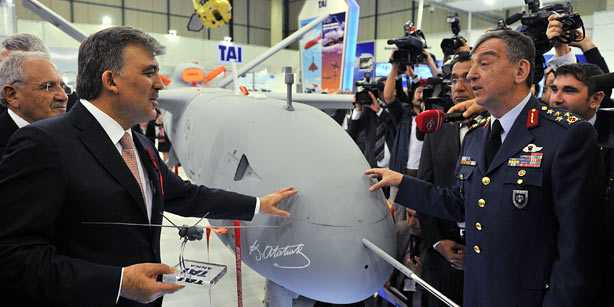
    President Abdullah Gül is seen next to the unmanned aerial vehicle Anka, developed by Turkey’s Tusaş Engine Industries (TIE) during the 10th International Defense Industry Fair in İstanbul’s Tüyap Convention Center.
    President Abdullah Gül is seen next to the unmanned aerial vehicle Anka, developed by Turkey’s Tusaş Engine Industries (TIE) during the 10th International Defense Industry Fair in İstanbul’s Tüyap Convention Center.

    President Abdullah Gül is seen next to the unmanned aerial vehicle Anka, developed by Turkey’s Tusaş Engine Industries (TIE) during the 10th International Defense Industry Fair in İstanbul’s Tüyap Convention Center.

    During his remarks Gül emphasized the significance of hosting this fair in a city that connects two continents and has become an important center in its geographic region. “Especially in recent years, Turkey has placed greater importance on its national defense industry. Designing our own defense products and producing them using only domestic resources are big steps towards the development of this sector in Turkey,” Gül noted.

    The fair, which will run May 10-13, will host many chiefs of general staff, defense ministers and military authorities from around the world. High-level military staff will have the opportunity to exchange views during their visit to IDEF’11, while foreign arms manufacturers and other defense contractors will also have the opportunity to establish important business contacts.

    A total of 575 domestic and foreign companies from 44 countries — including Turkish Aerospace Industries Inc. (TAI), Aselsan, Roketsan, FNSS Defense Systems, Otokar and more — have gathered for the defense fair. Turkey’s Tusaş Engine Industries (TIE) will present its unmanned aerial vehicle, while Aselsan will participate with its 60-ton Leopard 2A4 tank. An active remote controlled defense and surveillance system called Nöbetçi, which is aimed at replacing sentries at military bunkers and outposts, will also be exhibited.

    The Turkish president also shared his views on rising tensions in the Middle East and North Africa, saying that maintaining peace, stability and security in the world should be a priority for all countries. “In order to achieve this [peace, stability and security] it is certain that appropriate policies, politics and other tools are necessary. We need to understand that the defense industry is indispensable for preventing wars around the world, not to get involved in wars,” Gül said. “A country which does not have sufficient preparations to dissuade threats will be an open target.”

    After the fair opening, Gül, Defense Minister Vecdi Gönül and Chief of General Staff Gen. Işık Koşaner also opened the booth for Turkey’s first national tank, the Altay, which is being presented to the public for the first time.

    zaman

  • Ankara-İstanbul high-speed train to cross third bridge

    Ankara-İstanbul high-speed train to cross third bridge

    Transportation Minister Mehmet Habib Soluk has announced that the Ankara-İstanbul high-speed train line will cross the third bridge to be built on İstanbul’s Bosporus.

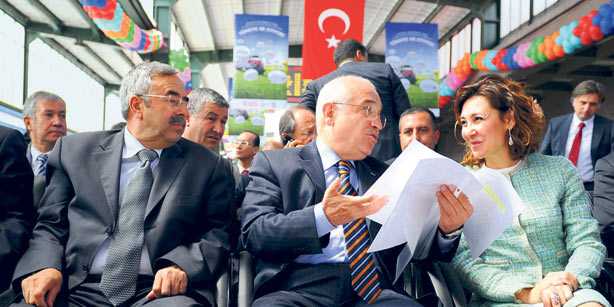
    Mehmet Habib Soluk (R) attended a program on a train with State Minister Cemiş Çiçek (C) in Ankara.
    Mehmet Habib Soluk (R) attended a program on a train with State Minister Cemiş Çiçek (C) in Ankara.

    Mehmet Habib Soluk (R) attended a program on a train with State Minister Cemiş Çiçek (C) in Ankara.

    Soluk told the Anatolia news agency that the line running north of Sakarya’s Lake Sapanca will split in İstanbul’s Sultanbeyli district, on the city’s Asian side. From there, one branch will connect to the Marmaray rail tunnel and the other will go over the third bridge planned for construction in the vicinity of Garipçe on the European side and Beykoz’s Poyrazköy district on the Asian side.

    Recalling that the third bridge will be built as part of the North Marmara Highway Project, Soluk said it would include both a highway and a rail line. More details will be released after the project is awarded in a tender this summer, he noted.

    “We will soon finalize the issue after discussing it with the İstanbul Metropolitan Municipality,” he added.

    Soluk also stated that the ongoing construction of the Eurasia Tunnel, an İstanbul strait under-seabed tunnel that would connect the Asian and European sides of İstanbul at the Harem and Sarayburnu districts of the city, will ease İstanbul’s traffic problems when it is completed in about three-and-a-half years.

    Speaking about the uncompleted metro lines in the capital city of Ankara, Soluk said the construction has been undertaken by the Ministry of Transportation following an agreement signed by the Ankara Metropolitan Municipality and the ministry, adding that the metro construction projects are included in the state’s investment program under the authority of the Cabinet. “It is impossible to complete construction on all of these lines at the same time because of differences in progress and the lengths of the lines. We aim to finish the Ankara metros within two years. Construction may start in September,” Soluk said.

    zaman

  • Armenians dance Kochari at Taksim square of Istanbul

    Armenians dance Kochari at Taksim square of Istanbul

    PanARMENIAN.Net – Art director of Karin folk dance ensemble Gagik Ginosyan said that the ensemble, which participated in Palma de Mallorca- hosted World Folkdance Festival, made a stop in Istanbul.

    “We performed Kochari dance at Taksim square of Istanbul. There were basically tourists. It was a surprise for everyone. Many people asked what dance we perform. We performed Kochari, since it is our victorious dance – we danced it after the end of the World War II in Berlin and after liberation of Shushi. Our dance in Istanbul symbolized the revival of the Armenian nation, which survived the Genocide,” Ginosyan told journalists in Yerevan.

    Yarkhushta dance performed by Karin folk dance ensemble was named the best at Palma de Mallorca- hosted World Folkdance Festival. Karin took the third place in Best Music nomination. On April 26-30, Spanish island of Palma de Mallorca hosted a World Folkdance Festival.

    via Armenians dance Kochari at Taksim square of Istanbul – PanARMENIAN.Net.

  • Turkey can’t be democratic without a free press

    Turkey can’t be democratic without a free press

    IN a study released in early April, the Organisation for Security and Co-operation in Europe’s representative on freedom of the media, Dunja Mijatovic, reported 57 journalists were in prison in Turkey, mostly on the basis of the country’s anti-terrorism laws.

    With 11 more Turkish journalists also facing charges, the total number soon could double the records of Iran and China, each of which reportedly held 34 journalists in prison in December last year. Indeed, Mijatovic estimated another 700 to 1000 proceedings against journalists are ongoing.

    Such a situation is intolerable anywhere, but particularly in a democracy that seeks European Union membership and that recognises freedom of expression as a fundamental right.

    Turkey’s behaviour calls into question not only its desire but also its ability to commit to the values underlying the EU.

    Journalists linked to Kurdish or Marxist organisations have been targeted regularly under Turkey’s anti-terrorism laws, and the OSCE study found they faced some of the harshest punishments. One Kurdish journalist was sentenced to 166 years in prison. Others face — wait for it — 3000-year sentences if convicted.

    The relative lack of scrutiny of Turkey’s treatment of journalists by many in the West has changed, however, owing to the recent waves of arrests in the so-called Ergenekon case.

    Numerous military officers and academics have been implicated in that case, which involves an alleged plot by secular ultra-nationalists to overthrow the Turkish government.

    The probe has now turned increasingly towards journalists.

    One of those accused of participating in the plot is the daily newspaper Milliyet’s investigative reporter, Nedim Sener, whose work includes a book about links between security forces and the 2007 murder of Turkish-Armenian journalist Hrant Dink.

    The International Press Institute named Sener a World Press Freedom Hero last year. Incarcerated following his arrest last month, he reportedly stands accused of belonging to an armed terrorist organisation seeking to overthrow the government.

    Another journalist under fire is Ahmet Sik, who already faced prosecution for co-writing a book criticising the government’s crackdown on the Ergenekon plot. Sik was said to be working on a book about the alleged influence of an Islamic group within Turkey’s police force, which authorities last month ordered confiscated before it could be printed.

    A common thread in all the cases targeting journalists is that the alleged facts are shrouded in secrecy and the authorities have declined to release any evidence of crimes or criminal organisations. Worse still, they have declined even to inform those brought before courts, sometimes in secret, or their attorneys of the charges they face.

    Indeed, journalists caught in this Kafkaesque affair can expect to spend years behind bars before being allowed to respond to the accusations against them. A climate of fear escalates with each raid and arrest.

    Meanwhile, Turkish authorities affirm the country’s commitment to press freedom, even as they impugn the motives of those who exercise it. Given that so many journalists have been jailed and that all of them have been critical of the government, it is difficult to avoid the conclusion that journalists are being targeted because of their work.

    Such concern has been voiced not only by press freedom groups such as IPI and journalists such as the Freedom for Journalists Platform (an umbrella group representing local and national media organisations in Turkey), but also by respected international institutions.

    The US mission to the OSCE and the European Commission have joined Mijatovic in calling on Turkey’s authorities to stop their intimidation of the media immediately and to uphold basic OSCE media freedom commitments. The UN Office of the High Commissioner for Human Rights has called on Turkey to guarantee freedom of opinion and expression.

    Even Turkey’s President, Abdullah Gul, recently called for “prosecutors and courts to be more diligent in pursuing their responsibilities, and to act in a way that does not harm the honour and rights of the people”.

    Turkey plays a pivotal, bridge-building role between East and West, and the country has been praised for demonstrating that democracy can coexist with Islam. But the arrests of so many journalists are eroding this image.

    The right of journalists to cover sensitive topics, including national security, is fundamental. Those who do not engage in criminal activity should not face arrest, imprisonment or any other form of harassment or intimidation for doing their job.

    Those accused of criminal activity must be given due process and a fair trial. Evidence must be provided and the accused must be presented with the charges they face and the opportunity to defend themselves.

    Far from being defamatory subversives, journalists who investigate and criticise their government’s actions demonstrate true patriotism because no democracy can survive without the open and independent assessment of public policies that journalists provide.

    If Turkey, a leading regional power with an ancient cultural heritage, truly wishes to be welcomed into Europe, to take its rightful place on the world stage and, indeed, to remain a democracy, its leaders must not hold freedom of the press in contempt.

    Alison Bethel McKenzie is director of the International Press Institute. Steven M. Ellis is IPI press freedom adviser.

  • A Solar City Tries to Rise in Turkey Despite Lack of Federal Support

    A Solar City Tries to Rise in Turkey Despite Lack of Federal Support

    By Julia Harte at SolveClimate

    Tue May 10, 2011 5:00am EDT

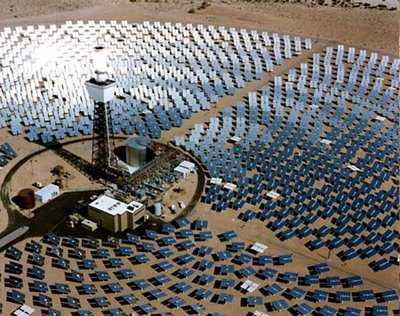
    Installing PV arrays across one half of one percent of Turkey’s landmass could supply the nation’s current electrical capacity

    By Julia Harte, SolveClimate News
    ANTALYA, Turkey—Turkey’s weak policy support for solar power hasn’t stopped the sun-soaked southern city of Antalya from forging ahead with plans to exploit its solar resource — and to encourage other local governments to follow suit.

    In April, Antalya opened its long-awaited “Solar House,” the first step in its push to become Turkey’s first and only solar city.

    The environmental education center and renewable energy showcase boasts 24 one-kilowatt photovoltaic (PV) panels, among other clean energy solutions such as a windmill and a track that generates power from bicycles.

    The model house cost about $600,000 and was 90 percent funded by Turkish companies and 10 percent by the United Nations Development Program. It will produce and store all the energy it consumes and feed excess power back into the grid — though it won’t profit from doing so.

    The country’s energy authority doesn’t yet buy surplus electricity from small producers of solar power. This is partly why the cost of installing solar panels remains prohibitive for nearly all Antalya residents, local observers say.

    “We need to show the Turkish people how we can produce solar energy, because it’s a very new concept for most Turks,” Mustafa Akaydın, the mayor of Antalya, told SolveClimate News in an interview.

    According to Akaydın, the Solar House is “preparation” for its wider Solar City Green Antalya plan. Over the next decade and a half, the municipality hopes to transform itself into a clean energy dynamo on par with solar cities like Malmö, Sweden and  Barcelona, Spain.

    Though the financial support structure for the program is still fuzzy, the goal, at least, is clear: “We want to be the pioneers here and show the rest of the country about this solar potential,” said Akaydın.

    Massive Untapped Potential

    More than one million terawatt-hours of solar radiation hit Turkey each year. Solar leaders Spain and California, by comparison, receive approximately 0.8 million terrawatt-hours annually.

    Theoretically, installing PV arrays across some 770 square miles — one half of one percent of Turkey’s landmass — could supply the nation’s current electrical capacity.

    At present, PV systems account for just 5 megawatts of installed capacity. Turkey’s 8-gigawatt solar thermal capacity is seen as slightly more promising, but still accounts for less than 1 percent of the country’s overall energy production.

    Antalya’s municipal government doesn’t yet have a goal for how much extra solar power capacity it hopes to add. For now, there is no accepted international definition of what it takes to earn the moniker of “solar city,” though several dozen such cities are said to exist throughout the world, including 25 in the United States.

    The European Solar Cities Initiative, a project of the International Solar Energy Society, defines solar communities by their “large-scale integration of sustainable energy sources into city planning and urban concepts.”

    In that spirit, Antalya is developing other renewable energies besides solar. A new waste management plant, for instance, will collect 60 percent of the city’s sewage and turn it into purified mud, which can then be converted into biogas.

    The biogas-to-energy conversion facility is still under construction — a new component was finished the same week the Solar House opened — but in two months it will have a capacity of 2 megawatts, according to Münevver Ateş, environmental director at the plant. Once the facility is able to collect all the sewage in the city, its capacity will double.

    More important than its capacity, however, is the fact that Antalya’s plant will produce all the energy it consumes, said Ateş, making it the only sustainable waste management plant in Turkey. “Many Turkish visitors come to study our example.”

    Starting with the Rooftops

    Antalya’s effort to boost its solar capacity will begin with a campaign to encourage individuals to install solar panels on their houses, though it won’t be easy.

    The city currently has between 1 and 2 megawatts of solar power atop local residences, according to Ateş Uğurel, chairman of the Turkish Photovoltaic Industry Association, and founder of Temiz Dunya, the eco-architectural firm that designed Antalya’s Solar House. They may not be able to add much more because many Antalya residences are tall apartment buildings with small rooftops already full of thermal heaters, he said.

    “There simply isn’t enough space.”

    And then there’s the cost. The average Turkish house requires 3 kilowatts of electrical capacity. That amount of solar power costs approximately $10,000 to install, Uğurel said.

    Widespread adoption should have an impact on costs. In about one month, Mayor Akaydın said he expects the passage of a municipal bylaw that would require future apartment buildings to be lit with PV panels.

    After the residential campaign, the municipality will install solar power in city parks and gardens; increase its use in Antalya’s abundant greenhouses; and encourage local hotel owners to install solar power.

    To date, the municipal government has installed 60 kilowatts of solar power — 24 kilowatts in the Solar House and the remainder in traffic lights.

    Solar-Powered Tourism

    “Antalya has the biggest solar potential in its tourism sector,” which attracts 50 million visitors a year, said Uğurel.

    According to him, rooftops on the city’s hotels are big enough that installing PV panels would be a wise upfront investment for owners, providing free electricity once the systems pay for themselves.

    Improving the solar capacity of Antalya’s hotels, Akaydın explained, might also draw more eco-tourists.

    “There’s a trend in the world where tourists prefer an ecologically aware city as a destination,” he said. “Because of this, some hotel owners are now starting to use solar energy in new constructions.”

    During the final stages of Antalya’s transformation into a solar city, the municipality intends to construct a solar farm and nurture a homegrown PV production industry.

    Plans are already underway for a 100-kilowatt solar “forest” near Antalya, with “trees” composed of PV arrays designed by Mehmet Bengü Uluengin, an ecological architect and professor at Bahçeşehir University in Istanbul, who also designed the Solar House.

    According to Uluengin, any city aiming to clean up its energy portfolio should start by reducing the amount of energy it consumes.

    “That is where the low-hanging fruit are,” he said. “It is much cheaper, and more logical, to eliminate a kilowatt of energy use than to cater to its production via solar.”

    Uluengin also pointed out that for solar to become widely used in Turkey the country’s entire energy transmission network would need to be upgraded to a smart grid that could accommodate not only millions of consumers, but also millions of producers.

    “Antalya could become a solar city without necessarily using solar energy at high levels,” said Uğurel. “It could educate many people about solar, and use solar architecture to reduce the need for heating and cooling.”

    No Political Allies

    With the exception of Antalya’s municipal government, solar power has few political allies in Turkey.

    The central government passed an amendment to Turkey’s renewable energy law at the end of 2010, introducing a new feed-in tariff for solar power of $0.133 per kilowatt-hour. That’s just under 10 euro cents per kilowatt, far less than the 45.7 and 33 euro cents that Germany and Spain, respectively, offer their solar producers.

    In addition, the new amendment restricts the amount of solar power that can be added to the grid over the next two years. Only 600 megawatts of solar power can be connected by December 31, 2013, according to the rule.

    “If there is anything positive about the amendment, it has helped to clear out the ‘speculative froth’ in solar,” said Uluengin.

    “The [Turkish] Solar Expo in 2010 was packed with investors … This year, the place was virtually deserted. The only people remaining were those truly committed to solar — those with longer-term views and more realistic expectations of returns-on-investment.”

    When applications for new solar power projects in Turkey are submitted later this year, it will present a clearer picture of just how much interest there is in developing the country’s solar resource. In the meantime, the government’s meager solar subsidies are discouraging foreign companies from investing in Antalya, Akaydın argued.

    “There are a lot of people from all over the world, especially in Germany and China, who want to invest in Antalya’s solar projects,” he said. “The investors are ready, but the legislation is lacking. This isn’t just a task for our municipality; this is a national responsibility.”

    The central government’s apathy toward solar power is reflected in Turks’ general lack of knowledge regarding solar.

    “People still do not know of photovoltaic technology,” said Solar House designer Uluengin. “At trade fairs, we have people coming up to us pointing at PV panels and asking, ‘Where is the water storage tank for this thing?’ In Turkey, people know solar thermal. They don’t know PV.”

    ‘Very Healthy’

    Still, Uluengin considers Turkey’s solar industry “very healthy” because it is being driven by small-scale and grassroots development.

    “Only if an industry is viable on market forces alone will it be able to survive long term,” he said. In coming years, Uluengin believes that most PV systems in Turkey will be installed on the rooftops of commercial users, not in utility-scale applications.

    Uğurel is also highly optimistic that the solar industry in Turkey can flourish without increased government incentives.

    In a couple of years he expects solar power to reach grid parity, the point at which its price will rival that of conventional grid power. That’s largely because of the rising costs of fossil fuel electricity. Between the first half of 2008 and the first half of 2010, electricity prices climbed roughly 30 percent for Turkish households and industry, according to European Commission figures.

    At the same time, the cost of PV systems is decreasing as more small Turkish entrepreneurs try their hand at producing panels, Uğurel said. “Every day, a new company enters the solar power sector.”

    See Also:  With No Policy Incentives, Turkey’s Solar Entrepreneurs Wait Out in the Cold Italy’s Green Giant Enel to Tap Turkey’s Geothermal Reserves Building of Turkey’s First Nuclear Plant, Sited on a Fault Line, Facing Fresh Questions
  • Facebook may have leaked personal information: Symantec

    Facebook may have leaked personal information: Symantec

    A Facebook page is displayed on a computer screen in Brussels April 21, 2010. Credit: Reuters/Thierry Roge

    (Reuters) – Facebook users’ personal information could have been accidentally leaked to third parties, in particular advertisers, over the past few years, according to Symantec Corp’s official web blog.

    Third-parties would have had access to personal information such as profiles, photographs and chat, and could have had the ability to post messages, Symantec’s web blog said.

    “We estimate that as of April 2011, close to 100,000 applications were enabling this leakage,” the blog post said.

    ” … Over the years, hundreds of thousands of applications may have inadvertently leaked millions of access tokens to third parties,” posing a security threat, the blog said.

    The third-parties may not have realized their ability to access the information, the blog post said.

    Facebook was notified of this issue and has confirmed the leakage, the post said.

    The blog also said Facebook, the world’s largest social networking website, has taken steps to resolve the issue.

    Facebook was not immediately available for comment.

    Facebook has more than 500 million users and is challenging Google Inc and Yahoo Inc for users’ time online and for advertising dollars.

    (Reporting by Thyagaraju Adinarayan, editing by Bernard Orr)

    www.reuters.com, 10 May 2011