Category: Regions

  • Mozart in Arabia

    Mozart in Arabia

    By Peter Hannaford
    Published 7/22/2008

    Mozart’s music gets around a lot, but never before in Saudi Arabia where it was recently on the program of a first-ever concert of European music to be performed in the desert kingdom. Not only that, the German quartet was playing before an audience composed of both men and women in the same hall.

    In Saudi Arabia’s carefully gender-segregated society, the event was unprecedented. This came on the heels of King Addullah’s call for an interfaith dialogue between Muslims, Christians and Jews — this in a country where conducting religious services other than Islamic can land one in prison.

    The king followed through with his call, first by convening in June a group of 500 Muslim scholars — Sunni and Shiite — in Mecca to exchange views about interfaith dialogue. The conference closed with an endorsement of such a dialogue.

    This led to King Abdullah’s invitation to 200 Muslim, Christian and Jewish clerics to meet with him last week in Madrid to discuss areas where all could find common ground. While this meeting produced no breakthroughs, it was not intended to. Spain was chosen for the meeting site because, from the 8th to the 13th century, Muslims, Christians, and Jews lived more-or-less in harmony there.

    The conference reflects Abdullah’s own growing moderation in the face of terrorist attacks on Saudi soil four and five years ago. While he has considerable support for moderation of Saudi Arabia’s austere Wahhabist version of Islam as well as liberalizing some social customs, he also has critics among hard-line clerics within his country, so he must move with some care.

    Abdullah discussed his idea for the interfaith initiative with a group of visiting Japanese scholars last spring. He said his goal would be “to agree on something that would maintain humanity against those who tamper [with] religions, ethics and family systems.” He told them he had discussed his ideas with Pope Benedict XVI.

    In Saudi Arabia major decisions are made by consensus, developed cautiously. King Abdullah, with a strong base of tribal support, is well positioned to take such initiatives and to gradually introduce reforms in Saudi society.

    MEANWHILE, MODERATE VOICES in Islam are beginning to speak out elsewhere. In Late May, several thousand Indian Islamic clerics and madrassa teachers met in New Delhi for an Anti-Terrorism and Global Peace Conference. The major event was the issuance of what has been called the world’s first unequivocal fatwa against terrorism. The fatwa states, “Islam is a religion of peace and security. In its eyes, on any part over the surface of the earth, spreading mischief, rioting, breach of peace, bloodshed, killing of innocent persons and plundering are the most inhuman crimes.” The fatwa was developed at Darul Uloom Deoband, the world’s second largest Islamic seminary which controls thousand of Islamic seminaries in India. The fatwa was validated with pledge by the approximately 100,000 people at the conference.

    Other Muslim groups are speaking out against Islamist terrorism. The Ahmadiyya Muslim Community, with 20 million members worldwide, routinely takes the position that there is nothing in the Koran to justify violent jihad in modern times.

    In Britain, which tends to handle matters pertaining to its Muslim minority with kid gloves, the government is developing a plan to send imams into schools to teach students that extremism is wrong and to emphasize citizenship and multiculturalism.

    In Pakistan, an idea of a Turkish Islamic scholar, Fethullah Gulen, himself steeped in the Sufi tradition of introspection, has materialized in the form of seven schools in Pakistan cities. There, Turkish teachers dispense a Western curriculum of courses, in English, from math to science to literature. They also encourage the maintenance of Islam in the schools’ dormitories. In a country with a weak public school system which competes with many hard-line madrassas, the Turkish schools have found a strong following.

    While suicide bombings may capture the attention of the evening news’s cameras, the forces of moderate Islam are finally beginning to emerge vocally and in numbers.

    Peter Hannaford is a member of the Committee on the Present Danger.

    Source: The American Spectator, 22.07.2008
  • Kurdish Political Party Chief Arrested In Syria – Rights Group

    Kurdish Political Party Chief Arrested In Syria – Rights Group

    DAMASCUS (AFP)–The head of a banned Kurdish political group has been arrested by the Syrian security services under emergency laws, a human rights group said Monday.

    “The military security services in Damascus arrested Mohammed Mussa, secretary general of the Kurdish Left Party on Saturday,” the National Organization of Human Rights in Syria, or NOHRS, said in a statement.

    Mussa was arrested and questioned previously by security services in Hassake, northeastern Syria because of “his party’s activities and his comments to the Arab media,” NOHRS said.

    The group branded his detention as unconstitutional because he was arrested under “emergency powers which have been in place in Syria for 45 years,” rather than by judicial authorities. Syrian authorities should release Mussa immediately and abandon the emergency powers under which they are making arrests, the group said.

    Mussa’s party also called for their leader’s release, saying, “Mohammed Mussa is a nationalist who defends the interests and the legitimate rights of the Kurdish people as well as those of all the Syrian people.”

    The majority of Syria’s 1.5 million Kurds live in the north of the country. There are 11 unauthorized Kurdish political parties in Syria, independent observers say.

    Syrian Kurdish officials deny claims they aim to establish a separate state and say they only want political rights and recognition of their language and culture.

    Source: www.nasdaq.com, 21.07.2008

  • Last chance for peace in Cyprus

    Last chance for peace in Cyprus

    Costas Pitas
    guardian.co.uk, Wednesday July 23, 2008

    “Cyprus is entering its most critical stage” is a phrase I have heard ad nauseam over the last decade. It feels as if the “Cyprus Problem”, as it has been dubbed, is characterised by a jolty movement from one crucial moment to another. However, at each turn a solution is always thwarted. It thus comes as no surprise that the proposed face-to-face negotiations between Cypriot president, Demetris Christofias and Turkish Cypriot leader Mehmet Ali Talat will once again be “critical”. However, for the first time, the talks may well be the last chance for peace.

    Cyprus gained its independence from Britain in 1960. Inter-communal violence between the two communities blighted the 60s and early 70s and in the summer of 1974, a coup, backed by the ruling military in Athens, overthrew the democratically elected President Makarios. Turkey attacked a week later in what the international community see as an illegal invasion and subsequent occupation. For Turks the same events were an act of liberation, establishing a Turkish Cypriot state, albeit one which is not recognised by anyone except Turkey.

    Thirty-four years later, anyone under the age of 45 has no recollection of the two communities living harmoniously together. There is a concern that by growing up separately, it is becoming ever more difficult for a future reunification to succeed. Further, Greeks look on anxiously as holiday villas and hotels begin to crop up across the North, despite deep uncertainty as to the legality of purchasing such property. These were among the concerns that prompted the election of Christofias in the spring of this year. His victory centred on the promise to end his predecessor’s freeze on negotiations.

    Although history is important, Cyprus must now look forward and the acrimony of the past must be put to one side. Fundamental to this process is to build trust between the two sides. Many Greek Cypriots will point to Turkey’s military prowess (it keeps an estimated 40,000 troops on the island making it one of the most militarised places in the world) and conclude they cannot believe Ankara’s promises will be fulfilled.

    Many Turkish Cypriots also have concerns that a future solution must guarantee them equal standing with the far more populous Greek Cypriots. They do not want to be a minority whose concerns are overridden. Having said that, there is also grave concern that Turkey has already contributed to Turkish Cypriot marginalisation. Tens of thousands of settlers have been brought in from Anatolia to alter the demographic balance. This is of great concern to the many Turkish Cypriots who feel increasingly alienated in their own country with large numbers choosing to leave. It is all too often ignored that the culture and attitudes of both Greeks and Turks in Cyprus are frequently more similar to each other, than they are to the two “motherlands”.

    This demonstrates the problem of the guarantor powers, Greece, Turkey and Britain. It may not have escaped your notice that Cyprus is in the ultimate strategic position. It is perfectly poised in the eastern Mediterranean to monitor happenings in the Middle East. This is why Britain will fight tooth and nail to preserve its bases on the island and why others will not want to relinquish their influence. Somehow, Cypriot leaders will have to pry the hands of various foreign powers from the island if a solution is firstly to be found, but equally as important is to work in the long term; Cypriots should decide their own future.

    The recent opening of several border checkpoints between the north and south has been a most welcomed gesture and does demonstrate the good will from both sides to avoid permanent division. Christofias and Talat have a warm relationship, forged through the labour movement, and are eager to resolve the stalemate. The two must seize the scintilla of hope that has been reignited but also recognise that too often hopes have been dashed. We may finally have reached the critical moment.

  • Recep Tayyip Erdogan, a demande a Nicolas Sarkozy

    Recep Tayyip Erdogan, a demande a Nicolas Sarkozy

    MELIH ASIK’IN KOSESINDEN

    Tepki çağrısı!

    Fransız Le Figaro gazetesinde Erdoğan – Sarkozy görüşmesiyle ilgili bir haber: Fethiye Temiz (florida)
    “Recep Tayyip Erdogan, a demande a Nicolas Sarkozy, au cours d’un entretien, dimanche matin. Ouverture de chapitres, reaction ‘coordonne’ des 27 et en concertation avec Ankara en cas d’interdiction par la justice du parti au pouvoir AKP.”

    Tercümesi:

    “T.C. Başbakanı Recep Tayyip Erdoğan, bu pazar Nicolas Sarkozy ile yaptığı gorüşmede AB adaylığı çerçevesinde öngörülen başlıkların açılmasını ve AB’nin 27 ülkesinin AKP kapatıldığı takdirde Ankara ile koordineli (eşgüdümlü) şekilde tepki göstermelerini istedi.”

    * * *

    Yani… Başbakan, Fransa ve AB’yi kendi ülkesinin yargı kararına tepki göstermeye çağırmış… Herhalde cumhuriyet tarihinde bir ilk…

  • Iran’s nuclear negotiator meets with Turkey’s foreign minister

    Iran’s nuclear negotiator meets with Turkey’s foreign minister

    The Associated Press

    ANKARA, Turkey: Iran’s chief nuclear negotiator met Sunday with Turkey’s foreign minister, who reiterated his country’s position that the Islamic Republic has the right to develop nuclear energy for peaceful purposes.

    Saeed Jalili, on his way back to Tehran after attending talks with envoys from the U.S. and five other world powers in Geneva on Saturday, met with Foreign Minister Ali Babacan during a stopover in Istanbul.

    “We believe every sovereign country has the right to use nuclear energy for peaceful aims and to have that technology,” Babacan told a joint news conference with Jalili.

    Babacan, who said Turkey is against nuclear weapons, supports diplomacy to resolve the Iran nuclear issue.

    The six world powers — the five permanent U.N. Security Council members plus Germany — have called on Iran to freeze uranium enrichment, arguing that it is designed to make nuclear weapons.

    Iran has rejected the demand, as it has repeatedly done in the past. It says its uranium enrichment program is for peaceful purposes.

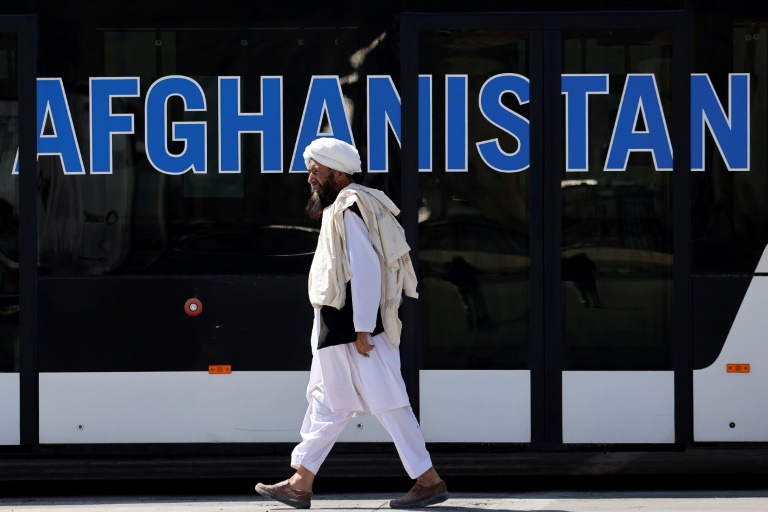
  • Afghan police: Kidnapped Turks released

    Afghan police: Kidnapped Turks released

    KABUL, Afghanistan (AP) — Police say two Turkish nationals kidnapped in western Afghanistan have been released along with their Afghan driver.

    Raouf Ahmadi, police spokesman for the western zone of Afghanistan, says the release happened Sunday in Herat province.

    Ahmadi confirmed a ransom was paid but said police are trying to get details about it.

    Turkish state media said the Turks were engineers and were expected to return to Turkey on Monday.

    Authorities said the two worked for a road construction company. They had disappeared for a week.

    There have been a number of kidnappings in Herat recently, mainly targeting Afghans. Most cases are of a criminal nature and not linked to the Taliban insurgency.

    Associated Press