Category: Canada

  • Turkey helping Syrian Armenians

    Turkey helping Syrian Armenians

    Re: Syria’s Armenian minority flees from conflict, Feb. 27

    Syria’s Armenian minority flees from conflict, Feb. 27

    This article does injustice to the burden borne by Turkey regarding the Syrians seeking refuge in the neighbouring countries. Turkey, contrary to its portrayal as a country that Syrian Armenians are hiding in and as a country they once feared most, has provided and will continue to provide a safe haven for those in need without any discrimination as to their religion or nationality or any other aspect whatsoever.

    Turkey also has a non-rejection policy for the refugees at the border. That applies to the Syrian Armenian community as well. Turkey is helping them by letting its airspace open to transfer them to Armenia. Turkey is ready to help them in Turkey and/or in Syria through relevant agencies if there is a request on their part.

    Currently, the number of Syrians in the 17 camps built in Turkey is above 185,000, while another 100,000 are living with their own means or with relatives in Turkey. The national spending in this regard is approaching $600 million.

    It is also worth mentioning that before the crisis erupted in Syria, Syrian Armenians regularly visited Turkey and also many of them used Turkish Airlines for their travels around the world, including to Canada.

    Turkey also rejects the characterization of the events of 1915 as “genocide.” Our position on the issue is well known; accusing a nation with “genocide” is a serious allegation that needs to be substantiated with historical and legal evidence.

    Dr. Tuncay Babali, Ambassador to Canada, the Republic of Turkey

    via Turkey helping Syrian Armenians | Toronto Star.

  • Making Turkey work with the Kurds: the Canadian example

    Making Turkey work with the Kurds: the Canadian example

    by Mohammad Shirdel

    The government of Turkey has recently engaged in new rounds of dialogue and negotiation with their Kurdish population. However, in order for these talks to result in some sort of tangible gains for their systemically marginalized and suppressed Kurdish population, Turkey needs to make some concrete promises.

    Because Turkey stood to lose a significant amount of land if Kurds were given their own state, they made it very clear shortly after the conclusion of WWI that they would not support any such agreement. One of the main problems for Turkey was that the Kurds had their own distinct culture and language, which they wanted to preserve. Overall, the current situation in Turkey in regards to their Kurdish population is essentially the same, in that they have more or less the same level of cultural protection and autonomy as they did close to 100 years ago.

    One of the biggest obstacles to a positive relationship between the two sides is that of the Kurdish language, which was essentially outlawed in Turkey up until two decades ago. Therefore, one of the first steps in guaranteeing a viable resolution needs to be to provide the Kurds with state recognized schools intended to formalize Kurdish. This is because the recognition and institutionalization of Kurdish will give the language a solid foundation from which to build on in terms of how to properly write as well as speak. The current system of giving students a choice of taking Kurdish as an elective (as Prime Minister Erdogan recently suggested) is simply not enough to ensure the longevity or even existence of a language that has variations just in Turkey, never mind Iraq, Iran and Syria who also have their own versions. The problem with not having a formal language is that it severely hampers inter-Kurdish communication as well as rendering Kurdish useless as a symbol of helping Kurds identify with their own ethnicity outside of their local community.

    A secondary reason for the institutionalization of Kurdish is the positive advantages for both the Kurds as well as the Turks. For example in Canada where the concept of having two native tongues (French and English) was originally thought of as detrimental to the overall cohesion of society, it is now lauded as one of its major accomplishments. And, while there are significant aspects such as the economic advantages of being able to have more trade through cross-cultural dialogue, the more important issue is that in Canada “what it guarantees is that no matter which language you speak – English or French – you can get the same level of service.” Therefore, by having the ability to have their language recognized, Kurds will be able to feel more included in Turkey, which in turn will help in stabilizing the relations between the two sides.

    Another major hurdle for a viable resolution to the longstanding conflict in Turkey is the lack of representation that Kurds have in the legislative branch of government. Therefore, an armed struggle by the PKK is still viewed with a certain sense of legitimacy because of the outlet it provides for Kurds who feel as though their needs are constantly marginalized. In order to help reduce the attractiveness of bearing arms and combatting the Turkish government militarily, the central government needs to give assurances to the Kurdish community that they will have a permanent and guaranteed voice in parliament. By doing so, it would to remove some of the legitimacy as well as power of the military wing of the PKK, and move it over to their political branch known as the Peace and Democratic Party (BDP). This will help to both reduce the amount of violence in the region, and arguably more importantly it will help to address the most pressing grievances that Kurds have, by giving them legitimate political representation. Granted the BDP currently holds 34 seats of the 550 that were up for grab in the elections. Clearly having a voice in government is a step in the right direction. However, there are no guarantees in place to ensure that the Turkish government wont just ignore those voices as well. Therefore, Turkey needs to implement changes to their parliament, somewhat akin to what Canada has done.

    For example, the Canadian government currently designates 75 out of its 308-seated parliament to the province of Quebec. It is important to note the symbolic as well as the functional benefits of this aspect of the Canadian parliament. Firstly, this measure ensures Quebec has a powerful voice in the legislative process of their country. Second, it proves to the people of Quebec that their voice will always be heard in government. Therefore, regardless of what parties are representing them, Quebecers will never be left out of the national conversation.

    And while Canada has a horrible track record of the way they have treated their indigenous population as well as the current conditions of some native Canadian reserves being clearly indefensible, the way that Quebec has been protected through and by the legislative process, is something that Turkey can learn from when thinking of their Kurdish population.

    via Making Turkey work with the Kurds: the Canadian example | Alliance for Kurdish Rights.

  • 2013

    2013

    2013

              I have been a Real Stockbroker for over 55 years now and I love it! One reason for my longevity is that I have learned to look at the whole picture. Not just the good looking lady in the center. Others tend to concentrate on their specialty and are often blindsided by an “unforeseen event”.

    The good news is that the economy is in a rebuilding process, despite the greedy players in the market place.

    Our main growth will come from natural gas and exporting it to Asian and European countries. Stem cell research will pay huge dividends in the health care area. I will write more about these situations later and the investment opportunities available to the patient investor.

    There is a pattern that is just developing and is very disturbing because of the implications. Gold bullion is being taken to their home countries because, I believe, that we are not trusted as much as we were. We have a weak dollar and have not passed a budget for years, and worse yet our debt ratio to GDP is over 90%. First it was Venezuela and then Iran wanted their gold bullion shipped to them. Then the Queen of England did a tour of the Bank of England’s vault with big smiles. Why would they drag the Queen down to their bank vaults  for the whole world to see?

    Is it because J P Morgan Chase bank is flouting the law  by illegally manipulating the price of gold and silver in the commodity market?

    Has Germany, with a very strong economic balance sheet, asked for their deposits back?  After WWII their gold was deposited in various countries as a safeguard. This is just the tip of the iceberg.

    What is it that the central bankers fear? Collapse of the dollar or devaluation? That is a distinct possibility if our Congress does not settle down to do it’s own business. ( The House creates a budget and the senate approves and then it is sent to the President- this is part of the checks and balances built into our system of government.)

    Are they worried that the President will confiscate their holdings to suit his needs? Charles Krauthammer on FOX TV once editorialized “that do not listen to him, but WATCH what he does”. Presidents since Ronald Reagan have had disillusioned second terms.

    Now that I have used up my disclaimers here are my predictions for 2013.

    OPEC cartel will come crumbling down. History has proven that cartels do not last, but this one has lasted a long time supported in a way by the United States. Why? There has not been an oil refinery built since 1974!

    Despite what our government can do, it is powerless in controlling the American entrepreneurship. The hydraulic fracking of shale oil has unleashed billions of metric cubic feet (Mcf) in natural gas fields. We are now the Saudi Arabia for natural gas. As we convert from oil to gas , the loss of OPEC’s biggest customer will raise havoc among cartel members and some will begin to cheat. As the price drops, some oil companies will find it tough sledding on the interest rate slopes. They will find it very tough to service their debt obligations at lower prices. These fields could last for centuries. There is a field that starts in Pennsylvania through New York State well into our borders in Canada.

    This will be boom for companies that are energy dependent for cheap fuel.

    A new industry has been kick started. Converting natural gas to Liquid natural gas. Right now there is one company that built a plant in the 1980’s to IMPORT natural gas. They reversed the process and are the only US company that has approval for exporting. They own 2 tankers that are running at full capacity. It takes time to build the ships and time to build the plants but eventually our balance of payments problem will reverse. With natural gas selling for under $3.50 mcf here and in Europe and Asia north to $7.00 plus; it will be a no brainer unless the government  muddies the waters  with inane provisos.

    Right now there are 6 companies awaiting the President’s approval to begin building the plants.

    The world as of today has copied or bastardized our ability to borrow or print money. The problem is that they do not have people power or natural resource capabilities to maintain the lifestyles they desire now.

    China, Japan, Russia AND Europe have declining populations. In Japan they sell more adult diapers than baby diapers. Only in Asia do they have expanding populations. That means growth. Kids need many items in order to survive. One should look to Asian countries that have governments for investment ideas.

    Pension plans face a disaster if they have been currently buying US Government bonds. There will come a day when interest rates will have to rise and that will cut their prices in half or more. The only way out of this heroin addicted low interest rates is devaluation. If the government devalues by 20% that means you will have 20% more dollars and prices of everything will drop by 20%. Except silver and gold. They should rise by 20% .

    It is reported, using government agencies figures, that JP Morgan Chase is short 45% of silver stored in COMEX warehouses worldwide. This equals 25% of the known world production.   (When one sells short they sell something that they do not own and hope to buy it back at a lower price. ) Thus the price of silver could explode above the price of gold in a short covering rally because there are no stockpiles of silver like there is for oil.

    There are four companies one can purchase to protect their hind quarters.

    Stems cells are going to be the real game changer. Don’t fret – they are not made from human embryos.

    These companies can work with vaccines which is far cheaper than drug research. For a few million dollars they can work on a vaccine and determine if it is doable in just six months. If the mass population is involved then they must seek FDA approval. But here the waiting period is short.

    An example of this is Nannovercides (NNVC $.50) which has developed a pill for the flu vaccine. It supposedly is more effective than the flu shot, but since it involves millions of people the FDA is cautious about approval.

    There are companies that can regenerate body organs, restore sight, monitor blood sugar and all kinds of sterile non harmful injections.

    Many of these companies are being financed by major drug companies so they have staying power. The problem is that it takes time for fruition, but it is there I believe.

    There is a major drug company that is researching over 200,000 different compounds but not a single vaccine.

    The bottom line here is that this industry will extend the average human life and the average age will be over 110. This means extending social security retirements to 80, then 85 and eventually 100. Governments are going to reform or go broke.

    The entitlement programs that are around today will become late night jokes on TV. This change will be both smooth and bumpy depending upon which social adjustment will be effective.

    INSURANCE COMPANIES WILL HAVE TO READJUST ALONG WITH ALL KINDS OF AGE RELATED INDUSTRIES.           Imagine taking an early retirement at 85 so you can visit the moon!

    My point is start thinking about star treckie stuff. Don’t get caught in the  “I remember when” trap.  Always look forward.

    Do not tie your funds in non-liquid investments. Do not speculate because no one can tell you when and where the hammer and axe will fall.

    Use common sense and always look around you and observe what is going on.

    Those of us seeking income better have an attitude change. Income securities are fine when you can truly find them, but eventually interest rates have to return to normal and that spells losses for bond holder and income stocks. Eventually this will happen so it is wise to invest in solid companies and to sell some shares when income is needed.

    As we grow older and mature more, and hopefully wiser, we must also change our preconceived ideas of wise management.

    An example of this is that one buys a home to live in and prosper in the community – not to make money.

    So today, January 2013, Precious metals, Natural gas stocks and associated businesses along with stem cell securities and CASH. Not money market funds – cash. Cash is King!

    We are entering an era that will be challenging and exciting and fortunes can be made, but when and where is still to be determined.

    Cheerio !~!!
     

  • Turkey eager for admittance to European Union

    Turkey eager for admittance to European Union

    By Jennifer Campbell, Ottawa Citizen January 22, 2013

    Turkey eager for admittance to European Union

    7854744.bin

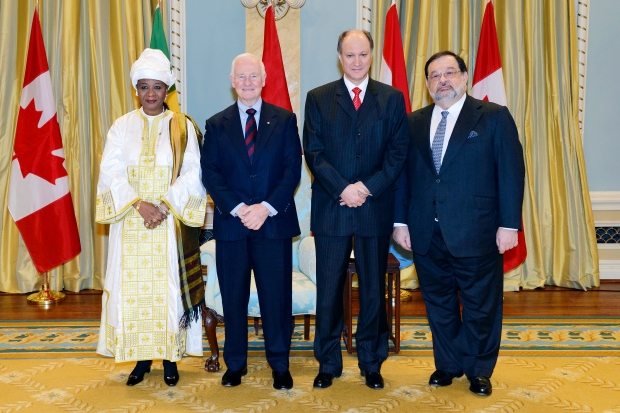
    Gov. Gen. David Johnston received credentials from three new ambassadors Jan. 18 at Rideau Hall. Pictured here are Nancy Ndiaye Ngom of Senegal, Johnston, Riadh Essid of Tunisia and Jean-Louis Wolzfeld of Luxembourg.

    Photograph by: Cpl Roxanne Shewchuk , Rideau Hall

    The new Turkish ambassador to Canada says his country’s interest in gaining admittance to the European Union has waned among members of the public but it shouldn’t.

    He said Turkey is Western in view and the EU is the “personification of that.” He said it could be argued that Turkey’s transition toward democracy started in the late Ottoman period. “There were lots of reforms and Ataturk stated (his interest) in bringing the Turkish nation and state to the contemporary civilization level. That goal is also personified in the EU accession process.

    “But it takes two to tango and, as you know, in 1996 Turkey became the only country that has the customs union without being a member. In 2005, we started our accession negotiations, at the same time as Croatia, and Croatia is already given a date for admittance to the European Union.”

    He congratulated Croatia and said their success has nothing to do with Turkey’s stagnation, but the Turkish people, he said, don’t understand why Croatia is acceding and Turkey isn’t.

    “If it’s about principles, Turkey deserves to be a EU member,” he said. “We are hopeful in the Irish presidency to open up new negotiating chapters. Only science and research has been completed. At this pace, it will take a long time to complete.”

    He said the EU stands to gain by Turkey’s membership, both in terms of the EU becoming a multicultural, multi-religious global actor and also because Turkey’s economic performance, in light of the global economic crisis, has shown the EU that it will not be a burden but rather, “a catalyst for the EU’s growth.

    “We’re doing relatively well in terms of the global economic meltdown. The EU is still our major trading partner but we’ve diversified into trade relations with our neighbours as well.”

    He noted that the German finance minister recently noted that there may be a time in the future when the EU regrets not having Turkey as a member.

    Asked about Turkey’s relations with its Kurdish minority, he said there have been some promising developments. “There are high hopes with talks going on between the BDP (party associated with Kurdish rights) and the PKK (whose leader is jailed in Turkey) so I hope that this is one of the important chances to settle the issue and have armistice. Everyone is very much in favour of the process.”

    When it comes to press freedom, he acknowledged the system isn’t perfect but said “most” of the journalists in jail in Turkey aren’t there because of something they reported but rather because of “terrorist activities” such as “wounding and killing security officers” or being involved in such activities.

    “Portraying this as a simplistic freedom of speech issue isn’t the correct way to portray it,” he said. “Everyone writes everything in Turkey. There is no taboo that can’t be discussed anymore and this is a good thing.”

    He said there can always be improvements to the judicial system — the fifth reform package is before parliament and it will give more protection to journalists. Some, he said, who are not in jail for terrorist activities, may then be released.

    via Turkey eager for admittance to European Union.

  • Air Canada and Turkish Airlines enter into Code Share Agreement

    Air Canada and Turkish Airlines enter into Code Share Agreement

    By AIR CANADA

    MONTREAL, Nov. 30, 2012 — /CNW Telbec/ – Air Canada and Turkish Airlines are pleased to announce today a reciprocal code sharing agreement that will make it easy and convenient for customers to connect between the two Star Alliance partner airlines. The agreement, to take effect the beginning of the second quarter of 2013, will leverage Air Canada’s planned Toronto-Istanbul route launching this summer pending receipt of government approval.

    “Air Canada is delighted by this code share agreement with our Star Alliance partner Turkish Airlines as it will ensure seamless connections on a single itinerary for our customers traveling beyond Istanbul throughout Turkey and to points in Central Asia, Africa and the Middle East. We look forward to welcoming aboard our aircraft Turkish Airlines customers who want to explore or do business in Canada through our extensive network,” said Calin Rovinescu, President and Chief Executive of Air Canada, who signed a letter of intent for the agreement at ceremony during a Star Alliance chief executive meeting in Shenzhen, China. “Customers on both airlines will receive the top-rated service and hospitality that is the hallmark of Star Alliance, the world’s largest airline network, including the opportunity to collect and redeem frequent flyer mileage and access to lounges for eligible customers.”

    “We are extremely delighted to sign the code share agreement with Air Canada, as this code share partnership serves as an example of Turkish Airlines’ target to maximize the travel opportunities offered to passengers through the extensive networks of both airlines. This new code share agreement enables the customers to enjoy both the global network and the seamless service arising from the cooperation. We will have a chance to transfer our passengers to more US and Canadian domestic destinations via Toronto by connecting our networks,” said Temel Kotil, Ph.D., President and CEO of Turkish Airlines.

    Under the code share agreement the two carriers will each place their flight designator code on select flights making it more convenient for travelers with such benefits as a single itinerary, through-checked bags and mutual status recognition. The agreement will include Air Canada’s code on Turkish Airlines’ Toronto-Istanbul flight and several destinations beyond Istanbul, not only in Turkey but also in the Middle East and Africa region. Turkish Airlines will also code share on Air Canada’s new non-stop service between Toronto and Istanbul providing connections to domestic Canada and several points from Toronto to U.S destinations. Moreover, with the loyalty program, passengers will have the opportunity to earn and use miles both on Turkish Airlines and Air Canada flights.

    About Air Canada

    Air Canada intends to begin operating a year-round, three-times a week service between Toronto and Istanbul this summer pending government approval. Air Canada is Canada’s largest domestic and international airline serving more than 175 destinations on five continents. Canada’s flag carrier is the 15th largest commercial airline in the world and in 2011 served more than 33 million customers.  Air Canada provides scheduled passenger service directly to 59 Canadian cities, 56 destinations in the United States and 63 cities in Europe, the Middle East, Asia, Australia, the Caribbean, Mexico and South America.  Air Canada is a founding member of Star Alliance, the world’s most comprehensive air transportation network serving 1,356 destinations in 193 countries. In 2012, Air Canada was ranked Best International Airline in North America in a worldwide survey of more than 18 million airline passengers conducted by independent research firm Skytrax. For more information visit aircanada.com, follow @AirCanada on Twitter and join Air Canada on Facebook.

    About Turkish Airlines

    Established in 1933 with a fleet of only five airplanes, Star Alliance member, Turkish Airlines is today a four star airline with a fleet of 200 aircraft (passenger and cargo) flying to 207 cities around the world, comprised of 36 domestic and 171 international destinations. One of the fastest growing airline companies, Turkish Airlines has received several “Passengers Choice Awards” from the consumer ranking group, Skytrax. Based on 2011 and 2012 results, Turkish Airlines has been chosen as the winner of “Best Airline Europe”, “Best Premium Economy Seats” for its Comfort Class seats and “Best Airline Southern Europe”. It has also received awards for its catering and holds a coveted 4-star designation, putting the airline in a small group of top quality carriers. Turkish Airlines was also given the Skytrax designation of “World’s Best Economy Class On-board Catering” in 2010, and Skyscanner’s “Best On-board Food 2011”. Long haul Business Class passengers also enjoy the Flying Chef service on-board.

    About Star Alliance:

    The Star Alliance network was established in 1997 as the first truly global airline alliance to offer worldwide reach, recognition and seamless service to the international traveller. Its acceptance by the market has been recognised by numerous awards, including the Air Transport World Market Leadership Award and Best Airline Alliance by both Business Traveller Magazine and Skytrax. The member airlines are: Adria Airways, Aegean Airlines, Air Canada, Air China, Air New Zealand, ANA, Asiana Airlines, Austrian, AviancaTaca, Blue1, Brussels Airlines, Copa Airlines, Croatia Airlines, EGYPTAIR, Ethiopian Airlines, LOT Polish Airlines, Lufthansa, Scandinavian Airlines, Singapore Airlines, South African Airways, SWISS, TAM Airlines, TAP Portugal, Turkish Airlines, THAI, United and US Airways. EVA Air and Shenzhen Airlines have been announced as future members. Overall, the Star Alliance network offers more than 21,500 daily flights to 1,356 airports in 193 countries.

    SOURCE AIR CANADA

    Read more here:

  • Gateway to Eternity

    Gateway to Eternity

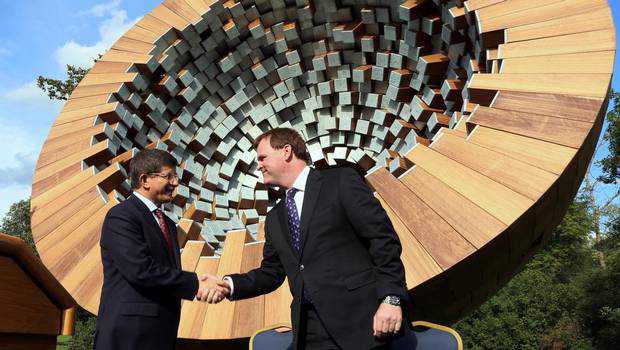
    That’s what the open face of the semi-globe shaped monument unveiled in Ottawa on September 20 by the Foreign Affairs Ministers of Canada and Turkey, John Baird and Ahmet Davutoglu, represented according to its Turkish designers. It is a gift from Turkey and it was built there, disassembled, shipped to Canada in crates, and finally re-assembled in Canada.

    Turkish Minister of Foreign Affairs Ahmet Davutoglu (left) and Canadian Foreign Affairs Minister John Baird.  (Photo credit: The Canadian Press)
    Turkish Minister of Foreign Affairs Ahmet Davutoglu (left) and Canadian Foreign Affairs Minister John Baird. (Photo credit: The Canadian Press)

    The massive monument, mostly composed of 1,100 pieces of hardwood, each one representing a diplomat around the world who has been assassinated by terrorists or otherwise victimized by violence, is a solemn reminder of the scourge of terrorism amongst us. The plated face of each piece is an eternal flame that keeps alive the silent memory of a fallen diplomat somewhere around the globe.

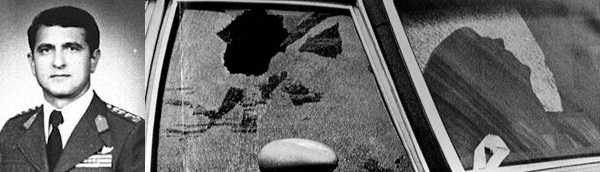
     It is all the more meaningful when one considers the tragic murder of an American ambassador, Christopher Stevens, in Binghazi, Libya only eight days earlier. Glyn Berry, a Canadian diplomat killed by a roadside bomb while serving in Afghanistan in 2006, is not too distant memory, either. But perhaps the most moving tribute, a lone prism, was to the slain Turkish envoy, Turkish military attaché, Col. Atilla Altikat.

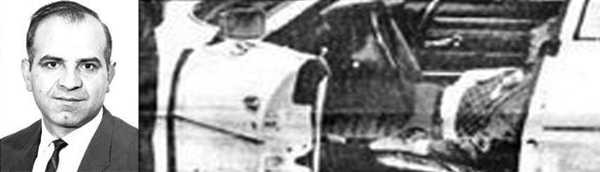
    Altikat was gunned down in cold blood just a few feet from the location of the monument, on his way to work as he stopped at a traffic light on the morning of Aug. 27, 1982. It was the most shocking, heinous, and dastardly attack on a diplomat on Canadian soil. To this day, this hate crime remains unsolved, despite the overt and arrogant claim by one of the numerous Armenian terror groups.

    Baird put it succinctly: “The great struggle of our generation is international terrorism, and that all began for Canada right here, over 30 years ago.”

    Davutoglu was equally articulate: “While the Turkish diplomats have been targets of extremist Armenian groups in the past, we know very well that terrorism is a broad international threat that cannot be associated with any ethnic, religious or political groups… The right to life and security are sacred… (Altikat) will remain in the collective memory of our great nations, as fresh as the first day (he was) fallen.”

    ATAA congratulates both Turkish and Canadian governments for their courage and vision in focusing a modest, though momentous, light on international terrorism. While Armenian terrorism may be a small part of global terrorism, it remains the best kept secret in America today.

    We hope that the U.S. government takes this hint and, again jointly with the Turkish government, erects a monument in Los Angeles, to the silent memory of Turkish Consul General Kemal Arikan. He was also shot at close range on his way to work when he stopped for a red light on Wilshire Boulevard on January 28, 1982, and the perpetrators were also Armenian terrorists.

    Another monument in Santa Barbara, California (for the killing of Turkish diplomats Mehmet Baydar and the Consul, Bahadir Demir by another Armenian, Yanikian, on January 27, 1973) and a third monument in Boston (for the murder of Turkish Honorary Consul General Orhan Gündüz by Armenian gunmen on May 4, 1982) would be not only appropriate and meaningful but also essential as reminders that international terrorism is very real, very personal, and that it takes a village to fight it.

    Such a humane gesture could at last usher in a welcome change in American ethnic politics, especially in Congress, where some representatives see it fit to renew their perennial efforts to legislate history in order to curry favor with ethnic lobbies, being totally oblivious to Armenian terrorism and Turkish suffering.


    May this poignant monument open the gateway to peace!


    Ergün Kırlıkovalı

    President

    Assembly of Turkish American Associations