MIRAS Social Organization in Support of Studying of Cultural Heritage announces 1st International Youth Forum of Cultural Heritage and Tourism.
Information. Forum will be held under slogan “Explore, Protect and Promote!”. Youth of the age till 35 from different countries will forward new ideas in the line of study, protection and promotion of cultural heritage. In the end speakers and participants will be granted certificates.
Purpose. The Forum aims at maintaining collaboration perspectives in the direction of protection and study of cultural heritage, tourism and new fields of tourism by gathering youth among the countries, achieving wide application of exchange of new ideas and successful practices.
For this purpose:
– brings together young people from different countries; helps widening of cultural and tourism relations among those countries;
– displays the role of youth in exploration, protection and promotion of cultural heritage;
– tries to study culture, tourism, traditions of different countries;
– promotes traditions, rich history, culture and tourism of our country among youth of various world countries;
– gives “peace and unity” message to the world;
– listens to the youth’s ideas and initiatives and on its basis adoption of Declaration.
Terms of participation: Youth of 16-35 ages having cultural heritage and tourism activities, wishing to have new relations are invited to participate as presenters of forum and share ideas and practices. Along with Azerbaijan, youth from Turkey, Iran, Georgia, Russia, Italy, Macedonia, India, France, Germany, Spain, Egypt and other countries will participate there. The papers covered new ideas, methods and conception, understandings and the analysis of successes and failures in the field of cultural heritage and tourism will be preferred. Take into consideration the following when sending the abstract:
1. Abstracts must be in Azerbaijani or English languages.
2. Abstracts must be short (maximum 300 words) and should cover main purpose and results. Basic measurements for the forum: quality, originality, comprehensiveness. Abstract covers: (a) title ( abstract topic); (b) entrance with the forum purposes; (c) short description of relevant practice processes; (d) new and non-published information base (d) result.
Authors are accountable for any ideas, as well as writing and grammar rules or mistakes in scientific facts indicated in the abstract. The participant should fill in this application form on ‘miras.az’ web-site to register and then send an abstract.
Deadline: 8th January, 2015
The accepted will be notified till 22nd January, 2015.
There is no limit for participants of the forum. Fill in the application form on web-site miras.az and register.
Fees:
Presenters – 60 AZN (publications, 2-day coffee breaks and lunch);
Participants – 30 AZN (2-day coffee breaks and lunch).
Venue and date:
1-2 February, 2015
Modern Hotel, Baku, Azerbaijan
Advisory Board:
Veli Aliyev, ANAS Associate member
Jafar Giyasi, ANAS Associate member
Prof.Dr. Gafar Jabiyev
Prof.Dr. Luigi Scrinzi (Italy)
Prof.Dr. Kubra Aliyeva
Prof.Dr. Minakhanim Tekleli-Nuriyeva
Prof.Dr. Shikar Gasimov
Prof.Dr. Abbas Seyidov
Prof.Dr. Kamil Ibrahimov
Dr. Fariz Khalilli
Dr. Juanjo Pulido (Spain)
Dr. Irina Gusac (Russia)
Ahmet Aytaç (Turkey)
Emil Safarov
Maleyka Huseynova
Arzu Soltan
Gulshan Huseynova
Teymur Najafzade
Mammad Rahimov
1 February, 2015
10.00-11.00-Registration of participants
11.00-12.30-Opening ceremony of the Forum
12.30-14.00- Lunch
14.00-18.00-The session “Explore”
2 February, 2015
09.00-13.00-Session “Protect”
13.00-14.00-Lunch
14.00-18.00- Session “Promote”
18.00-19.00-Discussions (cultural heritage and tourism studies), adoption of Declaration
19.00-19.30-Granting of certificates
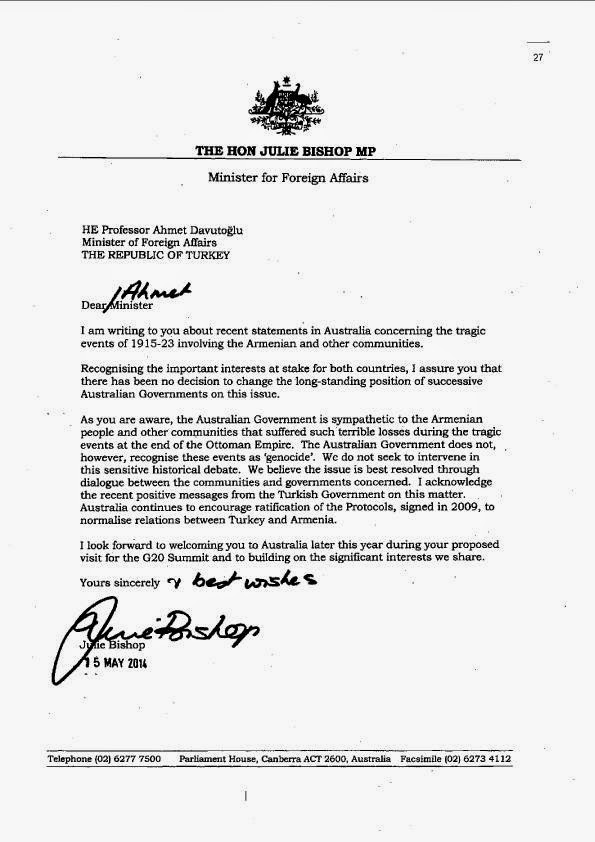
Department of Foreign Affairs and Trade, Australia released internal communication documents about the “Events of 1915” under the Freedom of Information request made last month.
The letter requests DFAT to disclose “ANY” correspondence about “Armenian Genocide” and or “Armenian Massacres” from 1 January 2014 onward. . .
The nation of Israel is galloping blindly toward Bar Kochba’s war on the Roman Empire. The result of that conflict was 2,000 years of exile.
By Shabtai Shavit
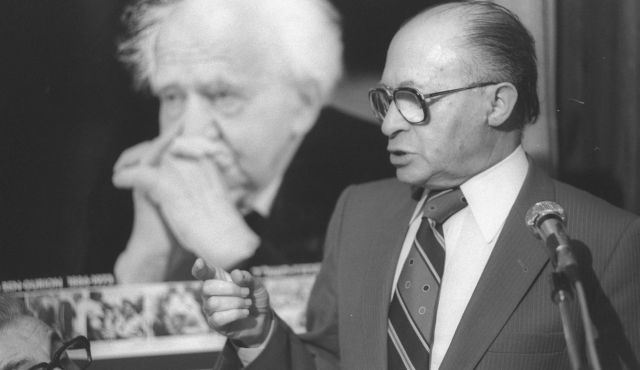
Menachem Begin before an image of David Ben-Gurion
From the beginning of Zionism in the late 19th century, the Jewish nation in the Land of Israel has been growing stronger in terms of demography and territory, despite the ongoing conflict with the Palestinians. We have succeeded in doing so because we have acted with wisdom and stratagem rather than engaging in a foolish attempt to convince our foes that we were in the right.
Today, for the first time since I began forming my own opinions, I am truly concerned about the future of the Zionist project. I am concerned about the critical mass of the threats against us on the one hand, and the government’s blindness and political and strategic paralysis on the other. Although the State of Israel is dependent upon the United States, the relationship between the two countries has reached an unprecedented low point. Europe, our biggest market, has grown tired of us and is heading toward imposing sanctions on us. For China, Israel is an attractive high-tech project, and we are selling them our national assets for the sake of profit. Russia is gradually turning against us and supporting and assisting our enemies.
Anti-Semitism and hatred of Israel have reached dimensions unknown since before World War II. Our public diplomacy and public relations have failed dismally, while those of the Palestinians have garnered many important accomplishments in the world. University campuses in the West, particularly in the U.S., are hothouses for the future leadership of their countries. We are losing the fight for support for Israel in the academic world. An increasing number of Jewish students are turning away from Israel. The global BDS movement (boycott, divestment, sanctions) against Israel, which works for Israel’s delegitimization, has grown, and quite a few Jews are members.
In this age of asymmetrical warfare we are not using all our force, and this has a detrimental effect on our deterrent power. The debate over the price of Milky pudding snacks and its centrality in public discourse demonstrate an erosion of the solidarity that is a necessary condition for our continued existence here. Israelis’ rush to acquire a foreign passport, based as it is on the yearning for foreign citizenship, indicates that people’s feeling of security has begun to crack.
I am concerned that for the first time, I am seeing haughtiness and arrogance, together with more than a bit of the messianic thinking that rushes to turn the conflict into a holy war. If this has been, so far, a local political conflict that two small nations have been waging over a small and defined piece of territory, major forces in the religious Zionist movement are foolishly doing everything they can to turn it into the most horrific of wars, in which the entire Muslim world will stand against us.
I also see, to the same extent, detachment and lack of understanding of international processes and their significance for us. This right wing, in its blindness and stupidity, is pushing the nation of Israel into the dishonorable position of “the nation shall dwell alone and not be reckoned among the nations” (Numbers 23:9).
I am concerned because I see history repeating itself. The nation of Israel is galloping blindly in a time tunnel to the age of Bar Kochba and his war on the Roman Empire. The result of that conflict was several centuries of national existence in the Land of Israel followed by 2,000 years of exile.
I am concerned because as I understand matters, exile is truly frightening only to the state’s secular sector, whose world view is located on the political center and left. That is the sane and liberal sector that knows that for it, exile symbolizes the destruction of the Jewish people. The Haredi sector lives in Israel only for reasons of convenience. In terms of territory, Israel and Brooklyn are the same to them; they will continue living as Jews in exile, and wait patiently for the arrival of the Messiah.
The religious Zionist movement, by comparison, believes the Jews are “God’s chosen.” This movement, which sanctifies territory beyond any other value, is prepared to sacrifice everything, even at the price of failure and danger to the Third Commonwealth. If destruction should take place, they will explain it in terms of faith, saying that we failed because “We sinned against God.” Therefore, they will say, it is not the end of the world. We will go into exile, preserve our Judaism and wait patiently for the next opportunity.
I recall Menachem Begin, one of the fathers of the vision of Greater Israel. He fought all his life for the fulfillment of that dream. And then, when the gate opened for peace with Egypt, the greatest of our enemies, he gave up Sinai – Egyptian territory three times larger than Israel’s territory inside the Green Line – for the sake of peace. In other words, some values are more sacred than land. Peace, which is the life and soul of true democracy, is more important than land.
I am concerned that large segments of the nation of Israel have forgotten, or put aside, the original vision of Zionism: to establish a Jewish and democratic state for the Jewish people in the Land of Israel. No borders were defined in that vision, and the current defiant policy is working against it.
What can and ought to be done? We need to create an Archimedean lever that will stop the current deterioration and reverse today’s reality at once. I propose creating that lever by using the Arab League’s proposal from 2002, which was partly created by Saudi Arabia. The government must make a decision that the proposal will be the basis of talks with the moderate Arab states, led by Saudi Arabia and Egypt.
The government should do three things as preparation for this announcement:
1) It should define a future negotiating strategy for itself, together with its position on each of the topics included in the Arab League’s proposal.
2) It should open a secret channel of dialogue with the United States to examine the idea, and agree in advance concerning our red lines and about the input that the U.S. will be willing to invest in such a process.
3) It should open a secret American-Israeli channel of dialogue with Saudi Arabia in order to reach agreements with it in advance on the boundaries of the topics that will be raised in the talks and coordinate expectations. Once the secret processes are completed, Israel will announce publicly that it is willing to begin talks on the basis of the Arab League’s document.
I have no doubt that the United States and Saudi Arabia, each for its own reasons, will respond positively to the Israeli initiative, and the initiative will be the lever that leads to a dramatic change in the situation. With all the criticism I have for the Oslo process, it cannot be denied that for the first time in the conflict’s history, immediately after the Oslo Accords were signed, almost every Arab country started talking with us, opened its gates to us and began engaging in unprecedented cooperative ventures in economic and other fields.
Although I am not so naïve as to think that such a process will bring the longed-for peace, I am certain that this kind of process, long and fatiguing as it will be, could yield confidence-building measures at first and, later on, security agreements that both sides in the conflict will be willing to live with. The progress of the talks will, of course, be conditional upon calm in the security sphere, which both sides will be committed to maintaining. It may happen that as things progress, both sides will agree to look into mutual compromises that will promote the idea of coexisting alongside one another. If mutual trust should develop – and the chances of that happening under American and Saudi Arabian auspices are fairly high – it will be possible to begin talks for the conflict’s full resolution as well.
An initiative of this kind requires true and courageous leadership, which is hard to identify at the moment. But if the prime minister should internalize the severity of the mass of threats against us at this time, the folly of the current policy, the fact that this policy’s creators are significant elements in the religious Zionist movement and on the far right, and its devastating results – up to the destruction of the Zionist vision – then perhaps he will find the courage and determination to carry out the proposed action.
I wrote the above statements because I feel that I owe them to my parents, who devoted their lives to the fulfillment of Zionism; to my children, my grandchildren and to the nation of Israel, which I served for decades.
Having read your most recent article “Countries selling weapons to Azerbaijan are just as guilty for attacks on Artsakh = Karabag”, I must say that your leading article is simply an unworthy attack on Azerbaijan. Your article, Sir, not written with a journalistic style but with the genetic lines of a propaganda Minister of a country at war, is, slowly but surely killing off your credibility.
You are forgetting, of course, who is the aggressor and occupier of land belonging to Azerbaijan! Just to refresh your memory:
“ … By the end of the war in 1994, the Armenians were in full control of most of the enclave and also held and currently control approximately 9% of Azerbaijan’s territory outside the enclave. As many as 230,000 Armenians from Azerbaijan and 800,000 Azeris from Armenia and Karabakh have been displaced as a result of the conflict. A Russian-brokered ceasefire was signed in May 1994 and peace talks, mediated by the OSCE Minsk Group, have been held ever since by Armenia and Azerbaijan.”
Current Situation:
“In the years since the end of the war, a number of organizations have passed resolutions regarding the conflict. On 25 January 2005, for example, PACE adopted a controversial non-binding resolution, Resolution 1416, which criticized the “large-scale ethnic expulsion and the creation of mono-ethnic areas” and declared that Armenian forces were occupying Azerbaijan lands.[187][188] On 14 May 2008 thirty-nine countries from the United Nations General Assembly adopted Resolution 62/243 which called for “the immediate, complete and unconditional withdrawal of all Armenian forces from all occupied territories of the Republic of Azerbaijan.” Almost one hundred countries, however, abstained from voting while seven countries, including the three co-chairs of the Minsk Group, Russia, the United States, and France, voted against it.” ).
These are the facts Mr. Sassounian. Furthermore, don’t forget that; you are the master of your evil thoughts, the moulder of your character, and the shaper of your condition, environment and destiny. An ignoble and bestial character is the result of the continued harboring of gravelling thoughts.
Your call for retaliation, revenge and disproportionate use of force shows what a sick character you are! You , Mr. Sassounian, sitting in the comfort of California have no idea of life in poor Armenia, and what it means to make war and suffer the destruction as such! There are no winners in a war, only loosers. The only winners are the ones (Israel, Russia) supplying the expensive weapons. Wake up Mr. Sassounian and rid yourself from your evil thoughts. As soon as you have done that, and your thoughts become healthy and beneficial to all man kind, joy will soon follow you as surely as your shadow follows you on a sunny day.
Armenian parliament rejected Nov. 12 the oppositional Heritage faction’s draft law, submitted in extraordinary manner, which stipulates recognition of independence of Azerbaijan’s separatist region of Nagorno-Karabakh, Novosti-Armenia news agency reported.
Prior to the voting on the draft law, Artak Zakarian, an MP from the Republican Party of Armenia (RPA) faction said the RPA believes that the draft law is not timely, so the RPA faction will not participate in the voting.
Thus, the draft law gained 8 votes “in favor”, with one abstention. Other MPs didn’t vote.
The conflict between the two South Caucasus countries began in 1988 when Armenia made territorial claims against Azerbaijan.
As a result of the ensuing war, in 1992 Armenian armed forces occupied 20 percent of Azerbaijan, including the Nagorno-Karabakh region and seven surrounding districts.
The two countries signed a ceasefire agreement in 1994. The co-chairs of the OSCE Minsk Group, Russia, France and the US are currently holding peace negotiations.
Armenia has not yet implemented four UN Security Council resolutions on the liberation of the Nagorno-Karabakh and the surrounding regions.
Nearly all congressional candidates nationwide who supported Armenian -American issues were victorious during the November 4 elections. The outcome was similarly positive for other candidates running in state and local races. Consequently, the Armenian National Committee of America (ANCA) announced that over 95% of its endorsed candidates had been successful. Although both Republicans and Democrats have traditionally supported Armenian-American issues, there are some dark clouds looming over Armenian lobbying efforts in Washington due to major changes in the new Congress, which take effect in January 2015, during the critical Centennial Year of the Armenian Genocide. Several key pro-Armenian Democratic Senators will lose their leadership positions as a result of the new Republican majority. For example, Sen. Robert Menendez (D-NJ), rated A+ on Armenian issues by ANCA, will no longer Chair the Foreign Relations Committee. He will be replaced by Sen. Robert Corker (R-TN), rated D+ by ANCA, one of five Republican Senators who voted against the Armenian Genocide Resolution in the Foreign Relations Committee last April. In addition, Senate Majority Leader Harry Reid (D-NV), rated A by ANCA, will become Minority Leader. He will be replaced by Sen. Mitch McConnell (R-KY), rated C+ and endorsed for reelection by ANCA. Sen. McConnell has voted positively on some Armenian issues. The picture is not any brighter on the House side, in terms of the position of its top leadership on Armenian-American issues. Speaker John Boehner (R-OH), who saw a major surge in his party’s majority, had announced during a recent visit to Ankara that the House of Representatives will not deal with the Armenian Genocide issue. No wonder ANCA gave him a C rating. A glimmer of hope is House Majority Leader Kevin McCarthy (R-CA), rated B- and endorsed by ANCA for reelection, who has maintained close contacts with his Armenian constituents. Fortunately, Cong. Ed Royce (R-CA), rated A+ and endorsed by ANCA, will still Chair the important Foreign Affairs Committee. It is not surprising that the Turkish media has been gloating over the congressional election results. “Republicans favor Turkey on Armenian issue,” was one of the headlines in Sabah, a Turkish newspaper. Reporter Ragip Soylu wrote: “Some changes within the Senate will help Turkey’s distasteful experience with Congress.” The “removal” of Sen. Menendez from chairmanship of the Foreign Relations Committee “will help Turkey’s uncomfortable and weak position in the Senate.” The reporter went on to call the continued Republican control of the House “more good news for Turkey as House Speaker John Boehner has already promised to not bring up the Armenian issue to the executive agenda of the chamber. ‘Congress won’t get involved in this issue. We don’t write history, we are not historians,’ he reportedly said during his visit to Ankara in April 2014.” In another Sabah article, Ilnur Cevik confidently wrote: “Turkey’s fortunes are not so bad,” in the face of “the likely problems posed by the advent of the 100th year since the 1915 incidents regarding the Armenians during Ottoman times.” Cevik described Republicans not as “combative” on the Armenian issue as Democrats “who are dying to appease the Armenian lobby in the U.S. and thus would be more receptive to a tough worded motion regarding Armenians, especially in 2015 when the 100th year of the events during World War I when Armenians living under Ottoman rule were killed and the Armenians called this controversially a genocide.” Another Turkish publication, “World Bulletin,” cheerfully headlined its report: “Republican Victory in US Congress Benefits Turkey.” The article pointed out that “a Democrat-led Senate’s Foreign Relations Committee would have been a nightmare for Turkish-American relations, as it would have come out with bills on Armenian claims of genocide during the 1915 incidents in eastern Turkey.” Soner Cagaptay, Director of Turkish Research Program at Washington Institute for Near East Policy, confirmed the pro-Turkish orientation of the new Senate, as “it has been Republicans in the Senate who have blocked bills on genocide claims against Turkey.” Another Turkish analyst, Kadir Ustun, observed that the chance of passing a Congressional Resolution on the Armenian Genocide “is now lower than ever, as the Republicans are in control of Congress.” It is now incumbent upon Armenian-Americans who have strong ties with Republican Congressional leaders to convince them to uphold Armenian initiatives, while exposing Turkey’s support for ISIS terrorists who threaten US national interests in the Middle East.