Category: Australia

  • Australia ‘spied on Indonesia President’

    Australia ‘spied on Indonesia President’

    Mr Yudhoyono and several senior ministers were said to be targeted
    Mr Yudhoyono and several senior ministers were said to be targeted

    Indonesia is recalling its ambassador to Australia over allegations that Canberra spied on phone calls of the Indonesian president.

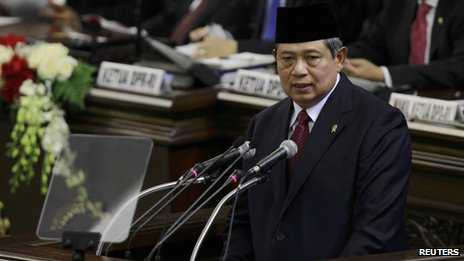
    According to BBC, President Susilo Bambang Yudhoyono, the first lady and Vice-President Boediono were reportedly amongst those targeted.

    The allegations came from documents leaked by whistleblower Edward Snowden which were published by broadcaster ABC and the Guardian newspaper.

    Indonesia said the ambassador was being called to Jakarta for “consultations”.

    It is the latest in a series of spying allegations that have strained relations between the two allies.

    On 1 November Indonesia summoned Australia’s ambassador amid reports that Australia’s Jakarta embassy was used as part of a US-led spying network in Asia.

    The latest leaked document showed that Australia spy agencies named Mr Yudhoyono, the first lady, Vice-President Boediono and other senior ministers as targets for monitoring, the reports said.

    The presentation from Australian spy agency the Defence Signals Directorate (now known as the Australian Signals Directorate) showed that agencies attempted to listen to Mr Yudhoyono’s calls at least once, and tracked calls made to and from his mobile phone, in August 2009, theAustralian Broadcasting Corporation and the Guardian added.


    The news organisations published slides from the presentation, which appeared to show a list of Indonesian “leadership targets” and the handset models used by each target, as well as a diagram of “voice events” of the Indonesian president in August 2009.

    One slide entitled “Indonesian President voice intercept (August ’09)” appeared to show an attempt to listen to the content of a phone call to Mr Yudhoyono.

    ‘Research’

    On Monday, Indonesian Finance Minister Marty Natalegawa said: “This is an unfriendly, unbecoming act between strategic partners.”

    “This hasn’t been a good day in the relationship between Indonesia and Australia.”

    Indonesia was reviewing all of its agreements related to information exchange with Australia, Mr Natalegawa added.

    Djoko Suyanto, Indonesia’s Co-ordinating Minister for Politics, Legal and Security Affairs, told the BBC that Jakarta would summon the Australian ambassador for questioning.

    However, Sofyan Djalil, the former minister for state-owned enterprises whose name was also on the list of targets, told AFP news agency: “Diplomatic relations always have their ups and downs. This has caused anger in the short-term, but in the long-term we are still neighbours and I think we will overcome this.”

    Earlier on Monday, responding to questions in parliament, Australian Prime Minister Tony Abbott said: “The Australian government never comments on specific intelligence matters.”

    He added: “I will never say or do anything that might damage the strong relationship and the close co-operation that we have with Indonesia, which is all in all, our most important relationship.”


    Last week, commenting on the earlier claims, Mr Abbott had described the term spying as “kind of loaded language” and suggested that “researching” would be more appropriate.

    Indonesia has publicly voiced anger over previous allegations of Australian spying.

    Vice-President Boediono, who like many Indonesians goes by only one name, said last week that the Indonesian public were “concerned” about the spying allegations.

    “I think we must look forward to come to some arrangement which guarantees that intelligence information from each side is not used against the other,” he said.

    Australia and Indonesia are key allies and trading partners.

    Australia requires Indonesia’s co-operation on the asylum issue, as many asylum seekers travel via Indonesia to Australia by boat, but there are tensions on the issue.

    Earlier this month, Indonesia declined an Australian request to receive a boat of asylum seekers whose vessel, bound for Australia’s Christmas Island, had got into trouble after it departed from Indonesia.

    The reports are amongst the series of documents leaked by ex-US intelligence contractor Edward Snowden, who has been granted temporary asylum in Russia and is wanted in the US in connection with the unauthorized disclosures.
  • Turkey rejects more for Gallipoli 100th

    Turkey rejects more for Gallipoli 100th

    • From: The Australian
    • October 23, 2013 12:00AM

    ANZCoveBig

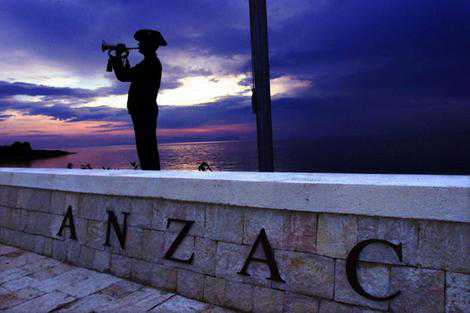
    TURKEY has rejected an Australian request to increase the number of Australians and New Zealanders visiting Gallipoli for the 100th anniversary of the Anzac landings.

    The Turks insist that for safety reasons no more than 10,500 Australians and New Zealanders may attend the commemoration on April 25, 2015. And the Abbott government will press on with the plan for a national ballot to allocate those places to those who want to attend.

    When the ballot plan was announced by the Labor government last year, battlefield tour operators and some of those who had booked places reacted angrily to the Department of Veterans Affairs’ plan to limit the number able to attend the dawn service. The Coalition undertook to review the planning for the centenary if it won government.

    The Minister Assisting the Prime Minister for the Centenary of Anzac, Michael Ronaldson, said he had discussed the numbers with the Turkish government. “It’s been made very clear to me . . . that they view 10,500 as the maximum figure. They are our hosts. They are very generous hosts and if that’s the figure they believe is appropriate then that’s the figure we will work on.”

    He said he would make announcements about the ballot process in the next month. The previous government’s estimates of the numbers of people eligible for the various categories in the ballot were reasonable.

    But large numbers of Australians wanted to make the journey and there had to be a way to ensure that those who entered the ballot actually intended to go, Senator Ronaldson said.

    “It’s important that people have thought long and hard about whether they want to go, whether they can go and whether they will go,” he said.

    To take some of the pressure off the anniversary of the Anzac landing, Senator Ronaldson is considering a proposal for commemoration ceremonies marking other key dates.

    “I’m looking at how we might be able to have some smaller, but no less important for the families involved, commemorative activities through the campaign.”

    In April, former defence force chief Angus Houston told The Australian that being at Gallipoli in August for the anniversaries of the battles such as Lone Pine and The Nek or the evacuation would give visitors the space to contemplate the Anzac sacrifice without battling the crowds expected to mark the 100th anniversary of the landing.

    Mr Houston, who headed the inquiry into how the Gallipoli centenary should be commemorated, said it could be dangerous to allow unlimited numbers to visit. “I think if you just have a free-for-all, it will be a shambles. The simple fact is that the site will not take more than 10,500 people,” he said.

    He said it might be possible to have a small team including a chaplain and a bugler at Gallipoli to carry out services daily during the anniversary period.

    Senator Ronaldson said a key priority for him as minister would be caring for those who served in Afghanistan and Iraq and other conflicts.

    He said he wanted the next generation of Australians to come out of the Anzac commemorative period with a clear understanding of a century of sacrifice, from World War I to Afghanistan, knowing where their forebears fought, when they fought and the values they were fighting to defend, as well as what 102,000 names on the Australian War Memorial meant.

    via Turkey rejects more for Gallipoli 100th | The Australian.

    • From: The Australian
    • October 23, 2013 12:00AM

    – See more at:

  • Overcoming Conflict: How The Battle Of Gallipoli Sparked A New Friendship

    Overcoming Conflict: How The Battle Of Gallipoli Sparked A New Friendship

    Overcoming Conflict:
    How The Battle Of Gallipoli Sparked A New Friendship

    The following op-ed by Sevin Elekdag, TCA Research Fellow and Onur Isci, Lecturer at the Department of History at Georgetown University was published in the Eurasia Review on   April 25.Every year on April 25, Turks join with Australian and New Zealand friends to commemorate ANZAC Day. On this day 98 years ago, with the Allies at their side, the newly formed Australian and New Zealand Army Corps (ANZACS) landed on the Gallipoli peninsula to invade the Ottoman Empire’s capitol, modern-day Istanbul, and take control of a precious WWI supply route to Russia. As support for the war waned, the British came to Australia with a propaganda machine aimed at encouraging young Australian men to sign-up to fight in this war on a foreign land half a world away. Over the next nine months, the Turks fought a bloody battle against the ANZACs, and while the Ottoman army ultimately prevailed, both sides suffered great hardships and heavy casualties.

    For the ANZACS, this little known WWI event is recognized as their first ever major offensive and has become a defining moment in shaping the national identities of the Australian and New Zealand people. For Turks, it gave inspiration and a leader (Mustafa Kemal) to the Turkish National Resistance Movement that eventually freed Anatolia from foreign invaders.

    In 1934, when memories of the battle were still fresh, Mustafa Kemal Atatürk, commander at Gallipoli and founder of modern Turkey, stated:

    “Those heroes that shed their blood and lost their lives…You are now lying in the soil of a friendly country. Therefore rest in peace. There is no difference between the Johnnies and the Mehmets to us where they lie side by side now here in this country of ours…you, the mothers, who sent their sons from faraway countries wipe away your tears; your sons are now lying in our bosom and are in peace. After having lost their lives on this land. They have become our sons as well.”

    These words mark the beginning of years of cultural exchange and efforts to establish official diplomatic relations between these nations. At the time, it may have seemed impossible to bridge the obvious differences in how the event was, and is, perceived in each country. But with perseverance, what ultimately emerged from the wreckage was a new friendship between Turkey, Australia and New Zealand. Out of respect and understanding, these nations now come together to reflect on the tragic realities of war.

    So it is that Gallipoli has become a national symbol of reconciliation. How inspiring to see Turks, Australians and New Zealanders set aside animosity and empathize with the experiences and suffering of the other. Coming together over this shared experience has allowed nations once at war to build friendship and solidarity from its ashes.

    Following last year’s anniversary, Turkish Prime Minister Recep Tayyip Erdogan and his Australian counterpart, Julia Gillard, met in Ankara, Turkey to plan a special remembrance of the centenary of the Gallipoli campaign. The two leaders announced that 2015 would be proclaimed the Year of Turkey in Australia and the Year of Australia in Turkey.

    Every day, news from the Middle East is dire. As governments change and conflicts rage on, one worries about the next generation of leaders for Palestine, Syria, Israel, Iraq and Afghanistan. Are they being given examples showing that after the hostilities, there is the possibility for finding common ground? That dialogue and reconciliation are important steps towards a more prosperous and stable future for their children, and every generation thereafter? Is history passed down in a way that considers the perspectives of other cultures?

    As war and threats of conflict swirl across the continents, it is never too soon to use the lessons of Gallipoli to teach our children not just to honor bravery and sacrifice, but also to recognize that it takes equal measures of great strength and empathy to set aside the tragedies of war.

  • Turkey: Following the Anzacs

    Turkey: Following the Anzacs

    Turkey puts $60 million into multimedia encounter, writes Russell Maclennan-Jones

    Turkish World War I memorial at Canakkale near Gallipoli, Turkey. Photo / Supplied

    People on this side of the world have a clear picture of Gallipoli: mateship, valour, sacrifice in a small campaign that we lost on the way to winning World War I. It’s far more complicated for Turkish people. They won the campaign at the cost of many lives and saved their country, but went on to lose the war.

    They lost an empire, too, but from its ashes rose modern Turkey, a prosperous, fairly stable country linking Europe to the Middle East.

    A new centre near the battlefields of a century ago makes it easier for visitors to get a Turkish perspective. Allied victory there, and greatly increased support for Russia through the Bosphorus, could have ended the war swiftly and even altered the Russian revolution.

    The Turks have spent nearly $60 million on the Canakkale Epic Promotion Centre and epic is the right word. It’s history as entertainment and a vivid celebration of the men who defeated the invading Anzacs, British and other Allies, in 1915.

    Conceived as a multimedia extravaganza, with actors bringing many scenes to life in film segments, the building has an ambitious flowing scheme to cope with big crowds moving from one multimedia experience to another.

    No media trick is forgone, from the 3D thrill of being shelled by a battleship to hand-to-hand battles in the trenches on the peninsula. It gets pretty confusing and is very noisy. Headphones provide an English translation, which can be a bit hard to follow.

    anzacs and ottoman turks
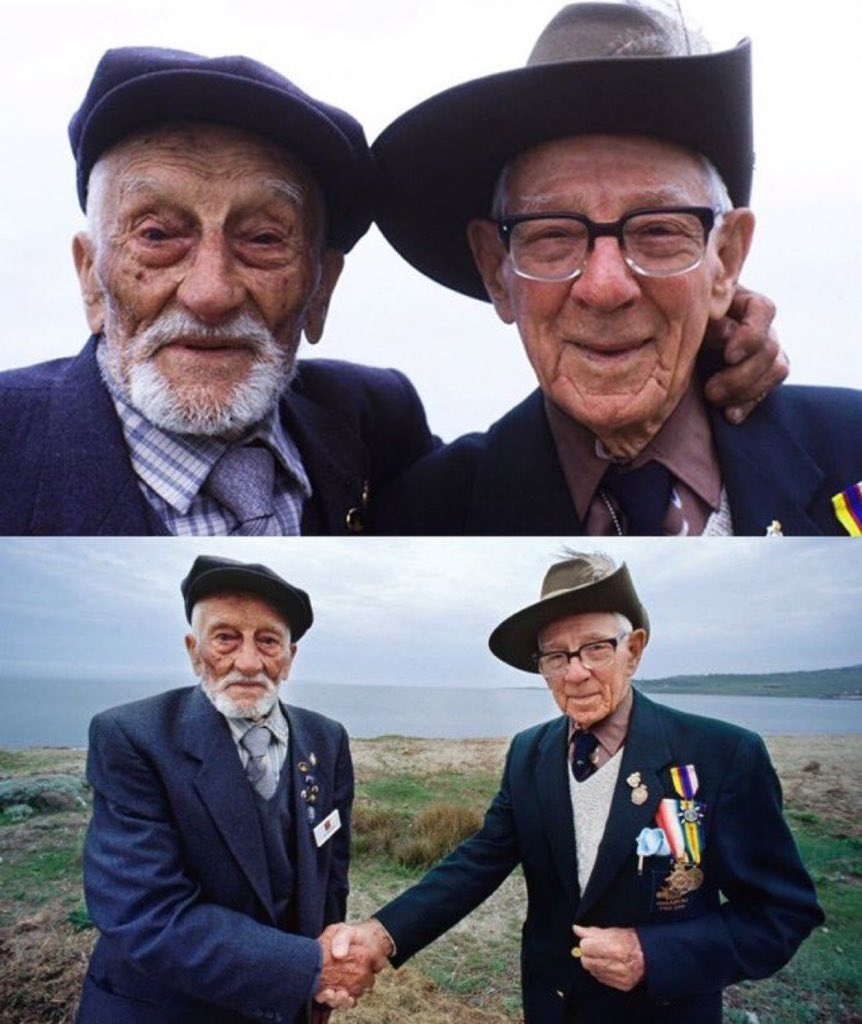
    The Ottoman veteran Adil Şahin and the Australian veteran Len Hall met as friends in Gallipoli in 1990, 75 years after they fought as enemies in the same place.

    Generations of Kiwis mark the battle’s start on April 25, Anzac Day, but the Turks celebrate March 18, when they routed Allied navies, a defeat that led to the invasion attempt, and this naval battle takes up a lot of the experience.

    Guides lead the 30 or so people in each group from room to room. At one point you’re on the heaving deck of a battleship, at another you feel as though you are in the middle of the fighting.

    Some of the acting is unconvincing (British Navy types discussing tactics, all in Turkish, of course), but the ordinary soldiers bring some of the scenes to life. Facts, figures and statistics are sparing. It’s more a matter of the feeling that the homeland was under threat and brave soldiers stood up when it mattered.

    Allied soldiers are shown being shot down on the beach, and the ruse of guns left to fire themselves as the Anzacs withdrew is depicted in detail. But between those two events little is shown of the Allied effort or of how the soldiers scraped an existence on the unfriendly hills.

    After the high-tech experience I hope schoolchildren are taken up the hill to where their forefathers fought ferocious battles. The graves there show how many people died in what was a fruitless campaign.

    Because the centre is new, tour groups may not have incorporated visits yet. The best way to get there is to take a taxi from Eceabat. Buses are infrequent. If you can spend two or three days in Eceabat or Canakkale do visit the centre and take a guided tour of the battlefields. To avoid crowds go at dawn or sunset and ask a taxi driver to show you the landing places and cemeteries.

    CHECKLIST

    Getting there: Emirates flies daily from Auckland to Dubai with a connection there to its flight to Istanbul. fares are currently available from $2,497 return.

    By Russell Maclennan-Jones

    Watch: Anzac Day weather forecast

    VIDEO Anzac Day weather forecast (2:56)

    1. Turkey: Why would you walk 500k’s?
    2. Russell Baillie: Commanding but not compelling
    3. Turkey: Rising from margins to centre stage
    4. Veterans revisit ‘end of beginning’

    Related Tags

    1. Anzac Day
    2. Europe
    3. International Travel
    4. Turkey
  • Anzac Day terror warning for Australians travelling to Turkey

    Anzac Day terror warning for Australians travelling to Turkey

    AUSTRALIANS attending Gallipoli’s Anzac Day dawn service are being warned of the possibility of a terrorist attack in the country.

    Visitors making the April 25 pilgrimage are being told to “exercise a high degree of caution in Turkey because of the high threat of terrorist attack”.

    The warnings, contained in the Department of Foreign Affairs’ Smartraveller bulletin for Turkeyand Anzac travellers, ask people to be aware terrorists are constantly active in the country.

    The latest attack was in February when a suicide bomber targeted the US Embassy in Ankara, killing himself and a security guard and injuring others.

    Australians are being warned of the possibility of terror attacks in Turkey as Anzac Day approaches. File image. Source: AFP
    Australians are being warned of the possibility of terror attacks in Turkey as Anzac Day approaches. File image. Source: AFP

    The Turkish Government has warned the group claiming responsibility is planning further attacks.

    There have been nine notable events since 2010, and Australian Amanda Rigg, 22, was killed when a suicide bomber hit an Istanbul police station in 2001.

    “Terrorist attacks can occur anywhere at any time in Turkey,” the travel advice says.

    “In recent years, terrorist attacks have occurred in tourist areas and locations frequented by foreigners.

    “Foreigners have been killed and injured.”

    Terrorism expert Professor Clive Williams, from the Australian National University, said Australian tourists were not usually targets but the advice was sensible.

    Travellers risked being caught in “the wrong place”, as Ms Rigg had been, he said.

    “She was not targeted, she just happened to be where a bomb went off,” Professor Williams said.

    “In Turkey, the main target is the government and then second is the United States and then third is the UK.

    “You just need to be careful where you go and what you do in Turkey.”

    Travellers should avoid government offices, embassies and consulates, be wary in busy areas like transport hubs and exercise particular care around significant local dates, like May Day on May 1.

    Those considering travelling to areas bordering with Syria, Iraq and Iran are told to reconsider their need to travel.

  • Turkish Airlines plans Istanbul-Sydney non-stops

    The day before the Qantas-Emirates kicks off, Turkish Airlines gate crashes the party with non-stop intentions for Sydney-Istanbul flights

    Great Circle Mapper SYD-IST diagram

    Turkish Airlines CEO Temel Kotil intends to connect Europe and Australia with its first commercial non-stop air service next year by operating the Istanbul-Sydney route with either a 777-300ER or 7770200LR.

    The report in ATW is light on details, but clear about aims.

    Turkish Airlines doesn’t have any 777-200LRs in its large fleet of Airbus and Boeing airliners, which like the Airbus A345 is a jet with the range to fly the route non-stop both ways with a commercial payload, but it has been speculated that it could source some of the -200LRs within a year, and readily integrate them into its -300ER operations.

    The story should be taken seriously. Istanbul airport is growing faster than Dubai airport, and unlike the latter, can be greatly expanded.

    In the report, Kotil refers to both the non-stop ambitions and the possibility of connections through either Jakarta or Bangkok, which implies using either of those cities if the Sydney flights were operated with 777-300ERs which would need to refuel on the return leg.

    From an air treaty perspective Indonesia is considered a difficult state with which to negotiate new services, making Bangkok the favourite when it comes to the -300ER probabilities.

    The nominal great circle distance between Sydney and Istanbul is 14,956 kilometres, which is only 389 kilometres shorter than the 15,345 kilometres flown daily each way between Singapore and Newark (for New York City) by Singapore Airlines A340-500s, on what has been world’s longest scheduled passenger service since mid 2004.

    The same fleet operates the world’s current second longest commercial flights between Singapore and Los Angeles, a nominal distance of 14,114 kilometres, but both services will end later this year with the retirement of the A345s.

    The world’s third longest route but only one way is the Sydney-Dallas Fort Worth service flown by a Qantas 747-400ER  at a nominal 13,804 kilometres.

    Recently Turkish Airlines spoke cautiously about starting flights to Australia because of the Qantas-Emirates partnership over Dubai, which begins tomorrow.  Something has changed, but the airline has always been comfortable with being reported as the major competitor on a global scale to Emirates.

    Its current and rapidly growing network centred on Istanbul has the greatest potential for frequent connections to diverse European centres because the hub is within single-aisle jet range of those cities which are served by less frequent but larger Emirates wide-bodied airliners.

    via Turkish Airlines plans Istanbul-Sydney non-stops | Plane Talking.