Our View: Our politicians need to leave their fantasy world
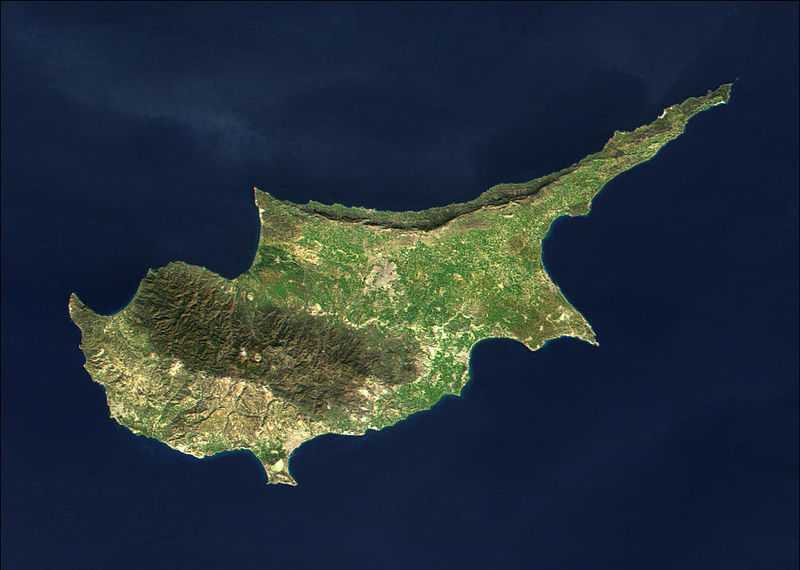
DELUSIONS and myths have always been the currency of Cyprus political life, which took a divorce from reality from the day the Republic was established. Ever since, our politicians have been operating in a fantasy world of their own making, a world in which a tiny and powerless country (now also bankrupt) with the population of a mid-size town is a major political player, capable of imposing its own agenda on the world stage.
This may sound like the script for a political satire or a comedy show but in Cyprus it is for real and despite the catastrophes it has brought upon the country over the decades the delusions of grandeur and lack of a sense of perspective still reigns supreme. The politicians, urged on by a media suffering from the same delusions, make all types of pronouncements that are based on a series of irrational assumptions the main one being that all states are equal irrespective of their military and economic power.
No matter how many times this assumption has been as a fallacy by hard facts the politicians still adhere to it, as if the world had to operate in the way they imagine rather than in the way it does. Archbishop Makarios set the agenda when at the height of the Cold War he believed he could punish lack of US support for his brinkmanship, by strengthening relations with the Soviet Union and taking Cyprus into the Soviet-controlled Non-Aligned Movement, instead of NATO to which all guarantor countries belonged. Events of 1974 were the direct result of Makarios’ folly and his delusions of grandeur.
But nothing was learned and Cypriot leaders continued to grossly overestimate their power and ability to influence events. For instance, there was the fiasco of the S300 missiles, which cost the taxpayer in excess of 200 million pounds, when then President Clerides thought he would redress the imbalance of power with Turkey by deploying ballistic missiles. They were never deployed because the Turks had threatened to take them out if they had been. The Papadopoulos presidency believed it could achieve with diplomatic means what Clerides had failed to with military means. After deceiving our EU partners over the Annan plan, he tried to use membership of the Union to put pressure on Turkey, but achieved nothing.
There are countless examples of this folly and no matter how many times we were cut down to size, politicians still labour under the illusion that they can play international power games and impose their wishes on Turkey, the EU and rest of the international community. How many times in the last year have we heard Papadopoulos junior, Omirou and Lillikas calling for a new strategy in the national problem because the talks were futile? But would a new strategy make Cyprus a bigger and more powerful country that would be able to achieve the objectives of deluded politicians?
Whatever strategy we adopt Turkey would continue to have overwhelming military, economic and diplomatic superiority which are what count. It would carry on violating our EEZ, because we have no practical way of stopping its ships, and continue its military occupation of the north because we have no practical way kicking her troops out. This is the harsh reality – however unjust and unfair – that we should accept.
Nor will any third country help Cyprus defend its sovereign rights as the politicians have been claiming. In the last few months the above-mentioned party leaders have been arguing that we should strengthen relations with Russia as if this would make any difference to our extremely weak position. The latest folly is the proposal to offer Russia military facilities at a time when there is a major stand-off between Moscow and the West which included our EU partners. The idea that Russia would jeopardise its trade relations with Turkey, worth tens of billions of dollars per year and the potential of selling it vast quantities of natural gas, for the sake of helping Cyprus, is as unreal as the talk of the new strategy.
Our politicians need to leave the fantasy world they have been residing and in before they cause even more harm to the country. The only way of avoiding future instability and cashing in on what hydrocarbon deposits we may have is by returning to the talks and reaching an agreement with the Turks. The settlement might not be as just and fair as we would like, because in the world of reality and hard facts we are in a very weak position, which we do not have the power to change either now or in the foreseeable future.
Kufi Seydali
Comment by John Mavro
An excellent CM view which perfectly describes the absolutely tragic, depressing and catastrophic state of affairs we find ourselves in.
With one major exception: the writer is being extremely charitable, almost naive, to refer to the protagonists of these disasters as “politicians”. Since this term implies some degree of intelligence and thinking ability. A better description for these corrupt idiots would that of a “curse”. Successive curses, not imposed upon us by anyone, but brought upon by our immaturity, moral bankruptcy and ultimately infinite stupidity. Since we never learn from our mistakes, from the 1950’s onward, and keep electing these stupid, anachronistic and narrow minded nationalistic peasants into power. Who then dutifully perpetuate the disasters of their predecessors as if this is our only way forward. And perhaps there maybe a hidden agenda in their muddled, delusional and non-visionary thinking. Lunacy in reality. Which is nothing more than to bring about a two state solution. To establish an ethnically cleansed, church approved “Hellenistic” nation which is totally isolated from our perceived perpetual enemies, the Turks- be it TCs or mainland Turks. And given their inherent dishonesty, cowardice and aversion to taking responsibility for their actions, they wish to “achieve” this final destruction not thrugh their direct actions but by having it imposed upon them by the international community. Thus achieving their goal without “political cost” to themselves. There cannot be any other explanation for their irrational, delusional and dishonest behavior. And most tragic of all is that they are very close to achieving their goal. De jure partition. Without any land adjustments, concessions from the other side or compensation. And to hell with the 200,000 or so refugees created by these same “politicians” and their cowardly actions. Some simple advice to our alleged “president”. Acknowledge reality, accept we are in an extremely weak position and unconditionally return to these “negotiations”. And negotiate a loose federation in exchange for land adjustments. We may then gain something. For if he does not, in 2018 little Nicholas, as the latest addition to this long list of curses will achieve his “vision”. When the international community recognizes two states- without any land adjustments or gains for our side. It is as obvious and clear as that to all thinking individuals with some common sense. Which given his “performance” so far, clearly excludes the idiot that passes as our “president” who much prefers to travel the world and stay away as much as he can from this dysfunctional, cursed banana republic to avoid confronting the numerous problems facing us. We do have the ” leaders” we deserve. Since we always put them into these positions where they have brought us untold destruction and even death.
Comment by Ozay Mehmet
Delighted to see this as Op-Ed article…summarizing comments and views of some of us in these pages, in exact words…Fantasy-world, myths….It shows that, at least the editors, are reading our comments. The important point, of course, is your call for Mr. A to return to the negotiating table, unconditionally, soonest and make the best deal possible with the Turks…About the only thing I disagree in the article is your implication that it will be a “bad” or “humiliating” deal because of the weakness of GC side. On the contrary I believe it will be honorable and fair deal because the Turks, especially Ankara, is driven by realism…not vengeance. Both sides, Turks and Greeks, have never before needed each other more….owing to regional and global conflicts… Lets hope your wise words will be heeded…without delay.
The essence of a GC-TC deal, brokered thru Eide, must be Land-for-Peace….TCs to return 5%+ [ including Varosha/Maras] in return for 50-50 ownership of a brand new United Cuprus…or Agreed Loose Confederation, legitimizing the existing two-states, both within EU, with an agreed border adjustment.
The USA is trying to create the conditions necessary to restart reunification talks, which stalled after Turkey sent a research vessel inside Cyprus’ exclusive economic zone prompting President Nicos Anastasiades to abandon the negotiating table, the government said on Friday.
Anastasiades discussed the developments in the Cyprus problem with US State Secretary John Kerry on the sidelines of the World Economic Forum at Davos.
During the 45-minute meeting, the president briefed Kerry about his decision to pull out of talks while Turkey continued to threaten, and violate Cyprus’ sovereign rights.
According to an official statement, Kerry reiterated the US position concerning the Republic’s right to exploit the natural resources inside its EEZ.
“He also noted that the US is working to create the conditions necessary for the resumption of substantive talks on the Cyprus problem,” the government spokesman said.
Anastasiades lashed out at the UN and the USA last week, following the publication of UNSG Ban Ki-moon’s UNFICYP report, which the president described as an effort to force his return to the negotiating table while Turkey continued to violate Cyprus’ sovereign rights.
In an interview with private Mega television, Anastasiades said he had received promises from Ban, Kerry, and US Vice President Joe Biden, the Russian foreign minister and even Turkish President Tayyip Erdogan, that Turkey was ready to go ahead with talks at the start of October as agreed.
On top of that, the ambassador of a big power – he did not name – had told him that before the start of the talks, Turkey was going to lift the embargo on Cyprus-flagged vessels.
Instead, five days later Turkey dispatched Barbaros to carry out seismic surveys inside Cyprus’ EEZ, he said.
“It is the first time I say it, but patience has its limits.”
Anastasiades said he would not “bow, under any circumstances, and be dragged into talks under threat or blackmail”.
On Friday, Turkish Prime Minister Ahmet Davutoglu said natural gas found around Cyprus would go through Turkey if there is peace on the island, state broadcaster CyBC reported.
The Turkish prime minister was speaking to businessmen at Davos. Davutoglu said Turkey aimed to become an energy hub and have pipelines from neighbouring countries go through its territory.
It also emerged that Anastasiades will be visiting Egypt on March 15, at the invitation of Egyptian President Abdel Fattah el-Sisi, who is also attending the Davos forum.
Kufi Seydali
Comment by Ozay Mehmet:
Mr. Anastasiades is a ‘dead-man-walking’ though he doesn’t realize it….His hydrocarbon “walkout” [ so loudly applauded by Super-Patriots] was an act of political suicide….The essence of Cyprus Problem is SOVEREINGTY SHARING….That is how the UN from the outset in 1963/4 saw it, that is how the problem has been managed ever since….Now, suddenly Mr. A is going around, using the hydrocarbon issue…trying to settle the Cyprus Problem outside the negotiating room.. arguing in futility that Sovereignty belong all to Greek Cypriots.That is why he can’t find anyone to agree or support him. The moral: (1) You can fool some people all the time….you cannot fool all people all the time! (2) Rise again…come back….go to the negotiating table unconditionally.
Book Review: The Armenian Massacres in Ottoman Turkey, A Disputed Genocide
Fatih Balci and Arif Akgul
There could be some mistakes in the history, but it should be more objective to enlighten those mistaken events with the helping of the historians. Guenter Lewy’s book, The Armenian Massacres in Ottoman Turkey, A Disputed Genocide, mainly focuses on the massacres in Ottoman Turkey, and he strongly stands on the way of the truths which he finds from the historical documents. After all, he mentions that trustfully the deaths of Armenians in Ottoman Turkey can not be called “genocide”. There were some deaths but they can not be called as genocide. For calling genocide, it is needed to have a look at the definition of genocide which is mostly accepted to intention to annihilation of one group. To use or say genocide for an event it has to involve an intention of annihilation. In the Armenian case the main aim was not based on the intention of Armenian annihilation. The only thing was deporting· the Armenians from some places only for security purposes, because the Armenians became a big problem for the Turks during World War I with the rebellions and armed guerillas inside the country.
It is seen to the massacres as the only culpability was the Turks, but with Lewy’s book, it is understood clearly that the Armenians had many problems for the Turks at their worse situation during the wartime. At the war time, Turks had in troubles in different reasons, and at that position the Armenians also had problem to Turks. The Armenians wanted to establish their independent state and they wanted to get some more help from the Christian world with using their Christian identity. They gave ways to the Turks to make some plans against the Armenian problem, and the Turks found the best way to deport them, but they did not foresee some problems such as the geographic conditions and some other issues that caused mass killing while making their decisions. These kinds of unintended things caused the deaths of the Armenians. Lewy’s argument about the massacres of the Ottoman Turks against the Armenians can be clarified with one of the Turkish proverbs: “Okay, the burglar has culpability but does not have any culpability of the house holder?”
Guenter Lewy, in his book, approaches Turk-Armenian conflict from the historical perspective. He shows the events that happened in the late 19thcentury and the beginning of the 20th century in the Ottoman Empire between the Turks and the Armenians. He gives information from the sources and explains that it was not genocide, it was only massacres. · Lewy uses deportation, but may be it could be used relocation, because deportation is used for taking out of the frontiers, whereas relocation means mostly changing places into the frontiers. The places of Armenians changed their residential were still in the Ottoman frontier.
The book, The Armenian Massacres in Ottoman Turkey, includes four main parts with fourteen chapters. In the first part, with its four chapters, the author mostly looks at the Turk-Armenian problem from its beginning with historical events. His main argument in this part is that the characteristics of the conflict were based on religious background. The Armenians have approximately two thousand years history and they were the first Christian state in the world history, whereas the Turks are one of the major states among the Islamic world. The author argues that the Armenians tried to get attendance of the Christian world with provoking the Turks to attack themselves. Different courtiers with different purposes tried to help Armenians (For example, Russia helped to reach the south which had been its main desire for years, while Great Britain did not want that Russia to reach its desire), and the Armenians wanted to get their independence after political events. On the other hand, all the responsibilities were given by the Armenians to the Ottoman Sultan, Abdul Hamid II, because, for the Armenians, he was preventing the aims of the Armenian committees. Only because of this, the Armenians tried to kill him on Friday, July 21, 1905 with planting dynamite in his carriage, but Abdul Hamid II delayed his departure only a few minutes which saved his life; however, twenty six people died while fifty eight were wounded (p.32). The other events, which caused the Armenian massacres, were seizing the Imperial Ottoman Bank by Armenian revolutionaries on August 26, 1896 (p.24) and a shot assumed by an Armenian outside a mosque in Bitlis on a Friday while the Muslims were in the mosque for their ritual Friday praying (p.23). From the resources the author collected, the range of death of Armenians only of the 1895-1896 events is between twenty thousand and three hundred thousand (p.26).
In the first part of the book, Lewy generally explains the causes of the differences, occurred between these two nations which had been living together for centuries. He focuses on the causes, which started after the Russian war, and the Armenians intended to establish their own states at the region, and they wanted to use their Christian identity to get supported by the Christian world. The best way of doing this was also provoking the Ottoman Turks, which they did well at the end of the nineteenth century. The best way to get support from the Christian world is to provoke and cause the Ottomans to attack the Armenians.
In part two, the author mostly focuses on the Armenians’ genocide plans and the Turks positions against them. Ziya Gokalp, a Turkish sociologist and educator, is shown to be the responsible person of the massacres because of his argument of Turkification, which is based on blood and race for some scholars. From an Armenian perspective, the Committee of Union and Progress (CUP) premeditated the massacres of Armenians, and they played their role in this plan. “The Ten Commandments” (p.48) was the Armenians’ main argument to express the CUP’s main aim on the Armenians. For Armenians those Ten Commandments show the CUP’s plan clearly. Another source to make stronger this thesis about Armenians is Armenian author Aram Andonian’s book named The Memoirs of Naim Bey. This book is about one of the Ottoman chief’s secretaries telling during the deportation of the Armenians. However, there could not be found any documents about Naim Bey to be hired in the Ottoman army. The other important point also the real document that Andonian argues about the book (Naim Bey’s telling) does not exist in any archives. Andonian says that he sent all the original documents to the Armenian patriarch and later he never learned anything about what happened to them. (p.67) He also says that in a different time about his book that he wrote that book for doing Armenian propaganda (p.70). The sources of Armenian sides have not any real genuineness as the author explains in this part of the book.
From the Turkish perspective, even the Turkish sources are biased; their main argument is that the relocation of the Armenians from many main places was necessary, because Armenians were getting armed with the help of Russia. During the wartime, the Armenians were a big problem to the Turkish military and the Muslim people in the region. According to the information supplied by the Ministry of Interior, thirty thousand armed Armenians were at the east region of the country (p.92). Fifteen thousand of them joined the Russian army, while the other fifteen thousand were helping the Russian army behind the Turkish army. The enemies were inside according to the Turks and it was needed to find any solutions. The revolts also were major problems for the Turkish army during the wartime.
On the other hand, the Turks also had real economic, military, and social problems at that period. The refugees from the other provinces where the places conquered by the winner countries at the war were coming to the country, and they needed places to live. There was a civil war within a global war for the Turks. Under these conditions, the Turks decided to relocate the Armenians to different provinces for both to make safe its back yard and to open new provinces to the Muslim refugees.
Another important issue to make a decision of relocation was the Armenians’ brutality against the Muslim people of some cities and towns in the region. The Armenians were attacking the Turkish people with Russian support, because they knew that Russia was at their side. It also was known that they got their weapons from Russia. For example, the Russians took Diyarbakir, led by advance guards of Armenian volunteers in January 1916. The Muslims who were not able to escape were put the death. When the Turkish forces entered the city of Erzincan in February 1918, they found a destroyed city, fell upon the Turkish homes and committed extraordinary acts (p.118-119).
In some places in the Ottoman Empire, Armenians rebelled against to the Turks while the war was ongoing and especially near the end of the war. For example, the Armenian volunteers joined the fighting against the Turks in Palestine and Syria (p.108). Because of all these reasons, from the Turkish perspective, the deportation was needed to secure the east part of the Empire. Turks had to make a secure place in the east cost of the country and the best way to do this is to relocate the Armenians to different places. The main purpose did not punish the Armenians. Relocation was the prevention of Armenian activities against the government which had some troubles at this time also. The decision was not intended to destroy innocent people.
The third part of the book is mostly focuses on the sources to light the history, because the author’s main argument is to bring up the events is mostly the duty of the historians. Historical memories can enlighten history better according to Lewy. From this perspective, Lewy explains the events with the sources from every side, which begins with the Turkish archives and goes on the way of who did a small part from the puzzle of this unclear event in the history. The missionary reports, the foreign countries official and unofficial reports and even eyewitnesses’ statements are seen in Lewy’s book. He shows the ways which and what conditions happened from these sources and he writes some of his critiques with historical explanations. He gives a major importance to the Turkish archives but he has some problems about the opening of the archives; only 9%, but now all the Turkish archives are open to the research. He compares his findings and he shows so many different explanations of the same events. For example, Lewy mentions that one of the German missionaries, Johannes Lepsius’s, book involves a collection of 444 documents, but Wolfgang Gust argues that only a few of these 444 documents corresponded fully to the originals (p.134). One of the British sources, a parliamentary Blue Book shows the massacre story, but it also involves a lot of narratives by eyewitnesses, which are mostly based on hearsay (p.138).
Lewy expresses an important result from the sources that he follows to understand that historical event between the Turks and the Armenians that “when Armenians used guns it was always strictly for self-defense, while Turkish troops using force were usually described as engaged in murderous activities” (p.144). He also does not give more reliability to the survivors’ testimony. His main argument on this issue is that the survivor’s testimony is mostly under the pressure of the historical events and their personality, perceptions and experiences.
Lewy’s main concern about the historical document is there are not many Turkish scholars who are specialists of the Armenian events. He gives more spaces to the Turkish archives than the scholarly resources. On the other hand, he does not give more reliability to the Armenian scholars who have scholarly sources about the issue, because he sees that most of them are not truly explaining the events. To answer the question of why there are not any Turkish scholars, while there are many more Armenian scholars in this issue, it could be said that Diaspora Armenians are mostly studied on this issue, so it is easy to find some sources from different languages. He can reach more Armenian sources than Turkish because Diaspora Armenians have more interest on this issue and they wrote books in different languages, whereas the Turks have not this chance.
After giving the historical perspective which shows the positions of the Empire especially during the war time, he expresses the specific events during the cities and towns in which deportation happened. He shows the readers that the main purpose was not based on the intention of annihilation of the Armenians. But he gives some responsibility to the governmental authority not to predict what should have-happened during the deportation. For him, the government had to make some prevention activities for the possibilities, however, one of the important points also needed to be on our eyes is that the government had little authority at that time period, even to help its soldiers, because so many soldiers died at that period without any war. From this perspective, more things were not wanted from the government, but it also does not throw its responsibilities from its shoulders.
Lewy separates the causes of the massacres of the Armenians during the deportation of 1915-1916, and he gives the most important clue to the geographic situations. Later he focuses on the Kurds, Circassians, brigands (cetes), irregulars, and the gendarmes as the causes of the mass killing. The Turks tried to protect the deportees from these unexpected causes, but most times and most places they could not achieve success. Lewy asks this question: Who killed the Armenians? He could not find the exact answer, because several culpabilities shared the massacres.
Nobody can say anything about the number of the victims during that period, because each side mentions the amount from their perspectives. The main problem is that the exact populations of the Armenians are not known. The estimated amounts also do not give any clue about the amount of the killed people, because some Armenians lost their lives as the result of the guerilla wars, some lost at the rebellions and some joined the Russian army. Lewy gives the amounts from the sources he investigated, and he gives a number as an average of the Armenians in the Empire in 1914 as 1,750,000. For the amount of the survivors after the events, he again gives an estimated number which is 1,108,000. So, for Lewy, 642,000 were killed, which is about 37% during the World War period.
In the last part of his book, Lewy explains the controversy of the massacres of the Armenians in the Ottoman Empire. While he gives the examples of the Armenian side, who mostly argue that it is premeditation, the Armenians try to take a picture of Turkish responsibility with the Turkish national character, which is called barbaric for by them. On the other hand, the Turkish view focuses on the necessity of the deportation and actually both sides had many deaths which should be accepted; the events were not genocide, it was a war between the Turks and the Armenians (p.248).
Lewy’s strongest argument is that the central government of Turkey has not more culpability because there no authentic documentary evidence exists (p.250). He says that the deaths were an intended outcome of the deportations. Lewy’s main concern is based on shaping this world on the events that happened in the first quarter of the last century. He says that the massacres began to play a role on the politics, which was seen at some countries’ parliaments. But Lewy advises that which is the most important issue to lighten the historical events, is not the job of the politicians, but the historians. The politicians should give up these kinds of historical events to the historians to get more reliable results.
The main argument about the Armenian problem in the Ottoman Empire was that they wanted to establish their own independent state and so they became more nationalist as they saw from some other nations into the Empire. On the other hand, they mostly sought to get support from the Christian world as being the first Christian state. They wanted to get a reputation for themselves. If they rebel against the governmental authority, it can be thought that they could have thought what could have happened to them if they could not achieve success.
Geunter Lewy denies genocide and claims that the Armenian deaths in the Ottoman Turkey at the end of the nineteenth century and the first quarter of the twentieth century were massacres. He wrote his book to enlighten one of the biggest problems for the last one hundred years. His approach is mostly based on the memory of the historical events. He investigates the literatures from each side and he concludes his research with saying that the historical events should be given to the historians to enlighten them. If those events go to the politicians, the problems could not be solved easily.
While the Turks and the Armenians were living together on the same lands for centuries, after the Ottoman Empires were getting weaker and losing the war against Russia, the Armenians got more wishes to establish their own independent states at the east provinces of the Ottoman Empire. They better knew that they needed to get some foreign help to achieve their ambitions. They used their Christian identity versus Muslim Identity to get more support from the Christian world. But they needed something to pull the Turks towards them, so they used some important activities in both Istanbul and Anatolia like the bombing events and rebellions. They achieved their aims of getting the Turks against them, and they did not see these specific events enough, so they got armed during the wartime. The Turkish government had to do something immediately, and decided to relocate the Armenians from their provinces to be less threatened by the government.
The deaths of most Armenians happened during these relocations, but the conditions, both geographic and other causes like Kurdish groups or the Circassians or the chettes, were not predicted by the Turkish government. Most of the Armenians died because of several reasons like starvation, illness and also with some other groups mentioned above. So, Lewy argues that it is not genocide that happened by the Turks, because there were not any intentions to annihilate the Armenians. The Turks’ main concern was to make the country safer. The sources also show this truth according to Lewy, even though there were many sources in which people complained about the Turks, but Lewy does not find these reliable.
Fatih BALCI, University of Utah
Arif AKGUL, Washington State University
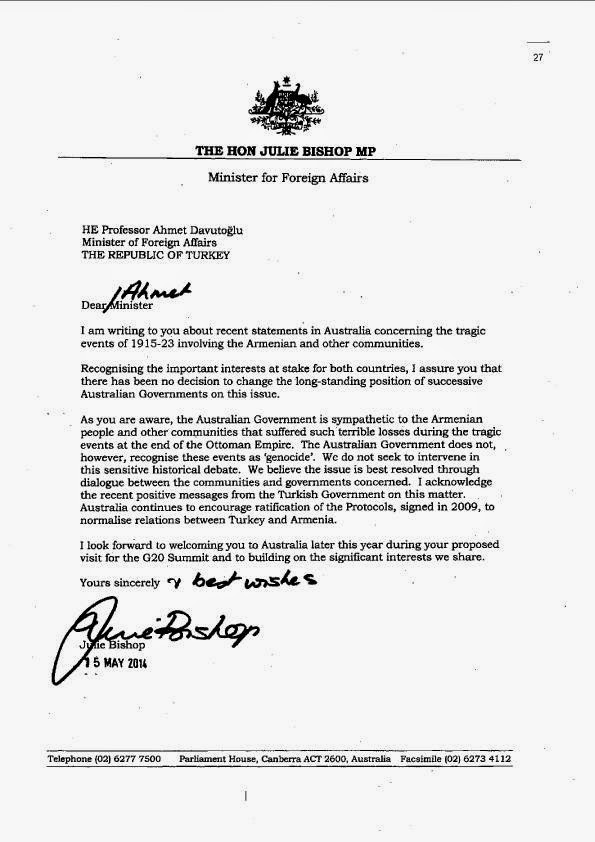
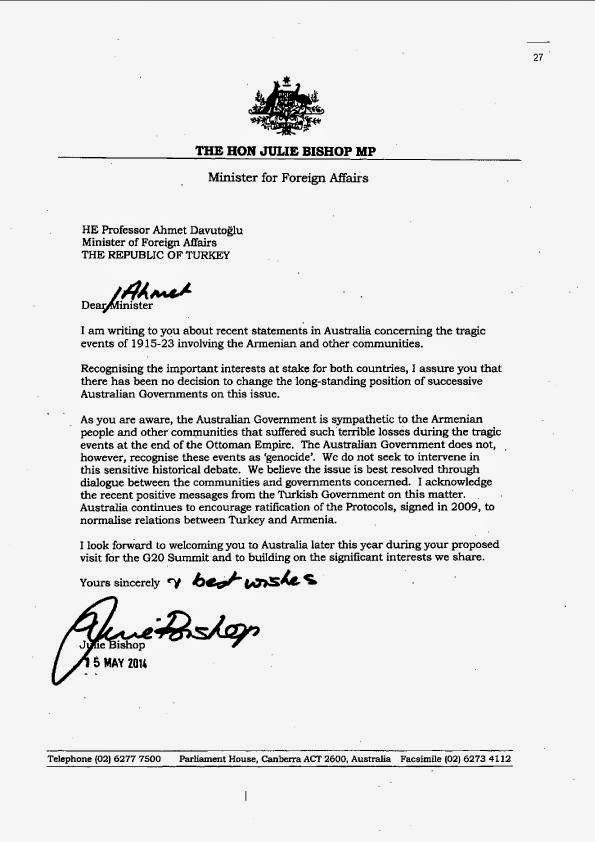
Department of Foreign Affairs and Trade, Australia released internal communication documents about the “Events of 1915” under the Freedom of Information request made last month.
The letter requests DFAT to disclose “ANY” correspondence about “Armenian Genocide” and or “Armenian Massacres” from 1 January 2014 onward. . .
Dervish Eroglu & Nicos Anastasiades with UN in between
By Gavin Jones
WHEN we were children, many of us were brought up with and inspired by the magical tales of the Greek myths which were dominated by such characters as Hercules with his 12 labors, Jason searching for the Golden Fleece, Perseus battling the multi-headed Gorgon Medusa and a host of other wonderful adventures. In all probability, at an early age these stories gave us the impetus to take up reading as a worthwhile pursuit and helped us to fire our imagination and open our eyes to the many wonders and possibilities that surrounded us.
In the modern Hellenic world, the propensity for myth-making and exaggeration is very much alive and well and ever more so in its eastern outpost, Cyprus. Hardly a day goes by when some Minister or worthy announces that some fantastical project or discovery will soon come to pass and that the island’s current woes will be a distant memory: gas extraction; LNG terminal; pipelines to Egypt, Israel, Greece and all points of the compass; hubs for medical tourism, port facilities and other such ‘hubs’; tourist resorts complete with seaplane facilities; Chinese trade exhibition hall; Qatari hotel, apartment and shopping mall; the overall recovery of the economy and the upward trend of the banking sector. The list is endless.
We then come to the long running national issue, more commonly known as the Cyprus Problem. Of all the fables that have been bandied about over the decades, those concerning this issue must surely take pride of place as it’s been the most prolific in terms of wishful thinking and myth generation as we enter 2015.
In the wake of the general consensus between Makarios and Denktash over 35 years ago that the island should become a bizonal, bi-communal federation, what has been achieved since? Absolutely nothing. Apart, that is, from plenty of mud-slinging and yet more myth-making. Greek Cypriot politicians have implored the refugees to remain strong as a solution would soon be forthcoming. The Church reinforced this view. In addition, the retort ‘All refugees to their homes’ is another cruel fallacy along with the inference that those refugees resorting to the Immovable Property Commission in the north were as good as traitors to the ‘patriotic’ cause.
The reality is that successive Greek Cypriot governments and politicians have made it abundantly clear that they’ve never been serious about a settlement and have merely gone through the motions for both domestic and international consumption. As for occasional references by these same politicians that the Turkish Cypriots are their ‘brothers’, this is fanciful in the extreme and ranks as insincerity in its crudest form.
That other great folklore that’s often quoted is that Greek and Turkish Cypriots lived in perfect harmony with one another and that any discord was encouraged and fomented by perfidious Albion during the EOKA struggle years. Television programes such as Biz/Emeis foster this idea with octogenarian Cypriots recalling how each community used to visit one another’s houses and attended their respective religious festivals together.
All well and good but the reality was rather different. The village in the Karpas peninsula where my mother and grandmother were born was mixed and while there was no open hostility between the two communities, by and large they led very separate existences. To reinforce this reality, there was no intermarriage (There were exceptions but these were extremely rare occurrences).
The modus operandi of the Legislative Council confirms the above. This body was set up by the British colonial administration with the express aim of allowing a certain degree of involvement in the running of the island by the ‘natives’.
In the 1920s and early 1930s, there were 12 GC elected members, of whom my grandfather was one, and 3 TC members. Unsurprisingly, each community as often as not voted along partisan lines. Furthermore, my grandfather who was a passionate advocate of ENOSIS, Union with Greece, often clashed with his TC colleagues in the Council as they stated that Turkey had a much better claim on Cyprus. (These exchanges are there in black and white via the Cyrus Research Centre publication, ‘Texts and Studies of the History of Cyprus’. The nearest equivalent would be Hansard which publishes the daily goings-on in the British parliament).
In conclusion, the social and political differences between the two principal communities have existed since time immemorial and those who currently govern the island continue to ignore them and pursue the myth that Humpty Dumpty, barring one or two adjustments, can politically be put back together again and return to his former status and position on the wall. In the context of Cyprus, the reality is that there were always two such characters who fell off it. And even if their respective shells are indeed put back together again, ultimately they’re more likely to be sitting at opposite ends of the same wall rather than side by side – if not on two different walls.
A Journey Through Hate and Possibility in Turkey, Armenia, and Beyond
by Meline Toumani
Hardcover, 286 pages, Henry Holt & Co, List Price: $28 | purchase
NPR Summary
Documents the author’s experiences as an Armenian-American who was raised in a close-knit community and her provocative decision to move to Istanbul to learn the realities of Turkish citizens she was taught to hate.
Read an excerpt of this book
Excerpt: There Was And There Was Not
1
When We Talk About What Happened
I had never, not for a moment, imagined Turkey as a physical place. Certainly not a beautiful place. But it was all I could do to get through my first taxi ride from the Istanbul airport into the city—the first of perhaps a hundred on that route, as I came and went and came back again and again over the span of four years before I was finished—without letting the driver see me cry. I shifted a bit so that my face would not be visible in the rearview mirror.
The sight of water was what did it. Istanbul is a city laced by three seas: the Marmara, the Bosphorus Strait, and the Black Sea. This struck me as utterly absurd. From as early as I knew anything, I had known Turkey only as an idea: a terrifying idea, a place filled with people I should despise. Somehow, through years of attending Armenian genocide commemorations and lectures about Turkey’s denial of the genocide, of boycotting Turkish products, of attending an Armenian summer camp whose primary purpose seemed to be to indoctrinate me with the belief that I should fight to take back a fifth of the modern Turkish state—somehow in all of that, it never occurred to me to wonder what Istanbul, or the rest of Turkey, looked like. And here it was, a magnificent, sea-wrapped city, as indifferent to my imagination as I had been to its reality.
Was it anger I felt, something like what James Baldwin described when he recalled descending in a plane to the American South for the first time and seeing the stunning red hills of Georgia below him? “This earth had acquired its color from the blood that dripped down from the trees,” Baldwin wrote. I felt something like that, and the thought that now formed in a place I didn’t know I still had within me was: how, after everything they’ve done, do they get to have a place that looks like this?
No, that’s not true. Anger was only what I was supposed to feel, what I perhaps even hoped to rekindle, when I arrived in Turkey, alone, looking out the window as the water chased the road all the way to my hotel. What I actually felt was loss. Not the loss of a place, of a physical homeland—that was for others to mourn. This had never been my homeland. The loss I felt was the loss of certainty, a soothing certainty of purpose that in childhood had girded me against life’s inevitable dissatisfactions; a certainty that as a college student and later as a journalist in New York City had started to fray, gradually and then drastically; a certainty whose fraying began to divide me uncomfortably from the group to which I belonged, from other Armenians. The embracing, liberating expanse of Istanbul’s waters, and the bridges that crossed them, and the towers on hills that rose up and swept down in every direction, made me realize upon sight that I had spent years of emotional energy on something I had never seen or tried to understand.
This was 2005. I had come to Turkey that summer because I am Armenian and I could no longer live with the idea that I was supposed to hate, fear, and fight against an entire nation and people. I came because it had started to feel embarrassing to refuse the innocent suggestions of American friends to try a Turkish restaurant on the Upper East Side, or to bristle when someone returned from an adventurous Mediterranean vacation, to brood silently until the part about how much they loved Turkey was over. I came because being Armenian had come to feel like a choke hold, a call to conformity, and I could find no greater way to act against this and to claim a sense of myself as an individual than to come here, the last and most forbidden place.
Does it sound like I’m exaggerating? Is there such a thing as nationalism that is not exaggerated?
* * *
WHEN WE TALK about what happened, there are very few stories that, once sifted through memory, research, philosophy, ideology, and politics, emerge unequivocal. But there are two things I know to be true.
One: I know that if your grandmother told you that she watched as her mother was raped and beheaded, you would feel something was yours to defend. What is that thing? Is it your grandmother you are defending? Is it the facts of what happened to her that you are defending, a page in an encyclopedia? Something as intangible as honor? Is it yourself that you are defending? If the story of the brutality that your grandmother encountered were denied or diminished in any way, you would feel certain basic facts of your selfhood extinguished. Your grandmother, who loved you and soothed you, your grandmother whose existence roots you in the world, fixes you somewhere in geography and history. Your grandmother feeds your imagination in a way that your mother and father do not. Imagination is farsighted; it needs distance to discern and define things. If somebody says no, what your grandmother suffered was not really quite as heinous as you’re saying it is, they have said that your existence is not really so important. They have said nothing less than that you don’t exist. This is a charge no human being can tolerate.
Two: I know that if somebody tells you that you belong to a terrible group of people, you will reject every single word that follows with all the force of your mind and spirit. What if somebody says to you that your history is ugly, your history is not heroic, your history does not have beauty in it? Not only that, you don’t know your history. What you have been taught by your mother and your father and your teachers, it’s false. You will retreat to a bomb shelter in your brain, collapse inward to protect yourself, because what has been said to you is nothing less than that your entire understanding of who you are is in danger. They will have said to you that your existence is without value. You, who wondered now and then what the meaning of your life was, who made a soft landing place for those worries by allowing yourself to feel a certain richness about where you came from and who and what came before you, will be left empty. The story you thought you were a part of does not exist. Neither do you exist.
Those accusations and their consequences are the first truths we must recognize when we talk about what happened between Armenians and Turks in the Ottoman Empire in 1915. A century after those events, Armenians and Turks—in Turkey, in Armenia, and especially in the widespread diasporas of both countries—believe in two radically different accounts of what happened. “Believe.” It is not a matter of faith, yet it might as well be for the power that these clashing narratives hold.
What did happen? I will tell you—but I am Armenian. It is almost impossible for me to talk about this history. Not because I find it painful to talk about—for me to claim that particular pain would be self-indulgent—but because the terms of the conversation have evolved to leave me no satisfactory options. To tell the Armenian version of the story goes against every instinct in me, not because I disagree with it—I do not—but because I know that even if I wanted to believe that the thing in question did not fit the definition of genocide, it would be impossible for me to find my way into that belief. Even if you wanted to believe that I am objective, it would be impossible for you to do so. I also know the pleasure of healthy contrarianism; so when I encounter an outsider who has been intrigued by the Turkish version of this history, I understand his desire to fancy himself open to an alternative point of view. But then I find myself inflamed, needing to convince him all the more. I am doomed to be what is known as an unreliable narrator. I hate the way it feels.
Newspaper articles dispense with the controversy in the first or final paragraph of any news report concerning Turkey and Armenia:
“Turkey denies that the deaths constituted genocide, contending the toll has been inflated and the casualties were victims of civil war. It says Turks also suffered losses in the hands of Armenian gangs” (AP).
“Turkey accepts that many Christian Armenians were killed by Ottoman Turks but denies that up to 1.5 million died and that it amounts to genocide, as Armenia views it” (Reuters).
“The Turkish government says massacres took place in the context of clashes that related to Armenian groups supporting Russia against Turkey during World War I” (Bloomberg).
This expository shrug is the peace that copyeditors the world over have made with the issue that, more than any other, defines the collective psychology of Armenians and of Turks, defines their educations, the development of their cultures, their political horizons, and—let me not call it any less than it is—their souls. Because what else but your soul can we speak of when, one hundred years later in your otherwise liberal and tolerant life, the very sound of the name of a country makes your head blur and your limbs tighten?
Now and then governments get involved, by participating in what Armenians refer to as “recognition.” In my life, this general word, “recognition,” with its various potential applications in the vast and flexible English language, had by the time I was eleven or twelve come to denote, with Pavlovian consistency, only one thing: recognition of the Armenian genocide.
Recognition: It is sought and secured anywhere possible, from the city council of Milan to the parliament of New South Wales, Australia. It has been granted in the form of official resolutions, commemorative statements, and board decisions from institutions large and small, including the European Union and at least twenty countries, forty-three US states, various American cities from Santa Fe to Minneapolis, Mayor Michael Bloomberg, and the New York Times. Their usage of the word genocide is tracked on lists that are ranked and counted each year in the run-up to April 24, Armenian genocide remembrance day.
For Armenians, recognition is not only institutional; tacit acknowledgment is expected on an individual basis, too. There was the thesis committee in college who reviewed my eighty-page paper about—what else could it be about?—the genocide; and there were friends (the subject has a way of coming up if you are Armenian) and boyfriends, too, and God help them if they tried to tease or argue.
Recognition means all of that, but what it really means is the United States Congress, that mysterious holdout, at once powerfully stubborn and surprisingly malleable and, as of yet, unwilling to fully appease the Armenians. Recognition means an official shift in terminology by the US president and the State Department, and one administration after another has withheld reprieve. On another level of importance, separated by an order of magnitude that straddles the realms of the possible and the inconceivable, recognition means Turkey.
To some Armenians, recognition means reparations from Turkey: to the true zealots, land; to the slightly more pragmatic, money. To most, it simply means the official usage of the word genocide. To me, it came to mean that I could no longer stand to attend any Armenian gathering, because it seemed that whether it was a poetry reading, a concert, or even a sporting match, it was always, ultimately, about the genocide.
Or was it? At some point I started to wonder. Not about what had happened, exactly, and not about whether the term genocide was applicable. It is clear that between 1915 and 1923, in Ottoman Turkey, a history-shifting number of Armenians, probably between eight hundred thousand and one million, were killed outright or driven to death on the watch of a government that was supposed to protect them; another million or so survived deportation to the Syrian desert or fled just in time to avoid it. These events echoed but exceeded earlier pogroms against Armenians, in the 1890s and 1909. The violence happened in fits and starts and was entangled with, though not fully explained by, the circumstances of World War I; and was complicated by the degrees to which different regional leaders throughout Turkey obeyed or defied central orders. In a few of the hundreds of towns and villages affected, Armenian nationalist committees seeking greater rights or independence staged violent resistance, and as a result, about thirty thousand Turks and Kurds were killed by Armenians, too. Of the 2.5 million Armenians then living in the Ottoman Empire, a few thousand men in border cities joined the Russian army against the Turks. When the fighting was over, only two hundred thousand Armenians were left in Ottoman lands, lands Armenians had called home for twenty centuries. Armenians had faced genocide. And the empire that had contained and then expelled them was itself dissolved and reborn as the Republic of Turkey.
What I started to wonder about was whether “recognition”—propagating the usage of the word genocide to every corner of the world like a smallpox shot—was what we really needed. Arguments for recognition spoke of “justice” or “honoring the memory,” but these had turned into hollow platitudes for me. Claims that human rights were at stake seemed disingenuous; and when Armenian lobbying groups yoked the cause to a platform of saving Darfur, it seemed motivated more by PR than conscience. Then there was that well-intentioned but unattainable promise, the favorite argument of first and last resort, repeated over and over by scholars and laymen alike: “Never again.” That if a tragedy were recognized by the world, if massacre were transfigured into punishment and compensation, such a horror would not be repeated. Doesn’t all evidence suggest that this is untrue?
Let me put it less coldly: I wondered whether our obsession with genocide recognition was worth its emotional and psychological price. I wondered whether there was a way to honor a history without being suffocated by it, to belong to a community without conforming to it, a way to remember a genocide without perpetuating the kind of hatred that gave rise to it in the first place. And as I questioned the underlying needs that drove my own community, I wanted to understand what drove Turks to cling to their view. Why couldn’t they admit it? This was the simple (or simplistic) question that took me to Turkey.
In both Armenian and Turkish, a particular phrase signals the start of a story: “There was and there was not.” In Armenian, Gar u chgar. In Turkish, Bir varmis bir yokmus. There was, and also there was not, a long time ago, in a place far away, an old man, a talking horse, a magical kingdom. Once there was, and once there wasn’t. It is an acknowledgment not only of the layers and complexities of truth in a given story, but of the subordination of a storyteller to the tale she tells. It is my way of saying that this is where we find ourselves now—locked in a clash of narratives that confuses outsiders, frustrates officials, stifles economies, and warps identities—and no matter what was or was not, this is where we must begin.
Earlier this year, protestors in Los Angeles called for recognition of, and reparations for, the 1915 Armenian genocide executed by Ottoman Turks.
David McNew/Getty Images
Writer Meline Toumani grew up in a tight-knit Armenian community in New Jersey. There, identity centered on commemorating the mass killings of Armenians by Ottoman Turks during World War I, a history that’s resulted in tense relations between Armenians and Turks to this day.
In her new book, There Was and There Was Not, Toumani recounts her attempts to understand Turkey and the Turkish people — people she was always taught were her bitter enemy. She also explores what she calls the Armenian community’s “obsession” with genocide recognition, which she herself harbored.
“There would be moments where I felt almost embarrassed by a certain deep-seated prejudice in me,” Toumani tells NPR’s Eric Westervelt. “For example, if a friend comes back from vacation in Turkey and they’re talking about it and I’m kind of bristling or brooding and just waiting for that to be over because I know that I can’t say what I feel — which is, you know, ‘I would never go to Turkey. The Turks, you know, killed the Armenians in 1915.’”
Interview Highlights
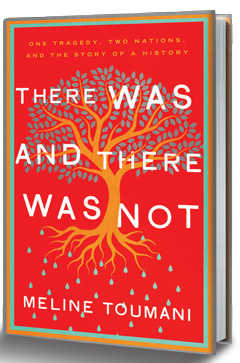
There Was and There Was Not
A Journey Through Hate and Possibility in Turkey, Armenia, and Beyond
by Meline Toumani
Hardcover, 286 pages purchase
More on this book:
NPR reviews, interviews and more
Read an excerpt
On why she decided to move to Turkey, a sort of forbidden place for Armenians
I’d have these feelings rise up in me and they didn’t fit anymore in the life that I had created, which was otherwise very progressive and intellectually oriented. And that was when I decided I kind of need to explore this. And through a series of events, it entered my mind that exploring it would mean going to Turkey, talking to Turks; not to try to take seriously the Turkish version of the history of the genocide, but just to understand how does it happen that another group of people have learned this history in a completely different way leading to a completely different conclusion? And is there any way that we can connect if I find the right way to talk about it, or the right way to listen about it?
On being attacked on Armenian-American news sites for taking on this project
It’s actually surprisingly painful given that I’ve just written a book that describes the kinds of attitudes that lead to that kind of criticism. … I knew that there would be people who would feel that way, and yet part of what my book is about is this incredible tension between belonging to a community and trying to individuate from it.
And it’s sad for me to see that some people are so threatened that they’re not even willing to engage, because most of the people publishing those attacks haven’t read the book. In fact, one of them celebrates the fact that he hasn’t read it and in the same breath calls for a boycott.
On how people in Turkey reacted when they learned she was Armenian
I was perhaps recklessly optimistic in thinking that things wouldn’t be quite as bad in Turkey regarding the Armenian issue as I had been taught to believe. … In some ways, they were even worse. The thing that shocked me the most was the fact that on a daily basis, you know and this is over the course of two and a half years of living there, people would find out that I was Armenian and sometimes the reaction would be so blunt: “Well, I guess you came here to prove that there was a genocide. I want you to know that I don’t believe that that’s what happened.” Or something like that. And those moments were really jarring and made it very difficult for me to ever really relax. There was a lot of stress in my daily life.
And I want to be clear, of course, that I also had the opposite reactions, you know. There was a young man who I met outside of a restaurant with some friends, just totally at random on a Saturday night, and when he found out I was Armenian he put his hand over his heart and he said, “I want to welcome you back to your country and I want to apologize on behalf of the Turkish nation.”
So I would have every manner of reaction, but to be honest, most of the reactions ranged from pretending I hadn’t said anything at all to saying something sort of blunt and harsh.
On where relations between Turks and Armenians stand today
It was a few years ago already that I left Turkey. And in the time since then, there have been some big changes. For example, on April 24, 2014 — which was the 99th-year commemoration of the Armenian genocide — in Istanbul you had several events commemorating the genocide openly and without any kind of the contorted language that you might have had in the past.
Also [Turkish President Recep Tayyip] Erdogan made a statement that was very much falling short but at the same time really breaking new ground in acknowledging that something tragic had happened to the Armenians. And although he, you know, was very careful not to call it a genocide and to say everyone suffered and to use a lot of the same rhetoric that he has always used, I consider it a major step.
Born in Iran and ethnically Armenian, Meline Toumani grew up in a close-knit Armenian community in New Jersey, where the genocide of Armenians at the hands of the Ottoman Turkish government in 1915 and hatred of the Turks were defining facts of life. In 2005, Toumani did the unthinkable and moved to Istanbul on a quest to understand how to remember a genocide without being crippled by it.
You went to Turkey because you “could no longer live with idea that I was supposed to hate, fear and fight against an entire nation and people.” Could you describe the process that led you to that position?
Coming from a family that was not directly involved in the genocide and that had a very strong sense of Iranian-Armenian ethnicity gave me a little bit of space to question and look from the outside. At home our identity was many things, but it wasn’t really about hating Turkey or being obsessed with the genocide. But when I participated in community activities, which was all the time, it came to me that this was a dominant part of our identity as a community. Since I didn’t have that direct experience and I didn’t have a grandmother who had told me some horrific story about what she had suffered, I had one foot in and one foot out.
So, without questioning the reality of the genocide, you began to wonder whether focusing on genocide recognition was helpful for your community?
I definitely wasn’t questioning what happened. When you’ve been immersed in something like that for your entire life, it’s a part of you. But it began to feel to me that the community was not psychologically well.
A lot of that manifested for me in looking at creativity and expression within the community. The [genocide] narrative was holding us hostage. As an Armenian, whatever you do has to serve that in some way–through your volunteer work or as a playwright or a musician or whatever. You’re not just addressing the history or the culture. You’re addressing this political impasse. A piece of writing that sets out with a political agenda is going to be limited from the beginning. You can’t explore its emotional and psychological dimensions freely.
Early on in my work I tried to frame it in a political way: “genocide recognition campaigns are bad for Armenia because it’s creating a climate in which diplomatic relations can’t be established.” I was trying to establish a geopolitical argument for why genocide recognition was problematic, but it’s more about an existential condition than it is about a political argument.
At one point you use the phrase “soft recognition”: the idea that you can make changes one person at a time. Is that where you started when you got to Turkey? I don’t think it’s where you ended.
I’m very glad that you understood that. That is where I started and that’s not where I ended. I had this vision that if there were just a certain way to portray the Turks to the Armenians and a certain way to portray the Armenians to the Turks, and if I could behave in a certain way as an Armenian among Turks, I could open up some speech where people would realize that the other side wasn’t so bad.
Then [Armenian journalist] Hrant Dink was assassinated. He was the ultimate case of someone really trying to connect and he was murdered because of it. Not in spite of it but exactly because of it. That moment had a huge impact on me. I was well into the project, and it really threw me for a loop as to what was I really doing here. Especially when I went back to Turkey and experienced discrimination and intolerance for Armenians every single day in so many ways large and small, spoken and unspoken. My intention was to be diplomatic and tactful and pleasant in talking to people and not offend anyone and not be too belligerent with Turks because I wanted to open up the pathway to communicate.
After two and a half years–this comes toward the end of the book–I realized I had to get out of there because I’d completely lost track of what I believe in. That led to a lot of self-questioning about what set me off into this project in this first place. The way I ended the book is that it really wasn’t about Turkey or Armenia or the genocide, but about how to find a way to individuate yourself.
Your title, There Was and There Was Not, has such a fairy-tale quality.
I’ve been waiting a long time to tell somebody about the title!
When I first started, the working title was “Silence and Madness.” The idea was that you have this overwhelming silence on the subject on the part of Turkey and this growing madness in the Armenian diaspora and these two things play off of each other. As I got further and further into the work, I realized silence wasn’t relevant any more in Turkey. Hrant Dink was murdered and suddenly there wasn’t silence anymore.
Then I was sitting with my parents at a café in Yerevan [Armenia]. We had been shopping in the outdoor market and my mom had bought a bunch of books. She opened one and started reading from it in Armenian: “There was and there also was not.” I heard that a million times growing up in stories. The previous week in Istanbul, in a Turkish class, we had been reading a story that started, “There was and there also was not.” I suddenly was struck that we started the stories in exactly the same way. I told my parents about having read that in my Turkish workbook. My dad said, “That’s your title!” We looked at each other–you can’t say that because that’s like you’re saying there was a genocide and there wasn’t a genocide. Then I realized it captured exactly what I was trying to do with the book in all sorts of ways.
I felt at first hamstrung by the fact that I’m an Armenian telling the story and [thus] expected to be an unreliable narrator. I was really attached to the narrative ambiguity of what happens when someone tells you a story and they tell you at the outset that there was and there was not. The storyteller puts that on you from the beginning and you have to sit with it the entire time.
What do you hope readers will take away from your book?
My biggest fear, to the extent that I want to reach Armenian and Turkish readers and have an impact on the conversation between the communities, is that the people who read only the first two chapters will completely misunderstand. Armenians who read the first chapters will think I’m some kind of traitor and hate me for it. And the Turks who only read the first two chapters will think, “Oh great, Armenians are just as crazy as we thought.”
You answered in terms of Armenian and Turkish readers. What about other readers?
Often the immigrant experience comes to us in a cute package, like My Big Fat Greek Wedding. “Oh look at the funny old grandmother in her black widow costume and the aunt who’s trying to feed you.” That’s a very real part of the immigrant experience in America in a lot of ethnic groups, but it underplays the extreme existential crisis that comes from having that kind of bifurcation in your life. This is not a cute clichéd thing about bringing egg rolls to school when all the other kids have sandwiches. There is crisis in a lot of different parts of your life and your psyche when you have that experience. Perhaps I darken it a bit? –Pamela Toler
In 2005, Armenian-American journalist Meline Toumani traveled to Turkey–a place she had previously known only as “a terrifying idea”–with the intention of studying Armenia-Turkey relations for a month or two, three at the most. She stayed for two years, with the help of regular “visa runs” over the border. The result of her immersion in a culture she had been trained to “hate, fear and fight” is There Was and There Was Not: A Journey Through Hate and Possibility in Turkey, Armenia and Beyond, an engaging and deeply personal exploration of ethnicity, nationalism, history and identity.
The conflicting Armenian and Turkish narratives regarding the massacre of Armenians in the Ottoman Empire in 1915 defined the Armenian diaspora community of Toumani’s childhood. On the one hand, Turkey has historically denied that the massacre existed, or minimized the scale of the deaths. On the other hand, the Armenian community focuses substantial energy on campaigns designed to pressure the Turkish government to recognize the massacre as genocide. Toumani had reached the point where the dominance of the genocide narrative felt like an artistic and emotional chokehold. She set out to Turkey in an attempt to answer two questions: How could she honor her history without being suffocated by it, and why do Turks cling to their version of the events of 1915?
Toumani brings the reader along on a voyage of discovery that begins with her growing doubts about the emotional, psychological and political costs of the Armenian diaspora’s focus on Turkish recognition of the genocide; it ends with Toumani defying rules about neutrality in the press box by screaming her support of Armenia at a World Cup match between Armenia and Turkey in Istanbul. In between, she tells a story riddled with unreliable narrators, unreliable listeners, lost memories, lost history, false assumptions and real places transformed by the imagination. She establishes the constantly shifting ground of her experience at the beginning when her plane lands in Istanbul and she realizes she has never imagined Turkey as a physical place. She is stunned by the country’s beauty and charmed by what she describes as the “particular sweetness of Turkish manners”; she actively enjoys learning the Turkish language. (The contrast between Toumani’s phobia about speaking Armenian and her delight in learning Turkish is typical of her skilled use of irony and reversal to enrich her narrative.) At the same time, she is repeatedly dismayed and occasionally enraged by the ways in which Turkey erases traces of the Armenian past: the opening ceremony of a newly renovated Armenian church as a UNESCO world heritage site that makes no reference to Armenians; a museum visit in which she discovers that hundreds of years of Armenian civilization in Anatolia don’t appear on the time line or the map; brochures and travel guides that describe Armenian artifacts in southeastern Turkey but never identify them as Armenian.
Moving between Turkey and the Republic of Armenia, Toumani shares her experiences of events as important as the assassination of Turkish-born Armenian journalist and civil rights activist Hrant Dink and as small as the street vendors calling their wares on the street outside her apartment. She finds friends and allies among the Turkish activists, journalists, scholars and lawyers who have taken up the Armenian issue, often at the risk of prison or worse. She speaks to millionaires, dentists and cab drivers; Turkish scholars dedicated to cooperating across ethnic lines and Turkey’s official historian; Turkish-Armenians and Armenians from the former Soviet republic; Kurds, Turkish nationalists and an ethnic Turk who refuses to identify himself as Turkish. She encounters Turks who are uncomfortable with the fact that she is Armenian and Turks who struggle to find a point of connection (described by Toumani as the “narcissism of small similarities”).
Over the course of the book, the clear-cut oppositions with which Toumani begins her project become more nuanced. Even the unity of the Armenian community itself becomes more complex as she examines the different concerns of the diaspora; Turkish-Armenians (described by members of the diaspora community as Bolsahay–a term that avoids describing them as Turkish) and citizens of the Republic of Armenia; those whose families survived the genocide and those whose families were not directly involved; and the ideological divide between those who support the activist Dashnak Party of the Republic and those who do not.
There Was and There Was Not is neither a history of the genocide nor an examination of its political ramifications for the modern world. It is the story of one woman’s attempt to understand her community, its fundamental assumptions, and herself. Written in a conversational style that is by turns heart-wrenching and unexpectedly funny, There Was and There Was Not will appeal not only to those interested in questions of the Armenian genocide but to readers interested in the larger questions of how individuals define themselves within communities and how communities define themselves. –Pamela Toler
Metropolitan Books/Holt, $28, hardcover, 9780805097627, November 2014