Category: Main Issues

  • What the Armenian lobby is really after

    What the Armenian lobby is really after

    What the Armenian lobby is really after in continuing to propagate their century-old claims of so-called genocide; their own newly released report.

    AMERIKAN ERMENI LOBISI NE ISTEMEKDE .. SON YAYINLADIKLARI SOZDE SOYKIRIM TAZMINAT RAPORU .. ILGILENEN ARKADASLARA

    http://www.armeniangenocidereparations.info/wp-content/uploads/2014/09/20140918-Armenian_Genocide_Reparations_Study-Into_and_ExecSum-EN-web.pdf

    __._,_.___LOGO (2)

  • UK High Commissioner: The key to a solution lies with the Cypriots

    UK High Commissioner: The key to a solution lies with the Cypriots

    “The key to a solution lies with the Cypriots”

    UK High Commissioner Damian Roderic Todd in Nocosia


    The key to the Cyprus solution lies with the Cypriots, who need to reach agreement on what a settlement looks like, British High Commissioner in Nicosia Damian Roderic Todd has said, pointing out that a political settlement will serve the interests of the people of Cyprus and noting that no-one can assume that a frozen conflict will always stay frozen.

    In an interview with CNA, he said the solution will be a bizonal bicommunal federation, with a single citizenship, one sovereignty and international personality, something supported by the friends of Cyprus.

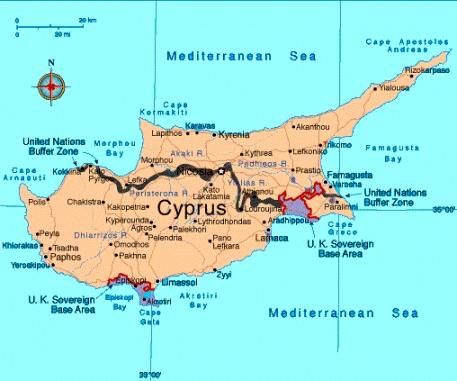
    “As soon as I arrived I had the opportunity to visit and walk in the buffer zone. And the same thought always comes to mind: what a waste of potential. The continuation of the division in Cyprus is such a waste,” he noted.

    He believes that Turkey wants to see a solution in Cyprus and supports UN efforts to that effect, adding that good relations with Ankara are not contrary to good ties with others.

    On the recent meetings Turkish Cypriot politician Ozdil Nami had in London with Foreign Office officials, he reiterated that the UK recognises only the Republic of Cyprus, and no other entity, noting that Britain attaches great importance to the dialogue with the Turkish Cypriots and will continue this dialogue. He described London`s explanation on the matter as “reasonable.”

    On bilateral ties, he said they are extraordinarily close, and referred to human and historical ties, in addition to trade links, cooperation on combating crime, reforming Cyprus` civil service, and to various other fields.

    Referring to the role of the Sovereign British Bases, on the island, he said “they are very important for Cyprus, the UK, Europe and our shared security.”

    In his interview, the High Commissioner said UN resolutions and the Joint Declaration, agreed between the leaders of the island`s two communities, set out the framework of a solution, saying that there is support for a settlement from the international community, Greece, Turkey, the UK, the five permanent members of the UN Security Council.

    Cypriots, he said, seem to be impatient to have the problem solved.

    Invited to qualify Turkey`s support, he referred to Ankara`s importance in NATO, London`s support to Turkey`s European aspirations and added “this is in no sense contrary to good relations with others.”

    “We feel the Turkish government does want to see a solution in Cyprus, it supports UN efforts and has made clear the wish to be engaged in this,” he replied.

    Asked if he sees any discrepancy between public remarks by Turkish officials and Turkish Cypriots and what has been agreed on the solution, he said the Joint Declaration is “a clear statement” on the settlement to be reached, pointing out that everybody agrees that the current status quo is not acceptable and the UK will do all it can to help bring about a solution.

    Asked where he thinks the key to the solution lies, he replied “it lies here among the Cypriots, they need to reach agreement” and feel comfortable with it as it will be put to a referendum.

    “Ultimately it is for the leaders to meet and talk and agree, then the people will vote in a referendum,” he explained.

    Questioned further on Turkey`s role as an occupation power, he said Cypriots must feel comfortable with the solution, and referred to many bicommunal initiatives by Cypriots, which he said are important and evidence of how people are promoting confidence.

    On regional developments, in relation to Cyprus, he had this to say “we cannot assume that Cyprus is and always will be immune to developments, we cannot assume the status quo will continue,” noting that problems in the region make it all important for Cypriots to find a way to solve the problem.

    He also said there is a need for sustained intelligent, consistent approach over time to stop the Islamic State, which he described as an organisation with a “brutal and murderous approach” which has prompted a humanitarian disaster. The UK, he added, at the forefront of humanitarian aid has sent so far assistance worth 25 million pounds sterling to thousands of people affected by the situation.

    On the role of the SBA, in humanitarian, military and intelligence matters, he said the “SBA are a very significant element in the way the UK and Cyprus are able to respond to tackle challenges they face”, adding that the Bases have been used to send humanitarian supplies to thousands of people.

    Todd expressed appreciation to the government for its support in this. The High Commissioner refrained from any comment on SBA operational matters, saying “we watch the situation very closely.”

    “We see the SBA as very important for Cyprus, the UK and Europe and our shared security. The nature of UK-Cyprus relations is so deep and significant for each of us and we need to see the SBA in that context,” he added.

    On bilateral ties, he referred to human and historical ties which are “very deep and extremely close.” He acknowledged that parts of the history are bad but this should not be an obstacle to good bilateral relations. He recalled that 300,000 Cypriots live in the UK, 65,000 British reside in Cyprus and some 11,000 Cypriot are studying in the UK.

    He said Cyprus is a big trading partner, and expressed hope that trade links will be further enhanced.

    He also referred to the assistance London gives to Nicosia on the efforts to reform the civil service, in particular the ministries of defence, foreign affairs and justice with the help of experts from the National School of Government, who are visiting the island the week 22 – 26 of September. This, he pointed out, reflects the close ties and is an example of how human relations can work.

    “We also work together on combating crime, on dispute resolution in trade matters and on cooperation in policing,” he added.

    Asked if advice given is heeded, he praised the Cypriots for their ability to respond to reform, a trait he described as an “enormous asset.” There is a strong acceptance in Cyprus that reforms are necessary to bring the economy out of recession and the economic crisis has heightened this,” he noted, adding that “Cypriots and society at large have shown an ability to respond to reform and this is an enormous asset.”

    “We have to think of ourselves in the 21st century as partners. We share views in the EU, the vision of where the EU should go, our ties within the EU can develop further,” he said, responding to other questions.

    The EU, he told CNA, has been a successful enterprise in many ways over many years but it needs to evolve to focus on how to make people more secure, increase prosperity and respond to the need for people to feel that it is more democratic and that it delivers better results for them.

    “We want the EU to be flexible, competitive, diverse, strong and respectful of individual countries and of the fact that voters are national voters,” he concluded.

    On a more personal noted, he said he would like to “build on bilateral ties, develop further relations in human, educational and other terms, help increase trade,” reiterating the importance of finding a negotiated settlement in Cyprus.

    Maria Myles


      Küfi Seydali

     

  • Greek Cypriot Leader Anastasiades meets with Junta Leader of Egypt

    Greek Cypriot Leader Anastasiades meets with Junta Leader of Egypt

    Greek Cypriot Leader Anastasiades and General EL-Sissi of Egypt


    The discovery of important gas/oil reserves in the Eastern Mediterranean could and must serve as a catalyst for a broader cooperation on a regional level,  Nicos Anastasiades and  Abdel Fattah el-Sisi have highlighted, according to a joint communiqué issued following their meeting held on Tuesday 23rd in New York.

    According to the joint communiqué, the two Leaders discussed issues of mutual interest, including the political transition in Egypt, the negotiations on the Cyprus Problem, the recent developments in the Middle East (Syria, Iraq, Libya, Gaza) and their impact on regional security and economy.

    Cyprus and Egypt stressed the importance of cooperation of the moderate forces in the area to tackle the regional challenges and defy terrorism, in all its forms.

    Cyprus expressed its support for the road map, as decided by the Egyptian people. Egypt reaffirmed its firm support for a solution of the Cyprus Problem on the basis of the UNSC resolutions.

    Cyprus and Egypt reconfirmed the excellent state of their bilateral relations and expressed their determination to further strengthen their mutually beneficial cooperation and to build a strategic relationship between the two countries.

    Following the acceptance of the invitation extended by Nicos Anastasiades to Abdel Fattah el-Sisi to visit Cyprus for the first time by the end of the year, something that will greatly enhance bilateral relations in all fields.

    The two Leaders expressed their commitment to intensify the exchange of visits and consultations between the two Governments in the next few months in order to be able to ratify bilateral agreements on issues that are currently being discussed when El-Sissi of Egypt visits Cyprus.

    The two leaders, finally agreed to further promote cooperation between the EU and the Arab world.

      Küfi Seydali

    Comment:

    Greek Cypriot leader Anastasiades, is taking advantage of the strained relations between Egypt and Turkey, the Motto being; “my enemy’s enemy is my friend”. In world politics this sort of  games can turn sour fairly quickly. The foreign policy of any country should be compatible with its economic as well as military capabilities. The Greek Cypriot government is economically buncrupt (needs EU money like bread and butter) and militarily, compared to her neighbors is insignificant!

  • CYPRUS: Leaders decide to accelerate talks

    CYPRUS: Leaders decide to accelerate talks


    The leaders of the Greek and Turkish Cypriot communities decided to accelerate talks aimed at reunifying the divided island, it was announced on Wednesday.

    Greek Cypriot leader Nicos Anastasiades and Turkish Cypriot leader Dervis Eroglu have also agreed to meet twice a month.

     Nicos Anastasiades (Greek Cypriot leader)

      Dervis Eroglu (Turkish Cypriot leader)

    The announcement was made by the UN following a meeting between the two leaders.

    Speaking afterwards, Anastasiades said “there has been a constructive discussion” highlighting the need for the two sides to engage in a substantive dialogue to change the current situation.

    Asked if he is optimistic, Anastasiades replied that he did not want to make any statements that might be perceived as engaging in the usual “blame game.”

      Küfi Seydali

    18.09.2014


  • CYPRUS MAIL:  ‘Two-state’ Erdogan supported Annan plan

    CYPRUS MAIL: ‘Two-state’ Erdogan supported Annan plan

    Turkish President Recep Tayyip Erdogan in North Cyprus

    By Loucas Charalambous

    WHAT HAD Turkey’s new president Tayyip Erdogan said during his recent visit to the north to spark a storm of angry protests by our political establishment?

    He said that Turkey would never accept a solution to the Cyprus problem “if this is not based on two constituent states with political equality”. Political equality, he added was “a necessity”.

    In short, he said what Turkey and the Turkish Cypriot leadership have been repeating for the last 40 years and is also included in UN resolutions. Nothing more. So why was there such a hysterical reaction by our politicians and journalists? What was it that riled them, especially this time?

    Nicolas Papadopoulos said: “Erdogan once again proves wrong all those that deluded themselves about his true intentions.” Giorgos Perdikis was blunter. “The myth about the ‘good’ Erdogan that was cultivated by various circles in Cyprus has completely collapsed,” he concluded.

    “The hope that the US would put pressure on Turkey has proved dangerously simplistic,” declared Giorgos Lillikas who called on President Anastasiades to “leave aside his self-delusions”. Statements by AKEL and EDEK were along the same lines, as were the comments by the well-known super-patriots of Phileleftheros and Simerini. Even Greece’s prime minister contributed some words of dejection.

    They all think that by labelling Erdogan’s comments ‘provocative’ and ‘arrogant’ and by citing these as supposed proof of the notorious ‘Turkish intransigence’ which they have been using for 50 years to cover up their own political crimes, they are absolving themselves of any responsibility for the situation. But they are making one mistake.

    The ‘arrogant’ Erdogan, who was supposedly speaking about two states for the first time on his visit, is the same person who accepted the settlement proposed by the UN in 2004 which was not a settlement based on two independent states.

    It was a settlement based on the continuation of the existing state with a federal structure, a settlement that ensured the withdrawal of Turkish occupation troops, gave us back Morphou and Famagusta, more than 40 villages and the entire buffer zone. This was what the arrogant Erdogan was willing to give us, but our political clowns rejected the settlement, surrendering everything to Turkey and allowing the Turkish army to remain here.

    Why? Then, as now, they did not want a settlement because they did not want to lose their privileges and positions. Tassos Papadopoulos did not want to give up his presidency, ministers wanted to keep their ministries, deputies their seats and state officials their well-paid posts.

    But let us look at this from another angle. Let us assume that their position is correct and Erdogan now wants the establishment of two independent states. What would this mean? This accentuates their blame and guilt. They killed off the opportunity when we had a settlement in our grasp and now they are claiming the obstacle is Erdogan.

    What did they tell us at the time? Hold on, in a week we will be a full member of the EU and we would be able to secure a wonderful ‘European’ solution. Ten years later, where are we at?

    Apart from losing Famagusta, Morphou and the other territory, apart from the fact the Turkish army is still here and apart from the fact the number of settlers has multiplied in the meantime, these apprentice political wizards have also led our economy to bankruptcy. Instead of accepting the responsibility for these political crimes, they are now claiming that they had been vindicated because of what Erdogan had said.

    And instead of keeping quiet, they have the audacity to accuse us of being self-deluded and naive. Who? The political pygmies who had promised us a ‘European solution’ and ended up cementing partition.

      Küfi Seydali


  • CYPRUS MAIL: Government should have stayed out of latest Cyprob theatrics

    CYPRUS MAIL: Government should have stayed out of latest Cyprob theatrics

    Turkish Cypriot Foreign Minister  Ozdil Nami


    THE knee-jerk reaction of the political parties and newspapers, sparked by the London meeting of Turkish Cypriot Foreign Minister Ozdil Nami with Britain’s Minister for Europe, David Lidington could not have surprised anyone. Any meeting of Turkish Cypriot officials with representatives of foreign governments abroad is guaranteed to provoke a chorus of disapproving announcement by the parties, all expressing fears about the ‘upgrading of the pseudo-state’. This alleged upgrading, has been taking place for years.

    The Cyprus government, fearing it might be accused by the parties and some newspapers of a taking a soft line on the meeting decided to enter the fray. The foreign ministry issued a strongly-worded statement condemning the meeting which “was held despite the intense and repeated warnings of the Republic at various levels, which have been disregarded by London.” It said the assurances that Britain did not recognise the ‘TRNC’ could “not be considered satisfactory.”

    Anticipating similar contacts in Washington, which Nami was also scheduled to visit, government spokesman Nicos Christodoulides said “it is possible problems would be created in relations between the Cyprus Republic and the countries that facilitate this type of contacts.” He did not elaborate on the nature of the problems that would be created, probably because he did not know. We presume this was just an idle threat to keep the newspapers and political parties happy.

    It would be no exaggeration to say that the government was taking part in the Cyprus problem theatre which follows a very rigid script. When a newspaper or a political party identifies the danger of the ‘upgrading the pseudo-state’ it alerts society and the government immediately issue statements of condemnation and makes representations to the country or countries supposedly facilitating this upgrading.

    We have been witnessing this ‘theatre of the reactions’ for decades now because the politicians still believe it pays off domestically. It is unfortunate that the government feels it has a national duty to take part in this theatre which achieves nothing except to illustrate its bad faith.

    It is not as if the regular representations have stopped countries from granting meetings to Turkish Cypriot officials. These are obviously ignored as the meetings keep taking place, exposing the government’s weakness and reliance on hollow words.

    The upgrading that everyone is terrified of never actually takes place but this is not because the government makes representations and the parties issue fiery declarations. It is because the international community still believes there could be a Cyprus settlement. But when it decides that this will never happen we may witness the only upgrading that will matter. (13.09.2014)


      Küfi Seydali


    Comment:

    Good article, well -timed warning that should be heeded…esp. the last sentence. “…a very rigid script.” is the product of GC Dogma, a frozen mindset….it sees Cyprus as a Greek island, instead of a joint home of GCs and TCs as the UN Resolutions define it. This same mindset has created many other myths….e.g. GC Roc is legitimate [not the result of coup in 1963/4], while TRNC is illegitimate, pseudo-state….that TCs are a demographic minority [rather than a co-founder of the 1960 ROC]….that CyProb began in 1974 [rather than in 1963/4]….that EOKA B, Akritas Plan, Sampson, are insignificant [rather than deliberate steps for ENOSIS that ultimately led to Turkish intervention in summer 1974]…The lesson? Lots of learning to catch up with REALITY of CyProb….and change GC mindset….Mission Impossible? Two-Sate solution via step-by-step upgrading.