On Sept. 11, 1990, U.S. President George H. W. Bush addressed Congress. He spoke in the wake of the end of Communism in Eastern Europe, the weakening of the Soviet Union, and the invasion of Kuwait by Saddam Hussein. He argued that a New World Order was emerging: “A hundred generations have searched for this elusive path to peace, while a thousand wars raged across the span of human endeavor, and today that new world is struggling to be born. A world quite different from the one we’ve known. A world where the rule of law supplants the rule of the jungle. A world in which nations recognize the shared responsibility for freedom and justice. A world where the strong respect the rights of the weak.”
After every major, systemic war, there is the hope that this will be the war to end all wars. The idea driving it is simple. Wars are usually won by grand coalitions. The idea is that the coalition that won the war by working together will continue to work together to make the peace. Indeed, the idea is that the defeated will join the coalition and work with them to ensure the peace. This was the dream behind the Congress of Vienna, the League of Nations, the United Nations and, after the Cold War, NATO. The idea was that there would be no major issues that couldn’t be handled by the victors, now joined with the defeated. That was the idea that drove George H. W. Bush as the Cold War was coming to its end.
Those with the dream are always disappointed. The victorious coalition breaks apart. The defeated refuse to play the role assigned to them. New powers emerge that were not part of the coalition. Anyone may have ideals and visions. The reality of the world order is that there are profound divergences of interest in a world where distrust is a natural and reasonable response to reality. In the end, ideals and visions vanish in a new round of geopolitical conflict.
The post-Cold War world, the New World Order, ended with authority on Aug. 8, 2008, when Russia and Georgia went to war. Certainly, this war was not in itself of major significance, and a very good case can be made that the New World Order actually started coming apart on Sept. 11, 2001. But it was on Aug. 8 that a nation-state, Russia, attacked another nation-state, Georgia, out of fear of the intentions of a third nation-state, the United States. This causes us to begin thinking about the Real World Order.
The global system is suffering from two imbalances. First, one nation-state, the United States, remains overwhelmingly powerful, and no combination of powers are in a position to control its behavior. We are aware of all the economic problems besetting the United States, but the reality is that the American economy is larger than the next three economies combined (Japan, Germany and China). The U.S. military controls all the world’s oceans and effectively dominates space. Because of these factors, the United States remains politically powerful – not liked and perhaps not admired, but enormously powerful.
The second imbalance is within the United States itself. Its ground forces and the bulk of its logistical capability are committed to the Middle East, particularly Iraq and Afghanistan. The United States also is threatening on occasion to go to war with Iran, which would tie down most of its air power, and it is facing a destabilizing Pakistan. Therefore, there is this paradox: The United States is so powerful that, in the long run, it has created an imbalance in the global system. In the short run, however, it is so off balance that it has few, if any, military resources to deal with challenges elsewhere. That means that the United States remains the dominant power in the long run but it cannot exercise that power in the short run. This creates a window of opportunity for other countries to act.
The outcome of the Iraq war can be seen emerging. The United States has succeeded in creating the foundations for a political settlement among the main Iraqi factions that will create a relatively stable government. In that sense, U.S. policy has succeeded. But the problem the United States has is the length of time it took to achieve this success. Had it occurred in 2003, the United States would not suffer its current imbalance. But this is 2008, more than five years after the invasion. The United States never expected a war of this duration, nor did it plan for it. In order to fight the war, it had to inject a major portion of its ground fighting capability into it. The length of the war was the problem. U.S. ground forces are either in Iraq, recovering from a tour or preparing for a deployment. What strategic reserves are available are tasked into Afghanistan. Little is left over.
As Iraq pulled in the bulk of available forces, the United States did not shift its foreign policy elsewhere. For example, it remained committed to the expansion of democracy in the former Soviet Union and the expansion of NATO, to include Ukraine and Georgia. From the fall of the former Soviet Union, the United States saw itself as having a dominant role in reshaping post-Soviet social and political orders, including influencing the emergence of democratic institutions and free markets. The United States saw this almost in the same light as it saw the democratization of Germany and Japan after World War II. Having defeated the Soviet Union, it now fell to the United States to reshape the societies of the successor states.
Through the 1990s, the successor states, particularly Russia, were inert. Undergoing painful internal upheaval – which foreigners saw as reform but which many Russians viewed as a foreign-inspired national catastrophe – Russia could not resist American and European involvement in regional and internal affairs. From the American point of view, the reshaping of the region – from the Kosovo war to the expansion of NATO to the deployment of U.S. Air Force bases to Central Asia – was simply a logical expansion of the collapse of the Soviet Union. It was a benign attempt to stabilize the region, enhance its prosperity and security and integrate it into the global system.
As Russia regained its balance from the chaos of the 1990s, it began to see the American and European presence in a less benign light. It was not clear to the Russians that the United States was trying to stabilize the region. Rather, it appeared to the Russians that the United States was trying to take advantage of Russian weakness to impose a new politico-military reality in which Russia was to be surrounded with nations controlled by the United States and its military system, NATO. In spite of the promise made by Bill Clinton that NATO would not expand into the former Soviet Union, the three Baltic states were admitted. The promise was not addressed. NATO was expanded because it could and Russia could do nothing about it.
From the Russian point of view, the strategic break point was Ukraine. When the Orange Revolution came to Ukraine, the American and European impression was that this was a spontaneous democratic rising. The Russian perception was that it was a well-financed CIA operation to foment an anti-Russian and pro-American uprising in Ukraine. When the United States quickly began discussing the inclusion of Ukraine in NATO, the Russians came to the conclusion that the United States intended to surround and crush the Russian Federation. In their view, if NATO expanded into Ukraine, the Western military alliance would place Russia in a strategically untenable position. Russia would be indefensible. The American response was that it had no intention of threatening Russia. The Russian question was returned: Then why are you trying to take control of Ukraine? What other purpose would you have? The United States dismissed these Russian concerns as absurd. The Russians, not regarding them as absurd at all, began planning on the assumption of a hostile United States.
If the United States had intended to break the Russian Federation once and for all, the time for that was in the 1990s, before Yeltsin was replaced by Putin and before 9/11. There was, however, no clear policy on this, because the United States felt it had all the time in the world. Superficially this was true, but only superficially. First, the United States did not understand that the Yeltsin years were a temporary aberration and that a new government intending to stabilize Russia was inevitable. If not Putin, it would have been someone else. Second, the United States did not appreciate that it did not control the international agenda. Sept. 11, 2001, took away American options in the former Soviet Union. No only did it need Russian help in Afghanistan, but it was going to spend the next decade tied up in the Middle East. The United States had lost its room for maneuver and therefore had run out of time.
And now we come to the key point. In spite of diminishing military options outside of the Middle East, the United States did not modify its policy in the former Soviet Union. It continued to aggressively attempt to influence countries in the region, and it became particularly committed to integrating Ukraine and Georgia into NATO, in spite of the fact that both were of overwhelming strategic interest to the Russians. Ukraine dominated Russia’s southwestern flank, without any natural boundaries protecting them. Georgia was seen as a constant irritant in Chechnya as well as a barrier to Russian interests in the Caucasus.
Moving rapidly to consolidate U.S. control over these and other countries in the former Soviet Union made strategic sense. Russia was weak, divided and poorly governed. It could make no response. Continuing this policy in the 2000s, when the Russians were getting stronger, more united and better governed and while U.S. forces were no longer available, made much less sense. The United States continued to irritate the Russians without having, in the short run, the forces needed to act decisively.
The American calculation was that the Russian government would not confront American interests in the region. The Russian calculation was that it could not wait to confront these interests because the United States was concluding the Iraq war and would return to its pre-eminent position in a few short years. Therefore, it made no sense for Russia to wait and it made every sense for Russia to act as quickly as possible.
The Russians were partly influenced in their timing by the success of the American surge in Iraq. If the United States continued its policy and had force to back it up, the Russians would lose their window of opportunity. Moreover, the Russians had an additional lever for use on the Americans: Iran.
The United States had been playing a complex game with Iran for years, threatening to attack while trying to negotiate. The Americans needed the Russians. Sanctions against Iran would have no meaning if the Russians did not participate, and the United States did not want Russia selling advance air defense systems to Iran. (Such systems, which American analysts had warned were quite capable, were not present in Syria on Sept. 6, 2007, when the Israelis struck a nuclear facility there.) As the United States re-evaluates the Russian military, it does not want to be surprised by Russian technology. Therefore, the more aggressive the United States becomes toward Russia, the greater the difficulties it will have in Iran. This further encouraged the Russians to act sooner rather than later.
The Russians have now proven two things. First, contrary to the reality of the 1990s, they can execute a competent military operation. Second, contrary to regional perception, the United States cannot intervene. The Russian message was directed against Ukraine most of all, but the Baltics, Central Asia and Belarus are all listening. The Russians will not act precipitously. They expect all of these countries to adjust their foreign policies away from the United States and toward Russia. They are looking to see if the lesson is absorbed. At first, there will be mighty speeches and resistance. But the reality on the ground is the reality on the ground.
We would expect the Russians to get traction. But if they don’t, the Russians are aware that they are, in the long run, much weaker than the Americans, and that they will retain their regional position of strength only while the United States is off balance in Iraq. If the lesson isn’t absorbed, the Russians are capable of more direct action, and they will not let this chance slip away. This is their chance to redefine their sphere of influence. They will not get another.
The other country that is watching and thinking is Iran. Iran had accepted the idea that it had lost the chance to dominate Iraq. It had also accepted the idea that it would have to bargain away its nuclear capability or lose it. The Iranians are now wondering if this is still true and are undoubtedly pinging the Russians about the situation. Meanwhile, the Russians are waiting for the Americans to calm down and get serious. If the Americans plan to take meaningful action against them, they will respond in Iran. But the Americans have no meaningful actions they can take; they need to get out of Iraq and they need help against Iran. The quid pro quo here is obvious. The United States acquiesces to Russian actions (which it can’t do anything about), while the Russians cooperate with the Unit ed States against Iran getting nuclear weapons (something Russia does not want to see).
One of the interesting concepts of the New World Order was that all serious countries would want to participate in it and that the only threat would come from rogue states and nonstate actors such as North Korea and al Qaeda. Serious analysts argued that conflict between nation-states would not be important in the 21st century. There will certainly be rogue states and nonstate actors, but the 21st century will be no different than any other century. On Aug. 8, the Russians invited us all to the Real World Order.
Tell Stratfor What You Think
This report may be forwarded or republished on your website with attribution to www.stratfor.com
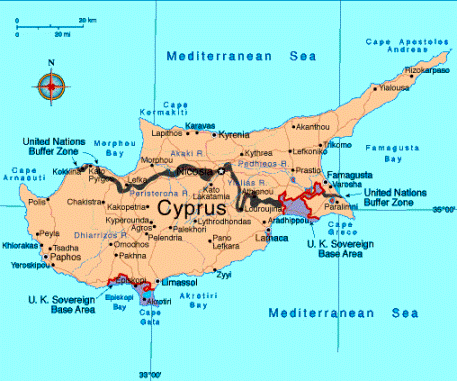
ANAMUR – Turkey will build a dam on a creek in the Mediterranean region to carry fresh water to Turkish Republic of Northern Cyprus (TRNC) through a 80-kilometers submarine pipeline.
The Alakopru Dam will be constructed on Dragon Creek in Anamur town of the Mediterranean province of Mersin and is planned to be completed within three years once the construction works are started.
The project aims to pump 75 million cubic meters of water yearly to the island, 15 of which will be used as drinking water and the rest for irrigation.
Turkish State Minister Kursad Tuzmen said project design works would be finalized next year.
“This project will be implemented to help TRNC fight drought and carry out irrigated farming,” Tuzmen said.
Turkey first started the project in 1998 to build a dam on Dragon Creek and Turkish construction company Alarko was contracted for the project. A memorandum of understanding was signed by Turkish State Hydraulic Works and Alarko in 2005.
The project will bring water to the island from Alakopru Dam through a 80-kilometers submarine pipeline to be installed 120 meters deep in the Mediterranean Sea.
Turkish Cypriot people, cultivating their land by means of dry farming for years, will now be able to carry out irrigated farming, officials said.
Coming from Cyprus, he rose through the oil industry to become a professional investor and advisor.
By Utku Cakirozer, Los Angeles Times Staff Writer
August 3, 2008
The gig: Chairman of TransGlobal Financial Corp., a private equity firm investing in and advising clients on emerging growth companies in such areas as healthcare, waste management and energy. Chairman, Vortex Resources Corp., an energy company.
Background: He grew up in Nicosia, Cyprus, during a civil war between Greek and Turkish Cypriots. His family was poor and lived in “miserable” conditions, he recalled. “It was like living in a big refugee camp.”
Personal: Mustafoglu, 58, lives in Beverly Hills. His wife, Demetra George, is of Greek and Italian heritage and a former Miss Oklahoma, competing under the name Debbie Giannopoulos. They have two daughters, Devran and Deniz.
Education: Attending Wichita State University on a Fulbright scholarship, Mustafoglu earned a bachelor’s degree in electrical engineering. Later, he received a master’s in finance from USC.
Culture shock: In 1966, Mustafoglu won a scholarship to study in the U.S., and he set off for what he hoped might be a dazzling spot such as Manhattan. Instead, off he went to Alhambra — Illinois, that is, a farm town of 550. “You can imagine my disappointment,” Mustafoglu recalled. “We drove five hours from Chicago, and here I was, coming from a small island, dreaming of coming to a big city. And here I was in the middle of cornfields and cows.” But he found opportunity in rural Illinois, where he learned to embrace the “core values of the American heartland.”
Early jobs: Waiter, guard, lab assistant, disc jockey.
Big break: He was hired by Shell Oil Co. when the recruiter found out that Mustafoglu was married to a onetime beauty queen representing his home state. He went on to become finance vice president of Getty Oil’s Canadian operation. Later, he moved to Oxbow Group to head its petroleum companies.
Big mistake: Failing to foresee the collapse of the dot-com boom in 2000. “If any businessman says he always makes money, he’s lying. You know how some people make lots of money? They learn from their mistakes.”
Investment ideas: “If I were in real estate, I would start buying in the inner cities. We will have to learn how to produce more, using less energy.” He sees a future for natural gas as a fuel for redesigned cars. He is interested in a natural gas field in west Texas, making diesel from low-cost animal fat and investing in distressed debt.
Giving back: Mustafoglu and his wife organized a benefit concert for victims of the 1995 Oklahoma City bombing. He helped found an umbrella group of Turkish-American organizations and chaired the American Turkish Assn. of Southern California. Mustafoglu, who co-chairs the American Friends of Israel and Turkey and is the honorary representative for Turkish Cypriots in L.A., helps support youths from his native land as they study in America. He also works with Latino groups and is the first person of Turkish heritage to be awarded the Ellis Island Medal of Honor, in 2002, which he calls “the crown of my 40 years in America.”
Advice: “The reason I was able to get ahead was education. If you have an education, you can be almost anything in this country.”
The late President Makarios, who died on this day in 1977, did not leave a memoir or diaries, so this interview with the Italian journalist Oriana Fallaci stands as one of the more revealing published conversations with the archbishop and president.
Oriana Fallaci was a well known writer and columnist and a former partisan during World War II.
This interview was conducted in November 1974, just months after the Turkish invasion.
At a certain point I said to Makarios, “You remind me of Jane Austin’s advice.” Makarios smiled. “What advice of Jane Austen’s?” “An intelligent woman should never let others know how intelligent she is.” Makarios smiled again. “But I’m not a woman.” “No, but you’re intelligent, so intelligent that you’re doing all you can to keep me from realizing it,” I said. And then his gaze hardened, something in him arched, like the back of a cat preparing itself for combat. I too arched myself, waiting for the blow of his claws, and ready to give it back. The blow didn’t come. With the same rapidity with which he had flared up, he regained his composure and went on with his story. “As I was telling you. I’m lucky. I know already what the newspapers will write when I pass to a better life. Last July I read such nice obituaries about myself. They gave me up for dead, remember? I lie cables to my ambassadors were nice too. The nicest came from Lord Caradon, the last British governor of Cyprus and a great enemy. I met Lord Caradon in London. We got to talking about the old days when we used to quarrel over the British bases on Cyprus. I told him those bases had been good for just one thing: to give me refuge after the coup d=état and help me leave the island.” Every time his mind wanders and he forgets Jane Austen’s advice, you’re a little sorry. You want to shout at him, “Pay attention!” And it goes without saying that in this interview this mind often wandered. Almost always. Which is one of the reasons I like Makarios.
I hadn’t liked him before. Once I had even tried to show him that I didn’t, with the result that I had received his blessing. It was in Athens, at the time of the wedding of Juan Carlos and Sophia. He was staying at the Grande Bretagne, and I was staying there too. One evening he came down to the lobby, and as soon as he appeared, all dressed up like an icon, shining with gold and jewels, and gripping his pastoral scepter, the lobby became a chapel. Some bowed till their noses touched their navels, some knelt on the floor, some tried to kiss his hand or at least his vestments. The only erect head was mine, very visible besides, because I had remained seated on a high armchair. The chair was situated between the elevator and the exit, and he noticed me at once. And his eyes pierced mine like needles of indignation, surprise, sorrow. Who was I? How did I dare? However, he continued his solemn advance, and, as he passed in front of me, he imparted to me that blessing.
Needless to say, I could have done happily without it. To the mind of a layman, he is irritating to say the least. Let us not forget that he represents the most solid fusion of the temporal power with the spiritual. He is like a pope who sits in the Quirinale instead of the Vatican; he is the head of the Greek Orthodox Church on Cyprus and the president of Cyprus. So, you never know whether to address him as a religious leader or a political one, whether to call him Beatitude or President, Archbishop or Mr. Makarios. Nor does the fact that he was democratically elected help yon to forget a bitter reality: he gets those votes thanks to his relationship with heaven. For the peasants of Cyprus, voting for him is almost a sacrament. While handing in their ballots with his name, even the communists make the sign of the cross. And yet, yet . . . he’s one of the few heads of state before whom it’s worth the trouble to get to your feet if not to kneel down. Because he’s one of the few with brains. Along with brains, courage. Along with courage, a sense of humor, independence of judgment, dignity. A dignity that approaches reality, and God knows where it comes from. The son of an illiterate shepherd, he guarded sheep until the age of twelve.
Many people cannot stand him. They accuse him, for instance, of devoting or having devoted too much attention to women, of being in no sense an ascetic. I believe it. They also accuse him of governing through lies, intrigue, and opportunism. And this I don’t believe completely unless by lies you mean Byzantinism, by intrigue, elasticity, by opportunism, imagination. His character cannot be judged by the yardstick we use in the West. He does not belong to the West. He belongs to something that is no longer the West but is not yet the East, something that sinks its roots into a culture that is sophisticated and archaic at the same time, and which has mastered the art of survival. He has the gift of survival, gained and regained through fast stepping, contortions, cleverness, lucidity, cynicism. Four times they tried to kill him. Four times he escaped. Twice they sent him into exile. Twice he came back. And only once did he seem to have lost for goodCafter the coup of July1974. Instead, those who lost were those who were thought to have wonCas a result of that coup, the Greek military junta tell and now finds itself under arrest. If I close my eyes on the subject of the archbishop-president, I can’t help accepting Makarios and taking him seriously even when he tells me he’s a socialist.
I interviewed him twice, for a total of six hours. The interview as written skips over such well-known incidents as the attempts on his life and his flight. I interviewed him in his suite in the Plaza Hotel in New York, where he had gone to keep an eye on Kissinger and the UN. No longer dressed up in gold and jewels, he wore a plain blue cassock and seemed older than his sixty-one years. His attitude was mild, deliberately humble. His voice was soft, deliberately suave. He said “he’s a criminal” in the same tone with which he might have said “he’s a good man.” I wasn’t bored for a minute, and indeed enjoyed myself. He knows how to be so brilliant. And at several moments I admired him. He cares so much about freedom. We parted friends. In the doorway, he whispered, “That advice of Jane Austen’s . . . it goes for you too. What a pity you’re a woman.” And I answered, “What a pity you’re a priest.”
ORIANA FALLACI: An abrupt question, Beatitude: are you going back to Cyprus or not?
ARCHBISHOP MAKARIOS: Of course I’m going back. Certainly! I’ll go back in November. At the latest, the end of December. The date depends entirely on me. I haven’t gone back as yet because I was waiting for the Greek government to withdraw and replace officers responsible for the coup against me. And also because I wanted to follow the UN debate on Cyprus from near by. I don’t understand why there should he any doubt about my returnCafter all I didn’t resign. Nothing and nobody is against my going hack, except those who are afraid of being tried and punished, something I don’t intend to do since it would hurt the unity of the country. Mind you, that doesn=t mean I intend to let history have a distorted version of the facts. On the contrary, I want the world to know what happened. But I want to avoid any punishment, any revenge. I’ll grant a general amnesty, and anyone who’s anxious about my return can calm his fears. Besides it’s only a question of a few individuals. The people support me today even more than before the coup. And they’re eager to have me back. They’re ninety-nine percent for me.
O.F.: Ninety-nine percent of the population includes the Turkish Cypriots. And I don’t think they’re so eager to have you back, Beatitude.
M.: Of course. I don’t think either that the majority of the Turks are in favor of me. I’m sure Mr. Denktash, the Turkish vice-president, is anything but pleased with the idea of seeing me arrive. But this doesn’t worry me, and anyway it won’t be up to me to negotiate with Mr. Denktash and the Turkish community. That will still be done by Clerides, who’s an excellent negotiator and knows Denktash better than I do. Oh, naturally it’s understood that Clerides won’t make any decisions without my consent. It’s understood that when I speak of going back to Cyprus, I mean to go back as president. I’m the president, I’ll go back as president, I’ll never agree to go otherwise. And the question of whether I’ll remain president for a long time or not concerns me alone. I’ll make that decision when I’m back in Cyprus. I’m saying I don’t exclude the possibility of retiring from the presidency after a certain period of time. I’ll have to decide on the basis of the situation. Should a bad agreement be readied, for instance, I wouldn’t care to stay as president. But this, I repeat, we’ll see later on.
OF: What do you mean by a bad agreement?
M.: Turkey is going to insist on a geographical federation, and I will never accept a federation on a geographical basis. It would lead to a partition of the island and to a double enosis: half of
Cyprus consigned to Greece and half to Turkey. It would mean the end of Cyprus as an independent state. I’m more than ready to discuss a federation, yes, but on an administrative basis not a geographical one. It’s one thing to have areas governed by Turks and areas governed by Greeks; it’s quite another to divide ourselves into two parts. It’s one thing to group, for example, or three Turkish villages and entrust them to a Turkish administration; it’s quite another to shift more than two hundred thousand people from one end of the island to the other. The Turkish Cypriots are scattered all over Cyprus. How can you say to them, “Pack up your things, leave your house, your land, and move elsewhere because we’re going to have a federation”?! It’s inhuman, to say the least.
O.F.: Is this really what worries you. Beatitude? I mean the tragedy of the Turkish Cypriots? It doesn’t seem to me that so far they’ve been the object of much concern. They’ve been treated like second class citizens and . . .
M: That’s not true! It=s not true! Though they=re a minority, they=ve had a lot of privileges, and they’ve behaved as though they represented the majority. We haven’t been the ones to mistreat them, it was their Turkish leaders, by forcing them to live in separate villages, blackmailing them, keeping them from co-operating with us even economically, and from progressing. They didn’t even let them do business with us, or help us to develop tourism. They weren’t our victims, they were their victims. Nobody can deny that a true democracy, and a good one, exists in Cyprus. In their newspapers the Turks could abuse me and insult me as much as they liked. They could come to see me at the archbishop’s palace whenever they liked. The trouble is they were obliged to come secretly, without their leaders knowing it. In mixed villages we had no problem living together, in the past and at the time of the Greco-Turkish war as well. What you say isn=t true.
O.F.: And is it true that you deprived them of many constitutional privileges, Beatitude? M.: I deprived them of nothing. I simply complained about those privileges because they only served to hamper the functioning of the state. The Constitution provides that they be represented in the government at the ratio of thirty percent. And very often the Turkish Cypriots didn’t have people capable of filling that thirty percent. There was, for example, a post that I could have been filled by an intelligent Greek and it had to be given to an illiterate Turk just because he was a Turk. Once they voted against taxes. I tried to explain to them that a state can’t survive if the citizens don’t pay taxes, and they refused anyway. So I forced them to pay all the same. Was that an abuse? Another time, when I was about to go to Belgrade for the conference of nonaligned countries, Mr. Denktash tried to stop me from going by exercising his veto power. I told him, “Exercise it all you like. I’m going just the same.” Was that an abuse?’
O.F.: Beatitude, whether you’re right or wrong, the reality today is different. The Turks occupy forty percent of the island and …
M.: And I don’t accept it. Because I can’t recognize a fait accompli, I can’t legalize with my signature a situation created by the use of force. So-called realists advise me to negotiate a geographical federation with the Turks; they say I should be less rigid. Instead of holding on to forty percent of the island, they repeat, the Turks might be content with thirty percent. So be flexible. I don’t want to be flexible.
O.F.: Flexible is a word dear to Henry Kissinger. Is he the one who says that?
M.: Kissinger has never clearly told me he was in favor of a geographical federation. He’s never told me clearly what he’s doing. He’s always talked about a “solution acceptable to both sides” and always repeated “we don’t want to say openly what we’re doing to persuade Turkey.” So I can’t state that he’s actually preparing the agreement that I reject, but I can tell you we’re still in disagreement on many things. Many. If it wanted to, the United States could play a more decisive and precise role in this matter. Doesn’t it supply economic aid and arms to Turkey? Isn’t it the only one that could persuade or even force Turkey to be more reasonable?
O.F.: Beatitude, do you think that what happened in Cyprus would have been possible without the tacit authorization of Kissinger and the Americans?
M.: Ah! I think the United States and other countries knew in advance that the Turks were preparing the invasion of Cyprus. And perhaps they were fooled by the Turks, perhaps they fell into the trap when Turkey said it would be a limited operationCa police action to restore constitutional order in two days. Perhaps they understood only later what Turkey’s real plans were. But all the same they could have prevented what happened. They could have stopped the continuous arrival of Turkish troops. I had a long discussion with Kissinger about it. And I expressed to him all my disappointment; I told him in no uncertain terms how dissatisfied I was with the attitude held by his country.
O.F.: And he?
M.: He answered that he didn’t agree with me, that he had tried to persuade Turkey, that he had acted behind the scenes. But again he didn’t want to explain clearly what he had done.
O.F.: Beatitude, many people feel that Kissinger’s responsibility and that of the United States go well beyond the Turkish invasion of Cyprus. Let’s not forget that the invasion took place following the coup carried out against you by the junta in Athens and that…
M.: Of course! The first chapter of this tragedy was written by the Greek military junta. Cyprus had been first of all destroyed by the intervention of Greece. Turkey came later, like a second evil. And I’m sorry to say so. I’m sorry because the present Greek government is behaving well toward me, in a frank and honest manner. I’ve not met Karamanlis or Averoff, but I’ve known Mavros. And I like Mavros. He’s a good man. He’s sincere, open, and that’s more than enough for me. But the fact remains that Greece would not have regained its freedom if Cyprus hadn’t lost its own. The fact remains that Turkey would never have dared intervene if the previous government, the junta, hadn’t offered it the pretext. The Turks had been threatening to invade us for such a long time, and yet they’d never done it. They’d never found an excuse.
O.F.: Yes, but don’t you think the United States and the CIA had something to do with that coup d=état? There are rumors that the CIA wasn’t exactly unhappy about the attempts on your life.
M. : As regards those attempts, I don’t believe it. Before the last one, in fact, it was people at the American embassy in Nairobi, during a trip I took to Africa, who informed me my life was in danger. They came to me and said, “We know that when you go back they’ll try to kill you. Be careful.” A few days later, in Cyprus, they confirmed the information to me, adding that the attempt would take place within two weeks. As indeed happened. As for the coup d’état, on the other hand . . . I don’t know. Kissinger told me, “It wasn’t in our interests to have that coup d’état against you.” I suppose I ought to believe him, but should I? There are plenty of indications that show just the opposite of what Kissinger told me, and still I have nothing to go on. I’ve even asked for information from Athens; I’ve tried to find out more. No use. I have to keep my idea without being able to offer any proof that it’s correct. Kissinger added, “Naturally we were following the situation and it was known to us that neither Ioannides nor the rest of the
liked you. But we had no concrete information as to ‘the day’ when the coup d=état against you would take place.”
O.F.: Maybe it was helped along by the letter you wrote to Gizikis in July.
M.: Let’s say that that letter speeded things up. If I hadn’t written it, the coup would have happened all the same, a month or two later. As Kissinger admits, it had been more than decided on; all that remained was to set the date. I was too big an obstacle to enosis, and they were too anxious to have enosis. Every time we were on the point of reaching an agreement between Greek Cypriots and Turkish Cypriots, officials in Athens intervened by shouting about enosis. “We don’t care about your local agreements, our goal is enosis.” I remember one of these officials who came to me one day and said, “You must declare I enosis. Anyway it will take three or four days before the Turks can send troops to Cyprus. In the meantime the United States will intervene and keep them from invading the island. In a week enosis will be a fait accompli.” Maybe they really believed that annexation to Greece was a viable alternative. Anyway, they expected me to take orders from Athens, they wanted e to obey like a puppet, and that’s absolutely impossible with my temperament. I obey only myself.
O.F.: So you too were expecting the coup.
M.: No. I never thought they’d be so stupid as to order a coup against me. In fact, to me it seemed impossible that they wouldn’t consider its consequences. I mean Turkish intervention. At the most I thought they might do such a thing by making a deal with Turkey, that is, authorizing Turkey to intervene so that Greece could then respond, to be followed by partition and double enosis. I went on thinking so even after the coup, when I got to London. It took some time for me to realize that Ioannides had simply acted out of a lack of intelligence. And yet I knew him. In 1963 and 1964 he had been in Cyprus as an officer of the National Guard, and one fill day he came to see me, accompanied by Sampson, in order to Aexplain to me secretly a plan that would settle everything.@ He had bowed to me, he had kissed my hand most respectfully, then: “Beatitude, here’s the plan. To attack the Turkish Cypriots suddenly, everywhere on the island. To eliminate them one and all. Stop.” I was flabbergasted. I told him I couldn’t agree with him, that I couldn’t even conceive the idea of killing so many innocent people. He kissed my hand again and went away in a huff. I tell you, he’s a criminal.
O.F.: Do you find Papadopoulos better?
M.: I’d say yes. If I had to choose between Papadopoulos and Ioannides, I’d choose Papadopoulos. At least he’s more intelligent, or, if you prefer, less stupid. I met him for the first time when he came to Cyprus, shortly after his coup, as minister for the presidency, and no one can say that at that time I was paying him any great consideration. But I saw him again a couple of times in Athens, when I went there to discuss the problem of Cyprus, and I must say that on those occasions he seemed to me much smarter. In any case, supplied with common sense. Well, Papadopoulos was suffering from megalomania, and besides I don’t know what he really thought about Cyprus. On the other hand, he was capable of controlling many situations, simultaneously, and he was head and shoulders above his collaborators. I don’t even think he hated me, in the beginning. He started hating me later, in the last two years. And maybe only in the last year.
O.F.: And you, Beatitude, are you capable of hating?
M.: Well, let’s say that the feeling we call hatred is part of human nature. You can’t stop anyone from feeling it once in a while. And though I don’t like to admit it, since I must preach love, there are moments when . . . well, when , . . All right, let’s say that I don’t like certain people. Why are you smiling?
O.F.: Because you make me think of certain Renaissance popes who led their armies in war, and I can’t understand to what extent you’re a priest. So I conclude that maybe you’re not a priest at all, but a big politician dressed as a priest.
M.: You’re wrong. I’m a priest first and then a politician. Better still, I’m not a politician at all. I’m a priest, first of all a priest, above all a priest. A priest who has been asked to be head of state and consequently a politician. But one would say you don’t much like that.
O.F: No, and I’m dismayed by it. In the world I live in, the struggle of laymen consists precisely in not allowing the spiritual power to be confused with the temporal power, and in keeping a religious leader from becoming a political one.
M.: In my world, on the other hand, it’s fairly common. And all the more so in Cyprus, where the archbishop, like the bishops, is elected directly by the people, with universal suffrage. In other words, in Cyprus, the archbishop isn’t only a representative and administrator of the Church, he’s also a national figure. The ethnarch. And then, in my opinion, the Church should interest itself in all aspects of life—the Christian religion doesn’t confine itself to taking care of the moral progress of men, it’s also concerned with their social well-being. I see no conflict between my position as priest and my position as president. I see nothing scandalous about my holding both the temporal and spiritual power. Besides I don’t lean on a party; I’m not the leader of a political party who goes around asking people to elect him. I simply serve the people in the two capacities that they insistently and almost unanimously offered me. As I explained many years ago to another layman, Prime Minister George Papandreou, I’m strong because I’m weak. Because I have neither a party nor an army nor a police force behind me. And because I don’t even know the rules of politics. Because I follow certain principles that are Christian principles and not games, tricks, political maneuvers.
O.F.: Oh, come off it. Beatitude! You, who are a past master in the most Byzantine game of compromise. You, who are considered the most brilliant specialist in intrigue and calculation.
M.: No! I don’t use those methods. I don’t! I yield to compromises of course, but never to anything that’s not clear and honest. I’m not a saint. But I=m an honest man, and I don’t believe politics has to be dishonest. I don’t think that in order to have success, it’s necessary to indulge in deceit. Do you know why my people love me? Do you know why they forgive all the mistakes I make? Because they understand that those mistakes are caused by bad judgment, not by bad intentions. You must not confuse me with the popes of the past, and in fact, if you were to ask me, I have a very negative opinion of them. I really try to bring Christian teachings into the maze of the office that’s been entrusted to me and which I accepted. I’ll give you an example. In Cyprus we have capital punishment, and as head of state, I’m the one who has to put his signature on death sentences. But executions in Cyprus are very rare because every time a condemned man appeals to me, I let him off. Everyone in Cyprus knows the death penalty is nominal, that I always suspend executions. Those popes went to war, but I don’t accept war, I consider it a madness that’s destined to end someday, to be remembered with disbelief. I don=t accept bloodshed.
O.F.: Excuse me. Beatitude, but YOU were the one who actually said, at the beginning of the struggle for the independence of Cyprus, “Much blood will have to flow.”
M: I can’t possibly have said it that way. Maybe I said. “The road to freedom is irrigated with blood,” something like that. Maybe I said, “We’ll have to die,” but not, “We’ll have to kill.” I was in favor of sabotage, yes, but on condition that it didn’t cost the blood of innocent people. All that killing took I place when I was in exile and couldn’t do anything to stop it. Oh. I’m not the terrible person you think!
O.F.: We’ll see. But now let’s forget about Cyprus and talk about you. First of all, why did you become a priest?
M.; I always wanted to be a priest. Ever since I was a child. I was barely thirteen when I entered the monastery. But the reason is hard for me to explain. Maybe I’d been impressed by my visits to the monasteries around my village. I liked the monasteries so much. Life there was so different from the kind we led in the village, and I sometimes wonder if for me the monastary wasn’t a way of escaping the sheep, the poverty. My father was a shepherd. And he always wanted me to help him look after the sheep, and I didn’t like looking after the sheep. In fact, he used to complain and say, “I can’t expect anything from my elder son! If I need help when I’m an old man, I’ll have to turn to my younger son!” He said it so often that in the last years of his life, when I was already archbishop, I liked to tease him: “Do you remember when you used to grumble and say you couldn’t expect anything from me?” He was very religious, like everyone in the family, but he couldn’t understand why on Sunday morning I left the sheep to run to the monastery and help the priest say Mass. I was twelve years old when I told him I wanted to take that path, and he got angry. But I wasn’t scared, I was so sure that nothing would be able to stop me.
O.F.: And your mother?
M.: I don’t remember my mother very well. She died when I was very small; I don’t even have a picture of her. In those days, the poor didn’t get their pictures taken, especially in the mountains of Cyprus. About my mother, I only remember the day she got ill. There was only one doctor in the whole district, and my father set out on foot to look for him. He had no idea in what village he might find him, and went wandering around for hours, and finally he came back dragging the doc- tor like a sheep. The doctor used the same pill for all illnesses. Aspirin, I guess. He gave my mother the pill, and she died soon after. I remember the funeral. I remember the nights I slept with my father, because with him I could cry better. And I remember the night when he too started crying, and I said, “If you’ll stop crying, I’ll stop too.” And then I remember my grandmother taking me away, and the relatives saying to my father, “You’re young, you should get married again. Also for the children.” Besides myself, there was my little brother, and my little sister who had just been born. And one day they brought me home to meet my new motherCFather had got married again. My new mother was a woman in the middle of the room, and she kept whispering, “Come in, come in!” I didn’t want to go in because I didn’t know her. But then I went in and soon I loved her. She was nice. She’s still alive, and still nice, and I still love her. Very much. Oh, it’s so difficult, and also so easy, to tell you where I come from. My father couldn’t read or write. Neither could my mother, nor my grandmother, nor my stepmother. I think my father resigned himself to the idea of letting me go into the monastery because there I would learn to read and write. When he took me there, he kept urging me: “Be obedient, study . . .
O.F.: Were you disobedient then too? You just told me that you only obey yourself. M.: I was shy. I was so shy in school I didn=t even have the courage to get up and show that I’d studied the lesson. When the teacher called on me, I blushed and my tongue got paralyzed. But not even then was I able to obey. Take the story of the beard. When I was twenty years old, the abbot of the monastery ordered me to let my beard grow. And a novice isn’t obliged to grow a beard. I refused, and he got angry, “Either you obey or out you go.” “All right, I’ll go.” Then I packed my bagCI knew exactly what would happen. “You mustn’t go! Stay.” “All right, I’ll stay.” “But grow a beard.” “No, no beard.” “Look out or I’ll beat you.” “Beat me.” He started beating me, and while he was beating me, he yelled, “Will you let it grow?” “No.” “Now will you let it grow?’ “No.” Finally he sat down, exhausted. “Please. Let it grow a little. Just a little, so I won’t lose face.” “No.” “Just the little bit needed to make people ask whether you have one or not.” I smiled. “This little bit?” “Yes.” “Like now?” “Yes.” “Not even a millimeter more?” “Not even a millimeter more.” “All I right.” And a compromise was reached without my giving in to obedience.
O.F.: Revealing, I’d say.
M.: It’s my strategy. It always has been. I mean, I’ve always enjoyed the game of pushing myself to the edge of the abyss and then stopping so as not to fall. You see what I mean? It’s not that I stop at the last moment because I realize the abyss is there; I calculate to the millimeter that I can go that far and no further. The others, naturally, think I’m about to fall, to commit suicide. Instead I go along very quietly, knowing I’ll put on the brakes. It was the same with the abbot. I hadn’t the slightest intention of leaving the monastery; I liked it too much. But I knew that by making him believe the contrary and taking his beating, he’d give in and accept a compromise that for me was a victory.
O.F.: And has there been any case when your calculations didn’t work, when destiny decided for you?
M.: I don’t believe in destiny. Everyone makes his own destiny. At the most there exist unforeseen circumstances, which one must know how to take advantage of. I, for instance, hadn’t foreseen that I’d become bishop at the age of thirty-five and archbishop at thirty-seven. . . . But that’s a story worth telling. After seven years in the monastery, three of which were spent studying at the high school in Nicosia, I was sent to Athens to take my degree in law and theology. There I was caught by the war, the Italian and then the German occupation, a tough as well as adventurous period. After the liberation, however, I got a scholarship in the United States and went to Boston. I liked AmericaCthey’d given me, among other things, a small Greek Orthodox parish. I decided to stay there for five years instead of the three that had been arranged and take my teaching degree in theology. And here the plan failed. Two years had barely gone by, in fact, when I received a cable from Cyprus informing me that a certain district wanted to elect me its bishop. I was alarmed. I didn’t want to leave America, I didn’t want to go back to Cyprus. Cyprus meant nothing to me except a vague geographical knowledge. And a limited one at that, since all I had seen were the mountains where I was born, the monastery where I’d grown up, and the school in Nicosia where I’d studied. Do you know I was eighteen when I saw the sea for the first time? I cabled back: “Many thanks but I don’t want to become bishop stop.”
O.F.: Are you telling me you weren’t ambitious?
M: Of course I was! No priest can be happy it he doesn=t succeed in an ecclesiastical career. But my ambitions were different. The fact is that no sooner had I sent my reply when a second cable arrived: “Elections held. People elected you unanimously.” It was 1948, the eve of the struggle for independence. Sadly I took a plane to Athens, and I remember that there I kept asking everybody, “Will I find a taxi at the Nicosia airport?@ Then I took the plane from Athens to Nicosia and . . . I’ve already told you that in Cyprus the election of a bishop something very democratic. The people participate in it spontaneously, enthusiastically, and without tricks. But I didn’t tell you that it arouses a mad fanaticism. And I can’t stand fanaticism. In any form. So you can imagine how I felt when, going out to look for a taxi, I saw this incredible crowd fanatically shouting my name. I recovered myself if only to utter what was to be my first political statement: “You wanted me. So I shall dedicate myself to the Church and to Cyprus. And I=ll do everything I can to help Cyprus win its freedom and break the chains of colonialism.” Then I saw myself lifted up and taken to Larnaca, the district where I’d been elected. And from that moment on, Cyprus became my life.
O.F.: A good life, Beatitude. A lucky life, let’s face it.
M.: A tough, difficult life, full of assassination attempts, of risks, anxiety, and exile. I was in the Resistance against the British. Still it’s true that two years later, when the archbishop died, I was triumphantly elected in his place, thus becoming the youngest head of a Church in the whole world. It’s true that I liked it. But it doubled my political commitment and cost me exile. To get rid of me, the British sent me to the Seychelles and . . . Of course, when I look back on it today, that exile seems anything but tragic. Actually it wasn’t an exile, it was a vacation. I was given a nice house where I was served and respected. The landscape was marvelous, so marvelous that wanted to see it again, and I went back as a tourist and even bought a little piece of land near the same house, which the owner, unfortunately, didn’t want to sell. The British treated me well and didn’t keep me there long—just eleven months. But at that time I didn’t know it and thought they’d keep me for at lest ten years or forever. I had no idea what was going on in Cyprus, I had no radio, no newspapers, and I couldn’t speak with anyone. And . . .
O.F.: And?
M.: Well, all right, I’ll tell you. I wasn’t born for the contemplative life. I can stay shut up for a week in this suite in the Plaza, but on the eighth day I have to go out, see people, do something, live. You’ll object: didn’t the monastery teach you anything? Well, our monasteries aren’t very strictCthose who stay inside them do so by choice and not because they’re forced to. And no one says I should go back and live in a monastery. I prefer to do what I’m doing and . . . why should I go back to a monastery?
O.F.: So I was right to compare you with those popes. Besides I’ve never believed in the picture some people paint of you: ascetic, vegetarian . . .
M.: I’m not a vegetarian! I like vegetables but I also eat meat. One of my most painful memories is a certain official dinner that was offered me in India. The waiter came over and asked me, “Are you vegetarian?” I thought he was asking if I liked vegetables and I answered yes. Then he put a flower beside my plate and for the whole meal served me nothing but vegetables. I was consumed with envy seeing the others devouring chicken, fish, steaks. In fact, now whenever they put a flower in my hand, I get suspicious.
O.F.: But I was referring to other flowers. Beatitude. It seems you were once at a party where a dancer did a wild belly dance, and you’re said to have remarked, “The beauty of woman is a gift of God ”
M.: I don’t know that incident. It’s true, I love popular dances, I like folklore . . .
O.F.: No, no, I wasn’t talking about folklore. I was talking about belly dancing. I was trying to ascertain that you’re not one of those priests who pray from morning to night and . . .
M.: I’m usually a very simple man. At the same time, however . . . What should I say? . . . When necessary . . . I make certain . . . adjustments. I like to walk, for instance, to run, to climb mountains, to keep in shape. Also because I like sports and I dislike fat people. So whenever I can, I take an excursion, I walk in the woods. . . . Under my robe, you see, I wear trousers. If I always dress this way, in robes, even at home, it’s because my people are used to seeing me in a cassock and I can’t disappoint them. But cocktail parties bore me and so do worldly things. . . . O.F.: I still haven’t made myself clear. Beatitude. Maybe it’s better to call things by their right names. I was referring to women, to the rumors that you’re very fond of women. They even say that in Cyprus you have two, well, two wives.
M.: Come now. In the Orthodox Church, bishops and archbishops can’t marry. Only priests can. But then they don’t become bishops.
O.F.: I know. I said “wives” to be polite.
M.: . . .
O.F.: Isn’t it true you’re very fond of women?
M.: . . .
O.F.: All right, let’s change the subject. They also say you’re not a sincere man, that a word of truth never comes out of your mouth. Do you think a head of state should be permitted to tell lies?
M.: No. this is something I can’t accept. I’m so incapable of telling lies, any lie, that when I can’t tell the truth, I prefer to keep silent. Silence is always better than lies. Look, during the Resistance struggle, the British arrested me several times. After being arrested, I was interrogated, and naturally I couldn’t deny what I was doing. And then everyone knew I had con- tacts with Grivas. So, in order not to lie, I answered, “I can’t say anything. I don’t want to say anything. I refuse to answer.” And I kept silent.
O.F.: Just what you did with me when I asked you about women.
M.: What did I say?
O.F.: Nothing.
M.: The perfect answer.
O.F.: I’m beginning to like you. Beatitude. And at this point it pains me to insist on the ugly things they say about you. For instance, that you rule through favors, and that you’re very rich, and that . . .
M.: I possess nothing. Absolutely nothing except that little piece of land in the Seychelles. I haven’t a penny in any bank in the world. I have nothing but a kind of salary, which I can use as I
like, but it’s very small. I administer the properties of the Greek Orthodox Church in Cyprus, it’s true, and as archbishop I can dispose of anything that belongs to the archbishop’s palace, but I’m not authorized to use a single cent for myself. Theoretically, even my linen belongs to the archbishop’s palace. As for favors, I help many people, it’s true. But my friends less than anyone. And my relatives still less. My brother is my driver. That doesn’t seem to me a great career; also when you stop to think of the attempts that are made on my life. I stay in good hotels when I travel, it’s true. But do you know why? Because I have friends all over the world and they’re anxious to pay for me. In London, for instance, after the coup d’état, I went to the Grosvenor House, where I always go. The next morning Charles Forte, whom I’d known ‘from Cyprus where he wanted to open a hotel, came to me and said, “Do you know I’m the owner of the Grosvenor House?” I hadn’t known. “It will be an honor for me to have you as my guest for as long as you care to stay in London.” And so I didn’t pay. In fact, he even wanted me to be his guest in New York, at the Pierre, another hotel he owns. I didn’t accept because I didn’t want to take advantage of him.
O.F.: Yes, but then why do they call you the Red Archbishop?
M.: I’ve never understood where that came from. Maybe from the fact that I’ve never made anticommunist propaganda. Or the fact that I follow a policy of nonalignment. Most of the non- aligned countries are accused of being leftist-oriented and even of looking to the Soviet Union. O.F.: Are you a socialist, Beatitude?
M.: If you’re referring to Swedish socialism, not Soviet socialism, I can say I really have nothing against socialism. Among all social systems, it’s the closest to Christianity, to a certain Christianity, or at least to what Christian teaching should be. Christianity doesn’t favor any social system—it recognizes that any social system, from the capitalist one to the communist, can contain something good. But if I had to choose the best system, or the most Christian system. I’d choose socialism. I said socialism, not communism. And let me add that, in my opinion, the future belongs to socialism. It will end by prevailing, through a kind of osmosis between the communist countries and the capitalist ones. Spiritually it’s already happening. The socialist, that is, egalitarian, spirit is permeating all human relationships. Today equality is an almost spontaneous feeling.
O.F.: You’re an optimist. Beatitude.
M.: I always have been. And never at random. In the last thirty years a great change has happened in the world. Thirty years ago who would have imagined that colonialism would be over
and that war would no longer be accepted as a means for subjugating a country? Who would have imagined that social hierarchies would no longer be accepted with conviction, that the word socialism would no longer be frightening?
O.F.: But if you believe in socialism, how can you administer a church that’s one of the richest in the world?
M.: Never so rich as the Catholic Church. And anyway the Church isn’t a reactionary force; it doesn’t represent the capitalist world. If it often goes to the right, the fault is only of its representatives. And the representatives of the Church aren’t the Church; the representatives of religion aren’t religion. When you think that not even the priests, bishops, archbishops, and
theologians have been able to uproot religion from the heart of men! I may be too optimistic, but even the Catholic Church leads me to make a positive judgment. It’s changed so much in recent years, thanks to Pope John. In 1961, when I was asked to stop in Rome on a state visit, I was invited by the pope. And naturally I had a great desire to go, but still I wondered if I should. Our lack of understanding goes back so far. Not only had I never met a Catholic bishop. I’d never met a Catholic priest! I told myself that the other heads of the Orthodox Church would be offended. But soon after that the patriarch of Constantinople, Athenagoras, met with Paul VI in Jerusalem.
O.F.: Did you feel at ease with the pope?
M: It was interesting. A pity all that protocol.
O.F.: And who are the leaders with whom you=ve felt at ease?
M: Let=s say that some leaders, not many, have impressed me, and that others have left me indifferent. They were considered great men, but they were only men at the head of great countries. Among those who impressed me, I=d put Jack Kennedy. That childish face of his was really nice; it had a dignity of its own. Besides Kennedy was simple, human. Along with Kennedy, I’d put Tito. But Tito and I are friends; I like to think he has the same affection for me that I have for him. . . . He’s such a dynamic man, full of clear ideas. And generous besides. “Anything you need, just let me know,” he always says. I liked Nasser too. I remember meeting him at the first conference of nonaligned countries, in Bandung in Indonesia. It was the first time he’d left Egypt, the first time he’d flown in a nonmilitary plane, and he was so excited. I found that touching. As for Castro . . . I don’t know. He has certain qualities necessary for a leader. With me he behaved . . . well, he behaved like Castro. Golda Meir is a very strong, interesting woman, but we disagree about too many things. We’ve met twice and we didn’t exactly throw our arms around each other. Sukarno . . . he didn’t impress me. Nixon even less. An ordinary man, very ordinary. And then . . . what do you want me to say? I like Constantine. Not because I’m a monarchistCI saw him coming into the world, I saw him grow up, I like him. But I can’t say that because I shouldn’t be making political propaganda for him,
O.F.: And Mao Tse-tung?
M.: I wouldn’t say I have much in common with him. And I don’t know how to define the impression he made on me. His health, when I met him last May, really wasn’t good and . . . Let’s put it this way: in China he’s a kind of god. His fingerprints are everywhere, obsessively, and I’ve already told you that I hate fanaticism. I feel more at ease with Chou En-lai. Besides I’ve known him for nineteen years, since the Bandung Conference. Chou En-lai is so intelligent, so pleasant, with him you can even joke. He prepared a fabulous welcome for meChundreds of thousands of people in the streets of Peking, a million in Shanghai. I kept saying to him, “You want to make me feel like somebody!” We also had fun when he started talking about our two countries, about the role they’d play in history. He kept repeating, “Our two countries . . .” Finally I interrupted and exclaimed, “Will you do me a favor? Will you stop talking about our two countries, about their historical roles? I feel ridiculous. How can you compare a little island of five hundred thousand inhabitants with a China of eight hundred million? What historical role can we have in common, we two? I’m a mosquito next to an elephant!” Mao Tse-tung was there too. He tried to smooth things over by saying that mosquitoes can sometimes give a lot of trouble, while elephants are innocent. But that didn’t go down with me. And I still kept my inferiority complex.
O.F.: Do you often feel that inferiority complex?
M.: Ah, yes. If it’s not inferiority, it’s uneasiness. During my visit to the Soviet Union, for instance, I stayed inside the Kremlin. Every morning I said to myself, “Good Lord! An archbishop inside the Kremlin!” Podgorny was nice and polite; he did nothing but smile at me, but he didn’t succeed in making me forget the paradox. To get out of it, I combined my state visit with a visit to the Russian Orthodox Church. And that was worse. The coronation ceremony for the new patriarch of Moscow was taking place just then, and the crowd was as numerous as in Peking, as in Shanghai. It was very hard for me to behave as though I really felt important. Look, there’s only one time when I lost that inferiority complex.
O.F.: When?
M.: When I visited Malta.
O.F.: We can offer you San Marino.
M.: They’ve never invited me. But I’ve felt comfortable in Africa too. Oh, it’s extraordinary the number of babies and streets that have been named after me in Africa! In Tanzania I did nothing but meet little black Makarioses, and the same in Zanzibar, though Zanzibar is Muslim. In Mombasa there’s a Makarios Avenue. And in Nairobi . . . Ah, Nairobi was the best of all, because in one week I baptized five thousand people. I’d been invited by Kenyatta, another leader who’s impressed me very much, and all of a sudden I had an idea. I asked, “How many people could I baptize if I stayed here a week?” They said, “As many as you like.” “Even fifty thousand?” “Even fifty thousand.” Well, fifty thousand was too much. I said, “Let’s do five thousand.” The first contingent arrived in two days, coming on foot from very distant villages. And naturally I should have baptized them in the river. But I didn’t want to run the risk. The water is polluted and I’m a hygienist. So I threw them all into a swimming pool, adults and children, and . . . For a week I did nothing but fill that pool. It was amusing because there’s a Catholic mission there that’s not too well liked because of its old ties with colonialism, and to baptize even a single person those poor missionaries have to sweat like hell. Help women give birth, nurse babies, and what have you. For me instead it was quite simple. I didn’t have to do any of those awful things, and the result is that in Africa I have at my disposal the largest concentration of black Orthodox Christians. Naturally they understood nothing about what it means to belong to the Greek Orthodox Church. You meet some fellow on the street and ask him, “What religion do you belong to?” And he answers, “To
Makarios’s religion!” But it’s all right just the same and . . .Look, I’ll always live in Cyprus. As I told you, Cyprus is now my life. But if I couldn’t live in Cyprus, I’d live in Africa.
O.F.: And now I begin to understand something about you, Beatitude. Good-bye, thank you, and see you again in Cyprus.
M.: See you again in Cyprus. Come when you like. I’ll receive you as president.
Reproduced from the publication “Interview with History” by Oriana Fallaci(1976) / Houghton Mifflin Company
The Government of the United States of America is pleased to announce the open competition for the Junior Faculty Development Program (JFDP) for the 2009 spring semester. The JFDP is a program of the Bureau of Educational and Cultural Affairs of the United States Department of State (ECA). American Councils for International Education:
ACTR/ACCELS, an American non-profit, non-governmental organization, receives a grant from ECA to administer the JFDP, and oversee each participant’s successful completion of the program. The United States Congress annually appropriates funds to finance the JFDP, and authorizes the Bureau of Educational and Cultural Affairs to oversee these funds.
If you are a citizen of Albania, Armenia, Azerbaijan, Bosnia and Herzegovina, Croatia, Georgia, Kazakhstan, Kyrgyzstan, Kosovo, Macedonia, Montenegro, Serbia, Tajikistan, or Turkmenistan, and are teaching full-time in an institution of higher education in your home country, have at least two years of university-level teaching experience, and are highly proficient in English, American Councils invites you to learn more about the program and apply.
JFDP applications may now be downloaded as a print version or submitted online at the JFDP website. Additional information, including the 2008-2009 calendar, academic field descriptions, a list of frequently asked questions, and information about past program participants and host institutions can be found at the JFDP website:
1960 – Britain grants independence to Cyprus under power-sharing constitution between Turkish and Greek Cypriots. Archbishop Makarios becomes first post- independence president.
Treaty of Guarantee allows Greece, Turkey and Britain to intervene in disputes. Britain has sovereignty of two bases on the island.
1963 – Makarios worries Turks by proposing constitutional changes which would abolish power-sharing agreements.
1964 – Power sharing crumbles amid fighting between paramilitary factions. United Nations sends peacekeeping force to help British troops patrolling the “Green Line” set up to divide the Turkish and Greek Cypriot sectors of Nicosia, the capital.
1967 – Military government seizes power in Greece, relations between Makarios and the generals in Athens are increasingly strained.
1974 – Military government in Greece backs coup against Makarious, seeking to unify Cyprus with Greece.
Makarios flees and five days later Turkish troops land in the north to protect Turkish Cypriot community.
The coup quickly ends and Greece’s military government collapses. Turkish forces occupy one third of the island and it effectively becomes partitioned.
1975 – Turkish Cypriots establish independent administration with Rauf Denktash becoming president.
1980 – UN-sponsored peace talks resume.
1983 – Turkish Cypriots proclaim independence as Turkish republic of Northern Cyprus – but it is only recognised by Turkey.
1985 – No agreement at talks between Denktash and Spyros Kyprianou, the Greek Cypriot president.
1993 – Glafcos Clerides becomes Greek Cypriot president.
1997 – UN-hosted talks between Denktask and Clerides fail.
2002 – Kofi Annan, the UN secretary general, presents a comprehensive peace plan involving a federation of two parts, with a rotating presidency.
2003 – Turkish and Greek Cypriots cross “Green Line” for first time in 30 years after Turkish side eases border restrictions.
2004 – In referendums, Turkish Cypriots accept UN power-sharing plan but Greek Cypriots reject it. Cyprus joins the European Union, still partitioned.
2006 – Greek Cypriots endorse ruling coalition in elections, reaffirming opposition to reunification.
2006 – Turkey’s EU entry negotitations break down over Turkey’s continued resistance to opening its ports to traffic from Cyprus.
2007 – Communist party quits Cyprus’ governing coalition.
2008
February – Communist party leader Demetris Christofias wins Cyprus’ presidential election and agrees to immediately reive reunification efforts.
March – Christofias and Mehmet Ali Talat, the Turkish Cypriot leader, agree to reopen the symbolic Ledra Street crossing in Nicosia.
April – Ledra Street is opened for first time since 1964.
July – Christofias and Talat agree enter direct peace negotiations on September 3, with a solution to be put to simultaneous referendums.