Category: Ibrahim Kurtulus

  • New York Turkish Consul General Ahmet Yazal

    New York Turkish Consul General Ahmet Yazal

    For over 35 years, I have held US elected officials members of US. Congress, US, governors, US, senators, and community leaders accountable by questioning and, when necessary, criticizing their actions. In the United States, this kind of scrutiny is not only accepted, it’s a fundamental part of civic engagement.

    What’s troubling is the double standard I’ve experienced. The same people who remain silent when I criticize U.S. officials react very differently when I raise concerns about Turkish diplomats. Instead of open dialogue, I face intimidation, threats, and harassment both directly and indirectly directed by Turkish Consul General Ahmet Yazal.

    Criticism of any public official, including consuls general, should not be labeled as anti country or anti government. Holding officials accountable is not an attack on a nation; it’s a necessary way for communities to voice concerns and demand better representation. Labeling dissent as harmful or “weaponizable” is often just a tactic to silence inconvenient voices rather than address the issues being raised.

    Respectfully,

    Ibrahim Kurtulus
    Community Activist

  • Silence about  terrorist origination Fethullah Gulen foot Soldiers in New York

    Silence about  terrorist origination Fethullah Gulen foot Soldiers in New York

    New York  Turkish Consul General Ahmet Yazal  / Silence about  terrorist origination Fethullah Gulen foot Soldiers in New York  

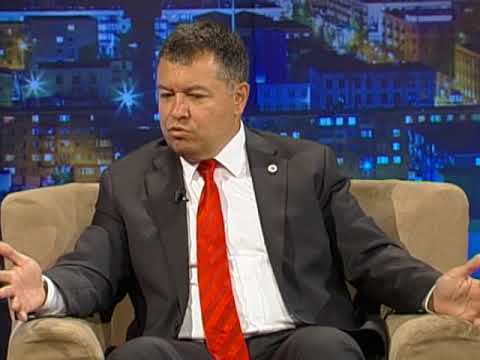
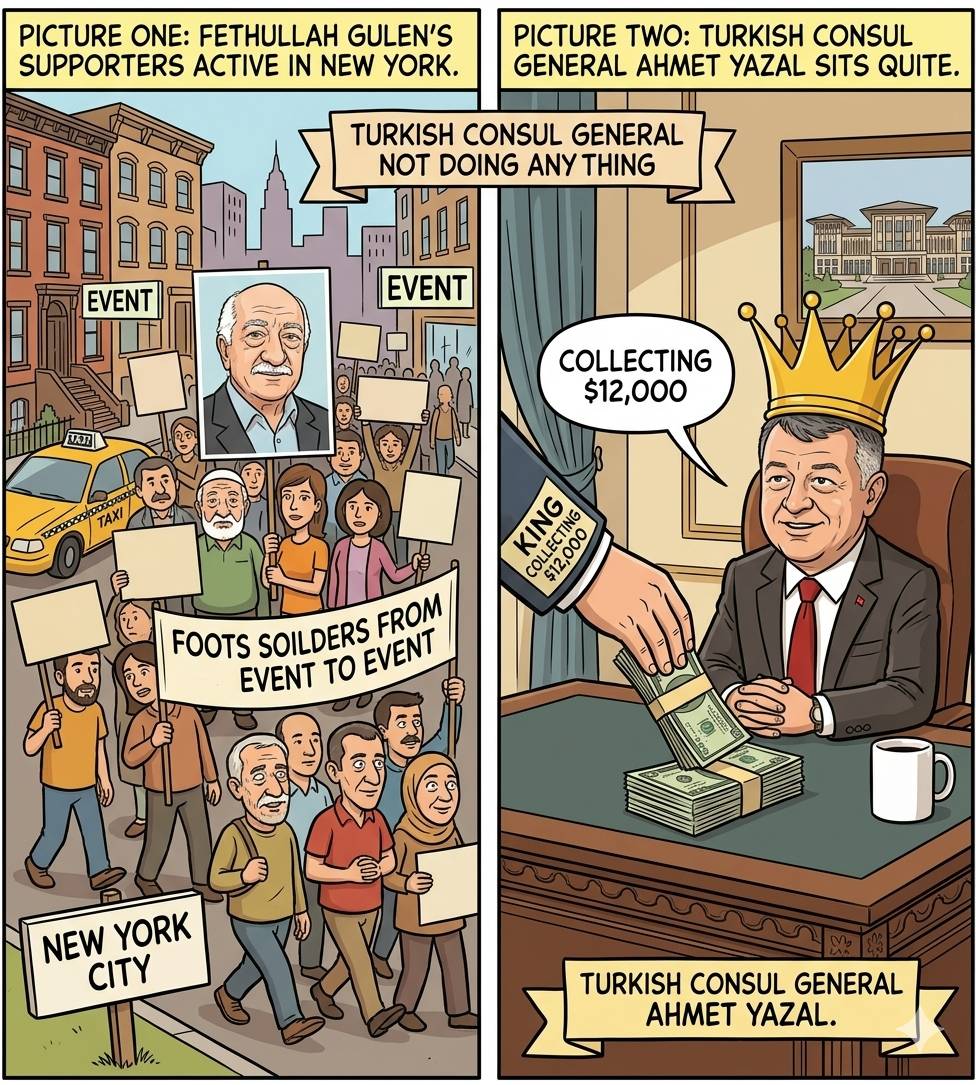
    Since the appointment of Consul General Ahmet Yazal, there has been little visible public response or outreach regarding activities in New York involving individuals believed to be linked to  the terrorist origination Fethullah Gulen and their engagement with various NGOs. This silence is raising questions as many in community  are wondering whether enough attention is being given to the issue in New York by Consul General Ahmet Yazal about the terrorist origination , and whether Turkish interests are being actively represented and protected, especially considering the responsibility to the Turkish public. Yazal is just collecting his $12,000 salary and waiting for his retirement and walking his two dogs. (picture attached) 

    Respectfully,

    Ibrahim Kurtulus
    Staten Island, New York 

  • An Urgent Need to Contain Turkey

    An Urgent Need to Contain Turkey

    Rebuttal to the Wall Street Journal Opinion Mar 4, 2026 : “An Urgent Need to Contain Turkey”

    The Wall Street Journal opinion titled “An Urgent Need to Contain Turkey” advances a deeply flawed premise: that the Republic of Türkiye should be viewed as a destabilizing power requiring containment. Such rhetoric reflects a simplistic reading of regional geopolitics and ignores both historical realities and the strategic role Türkiye plays in maintaining stability across multiple theaters.

    First, the framing itself is misguided. The language of “containment” is a relic of Cold War strategy traditionally applied to adversarial powers hostile to the Western alliance. Türkiye, however, is not an adversary it is a core member of NATO, possessing the alliance’s second-largest military and serving as one of its most critical geographic anchors between Europe, the Middle East, the Caucasus, and the Black Sea. Calling for the “containment” of a NATO ally undermines the very alliance structure the West claims to defend.

    Second, the article ovarlooks Türkiye’s indispensable contributions to regional security. Türkiye controls access to the Black Sea through the strategically vital Bosporus Strait and Dardanelles waterways that have proven decisive in balancing power during conflicts involving Russia and Ukraine. Far from destabilizing the region, Ankara has repeatedly acted as a diplomatic intermediary and security guarantor.

    Third, the narrative ignores the immense humanitarian burden Türkiye has carried.Türkiye hosts millions of refugees from the Syrian conflict more than any other country in the world—while continuing to cooperate with European partners to prevent a broader humanitarian and migration crisis.

    Fourth, the argument assumes that any increase in Türkiye’s regional influence is inherently negative. Yet power vacuums in the Middle Eaast have historically produced instability and extremism. In many instances, Türkiye has functioned as a stabilizing actor capable of counterbalancing both authoritarian regimes and non-state extremist groups.

    Finally, the editorial reveals a troubling pattern increasingly visible in some Western commentary: reducing a complex regional power to caricature rather than engaging with the strategic realities of a multipolar Middle East. Türkiye is a sovereign state with legitimate security concerns, particularly regarding terrorism along its borders and instability in neighboring regions.

    Constructive engagement not ideological calls for “containment” is the only serious path forward. Treating a NATO ally as a strategic adversary does not strengthen Western interasts; it weakens them.

    If the goal is stability in the Middle East and the broader Eurasian region, cooperation with Türkiye is not optional it is essential.

    Ibrahim Kurtulus

  • Türkiye’s Consul General Ahmet Yazal in New York Once Again Remains Silent

    Türkiye’s Consul General Ahmet Yazal in New York Once Again Remains Silent

    My Response to New York Post / Türkiye’s Consul General Ahmet Yazal – New York once Again Remains Silent.

    A Tabloid Smear Disguised as Foreign Policy: The New York Post’s Reckless Attack on a NATO Ally

    The New York Post article Published Feb. 5, 2026  accusing the Republic of Türkiye of secretly propping up Iran’s regime is not analysis it is ideological propaganda dressed up as concern for regional stability. Built on conjecture, selective outrage, and strategic illiteracy, the piece reflects more about its author’s bias than about Türkiye’s actual role in Middle Eastern diplomacy.

    Let us state the obvious: Türkiye is a NATO ally, home to the alliance’s second-largest military and a frontline state that has absorbed the human and security costs of Iran’s proxy conflicts for decades. To portray Ankara as an enabler of Tehran’s repression is not merely false it is intellectually lazy. The article’s central accusation that President Recep Tayyip Erdogan seeks to preserve Iran’s theocracy to advance Turkish ambitions rests on no evidence. None. Diplomacy is repeatedly conflated with endorsement, and mediation is dishonestly framed as sabotage. This is not serious foreign policy reasoning; it is a cartoonish worldview where war is virtue and restraint is betrayal.

    Türkiye’s position has been consistent and public: a regional war with Iran would trigger uncontrollable instability, mass displacement, asymmetric retaliation, and long-term chaos stretching from the Levant to Europe. Warning against this outcome is not duplicity it is responsible statecraft. Only someone detached from the consequences of war could dismiss such caution as sinister. The article also assumes, without justification, that Türkiye fears the emergence of a democratic Iran. This claim collapses under basic scrutiny. Türkiye has coexisted with Iran across ideological shifts for decades not because it favors repression, but because geography and regional responsibility demand engagement, not fantasy. States do not get to choose their neighbors, and mature powers manage reality rather than indulge in regime-change daydreams.

    Equally dishonest is the suggestion that Türkiye seeks to “block” American or Israeli action. Ankara has repeatedly emphasized that unilateral military strikes do not produce democracy and rarely produce lasting security. History particularly in the Middle East supports this view overwhelmingly. Opposing reckless escalation is not anti-American; it is pro-stability. The article’s treatment of diplomacy is especially revealing. Hosting talks, proposing de-escalation, or offering mediation are portrayed as acts of treachery. By this logic, decades of U.S. diplomacy from Coold War arms control to the Iran nuclear negotiations—would also constitute moral failure. The author applias a standard to Türkiye that the United States has never applied to itself.

    Most cynical of all is the article’s selective concern for the Iranian people. Their suffering is invoked only to justify military confrontation, despite the fact that war would inevitably kill far more civilians and entrench authoritarianism, not dismantle it. This is not solidarity it is exploitation. The piece also conveniently ignores our government, Washington’s own history of negotiating with regimes it opposed when doing so served strategic interests. Apparently, diplomacy is acceptable when conducted by Americans, but evidence of duplicity when pursued by a NATO ally. Such double standards do not strengthen alliances; they corrode them.

    What makes this smear campaign particularly damaging is the continued silence of Türkiye’s Consul General Ahmet Yazal in New York, who once again appears content to collect a reported $14,000 (est) monthly salary while allowing false and defamatory narratives to circulate unchallenged in a major American tabloid. Defending a nation’s reputation is not optional it is the fundamentel duty of diplomatic office. Silence in the face of repeated misrepresentation is not prudence; it is failure.

    The New York Post article does not expose Türkiye. It exposes the dangers of substituting ideology for strategy and outrage for evidence. Türkiye remains a NATO ally, a regional  superpower, and a state that understands the cost of war better than most.

    Foreign policy requires seriousness, not slogans. This article offers none and Western unity is weaker for it.

    Ibrahim Kurtulus 
    Community Activist 

  • My Response to New York Post

    My Response to New York Post

    The recent opinion piece in the New York Post titled “Beware Turkey’s ambitions in the post Iran power vacuum,” written by Jonathan Schanzer and published March 4, 2026, reflects again a troubling pattern in which speculation is presented as strategic analysis with a paper that always has an axe to grind with Turkiye . Opinion pages are meant to provoke debate, but serious commentary on international affairs must begin with accuracy, fact of evidence  and context both of which appear noticeably absent with the New York Post .

    First, a matter of basic accuracy and respect. The official name of the country is Türkiye, not “Turkey.” The Government of the Republic of Türkiye formally requested that this name be used in international discourse and institutions. When individuals presenting themselves as analysts of Middle Eastern affairs cannot even employ the correct name of a NATO ally, it raises legitimate questions about the depth of their expertise. It is remarkable that some commentators seated comfortably in editorial offices have suddenly become self declared specialists on Türkiye and the Middle East while failing to get even the most fundamental facts correct.

    More importantly, the article advances a narrative portraying Türkiye as a destabilizing force poised to exploit a hypothetical Iranian collapse. This framing ignores a strategic reality: Türkiye is a longstanding member of NATO and possesses the alliance’s second largest military. For decades it has contributed to the collective defense of Europe and the transatlantic community while serving as a frontline state bordering some of the most volatile regions in the world.

    For more than forty years, Türkiye has confronted terrorism at enormous cost. Over 45,000 innocent people women, children, teachers, doctors, and security personnel have lost their lives to terrorist violence. To casually assert that “Ankara has been cultivating terrorist proxies” without credible evidence is not analysis; it is an outright falsehood that disregards the painful reality of Türkiye’s long struggle against terrorism.

    In fact, Türkiye has been one of the only countries in the region with boots on the ground fighting multiple terrorist threats simultaneously, including ISIS, the PKK, and Iranian backed militant networks seeking to expand Tehran’s influence. Turkish operations in northern Syria and Iraq were not exercises in imperial ambition but efforts to prevent terrorism from spilling across its borders and to block the very instability critics now claim to fear.

    Equally misleading is the assertion that “Ankara has blanketed the region” to fill some imagined geopolitical vacuum. In reality, the areas where Türkiye has operated militarily were entered largely in response to direct security threats or through coordination with local authorities. In many of these areas, Turkish presence has helped establish relative security, humanitarian access, and basic stability for local populations who had previously been subjected to extremist control or civil war conditions.

    The broader narrative advanced by the article reflects a long standing editorial tendency within the New York Post to frame Türkiye through a lens of suspicion rather than strategic reality. Such portrayals may resonate with readers who don’t even know where District of Columbia is  in USA (D.C.) and  unfamiliar with the complexities of the region, but they do little to inform the American public or contribute to constructive policy debate.

    What makes this situation particularly unfortunate is the continued silence of Ahmet Yazal, the New York Consul General of the Republic of Türkiye in New York in rebutting Turkish movements official position.  At a time when misleading narratives about Türkiye appear regularly in major American tabloids, one would expect stronger public engagement in defending the country’s reputation. Diplomacy requires more than ceremonial presence and walking two dogs; it requires active communication when misinformation circulates widely. Not Opinion , but official government policy. 

    Ultimately, the article does not expose Türkiye. Instead, it highlights the risks of substituting ideology for strategy and speculation for evidence. Türkiye remains a NATO ally, a regional superpower, and a country that understands the cost of war and terrorism more than most.

    Foreign policy demands seriousness, not slogans. Unfortunately, this commentary offers little of the former. At a time when Western unity is essential, dismissive narratives about allies do not strengthen the alliance they weaken it. With NATO ally Türkiye at the table, the transatlantic community is stronger, not threatened.

    Respectfully,

    Ibrahim Kurtulus 
    Staten Island, New York 

    https://nypost.com/2026/03/04/opinion/beware-turkeys-ambitions-in-the-post-iran-power-vacuum

  • Letter of Appreciation to Congresswomen Marjorie T. Greene

    Letter of Appreciation to Congresswomen Marjorie T. Greene

    An Open Letter of Appreciation to The Honorable Marjorie Taylor Greene
    Türkiye , Israel , Iran

    The Honorable Marjorie Taylor Greene
    P.O. Box 829
    Dalton, GA 30722
    United States

    Dear Congresswoman Greene,

    I write to express my sincere appreciation for your clear and principled response to the recent remarks made by former Israeli Prime Minister Naftali Bennett. When you stated plainly, “Hello. Turkey is a NATO member country. Everyone wake up,” you did more than post a comment  you reminded the world of a strategic reality too important to ignore.

    Türkiye is not “the new Iran.” Such rhetoric is not analysis; it is provocation. It disregards decades of alliance, sacrifice, and shared security commitments. Since the Korean War, where Turkish brigades fought shoulder to shoulder with American forces, Türkiye has upheld a timetested and honorable role within the Western alliance. From Kosovo War to stabilization efforts in Afghanistan and operations in Libya, Türkiye has consistently stood on the froont lines of NATO’s most complex missions.

    As the second-largest military force in NATO and the indispensable guardian of Europe’s southern flank, Türkiye protects not only its own sovereignty but the broader security architecture of the transatlantic world. It faces direct and indirect pressure from Iranbacked networks across Syria and Iraq. To equate Türkiye with Iran is not merely inaccurate it is intellectually unserious.

    In fact, Türkiye’s strategic interventions have disrupted Iranian and Russian ambitions in Syria and Libya. Even James Jeffrey, who served as U.S. Ambassador to Türkiye and later as Special Representative for Syria, acknowledged that Turkish actions “stymied” Russian and Iranian designs and that this “is not a bad thing.” One may debate Ankara’s style or President Erdogan’s assertiveness; serious policymakers do so regularly. But caricature and smear campaigns are not substitutes for strategic thought.

    Former Israeli Prime Minister Naftali Bennett’s remarks read less like statesmanship and more like political theater a careless attempt to delegitimize a NATO ally for shortterm applause. Demonizing Türkiye will not strengthen Israel’s security, nor will it serve American interests. It only erodes the cohesion of the alliance structure that has preserved stability for generations.

    Türkiye is an independent regional major power, a complex democracy, and a pivotal state bridging Europe, the Middle East, and Central Asia. It is not Iran, nor is it on a path to become Iran. Reducing it to such a slogan is a disservice to history and to facts.

    Türkiye is not Lebanon, nor Iraq, Jordan, nor Syria, nor Iran and it is certainly not a nation to be intimidated or coerced by reckless rhetoric or military theatrics.

    Those who believe otherwise misunderstand its history and resolve. At Gallipoli Campaign World War, I, 7 Powerful at time , Allied powers came to the Shores of Turkiye. Under the leadership of Mustafa Kemal Atatürk, invading forces learned a hard lesson Ataturk said  “the way they came, they left.”. Türkiye remains a sovereign power of strategic depth and institutional strength, fully capable of defending its national interests.

    Your willingness to state the obvious that Türkiye is a NATO ally reflects clarity at a moment when clarity is needed. For that, many Americans who value strategic honesty are grateful.

    Respectfully,

    Ibrahim Kurtulus
    Community Activist