Author: Aylin D. Miller

  • Amanpour Screams ‘Bloody Murder’ But Not about Armenian Genocide

    Amanpour Screams ‘Bloody Murder’ But Not about Armenian Genocide

    TURKISH FORUM AILESINE CANDAN TESEKKURLER

    DUNYAYA YAYILMIS  300 BIN UYEMIZDEN VE MILYONU COKDAN GECMIS BULTEN UYELERIMIZDEN YAGAN BINLERCE PROTESTO UZERINE CNN SOZDE SOYKIRIMI PLANLANAN GOSTERIDEN KALDIRDI .

    ASAGIDA BU KONUDA ACIKLAMAYI / CIGLIKLARI / FERYATLARI VE CNN’E KARSI GOSTERMEK ISTEDIKLERI TEPKIYI ERMENI LOBICILERIN KENDI KALEMLERINDEN OKUYUNUZ

    Set CNN Straight
    Gripping Documentary Covers the History of Mass Slaughter; Neglects Armenian Genocide

    A powerful new CNN documentary, “Scream Bloody Murder,” anchored by Christiane Amanpour, premiered tonight (9:00 p.m. ET/PT). The program offered a compelling look at genocide throughout history, with a special focus on those who witnessed and warned the world about these atrocities.

    Sadly, however, in a disservice to it millions of viewers, CNN neglected to include the Armenian Genocide as the first such event, despite the fact that it was this atrocity that first prompted international lawyer Raphael Lemkin to coin the word “genocide,” and to work toward the eventual adoption of the U.N. Convention on the Prevention and Punishment of the Crime of Genocide.

    Read the Asbarez Armenian Daily Newspaper editorial on this documentary.

    Amanpour Screams ‘Bloody Murder’ But Not about Armenian Genocide
    BY ARA KHACHATOURIAN
    A powerful documentary entitled “Scream Bloody Murder” anchored by Christiane Amanpour premiering on CNN today (9 p.m. ET/PT) offers a gripping look at Genocide throughout history and those who witnessed and warned a deaf world about such atrocities, but neglects to mention the Armenian Genocide as the first such event that prompted Raphael Lemkin to coin the phrase.

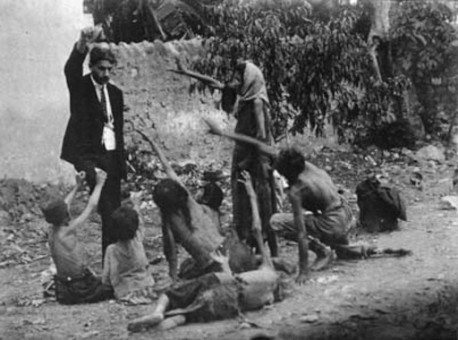
    The documentary begins with the roots of the word Genocide and chronicles the stormy conflicts within Lemkin, who, as Amanpour puts it, was affected by the slaughter of 1.5 million Armenians by Ottoman Turks and was prompted to coin the phrase Genocide. In the almost 90-minute press screener, the Armenian Genocide was mentioned for about 45 seconds as an anecdotal reference to Lemkin’s struggle for human justice. Using photographs now familiar to all Armenians and possibly obtained from Armin T. Wegner Collection, Amanpour illustrates the horror of the Armenian Genocide but does not delve into it in as in-depth and compelling manner as she does the other instances of Genocide.

    Throughout the program, Amanpour “reveals stories of those who tried to stop genocide,” as the CNN press information describes it and discusses the horrific stories of Genocide with “heroes who witnessed evil– and ‘screamed bloody murder’ for the international community to stop it.

    Amanpour and CNN should be applauded for the in-depth look at Genocide, from the Holocaust to the killing fields of Cambodia, to Iraq, Rwanda, Bosnia and now Darfur the horror of it all is told with searing images and graphic eyewitness accounts.

    To bring attention to Genocide, on the eve of the 60th anniversary of the adoption of UN Convention of Genocide and Human Rights, authored by Lemkin, is an important accomplishment, one that also asks the hard question of why the world did (does) not interfere when it has a moral obligation.

    Amanpour adeptly clarifies the political machinations behind the response–or lack thereof–by the US in all instances featured in the report and wonders, at the end, whether others who “scream bloody murder” will be heard. One wonders, however, if Amanpour heard the screams of Henry Morgenthau, the US Ambassador to the Ottoman Empire at the time of the Armenian Genocide, who along with Elie Wiesel, Father Francois Ponchaud, Peter Galbraith, Richard Holbrook, Canadian General Romeo Dallaire and others who bore witness to such unspeakable atrocities and whose warnings prompted action but not soon enough to save millions of lives.

    Perhaps, the Armenian community can now prompt CNN, as it did eight years ago ABC News and its venerable anchor the late Peter Jennings to take a closer look at the first Genocide of the 20th Century.

    Amanpour’s “Scream Bloody Murder” is an important piece of journalism as it asks the very critical questions that could have prevented so many acts of Genocide. In its reporting, Amanpour is also very adept at pointing to US complicity in all these events, much like Samantha Power was in her Pulitzer Prize-winning book “A Problem from Hell: America and the Age of Genocide.”

    “Scream Bloody Murder” anchored by CNN Chief International Correspondent Christiane Amanpour airs on CNN Thursday at 9 p.m. Eastern/Pacific, with an encore at midnight Eastern and Pacific.

    *****

    TAKE ACTION:

    1) Post your question on CNN iReport

    Ask Christiane Amanpour a question about this serious shortcoming in her documentary through CNN iReport, an interactive feature that allows you to post video and text viewable by the millions of visitors to CNN’s website. Your posting will also be searchable on Google News.
    View an effective CNN iReport posting commenting on “Scream Bloody Murder”.

    2) Write directly to CNN’s editors

    Send a free ANCA WebFax to CNN’s leadership pointing out this shortcoming and asking them to address this gap in their reporting in future coverage of genocide-related issues.

  • Karabakh Peace Proposals ‘Altered’

    Karabakh Peace Proposals ‘Altered’

    By Emil Danielyan

    The United States, Russia and France have made changes in their proposed basic principles of a Nagorno-Karabakh settlement in hopes of facilitating their acceptance by Armenia and Azerbaijan, Azerbaijani Foreign Minister Elmar Mammadyarov said on Friday.

    The so-called Madrid principles were formally put forward by the mediators in November 2007 and are still being discussed by the conflicting parties.

    “In order to achieve a new phase of the settlement, the foreign ministers of the countries co-chairing the OSCE’s Minsk Group have presented the parties to the Nagorno-Karabakh conflict with certain changes in the Madrid proposals,” Mammadyarov said, according to the Day.az news service. He did not specify those changes.

    The Armenian Foreign Ministry could not be immediately reached for comment on this.

    Mammadyarov spoke to journalists in Helsinki where he was attending an annual high-level meeting of the OSCE along with his Armenian counterpart, Eduard Nalbandian. The two men held talks there on Wednesday and had a brief conversation with Foreign Ministers Sergei Lavrov of Russia and Bernard Kouchner of France as well as U.S. Assistant Secretary of State Daniel Fried the next day.

    In an ensuing joint declaration, Lavrov, Kouchner and Fried urged the parties to “finalize the Basic Principles in coming months.” The mediating powers hope that the presidents of Armenia and Azerbaijan will meet again soon to iron out their remaining differences on the framework peace accord. Matthew Bryza, Fried’s deputy and the Minsk Group’s U.S. co-chair, expressed hope on Thursday that the meeting will take place “in a couple of weeks.”

    Mammadyarov said, however, that Presidents Ilham Aliev and Serzh Sarkisian will hold the next round of their face-to-face talks only “next year.” Aliev and Sarkisian pledged to intensify the search for a mutually acceptable compromise in a declaration which they signed with Russia’s President Dmitry Medvedev after talks outside Moscow on November 2.

    In a speech at the OSCE meeting on Friday, Nalbandian accused Azerbaijan of “misinterpreting” key provisions of the declaration. He pointed to Aliev’s recent remark that the declaration’s reference to a “political settlement” of the Karabakh conflict does not commit Azerbaijan to non-use of force.

    https://www.azatutyun.am/a/1598737.html

  • Principles of Azerbaijan on Nagorno Karabakh conflict

    Principles of Azerbaijan on Nagorno Karabakh conflict


    Helsinki. Tamara Grigoryeva-APA. Delegation of Azerbaijan attending the meeting of the OSCE Ministerial Council in Helsinki has issued written statement reflecting Azerbaijan’s Principles applicable to the peaceful settlement of the conflict in and around the
    Nagorno-Karabakh region of the Republic of Azerbaijan.

    APA correspondent in Helsinki reports that the document reads Azerbaijan is committed to solving the conflict by political means and in a constructive
    manner. But Azerbaijan will never compromise its territorial integrity and thus accept a fait-accompli based solution, which the Armenian side is trying to impose.
    The conflict can only be solved on the basis of respect for the territorial integrity and
    inviolability of the internationally-recognized borders of Azerbaijan, and peaceful coexistence of Armenian and Azerbaijani communities in the Nagorno-Karabakh region within Azerbaijan, fully and equally enjoying the benefits of democracy and prosperity.
    The ultimate objective of the settlement process is to elaborate and define the model and legal frameworks of the status of the Nagorno-Karabakh region within Azerbaijan. The process of definition of any status shall take place in normal peaceful conditions with direct, full and equal participation of the entire population of the region, namely, the Armenian and Azerbaijani communities, and in their constructive interaction with the Government of Azerbaijan exclusively in the framework of a lawful and democratic process. Attempts to define the status of the Nagorno-Karabakh region in a situation of continued occupation of the region and surrounding territories, and forced displacement of Azerbaijani population are incompatible with universal and European values and contradict the principles and ideas of peace, democracy, stability and regional cooperation. Such attempts seek to legitimize the results of ethnic cleansing and impose a fait accompli situation on Azerbaijan.
    A number of important steps have to be taken to reach a stage where the parties concerned can start negotiating a self-rule status for the Nagorno-Karabakh region within Azerbaijan:

    • The factor of military occupation must be removed from the conflict settlement context.
    Armenia has to withdraw completely from all occupied territories of Azerbaijan. Delay
    of return of the territories can complicate the already difficult settlement process.
    • IDPs should return in safety and dignity to their places of origin in the Nagorno-
    Karabakh region and adjacent territories.
    • Special programs on reconciliation and tolerance should be initiated with a view to
    foster cooperation between the two communities in the Nagorno-Karabakh region.
    • All communications in the region shall be opened for mutual use.
    • Upon release of the territories of Azerbaijan from the occupation the rehabilitation and economic development of the region shall take place.

  • Dashnaks Urge Caution In Armenia’s Ties With Turkey

    Dashnaks Urge Caution In Armenia’s Ties With Turkey

    By Emil Danielyan

    The Armenian Revolutionary Federation (Dashnaktsutyun) has urged Yerevan to exercise caution in the ongoing rapprochement with Turkey, saying that Ankara is using it to scuttle worldwide recognition of the Armenian genocide.

    The issue was on the agenda of a three-day meeting of the pan-Armenian party’s top governing body, the Bureau, that finished its work in Beirut on Monday.

    In a statement circulated on Thursday, Dashnaktsutyun said Bureau members agreed that “Turkey has still not taken any positive step” to reciprocate President Serzh Sarkisian’s diplomatic overtures. “On the contrary, there are attempts to use the existing [Turkish-Armenian] contacts for halting the genocide recognition process and making relations between the two states conditional Armenia’s relations with a third country, Azerbaijan,” it said.

    Some Dashnaktsutyun leaders warned earlier that the incoming U.S. administration will have second thoughts about its pledge to recognize the genocide if Yerevan agrees to a Turkish-Armenian academic study of the mass killings of Armenians in the Ottoman Empire which is sought by Ankara. Sarkisian has indicated that he is not against the idea in principle.

    The Dashnaktsutyun statement said that Armenia’s “supreme leadership” views genocide recognition by the international community and Turkey as a top foreign policy priority. But in a thinly veiled warning to Sarkisian, the party represented in Armenia’s government added: “On the other hand, it was stressed [during the Bureau meeting] that the immediate importance of normalizing Armenia-Turkey relations must not take precedence over the rights of generations.”

    Meanwhile, a senior U.S. official reportedly said on Thursday the two neighboring states have come close to establishing diplomatic relations after months of intensive diplomatic contacts. The Mediamax news agency quoted Deputy Assistant Secretary of States Matthew Bryza as making this assertion after a fresh meeting of the Turkish and Armenian foreign ministers held on the sidelines of a high-level OSCE meeting in Helsinki. The two ministers already met in Istanbul late last month.

    Turkey has long made the establishment of diplomatic relations and opening of its border with Armenia contingent on a resolution of the Nagorno-Karabakh conflict and an end to the Armenian campaign for genocide recognition. Despite the dramatic thaw in Turkish-Armenian ties, Ankara has so far given no indication, at least in public, that it is ready to drop these preconditions.

    https://www.azatutyun.am/a/1598716.html

  • Mediators Renew Calls For Karabakh Peace

    Mediators Renew Calls For Karabakh Peace

    By Emil Danielyan and Anush Martirosian

    The United States, Russia and France urged Armenia and Azerbaijan on Thursday to build on reported progress in recent talks between their president and reach a framework agreement on Nagorno-Karabakh in the “coming months.”

    High-ranking diplomats from the three nations jointly spearheading the drawn-out peace process reaffirmed the basic principles of a Karabakh settlement that were formally submitted to the conflicting parties in Madrid last year.

    “We call on the parties to work with the Co-Chairs [of the OSCE Minsk Group] to finalize the Basic Principles in coming months, and then begin drafting a comprehensive peace settlement as outlined by those agreed principles,” Foreign Ministers Sergei Lavrov of Russia and Bernard Kouchner of France and U.S. Assistant Secretary of State Daniel Fried said in a joint declaration.

    The declaration was issued after the three men met with the Armenian and Azerbaijani foreign ministers on the sidelines of an OSCE ministerial meeting in Helsinki. A spokesman for Foreign Minister Eduard Nalbandian told RFE/RL that the meeting lasted for about 15 minutes but gave no further details.

    Nalbandian and his Azerbaijani counterpart, Elmar Mammadyarov, held much lengthier talks in the Finnish capital on Wednesday in the presence of other American, French and Russian diplomats co-chairing the Minsk Group. A statement by the Armenian Foreign Ministry said they agreed to maintain the “positive atmosphere” created by the Armenian and Azerbaijani presidents at their November 2 talks outside Moscow. In a joint statement with Russian President Dmitry Medvedev, Serzh Sarkisian and Ilham Aliev pledged to “intensify” the peace process.

    Lavrov, Kouchner and Fried likewise emphasized the “positive momentum” which they said was established by the two presidents. “The Moscow Declaration signed that same day opened a new and promising phase in our shared endeavor to expand peace in the South Caucasus,” they said.

    The Helsinki statement called on the conflicting parties to bolster the ceasefire regime along the Line of Contact east of Karabakh and the Armenian-Azerbaijani frontier by pulling back snipers from their frontline positions. “We reiterate our firm view that there is no military solution to the conflict and call on the parties to recommit to a peaceful resolution,” it said.

    The declaration said nothing about the next meeting of Aliev and Sarkisian which the mediators say could prove decisive for the signing of an Armenian-Azerbaijani peace accord. Matthew Bryza, Washington’s chief Karabakh negotiator, said last month the holding of yet another Armenian-Azerbaijani summit hinges on the outcome of the Helsinki talks.

    Speaking to an RFE/RL correspondent in Helsinki on Thursday, Bryza expressed hope that Aliev and Sarkisian will meet again “in a couple of weeks” and insisted that the peace process is “moving forward.” “We need to see the basic principles finalized, and we believe they can be soon,” he said. “And we also want to see serious confidence-building measures and finally make sure everybody realizes there is only a peaceful settlement to this conflict. You cannot solve this conflict through a military way.”

    In Yerevan, meanwhile, a former military leader of Karabakh, Samvel Babayan, predicted that the Armenian-Azerbaijani dispute will remain unresolved in the next five years. He also criticized the Armenian government’s Karabakh policy.

    “Even though our foe hasn’t accepted any compromise variants, we are saying that are ready to compromise,” Babayan told journalists. “Nobody knows what are giving up and why.”

    The once influential general also accused Yerevan of helping to effectively drive the Karabakh Armenians out of the negotiating process. “Yerevan should not have become a negotiating party,” he said. “Stepanakert should have.”

    Arkady Ter-Tadevosian, another retired army general who played a major part in the 1991-1994 war with Azerbaijan, was also skeptical about chances of Karabakh peace. He claimed that oil-rich Azerbaijan is making “intensive preparations for hostilities.”

    (Armenian Foreign Ministry photo: Lavrov reads out the declaration to journalists.)

    https://www.azatutyun.am/a/1598714.html

  • General Rashid Dostum is in Turkey

    General Rashid Dostum is in Turkey

    Ankara – APA. Turkish Foreign Ministry confirmed that leader of Afghanistan’s Uzbek community, General Rashid Dostum is in Turkey, APA reports quoting Turkish media. Spokesman for Turkish Foreign Ministry Burak Ozugergin told journalists the reports that Dostum was in Turkey were true. Asked whether General had been illegally sent into exile by afghan government, the spokesman said no criminal case had been launched on Dostum in Afghanistan and he was not in house arrest in Turkey. Ozugergin said Dostum was together with his family living in Turkey.
    “General Dostum is the leader of Turkic community in Afghanistan. It is normal for him to hold meetings in Turkey,” he said.
    Enver Sedat, representative of the political party led by Rashid Dostum told Anadolu Agency that General had left for Ankara at the invitation of Turkish Foreign Ministry to celebrate Gurban holiday together with his family and would return after the holiday.