Year: 2010

  • Journey of Mankind

    Journey of Mankind

    In all our cells we have genes. Genes are made up of DNA, the string-like code of life that determines what we are, from our fingernails to our innate potential for playing the piano. By analysing genes, we can trace the geographic route taken by our ancestors back to an ultimate birthplace in Africa, at the dawn of our species. Further, if we take any two individuals and compare their genes, we will find that they share a more recent ancestor – living, in all probability, outside Africa. What is more, I believe that we can now prove where those ancestors lived and when they left their homelands. This remarkable proof has become fully possible only within the last decade, as a result of pioneering work by a number of people.

    Click here to play the Journey of Mankind

    * The interactive genetic map is currently being upgraded and will be available online shortly.

  • Turkish parliamentarians calls for suing Khojaly crime at international court

    Turkish parliamentarians calls for suing Khojaly crime at international court

    [ 25 Feb 2010 15:56 ]

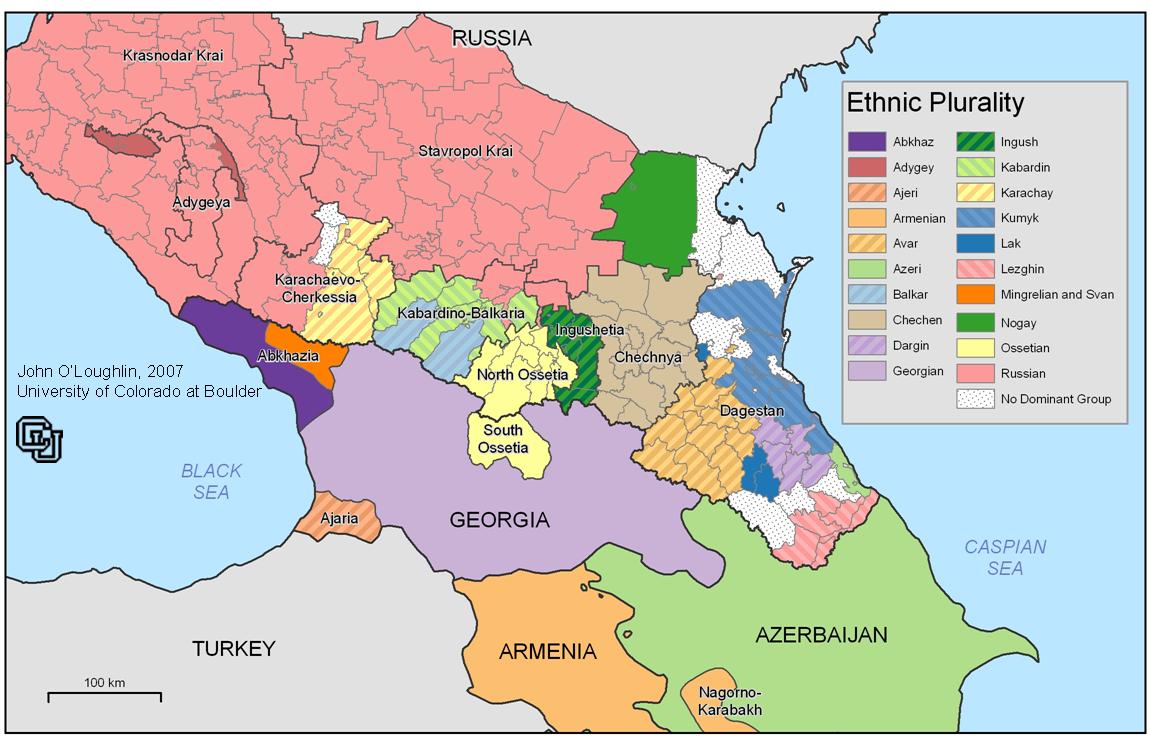
    Baku – APA. On February 25, Turkish parliament addressed the issue related to anniversary of Khojaly tragedy in Azerbaijan.

    According to APA, Turkish parliamentarians took the floor and expressed opinion of their parties about the frightful massacre committed in the occupied Nagorno Karabakh region of Azerbaijan by Armenian invaders and their supporters – Russian militaries 18 years ago. The parliamentarians cursed the Khojaly massacre as a crime against humanity and expressed their solidarity with Azerbaijan.

    Chairman of Azerbaijan-Turkish inter-parliamentary friendship group, member of ruling Justice and Development Party (AKP) Mustafa Kabakci said Armenia, which accused Turkey in genocide, itself committed genocide in the near past – in 1992. “Armenians supported by the Russian 366th infantry regiment closed entrance and exits of Khojaly town of Azerbaijan and killed 613 of our brothers and sisters. We were together with Azerbaijan yesterday and we are together today”.

    Atilla Kaya spoken on behalf of Nationalist Movement Party (MHP) said he took the floor to remember and remind about the Khojaly tragedy, one of the massacres of 20th century committed by Armenians. “Khojaly tragedy was a crime against our nation in Nagorno Karabakh. This massacre was committed with the support of Russians. Khojaly was a town with 11 000 population, but part of the people left the town. Those who didn’t leave faced with an attack of Armenians and Russians on February 26, 1992. 613 were killed, 1200 – taken hostage and 475 seriously wounded”.

    Kaya focused the attention on the fact that Nagorno Karabakh Armenians were led by incumbent president of Armenia Serzh Sargsyan and former president Robert Kocharian during the Khojaly genocide. “Unfortunately today Serzh Sargsyan visits Turkey and meets with our president. Those who committed war crimes in Bosnia appeared before the international court. Those who committed war crimes in Azerbaijan must also appear before the international court”.

  • U.S. Official ‘Praises’ Armenian Stance On Turkey

    U.S. Official ‘Praises’ Armenian Stance On Turkey

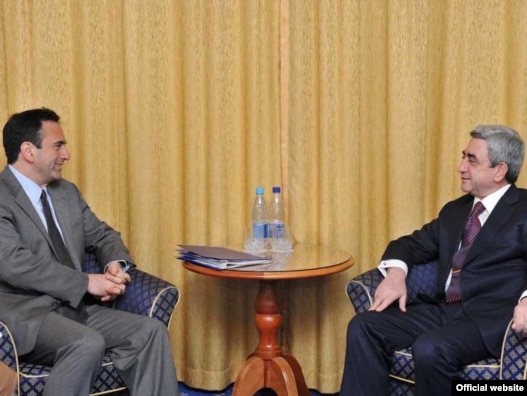
    Armenia — President Serzh Sarkisian (R) meets with U.S. Assistant Secretary of State Philip Gordon in Kiev on February 25, 2010.

    25.02.2010
    Emil Danielyan

    A top U.S. diplomat was reported to praise Armenia’s position in the stalled normalization process with Turkey at a meeting with President Serzh Sarkisian on Thursday.

    Sarkisian and Assistant Secretary of State Philip Gordon met in the Ukrainian capital Kiev after attending the inauguration of Ukraine’s newly elected president, Viktor Yanukovich.

    A statement by Sarkisian’s office said the talks focused on the U.S.-backed efforts to normalize relations between Armenia and Turkey. It said the Armenian leader reaffirmed Yerevan’s commitment to an unconditional implementation of the agreements to that effect which were signed by the two governments in October.

    The statement quoted Gordon as describing this position as “constructive” and saying that the Armenian and Turkish parliaments should ratify the two protocols “without linking them to other existing problems.”

    It was a clear reference to Turkish leaders’ statements making Turkish ratification conditional on a resolution of the Nagorno-Karabakh conflict that would satisfy Azerbaijan. The Armenian government says this “precondition” contradicts the essence of the protocols, which make no reference to the Karabakh dispute.

    Ankara also attributes its reluctance to ratify the protocols to the Armenian Constitutional Court’s recent interpretation of the protocols’ implications which it says ran counter to the letter and spirit of the deal. Gordon, who coordinates U.S. policy on Europe and the former Soviet Union, dismissed the Turkish claims last month.

    U.S. officials have yet to publicly comment on Yerevan’s threats to wake away from the agreements if the Turks continue to drag their feet. Acting on those threats, the Armenian parliament passed on Thursday, in the second and final reading, legal amendments that facilitate such a move.

    Adding a new twist to the normalization process is a decision by a U.S. congressional committee to discuss and possibly vote on March 4 on a resolution describing the 1915 massacres of Armenians in the Ottoman Empire as genocide. A Turkish parliamentary delegation is expected to visit Washington this week to lobby U.S. lawmakers to block it.

    The U.S. State Department opposed similar resolutions drafted by pro-Armenian legislators in the past, citing Turkey’s geopolitical significance for the United States. Department officials have so far pointedly refrained from criticizing the latest genocide bill. Some observers believe Washington will use it to press Ankara to ratify the protocols.

    Turkish Foreign Minister Ahmet Davutoglu clearly alluded to such possibility when he condemned the bill earlier this month. He said the prospect of U.S. recognition of the Armenian genocide will not force his government to soften its stance on protocol ratification.

    Davutoglu insisted this week that the Turkish-Armenian rapprochement has not reached an impasse. “Negotiations and the process are going on,” he said, according to the Regnum news agency.

    https://www.azatutyun.am/a/1968518.html
  • Paying too little for gas? How about $8 a gallon?

    Paying too little for gas? How about $8 a gallon?

    A SURPRISE FROM OBAMA ON THE WAY – STOP THE SURPRISE

    BIGGEST TAX INCREASE IN THE US HISTORY IS AROUND THE CORNER

    “I have been leading the fight against the global warming hoax in the Senate for a decade. Myron Ebell and his team have always been there fighting beside me. Freedom Action is an invaluable ally.”
    –Senator James M. Inhofe (R-Oklahoma)
    Stop $8 Gas—Click Here
    Dear Fellow Patriot,
    Are you paying too little for gas at the pump?
    Are your electric bills way too low?
    President Barack Obama thinks so. The President said that under his global warming plan “electricity rates would necessarily skyrocket.” And he holds up Europe—where gas prices routinely approach $8 a gallon—as the model for U. S. energy policy.
    If you too are outraged by this, read on.
    President Obama, Speaker Nancy Pelosi, Senator Harry Reid, and White House Climate Czar Carol Browner all agree: You are paying far too little for the energy that fuels your cars and keeps the lights on.  And they have BIG plans to change that.
    Our politicians must hear from millions of Americans loud and clear that we aren’t going to let them get away with it.
    We can force them to back down—we’ve already done it by  stopping Cap-and-Trade (which is really Cap-and-TAX). House and Senate Members are rapidly running away from those bills. Why? Because the American people found out how much it was going to cost them, and said NO!
    But that isn’t stopping the zealots in Obama’s  Administration. They are now trying to use backdoor EPA regulations to raise energy costs through the roof. And what is most outrageous, they think they can mount this sneak attack on American consumers without getting Congress to approve it.
    Why are they doing this? They say it’s to stop global warming. What global warming! The top scientist in the Climategate scandal even recently admitted that global temperatures stopped going up in 1995. That’s right—there has been no global warming since 1995!
    Stop $8 Gas—Click Here
    What is really going on here is that Obama’s zealots are using the phony global warming crisis in order to push their big government agenda. Their goal? A HIDDEN TAX INCREASE. But not just any tax increase. The biggest tax increase in history.
    It’s that simple. They want trillions of dollars of our money to pay for more and more government spending. Not just for a few years—but for decades and decades.
    But with all of us working together, we can stop this sneak attack on our own wallets and America’s prosperity.
    Here’s how—
    We are sending this SOS to over one million Americans—and that’s just a start. Just one of us will be ignored. But when millions of Americans speak with one voice, Congress and even President Obama will be forced to listen.
    Click here to sign the Declaration that tells President Obama to back down and demands that Congress take action to stop Obama’s global warming regulations!
    By signing the Declaration, you will be adding your voice to a mighty grassroots movement. Freedom Action is a grassroots web-based group, dedicated to more freedom and less government. Our motto is what Margaret Thatcher said about President Reagan, “He put freedom on the offensive.” At Freedom Action, we’re doing just that.
    So let me invite you to sign the declaration to tell your elected leaders that you won’t stand for $8 gas and “skyrocketing” electric bills.
    Stop $8 Gas—Click Here
    Thanks for all you do to keep America strong!
    Yours for freedom,
    Myron Ebell
    Director, Freedom Action
    (By way of background, I’ve been engaged in grassroots activism and public policy since volunteering for the Reagan campaign in the 1980s. In 2009, Business Insider stated, “Myron Ebell may be enemy #1 to the current climate change community.” I’m trying hard to live up to that!)
    P. S. Once you’ve signed the Declaration, please forward this email to your friends. You can tell them that it only takes a couple minutes to take action on the biggest threat we face to our personal freedom and prosperity.

  • Turkey’s Gul seeks to calm military ‘coup plot’ fears

    Turkey’s Gul seeks to calm military ‘coup plot’ fears

    Prime Minister Recep Tayyip Erdogan (left), President Abdullah Gul and Gen Ilker Basbug meet in Ankara, February 25 2010

    Thursday’s meeting was called amid escalating tension between the government and the military

    Turkey’s president has said tensions over an alleged military coup plot will be resolved within the law, after meeting the head of the armed forces.

    President Abdullah Gul made the statement after a summit with Prime Minister Recep Tayyip Erdogan and armed forces chief Gen Ilker Basbug.

    Tension between the government and the military has risen following a round of arrests over the alleged plot.

    Twenty military officers were charged this week in connection with the case.

    They were among more than 40 officers arrested on Monday.

    HOW ‘COUP PLOTS’ EMERGED
    June 2007: Cache of explosives discovered; ex-soldiers detained
    July 2008: 20 arrested, including two ex-generals and a senior journalist, for “planning political disturbances and trying to organise a coup”
    July 2008: Governing AK Party narrowly escapes court ban
    October 2008: 86 go on trial charged with “Ergenekon” coup plot
    July 2009: 56 in dock as second trial opens
    Jan 2010: Taraf newspaper reports 2003 “sledgehammer” plot to provoke coup
    Feb 2010: More than 40 officers arrested over “sledgehammer”; 20 charged

    Turkey’s religious-secular divide

    Turkish military faces crossroads

    The retired head of the air force Ibrahim Firtina and former navy chief Ozden Ornek were in court on Thursday morning for questioning and could still be charged.

    After several hours of talks on Thursday, Mr Gul sought to reassure the country.

    “It was stressed that citizens can be sure that the problems on the agenda will be solved within the framework of the constitution and our laws,” a statement from his office said.

    Mr Erdogan was quoted by local media as saying Thursday’s meeting had gone “very well”.

    The military has denied any coup plot and has held its own officers’ summit to discuss the “serious situation” in the wake of the latest arrests.

    Unprecedented operation

    The BBC’s Jonathan Head in Istanbul says the Turkish government is embroiled in the greatest test yet of its authority over the armed forces.

    Turkey’s military has overthrown or forced the resignation of four governments since 1960 – most recently in 1997 – though Gen Basbug has insisted that coups are a thing of the past.

    The scale of Monday’s operation against the military was unprecedented. Those arrested include two serving admirals, three retired admirals and three retired generals.

    Former Air Force Commander Gen Ibrahim Firtina arriving at court in Istanbul, 25 Feburary 2010

    Ex-Air Force head Gen Ibrahim Firtina was among those being questioned

    A number of them are being kept in jail while 12 have reportedly been freed.

    Dozens of current or former members of the military have been arrested in the past few years over similar plot allegations, and some have been charged.

    The latest men to be charged were arrested over the so-called “sledgehammer” plot, which reportedly dates back to 2003.

    Reports of the alleged plot first surfaced in the liberal Taraf newspaper, which said it had discovered documents detailing plans to bomb two Istanbul mosques and provoke Greece into shooting down a Turkish plane over the Aegean Sea.

    The army has said the scenarios were discussed but only as part of a planning exercise at a military seminar.

    The alleged plot is similar, and possibly linked, to the reported Ergenekon conspiracy, in which military figures and staunch secularists allegedly planned to foment unrest, leading to a coup.

    Scores of people, including military officers, journalists and academics, are on trial in connection with that case.

    ‘Painful transformation’

    Analysts say the crackdown on the military would have been unthinkable only a few years ago.

    The army has regarded itself as the guardian of a secular Turkish state, but its power has been eroded in recent years, with Turkey enacting reforms designed to prepare it for entry to the European Union.

    Many Turks regard the cases as the latest stage in an ongoing power struggle between Turkey’s secular nationalist establishment and the governing AK Party.

    Critics believe the Ergenekon and sledgehammer investigations are simply attempts to silence the government’s political and military opponents.

    The AK Party has its roots in political Islam, and is accused by some nationalists of having secret plans to turn staunchly secular Turkey into an Islamic state.

    The government rejects those claims, saying its intention is to modernise Turkey and move it closer to EU membership.

    “Transformations may sometimes be painful,” Economy Minister Ali Babacan said Wednesday.

    “We are trying to make Turkey’s democracy first class.”


    What is your reaction to the crackdown on the military? post your views on the current crisis using the form below.

  • Deciphering Denial: State, Modernity, and the 1915 Armenian Ethnic Cleansing”

    Deciphering Denial: State, Modernity, and the 1915 Armenian Ethnic Cleansing”

    Talk at Columbia University, International Affairs Building, Tuesday, 22 February 2010

    “Deciphering Denial: State, Modernity, and the 1915 Armenian Ethnic Cleansing”

    Yuksel Oktay [[email protected]]

    ========================================================================

    program
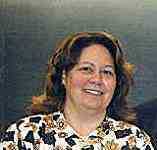
    FATMA MUGE GOCEK

    Penn Middle East Center Hosts Talk on Deciphering Turkish Denial: Modernity, Violence and 1915 Contextualized
    April 20, 2009

    WHO: Fatma Muge Gocek, associate professor of sociology, University of
    Michigan

    WHAT: Talk about Turkey and Armenians

    WHERE: 208 Williams Hall, 255 S. 36th St.

    WHEN: Thursday April 23, 6 p.m.

    Dr. Gocek has worked extensively in the fields of comparative historical sociology, social change and social theory. The talk will address similar topics to those in her forthcoming book, “Deciphering Denial: Turkish State and the Armenian Ethnic Cleansing of 1915.”By Fatma Muge Gocek (1), Discussions by Elazar Barkan (2) and Moderator, Mucahit Bilici (3)

    Organized by “Center for the Study of Democracy, Toleration, and Religion”

    Co-sponsored by Institute for Social and Economic Research and Policy (ISERP) and Institute for Religion, Culture, and Public Life (IRCPL), all affiliated with Columbia University, founded in 1756

    \=====================================================

    The talk, the first in a series of lectures on Politics and Religion for the students and public, was attended  by around 50 participants who sat around a long table in a small room, perhaps 10 Professors and academicians and the rest students (4). Mucahit Bilici opened the talk at 4:00 PM and introduced the speakers.

    Fatma Gocek  first stated that she has been working on the subject project for ten years and, although the title refers to Armenian Ethnic Cleansing, it contains all the elements of continued violence and denials. She reminded that the same terminology was used by the Young Turks and did not mention the word “genocide” during her talk. She claimed that “even though the collective violence committed against the Armenians in 1915 has been recognized by the international scholarly community, the Turkish state and society still deny its main parameters.” She further claimed that the collective violence against the non-muslim minorities and its subsequent denial was a multi-layered phenomenon, commenced with the modernity movements that was started by Sultan Selim III in 1789. She clamed that the collective violence is still going, especially against the Kurds and the Christian minorties.

    Gocek’s main thesis was, unless Turkey and Turkish people recognize the ethnic cleansing, the Armenians can not achieve healing, even if the world recognizes and provides support to them. Her argument included that Turkey can not achieve democracy unless recognition takes place. She also stated that lack of acknowledgement by the Turkish side keeps Armenians locked but healing needs to happen. She kept referring to the “humanity at large” which, she said needs to be enlightened in order to gain the trust of the people.

    Gocek presented her analysis under 4 phases, referring to it as “Phases of Turkish Modernity, Violence and Denial”, identifying each phase as indicated below:

    1789 – 1907 ,  Military, talked about Sultan Abdulhamid who was busy giving medals to Armenians

    1908 – 1918 , Political, Young Turks taking over and starting ethnic cleansing of the Armenians

    1919 – 1974, Educational, referred to the assassination of Mehmet Baydar and Bahadir Demir in Los Angeles on 27 Jan 1973 and stated that when the Turkish government was asked to provide documents at the trial, they had nothing to present. After that, Turkish government commissioned retired ambassadors to write stories about the Armenian issue? She further stated that the government also issued documents that could be interpreted in any way that people wanted and were contested, at the same time, taking away documents from the archives that would not support their views.

    1975 – 2009, Economics

    Following this elaborate analysis, Gocek presented information on “violence against the Armenians” under 5 phases, which she claimed began with modernization in the Ottoman society, also creating polarization, which led to violence to rationalizing events and finally denial.

    1894 – 96, Rebellions

    1915-1917, Ethnic Cleansing

    1941, Forced military service

    1942, Wealth Tax

    2007, Assasination of Hrant Dink

    Gocek explained that she analyzed the historical course of the Ottoman-Turkish modernity and violence under several categories, such as 1) Theoretical (Zygmunt Bauman, Hannah Arendt examples), 2) Historical, 3) Empirical, etc., and developments in wars, technological dealings, diplomacy and education. She never mentioned the fact that there were over 435 American missionary schools plus that many European schools that educated the Armenians with nationalistic views. She kept repeating impact of modernity and connection to violence and identification of sites of memory, contemporary and oral history, Turkish publications and minority lectures.

    Gocek ended her talk, stating, “Hopefully, I convinced you.” I left as Elazar Barkan started his commentary, I could not stay due to other commitments. However, I had interesting conversations before the talk started. I arrived at Room 801 where the talk was to take place and had a chance to meet some of the early comers. One was Armin Marsimian, a Professor of Philosophy at the State University of Connecticut. He told me that his grandparents were from Sivas and Merzifon and showed me photographs of his grandparents and the house that they lived in an i-pod. We talked about the American colleges in Turkey, including the Anatolia College that he said was transferred to Selanik. Then I had conversation with Harvey Neuman, a trauma expert who said that he works with Ann Kalayjian who teaches at Fordam University. Mucahit Bilici told me that he was from Diyarbakir, not Turkish, not Armenian, but a Kurd, teaching at John Jay School of Columbia University.

    This was a talk, just a talk but with influence on the students who probably does not know the other side of the story, monitored by a Kurd, presenteded by a Turk and commented on by an Armenian, almost totally one sided presentation with some acknowledgement of Turks and Kurds having been killed by the Armenians, but not much on the revolts that led to the relocation, which Gocek kept referring to as deportations. It is interesting that I was the only Turkish-American at the talk, unless I missed any that might have attended.

    Notes:

    1)  Fatma Muge Gocek is Assoc. Professor of Sociology, University of Michigan, Ann Arbor (TallArmenianTale web site has the real story about who she is.)

    2) Elazar Barkan is Professor of International and Public Affairs, Columbia University

    3)  Mustafa Bilici teaches at John Jay School of Columbia University

    4)  Miss Melisa form ISERP stated that the next lecture was scheduled for April 22, 2010 at the same location and representatives from TESEV (Turkey) would be presenting a talk. Anyone interested can write to [email protected] . Web page, www.iserp.columbia.edu

    Yuksel Oktay

    Washington, NJ