Month: March 2010

  • Armenia Rejects Turkish Warnings To U.S. Congress

    Armenia Rejects Turkish Warnings To U.S. Congress

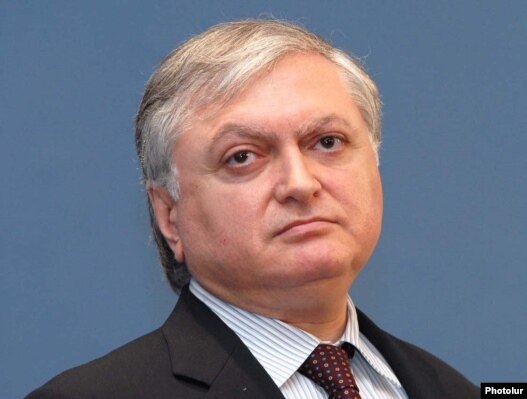
    Armenia — Foreign Minister Edward Nalbandian at a news conference on March 2, 2010.

    02.03.2010
    Emil Danielyan

    Official Yerevan dismissed on Tuesday Turkish warnings that a U.S. congressional resolution describing the 1915 massacres of Armenians in the Ottoman Empire as genocide would set back the normalization of Turkish-Armenian relations. (UPDATED)

    It also emerged that a group of mostly pro-government Armenian parliamentarians is heading to Washington in an apparent effort to facilitate the passage of the resolution introduced by pro-Armenian U.S. legislators a year ago.

    The Foreign Affairs Committee of the U.S. House of Representatives is scheduled to discuss and vote on the proposed legislation on Thursday. It urges President Barack Obama to “accurately characterize the systematic and deliberate annihilation of 1,500,000 Armenians as genocide.”

    The Turkish Foreign Ministry warned on Monday that its approval by the House committee would harm not only U.S.-Turkish relations but also efforts by Turkey and Armenia to normalize bilateral ties. “We would like to believe that the members of the committee are aware of the damage… the endorsement of the resolution will bring and, in this context, act responsibly,” the ministry said in a statement.

    Turkish Prime Minister Recep Tayyip Erdogan reportedly issued a similar warning over the weekend. He said passage of the genocide resolution to would bring the U.S.-backed Turkish-Armenian reconciliation process to a halt.

    Armenian Foreign Minister Edward Nalbandian brushed aside the warning, saying that the biggest threat to that process emanates from Ankara’s “preconditions” for the implementation of the Turkish-Armenian normalization agreements which were set by Ankara months before the House panel scheduled a debate on the resolution.

    “It is statements made in Turkey and the return to the language of preconditions that deal a blow to the process of normalizing Turkish-Armenian relations,” Nalbandian told a news conference. “We hope that Turkey will rid itself of artificial complexes created by the Turkish side and that we will be able to move forward in accordance with our understandings.”

    Nalbandian stopped short of explicitly urging U.S. lawmakers to recognize what many historians consider the first genocide of the 20th century. But in a sign of Yerevan’s tacit support for the resolution, four members of Armenia’s parliament will fly to Washington on Wednesday at the invitation of Frank Pallone and Mark Kirk, the two U.S. lawmakers co-chairing the congressional Caucus on Armenian Issues. The bipartisan group, currently numbering 150 House members, has long been pushing for Armenian genocide recognition.

    An official in the National Assembly told RFE/RL’s Armenian service that Pallone and Kirk asked their Armenian colleagues to “present their views on and approaches to issues of mutual interest” to U.S. legislators and foreign policy-makers. The genocide resolution will be the main focus of their meetings in Washington, said the official.

    A similar delegation of Turkish parliamentarians is already in Washington, meeting with U.S. officials and lobbying against the resolution. “My impression is that the (Obama) administration is not fighting against it very effectively,” one of them, Sukru Elekdag, said on Monday, according to Reuters.

    Obama has so far declined to openly endorse or, as past U.S. administrations did, oppose the measure. The Associated Press cited aides to senior Democratic and Republican lawmakers on the House Foreign Affairs Committee as saying last week there has been no pressure against the resolution from the White House yet. According to a spokesman for the pro-Armenian committee chairman, Howard Berman, the Obama administration was informed about Thursday’s vote ahead of time.

    Obama repeatedly pledged to recognize the Armenian genocide when he ran for president, earning the overwhelming backing of the Armenian Americans. However, he has refrained from using the word “genocide” since taking office, implicitly citing the need not to undermine the Turkish-Armenian rapprochement.

    “His view of that history has not changed,” US National Security Council spokesman Mike Hammer said last week. “Our interest remains the achievement of a full, frank, and just acknowledgement of the facts.”

    “The best way to advance that goal is for the Armenian and Turkish people to address the facts of the past as a part of their ongoing efforts to normalize relations,” said Hammer. “We will continue to support these efforts vigorously in the months ahead.”

    Some observers have speculated that Washington is using the prospect of U.S. recognition of the genocide to try to get the Turks to ratify the two Turkish-Armenian protocols signed in October. The Turkish ambassador to the United States, Namik Tan, seemed to give weight to this view on Saturday.

    “The greatest lobbyist in Washington is the administration,” Tan said, according to the Associated Press. “We have not seen them around enough on this.”

    Still, Erdogan expressed confidence on Tuesday that Obama will display “common sense” on the matter. Speaking before parliament deputies from his Justice and Development Party, he said he conveyed the Turkish concerns to U.S. Secretary of State Hillary Clinton at their recent talks in Qatar.

    “I separately discussed with her what would be the cost of an adverse result from that,” “Hurriyet Daily News” quoted the Turkish premier as saying. “I am calling on everyone once more to act with common sense. I’d like to say it would be more accurate to research genocide claims not at the House of Representatives but at universities and archives.”

    https://www.azatutyun.am/a/1972355.html
  • Crisis in Turkey

    Crisis in Turkey

    by Daniel Pipes
    National Review Online
    March 2, 2010

    The arrest and indictment of top military figures in Turkey last week precipitated potentially the most severe crisis since Atatürk founded the republic in 1923. The weeks ahead will probably indicate whether the country continues its slide toward Islamism or reverts to its traditional secularism. The denouement has major implications for Muslims everywhere.

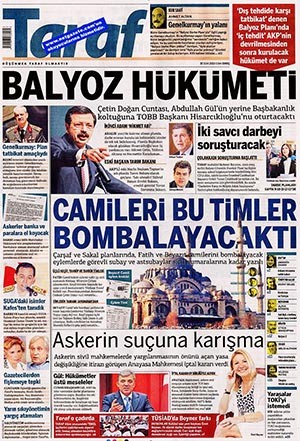
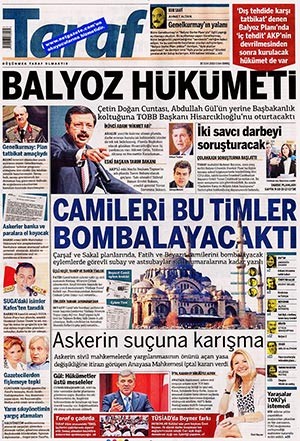
    “Taraf” broke the Balyoz conspiracy theory on Jan. 22, 2010.

    Turkey’s military has long been both the state’s most trusted institution and the guarantor of Atatürk’s legacy, especially his laicism. Devotion to the founder is not some dry abstraction but a very real and central part of a Turkish officer’s life; as journalist Mehmet Ali Birand has documented, cadet-officers hardly go an hour without hearing Atatürk’s name invoked.

    On four occasions between 1960 and 1997, the military intervened to repair a political process gone awry. On the last of these occasions, it forced the Islamist government of Necmettin Erbakan out of power. Chastened by this experience, some of Erbakan’s staff re-organized themselves as the more cautious Justice and Development Party (AKP). In Turkey’s decisive election of 2002, they surged ahead of discredited and fragmented centrist parties with a plurality of 34 percent of the popular vote.

    Parliamentary rules then transformed that plurality into a 66 percent supermajority of assembly seats and a rare case of single-party rule. Not only did the AKP skillfully take advantage of its opportunity to lay the foundations of an Islamic order but no other party or leader emerged to challenge it. As a result, the AKP increased its portion of the vote in the 2007 elections to a resounding 47 percent, with control over 62 percent of parliamentary seats.

    Repeated AKP electoral successes encouraged it to drop its earlier caution and to hasten moving the country toward its dream of an Islamic Republic of Turkey. The party placed partisans in the presidency and the judiciary while seizing increased control of the educational, business, media, and other leading institutions. It even challenged the secularists’ hold over what Turks call the “deep state” – the non-elected institutions of the intelligence agencies, security services, and the judiciary. Only the military, ultimate arbiter of the country’s direction, remained beyond AKP control.

    Several factors then prompted the AKP to confront the military: European Union accession demands for civilian control over the military; a 2008 court case that came close to shutting down the AKP; and the growing assertiveness of its Islamist ally, the Fethullah Gülen Movement. An erosion in AKP popularity (from 47 percent in 2007 to 29 percent now) added a sense of urgency to this confrontation, for it points to the end of one-party AKP rule in the next elections.

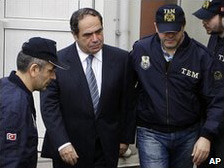
    Gen. Ibrahim Firtina, a former head of the air force, was questioned in court about a plot to overthrow the government.

    The AKP devised an elaborate conspiracy theory in 2007, dubbed Ergenekon, to arrest about two hundred AKP critics, including military officers, under accusation of plotting to overthrow the elected government. The military responded passively, so the AKP raised the stakes on Jan. 22 by concocting a second conspiracy theory, this one termed Balyoz (“Sledgehammer”) and exclusively directed against the military.

    The military denied any illegal activities and the chief of general staff, İlker Başbuğ, warned that “Our patience has a limit.” Nonetheless, the government proceeded, starting on Feb. 22, to arrest 67 active and retired military officers, including former heads of the air force and navy. So far, 35 officers have been indicted.

    Thus has the AKP thrown down the gauntlet, leaving the military leadership basically with two unattractive options: (1) continue selectively to acquiesce to the AKP and hope that fair elections by 2011 will terminate and reverse this process; or (2) stage a coup d’état, risking voter backlash and increased Islamist electoral strength.

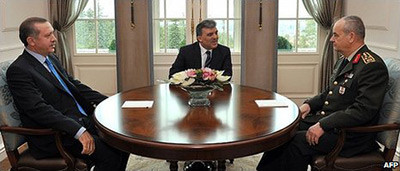
    Prime Minister Recep Tayyip Erdoğan, President Abdullah Gul and Armed Forces Chief of Staff Gen. İlker Başbuğ met on February 25.

    At stake is whether the Ergenekon/Balyoz offensives will succeed in transforming the military from an Atatürkist to a Gülenist institution; or whether the AKP’s blatant deceit and over-reaching will spur secularists to find their voice and their confidence. Ultimately the issue concerns whether Shari’a (Islamic law) rules Turkey or the country returns to secularism.

    Turkey’s Islamic importance suggests that the outcome of this crisis has consequences for Muslims everywhere. AKP domination of the military means Islamists control the umma‘s most powerful secular institution, proving that, for the moment, they are unstoppable. But if the military retains its independence, Atatürk’s vision will remain alive in Turkey and offer Muslims worldwide an alternative to the Islamist juggernaut.

    https://www.danielpipes.org/8009/crisis-in-turkey

  • International Women’s Day Conference

    International Women’s Day Conference

    You are cordially invited to attend to

    International Women’s Day Conference

    on

    “EQUAL RIGHTS, EQUAL OPPORTUNITIES:

    PROGRESS FOR ALL”

    Guest speaker

    PROF YAKIN ERTÜRK

    Sunday, 7 March 2010, 3 pm for 3.45pm*

    (*Refreshments will be available from 3 pm, Conference will begin at 4.00 pm)

    Princess Alexandra Hall,

    Royal Over-Seas League,

    Over-Seas House, Park Place, St James’s Street, London SW1A 1LR

    All friends, ladies and gentlemen are invited.

    Entry fee: £5

    Pre-registration required.

    Please register by 5th March 2010 at [email protected] or telephone

    07788 908 803 – 07956 810 882

    Organised by

    THE ASSOCIATION OF TURKISH WOMEN IN BRITAIN

    International Women’s Day 2010

    “Equal rights, equal opportunities: Progress for all”

    Prof. Yakın Ertürk

    Twenty-five years after International Women’s Day (IWD) was first observed by the United Nations in 1975, is a day dedicated exclusively to the celebration of the world’s women still relevant? A well-established international gender equality and women’s rights regime is now in place and while thanks is due to the tireless efforts of women’s movements worldwide, the reality of women on the ground, with respect to the goals of equality, development and peace, varies significantly and in no country do women enjoy their universal rights in full. Therefore, IWD continues to be an important day for inspiring and connecting women worldwide in their struggle against patriarchal subordination, for celebrating achievements and for assessing the emerging challenges embedded in the current dynamics of the global political economy. The presentation will address the gains and obstacles in the quest for universalising women’s rights and equality from a global perspective with a reflection on specific regions, including Turkey.

    Biography of Prof. Yakın Ertürk

    Yakın Ertürk is a faculty member at the Department of Sociology, Middle East Technical University in Ankara, Turkey, since 1986. In addition to her academic career she has worked for various national and international agencies on rural development and women in development projects (1986-2003). She also served as Director of the International Research and Training Institute for the Advancement of Women (INSTRAW) in Santo Domingo, Dominican Republic (Oct. 1997- Feb. 1999), Director of The Division for the Advancement of Women (DAW) at UN Headquarters in New York (March 1999 – Oct. 2001) and as UN Special Rapporteur on Violence against Women (2003-2006). In November 2009 she was elected to the European Committee for the Prevention of Torture (CPT).

  • If Turks had not Denied the Genocide, CBS wouldn’t have Aired this Show

    If Turks had not Denied the Genocide, CBS wouldn’t have Aired this Show

    By Harut Sassounian
    Publisher, The California Courier
    Turks have only themselves to blame for their unhappiness with the airing of a revealing program on the Armenian Genocide by CBS on February 28.
    Were it not for the Turkish government’s constant denials and distortions, the Armenian Genocide could have become a forgotten episode in world history. Yet, because Turks refuse to face their crimes and persist in concocting outrageous lies, fair-minded people everywhere take various measures to set the record straight, as CBS did in “60 Minutes” last Sunday. As long as Turks continue their refusal to acknowledge the truth, they will suffer the indignation of being called mass murderers and genocide deniers by the international community — an deserved punishment for committing such heinous crimes, and then covering them up! The Triumvirate of executioners of the Armenian nation — Talaat, Enver, and Jemal — could have never imagined that millions of people around the world, a century later, would still remember the dastardly crimes they committed in 1915?
    It was noteworthy that several days before CBS aired this program, Turkish organizations were already urging their members to write to the network’s executives to complain about the segment on the Armenian Genocide, even though they had no clue about its content! The well-known Armenian saying, “kogh sirde togh,” aptly describes this bizarre Turkish behavior. Loosely translated, this expression characterizes “a thief afraid of being exposed.” With a guilty conscience, Turks constantly fear of being blamed for committing genocide and loudly proclaim their innocence, long before anyone accuses them of perpetrating such a crime.
    The 12-minute segment on the Armenian Genocide totally debunked the Turkish myth of innocence in a most dramatic fashion. CBS correspondent Bob Simon along with Prof. Peter Balakian traveled all the way to Deir Zor, Syria — “the Armenian Auschwitz” — where they uncovered bone fragments of Armenian victims, by simply scratching the surface of the desert sand with their fingertips.
    The shocking images must have left an indelible mark on the minds of millions of viewers. Fast talking Turkish denialists could not wipe away what the audience saw with their own eyes! No one could believe former Turkish Ambassador Nabi Sensoy’s deceptive words, that Armenians were not killed but simply deported. When pressed by Bob Simon, Sensoy first dismissed the significance of the unearthed bones, and then tried to couch his falsehoods in an aura of respectability by stating that UN’s definition of genocide required the element of “intent.” He finally admitted that many Armenians “perished,” but that was not the Turks’ intent. How could 1.5 million men, women, and children, rounded up from all corners of the Ottoman Empire, vanish into thin air? Turkey’s Ambassador to Washington, who was unceremoniously dismissed from his post after that interview, conveniently forgot to mention another clause of the UN definition of genocide: “Deliberately inflicting on the group conditions of life calculated to bring about its physical destruction.” It is regrettable that CBS provided a national platform to this genocide denialist — something it would never do when airing a program on the Holocaust. Would CBS put on the air a Nazi or a Holocaust denier to present “the other side of the story?”
    Of course, it is not possible to cover all facets of the Armenian Genocide in 12 minutes. The segment on “60 Minutes” could have been even more devastating to the Turks, had the producers of been a bit more diligent in their investigation. For example, it is not true that “no U.S. President has ever uttered the word genocide.” It is well known that Pres. Reagan, in his Presidential Proclamation of April 22, 1981, made reference to the Armenian Genocide.
    Bob Simon also stated that Turkish-instigated political pressure blocked the passage of a congressional resolution on the Armenian Genocide in 2007. What he neglected to mention were the two resolutions that were adopted by the U.S. House of Representatives in 1975 and 1984. When Simon asked the Turkish envoy why eight former U.S. Secretaries of State had rallied behind Turkey to kill the 2007 resolution, Amb. Sensoy responded by pointing to Turkey’s importance to the United States. He was implying that geopolitical considerations far outweighed the loss of 1.5 million lives!
    Finally, Bob Simon wrongly asserted that the Armenia-Turkey Protocols contained a clause calling for the formation of a historical commission “to rule on whether a genocide took place.” Although this clause is vaguely worded, it does not call for the establishment for such a fact-finding commission.
    Regardless of these errors, millions of Americans who watched the program must have come away with the clear understanding that in 1915 the Turks had engaged in “race extermination,” as U.S. Ambassador Henry Morgenthau had reported to the State Department.
    In order to counter the negative Turkish comments inundating CBS, readers are urged to send e-mails thanking “60 Minutes” for its enlightening program that effectively fights genocide denial. To view the TV program and send a comment, please click on: .
    We also thank Prof. Balakian for his eloquent explanations and for accompanying the CBS crew to the Syrian desert.
  • Territorial Disputes

    Territorial Disputes

    By Edmond Y. Azadian

    There is no statute of limitation on the crime of genocide, nor is there one on territorial disputes between nations. In both cases, Armenia and Armenians remain as plaintiffs, waiting for their day in court.

    Spain waited exactly 500 years to apologize for the expulsion of the Jews in 1492. Indeed, King Juan Carlos of Spain finally admitted his country’s guilt in the harsh treatment of the Jews and apologized publicly in 1992.

    Before him, Chancellor Willy Brandt went to Israel, knelt down at Yad Vashem Sanctuary and, after almost half a century, apologized on behalf of his government and people for the Holocaust.

    Armenians have been waiting for almost a century for a day of reckoning. But the Turks had done such a thorough job through the Genocide, that Armenians have not been able to recover and lay a claim against Turkey. On the contrary, the criminals have become the guardians of the international law claiming territorial concessions from Armenia. Indeed, Turkey, as the rotating chairman of the UN Security Council, has been threatening Armenia with placing the Karabagh issue on the Security Council’s agenda. Through Turkey’s help and leadership and the cooperation of some Islamic countries, Azerbaijan was able to pass a non-binding resolution at the UN General Assembly, which “reaffirmed Azerbaijan’s territorial integrity” and demanded the “immediate withdrawal of all Armenian forces from all occupied territories there.”

    Although the resolution has no teeth and cannot be enforced, it acts as a valid propaganda tool for the Azeris and the Turks to claim that international law is on their side. It also demonstrates how isolated Armenia becomes when the chips are down.

    The Turks and Azeris have been demanding the return of all captured territories during the Karabagh War, against some vague and reversible promises.

    During the bloody rule of the Kenan Evren in Turkey, when answering a question about Armenian territorial aspirations, the dictator stated that territories are not given; they can only be taken by blood. That is where we are now. We have taken those territories by blood and no Karabaghtzi will be willing to compromise on that issue.

    Although there is no practical value, it is time to turn the tables and ask Turkey when is it ready to return Armenian historic territory to its lawful owner.

    In the light of these claims and counter claims, the wisest course for Armenia is to keep the Turks guessing whether Yerevan will ever debate, dispute or quit claims on the territories lost by the Treaty of Kars.

    Recently, an interesting sideshow was evolving in South America during the summit in Bariloche, Argentina (UNASAR). The presidents of Bolivia and Chile, Evo Morales and Michelle Bachelet, met on the sidelines of the summit to discuss or settle a territorial dispute, which is 125 years old. Bolivia still claims its access corridor to the Pacific lost to Chile during the Pacific War (1879-1884).

    For those who think that historic Armenia has been lost to Turks almost a century ago for good, need to take heart, that nations will never give up hope of restoring their historic rights, even after a relapse of 125 years.

    Although time-wise some similarity exists between Armenian claims and Bolivian claims, the similarities end because Chile has captured that territory in a war between equals and has not committed a Genocide like the Turks to compound its guilt.

    Today, both countries have attained democratic rule and they can discuss past grievances freely, especially when they need each other. Thus, Bolivia sits on the second largest gas reserves in South America and Chile needs to have access to those energy sources.

    That is why an accommodation has been reached between the two countries, which is not yet a final solution. Peru, over whose territory the Bolivian corridor is supposed to stretch, has become a spoiler in the deal. As Bolivia reactivates its claim over the Atacama Corridor, Peru contends that a 1929 treaty establishes Peruvian participation in any settlement between the parties.

    This arrangement is somewhat similar to the Kars Treaty, which recognizes Turkey as guarantor to Nakhichevan, stipulating that Baku cannot cede Nakhichevan to any third party, i.e. Armenia, without Ankara’s consent.

    In this case Chile has been offering unrestricted but not sovereign maritime access through Chile for Bolivian gas and other commodities; an accord which has placed long disputed Isla Suarez/Ilha de Guajara-Mirim, a fluvial island on Rio Mamore, under Bolivian administration since 1958, but sovereignty remains in dispute.

    Unfortunately in Armenia’s case, its territorial claim is not backed by natural resources, which the other parties, or the world for that matter, would need.

    Justice is on our side. It remains to muster international clout and support to make good on our rights.

    As the above cases testify, our claims never expire, even when sometimes our resilience does.

    =====================

    Actualities Back to the Home PageSite mapLinks
    Home page
    News&Activities
    News
    Activities
    The Armenian Mirror Spectator
    The California Courier
    AZG Daily
    World News
    Armenian Cause
    Press releases
    Actualities
    The Genocide
    The denial
    Documents
    History
    Roots
    Contemporary
    Links
    Contact
    Offices
    Central committee
    Reader’s letters
    Search
    WAO Moscow Convention

    Remarks at Kremlin

    A TIME FOR UNITY

    by Edmond Y. Azadian

    On October 6 and 7 the World Armenian Organization held its founding convention in Moscow.  The ADL was among the few Diaspora organizations, which sent a delegation to the convention, comprised of Edmond Azadian, Vice Chairman, and members Hagop Vartivarian and Panik Keshishian.  Also accompanying the delegation was Papken Megerian, Chairman of ADL Eastern District, and Varoujan Sirapian, Chairman of ADL France.

    Edmond Y. Azadian

    On behalf of the ADL, Edmond Azadian was asked to be one of the speakers at the opening session of the convention, which was held in the Convention Hall of the Kremlin in Moscow.  Attending the opening session were President Putin of Russia and President Kocharian of Armenia.  Also present was Foreign Minister Ivanov of Russia and the popular Mayor of Moscow, Louchkov.  Edmond Azadian greeted the two presidents, as well as Ara Aprahamian, who had taken the initiative to organize the convention and who eventually became the president of the World Armenian Organization.  The following is the text of Azadian’s speech, at the conclusion of which, he shook hands with them.

    “Today Armenians all around the world face a new horizon.  The founding convention of the World Armenian Organization heralds a new era in modern Armenian history.

    The times have been changing rapidly; new conditions develop, new horizons of thinking dawn every day, and new frontiers of science and space are conquered on a daily basis; and as a result, our globe is reduced to the size of a global village.  Therefore, all active groups and alert nations react correspondingly to the developing changes and they take appropriate measures to survive in this new world order.

    During the Cold War era it would have been unthinkable to hold a World Armenian Congress and to begin a new organization, which would attempt to bring all Armenians around the world under one umbrella.  It would also have been interpreted in a completely different manner had that convention taken place in Moscow.  But fortunately today the divisions of the past have become history; nations have come together to use the resources of the ever-shrinking globe in a more prudent manner.

    As far as Armenia is concerned, unfortunately the Cold War continues in that region, blockades and threats of new conflicts are directed towards Armenia, which always observes a very cautious policy towards the impending threats.  Today the entire world, and especially former adversaries, understand that Armenia has a very special historic relation with Russia, determining the fate and continuity of our homeland.  During the past centuries leaders like Nerses Ashtaragetzi, Israel Ori, Lazarian family, Nalbandian, and Abovian have always directed their eyes towards the friend in the north in the hope of preserving the tiny Armenian homeland, and they have never been disappointed.  In modern times leaders like Ara Aprahamian symbolize that orientation and policy, and we hope again that the favorable precedents of history will be repeated also in our own days.  The 20th Century witnessed many bloody conflicts, and Armenians inherited the goriest genocide at the beginning of the century.  Our people have not been yet emancipated from the psychological and practical fetters of that trauma.  The Armenian genocide still has not been appropriately recognized, nor has retribution been made to the survivors, while our historic lands still are occupied under the arm of the perpetrators.  Additionally, the cultural genocide continues even today from Nakhichevan to Ani and Van without any interruption.  The 21st Century brings new thoughts and new vision and new projects to the Armenian people, so that, as a nation, we can release ourselves from the burdens of history and keep pace with the march of the modern nations.

    Along with the legacy of the genocide, Armenians have inherited the tradition of disunity, which was forced upon them over the centuries by the occupying powers.

    This convention is a bold move to bridge those divisions to bring the different groups together, and once again to give the inspiration of a whole nation to disparate factions of our people.  During their long and arduous history, Armenians have always given potentates, generals, and also intellectual leaders to the Byzantine, Persian, Ottoman, Tzarist, and Soviet empires, but they have always felt meek in their own homeland.  Unfortunately, Armenians have refused to be led by other Armenians.

    Today is a historic stage where Armenians should lead Armenians, Armenians should complement each other, and they should come together to pursue projects of paramount significance.  We have already begun to take our revenge from the destiny forced on our people, first with the independence of our homeland, and then with the victories, which we have recorded in Karabagh, and also with the achievements that are in store for us, as we come together and strive to achieve common goals in the near future.

    It may happen that all the pa rticipants of this historic convention have brought very little to the convention, except their concerns and willing Armenian souls, but the most important issue is what we will be taking away from this convention, so that we can build bridges uniting Armenians on different continents and different countries, and we can look to the source of our inspiration, which is our newly independent Republic of Armenia.  At this time we cannot sit on our hands and watch opportunities pass by.  It is time to come down off the fences and give a helping hand to the magnificent initiative, which takes shape today.  Let us come together and contribute to the new movement with the brilliant hope of tomorrow; and let us always remember that a ten thousand mile march begins with the first step.

    Thank you.”

    From WAO Convention

    On October 6 and 7 the World Armenian Organization held its founding convention in Moscow.

    Over 300 delegates from 52 countries attended the convention.

    Here is some pictures

    Click here to enlarge
    R.Kotcharian, V. Putin, A. Abrahamian, Ivanov, A. Sarkissian
    Click here to enlarge
    Vladimir Putin adressing the WAO delegates and guests.
    Click here to enlarge
    A. Abrahamian elected chairman of WAO
    Click here to enlarge
    A. Ghoukassian, A. Mihranian, A. Tchilingirov, A. Abrahamian, Yersatz Sirpazan at the opening of the WAO Convention
    Click here to enlarge
    J. Sirapian, M. Atamian and A. Abrahamian
    Click here to enlarge
    ADL delegation with S. Madatian
    Click here to enlarge
    A. Ghoukassian decorating A. Abrahamian
    Click here to enlarge
    J. Sirapian et  Prof. A. Kerkiacharian
    Click here to enlarge
    J. Sirapian and A. Vartanian
    wiesenthal center.pdf
    File size : 26 Ko – Last update 02/03/2003
    Since the Simon Wiesenthal Center’s Museum of Tolerance opened its doors in
    1993, its founders have aimed to commemorate the Holocaust and to explore
    prejudice and persecution worldwide — a daunting dual mission that has won
    admirers from Jordan’s King Hussein to Hollywood’s Arnold Schwarzenegger.

    But as the institution’s 10th anniversary approaches, a widening circle of
    critics has gathered to press museum officials with a single question: Where
    are the Armenians?

    download the article for more

    © 2004 ARMENIAN DEMOCRATIC LIBERAL Party – Ramgavar Azadagan – All rights reserved
    Legal information

    Edmond Y. Azadian

    You may sort these results by title or by publication date.

    4 Titles Showing 14
     Ditumner Ew Datumner

    Ditumner Ew Datumner

    by Edmond Y. Azadian, Vache Semerchean
    Book – January 2006
    Compare Prices
     History on the Move: Views, Interviews and Essays on Armenian Issues

    History on the Move: Views, Interviews and Essays on Armenian Issues

    by Edmond Y. Azadian, Agop J. Hacikyan (Editor), Edward S. Franchuk (Editor)
    Hardcover – February 2000
    List price: $29.95
    Compare Prices
     Portraits and Profiles

    Portraits and Profiles

    by Agop J. Hacikyan, Edmond Y. Azadian, Edward S. Franchuk (Editor)
    Hardcover – March 1995
    List price: $99.95
    Compare Prices
    A Historical Survey of the Armenian Case

    A Historical Survey of the Armenian Case

    by Edmond Y. Azadian, Kersam Aharonian
    Book – January 1989
    Compare Prices
  • Turkish American Business Forum Gala on March 4th

    Turkish American Business Forum Gala on March 4th


    Turkish American Chamber of Commerce & Industry

    THIRD PARTY ANNOUNCEMENT FROM TURKISH AMERICAN CHAMBER OF COMMERCE & INDUSTRY (TACCI)
    Turkish American Business Forum 2010 Annual Gala

    Where
    :
    Jumeriah Essex House
    160 Central Park South
    New York, NY 10019

    Driving Directions

    When:
    March 04, 2010 at 07:00 PM
    -to-
    March 04, 2010 at 11:30 PM

    Add to my calendar

    Dear Turkish American Business Forum Members and Friends;

    We are delighted to let you know that we will be holding our 2010 Annual Gala this week Thursday on March 4th!

    We will have SURPRISE GUEST PERFORMANCES with attractive silent auction items; It will be a TRULY MEMORABLE GALA!!

    We are looking forward to seeing you all there. If you haven’t register yet, please do so until Tuesday at NOON.
    Click Here to Register Now!
    For information on upcoming events, please make sure to check our website –  www.forum.org
    Please call us at (212) 599-1192 or e-mail us
    We look forward to seeing you at this year’s Gala and our other upcoming events!
    Sincerely,
    Seyhan E. Arkonac Mehmet Kirdar President                                                 Co-President
    Turkish American Business Forum
    (212) 599 1192