Month: February 2010

  • Turkey’s Gul seeks to calm military ‘coup plot’ fears

    Turkey’s Gul seeks to calm military ‘coup plot’ fears

    Prime Minister Recep Tayyip Erdogan (left), President Abdullah Gul and Gen Ilker Basbug meet in Ankara, February 25 2010

    Thursday’s meeting was called amid escalating tension between the government and the military

    Turkey’s president has said tensions over an alleged military coup plot will be resolved within the law, after meeting the head of the armed forces.

    President Abdullah Gul made the statement after a summit with Prime Minister Recep Tayyip Erdogan and armed forces chief Gen Ilker Basbug.

    Tension between the government and the military has risen following a round of arrests over the alleged plot.

    Twenty military officers were charged this week in connection with the case.

    They were among more than 40 officers arrested on Monday.

    HOW ‘COUP PLOTS’ EMERGED
    June 2007: Cache of explosives discovered; ex-soldiers detained
    July 2008: 20 arrested, including two ex-generals and a senior journalist, for “planning political disturbances and trying to organise a coup”
    July 2008: Governing AK Party narrowly escapes court ban
    October 2008: 86 go on trial charged with “Ergenekon” coup plot
    July 2009: 56 in dock as second trial opens
    Jan 2010: Taraf newspaper reports 2003 “sledgehammer” plot to provoke coup
    Feb 2010: More than 40 officers arrested over “sledgehammer”; 20 charged

    Turkey’s religious-secular divide

    Turkish military faces crossroads

    The retired head of the air force Ibrahim Firtina and former navy chief Ozden Ornek were in court on Thursday morning for questioning and could still be charged.

    After several hours of talks on Thursday, Mr Gul sought to reassure the country.

    “It was stressed that citizens can be sure that the problems on the agenda will be solved within the framework of the constitution and our laws,” a statement from his office said.

    Mr Erdogan was quoted by local media as saying Thursday’s meeting had gone “very well”.

    The military has denied any coup plot and has held its own officers’ summit to discuss the “serious situation” in the wake of the latest arrests.

    Unprecedented operation

    The BBC’s Jonathan Head in Istanbul says the Turkish government is embroiled in the greatest test yet of its authority over the armed forces.

    Turkey’s military has overthrown or forced the resignation of four governments since 1960 – most recently in 1997 – though Gen Basbug has insisted that coups are a thing of the past.

    The scale of Monday’s operation against the military was unprecedented. Those arrested include two serving admirals, three retired admirals and three retired generals.

    Former Air Force Commander Gen Ibrahim Firtina arriving at court in Istanbul, 25 Feburary 2010

    Ex-Air Force head Gen Ibrahim Firtina was among those being questioned

    A number of them are being kept in jail while 12 have reportedly been freed.

    Dozens of current or former members of the military have been arrested in the past few years over similar plot allegations, and some have been charged.

    The latest men to be charged were arrested over the so-called “sledgehammer” plot, which reportedly dates back to 2003.

    Reports of the alleged plot first surfaced in the liberal Taraf newspaper, which said it had discovered documents detailing plans to bomb two Istanbul mosques and provoke Greece into shooting down a Turkish plane over the Aegean Sea.

    The army has said the scenarios were discussed but only as part of a planning exercise at a military seminar.

    The alleged plot is similar, and possibly linked, to the reported Ergenekon conspiracy, in which military figures and staunch secularists allegedly planned to foment unrest, leading to a coup.

    Scores of people, including military officers, journalists and academics, are on trial in connection with that case.

    ‘Painful transformation’

    Analysts say the crackdown on the military would have been unthinkable only a few years ago.

    The army has regarded itself as the guardian of a secular Turkish state, but its power has been eroded in recent years, with Turkey enacting reforms designed to prepare it for entry to the European Union.

    Many Turks regard the cases as the latest stage in an ongoing power struggle between Turkey’s secular nationalist establishment and the governing AK Party.

    Critics believe the Ergenekon and sledgehammer investigations are simply attempts to silence the government’s political and military opponents.

    The AK Party has its roots in political Islam, and is accused by some nationalists of having secret plans to turn staunchly secular Turkey into an Islamic state.

    The government rejects those claims, saying its intention is to modernise Turkey and move it closer to EU membership.

    “Transformations may sometimes be painful,” Economy Minister Ali Babacan said Wednesday.

    “We are trying to make Turkey’s democracy first class.”


    What is your reaction to the crackdown on the military? post your views on the current crisis using the form below.

  • Deciphering Denial: State, Modernity, and the 1915 Armenian Ethnic Cleansing”

    Deciphering Denial: State, Modernity, and the 1915 Armenian Ethnic Cleansing”

    Talk at Columbia University, International Affairs Building, Tuesday, 22 February 2010

    “Deciphering Denial: State, Modernity, and the 1915 Armenian Ethnic Cleansing”

    Yuksel Oktay [[email protected]]

    ========================================================================

    program

    FATMA MUGE GOCEK

    Penn Middle East Center Hosts Talk on Deciphering Turkish Denial: Modernity, Violence and 1915 Contextualized
    April 20, 2009

    WHO: Fatma Muge Gocek, associate professor of sociology, University of
    Michigan

    WHAT: Talk about Turkey and Armenians

    WHERE: 208 Williams Hall, 255 S. 36th St.

    WHEN: Thursday April 23, 6 p.m.

    Dr. Gocek has worked extensively in the fields of comparative historical sociology, social change and social theory. The talk will address similar topics to those in her forthcoming book, “Deciphering Denial: Turkish State and the Armenian Ethnic Cleansing of 1915.”By Fatma Muge Gocek (1), Discussions by Elazar Barkan (2) and Moderator, Mucahit Bilici (3)

    Organized by “Center for the Study of Democracy, Toleration, and Religion”

    Co-sponsored by Institute for Social and Economic Research and Policy (ISERP) and Institute for Religion, Culture, and Public Life (IRCPL), all affiliated with Columbia University, founded in 1756

    \=====================================================

    The talk, the first in a series of lectures on Politics and Religion for the students and public, was attended  by around 50 participants who sat around a long table in a small room, perhaps 10 Professors and academicians and the rest students (4). Mucahit Bilici opened the talk at 4:00 PM and introduced the speakers.

    Fatma Gocek  first stated that she has been working on the subject project for ten years and, although the title refers to Armenian Ethnic Cleansing, it contains all the elements of continued violence and denials. She reminded that the same terminology was used by the Young Turks and did not mention the word “genocide” during her talk. She claimed that “even though the collective violence committed against the Armenians in 1915 has been recognized by the international scholarly community, the Turkish state and society still deny its main parameters.” She further claimed that the collective violence against the non-muslim minorities and its subsequent denial was a multi-layered phenomenon, commenced with the modernity movements that was started by Sultan Selim III in 1789. She clamed that the collective violence is still going, especially against the Kurds and the Christian minorties.

    Gocek’s main thesis was, unless Turkey and Turkish people recognize the ethnic cleansing, the Armenians can not achieve healing, even if the world recognizes and provides support to them. Her argument included that Turkey can not achieve democracy unless recognition takes place. She also stated that lack of acknowledgement by the Turkish side keeps Armenians locked but healing needs to happen. She kept referring to the “humanity at large” which, she said needs to be enlightened in order to gain the trust of the people.

    Gocek presented her analysis under 4 phases, referring to it as “Phases of Turkish Modernity, Violence and Denial”, identifying each phase as indicated below:

    1789 – 1907 ,  Military, talked about Sultan Abdulhamid who was busy giving medals to Armenians

    1908 – 1918 , Political, Young Turks taking over and starting ethnic cleansing of the Armenians

    1919 – 1974, Educational, referred to the assassination of Mehmet Baydar and Bahadir Demir in Los Angeles on 27 Jan 1973 and stated that when the Turkish government was asked to provide documents at the trial, they had nothing to present. After that, Turkish government commissioned retired ambassadors to write stories about the Armenian issue? She further stated that the government also issued documents that could be interpreted in any way that people wanted and were contested, at the same time, taking away documents from the archives that would not support their views.

    1975 – 2009, Economics

    Following this elaborate analysis, Gocek presented information on “violence against the Armenians” under 5 phases, which she claimed began with modernization in the Ottoman society, also creating polarization, which led to violence to rationalizing events and finally denial.

    1894 – 96, Rebellions

    1915-1917, Ethnic Cleansing

    1941, Forced military service

    1942, Wealth Tax

    2007, Assasination of Hrant Dink

    Gocek explained that she analyzed the historical course of the Ottoman-Turkish modernity and violence under several categories, such as 1) Theoretical (Zygmunt Bauman, Hannah Arendt examples), 2) Historical, 3) Empirical, etc., and developments in wars, technological dealings, diplomacy and education. She never mentioned the fact that there were over 435 American missionary schools plus that many European schools that educated the Armenians with nationalistic views. She kept repeating impact of modernity and connection to violence and identification of sites of memory, contemporary and oral history, Turkish publications and minority lectures.

    Gocek ended her talk, stating, “Hopefully, I convinced you.” I left as Elazar Barkan started his commentary, I could not stay due to other commitments. However, I had interesting conversations before the talk started. I arrived at Room 801 where the talk was to take place and had a chance to meet some of the early comers. One was Armin Marsimian, a Professor of Philosophy at the State University of Connecticut. He told me that his grandparents were from Sivas and Merzifon and showed me photographs of his grandparents and the house that they lived in an i-pod. We talked about the American colleges in Turkey, including the Anatolia College that he said was transferred to Selanik. Then I had conversation with Harvey Neuman, a trauma expert who said that he works with Ann Kalayjian who teaches at Fordam University. Mucahit Bilici told me that he was from Diyarbakir, not Turkish, not Armenian, but a Kurd, teaching at John Jay School of Columbia University.

    This was a talk, just a talk but with influence on the students who probably does not know the other side of the story, monitored by a Kurd, presenteded by a Turk and commented on by an Armenian, almost totally one sided presentation with some acknowledgement of Turks and Kurds having been killed by the Armenians, but not much on the revolts that led to the relocation, which Gocek kept referring to as deportations. It is interesting that I was the only Turkish-American at the talk, unless I missed any that might have attended.

    Notes:

    1)  Fatma Muge Gocek is Assoc. Professor of Sociology, University of Michigan, Ann Arbor (TallArmenianTale web site has the real story about who she is.)

    2) Elazar Barkan is Professor of International and Public Affairs, Columbia University

    3)  Mustafa Bilici teaches at John Jay School of Columbia University

    4)  Miss Melisa form ISERP stated that the next lecture was scheduled for April 22, 2010 at the same location and representatives from TESEV (Turkey) would be presenting a talk. Anyone interested can write to [email protected] . Web page, www.iserp.columbia.edu

    Yuksel Oktay

    Washington, NJ

  • Women in Art,  French -VIDEO

    Women in Art, French -VIDEO

    Digital Art : Women in Art, by Philip Scott Johnson (2007)


    La vidéo “Women in Art”, réalisée par Philip Scott Johnson, est une hymne impressionnante consacrée à l’histoire de l’art à travers l’image de la femme. La musique est celle de Yo-Yo Ma jouant la Sarabande de la Suite pour Violoncelle n° 1 de Bach. Cette vidéo, téléchargée sur de nombreux sites vidéo collaboratifs, a créé une vraie euphorie sur le web. Rien que sur le site YouTube, elle a été visionnée par plus de 5,3 millions visiteurs et elle a suscité plus de 10.000 commentaires endéans 2 mois. Le nombre de visions atteint 10 millions en mi-2009. La vidéo est référencée sur des centaines de blogs à travers le monde.

    Cette vidéo est un vrai chef d’oeuvre d’art digital sur les plans de la maîtrise technique et de la créativité artistique. Philip a créé 15 autres vidéos intéressantes, accessibles sur YouTube, moyennant le logiciel de “morphing” d’images FantaMorph d’Abrosoft. Les oeuvres d’art utilisées pour la création du film “Women in Art” ont été répertoriées par Boni, instructrice professionnelle au “Fayetteville Technical Community College” sur son site dédié aux novices de l’Internet.

    Subscribe to the “ARTletters” of Leslie’s Artgallery to receive invitations and news about the gallery.
    Abonnez vous aux “ARTletters” de Leslie’s Artgallery pour recevoir les invitations et les nouvelles de la galerie.

  • Shoe Flung at Turkish Prime Minister while Visiting Spain

    Shoe Flung at Turkish Prime Minister while Visiting Spain


    Tuesday, 23 February 2010

    The Prime Minister of Turkey, Recep Tayyip Erdogan, began his visit to Spain on February 22, 2010. During the visit, he attended a meeting hosted by the Nueva Economia Forum and delivered a speech about Turkey’s European Union membership process. Later, he met with Spanish Prime Minister Jose Luis Zapatero to talk about Turkey-Spain relations in all aspects. During the meeting, it is reported that Zapatero and Erdogan exchanged views over recent developments in the world and in the region, and Turkey’s negotiation process with the European Union.

    Later on, Erdogan, his wife Emine Erdogan and his fellow ministers joined a ceremony at the town hall of Sevilla. Erdogan examined the paintings in the building accompanied by the mayor and signed the Honor Book.

    At the ceremony, the Prime Minister was presented with an award due to his remarkable efforts to launch the Alliance of Civilizations initiative. Turkish Prime Minister Recep Tayyip Erdogan received the Seville NODO Foundation’s award from Seville’s Mayor, Alfredo Sanchez Menteseirin, at the ceremony held in Seville, Spain.

    In his speech, Montesereirin emphasized the importance of the Alliance of Civilizations in the mutual understanding and dialogue in the world and said that they are proud of giving the award to Erdogan because of his important steps in the development of mutual understanding and solutions in conflicts.

    Mehmet Ozcan, director of Center for EU Studies at the International Strategic Research Organization (USAK), said that the meeting between Turkey and Spain is very important in terms of Turkey’s relations with both the European Union and Spain. He also emphasized the importance of visits to the countries which oppose Turkey’s EU membership and said, “The same determination of government is expected to be performed by extensive delegations during the visit of other countries.’’

    Upon leaving the Seville City Hall, a Kurdish-Syrian citizen threw a shoe at the Turkish Prime Minister. The 21 year old man who threw the footwear was promptly arrested in Sevilla. He is now accused of attempted assault on a head of state. The Syrian protester, who is reported to be an illegal immigrant in Spain, was detained at the scene, and his name is not known yet.

    __._,_.___
  • Proposal to Create a Framework  Uniting Diaspora Armenians

    Proposal to Create a Framework Uniting Diaspora Armenians

    By Harut Sassounian

    Publisher, The California Courier

    Armenians are great believers in national unity. Actually, they are obsessed with it.

    Yet, despite all the talk about unifying the Armenian people, writing fiery poems and singing patriotic songs about the benefits of unity, this most cherished dream remains elusive. Examples of failed attempts at unity are aplenty. Even in perilous times, Armenians have remained at odds and marched to the beat of different drummers.

    However, as growing numbers of Armenians have come to realize that unity is critical for their national survival, they have managed in recent years to register modest successes in coalition building. Both the worldwide Hayastan All Armenian Fund and the U.S.-based United Armenian Fund consist of coalitions of major community organizations that carry out humanitarian work in Armenia and Artsakh (Karabagh).

    Ironically, as the proponents of unity have proliferated, so have the schemes to unify Armenians, leading to potential new divisions on how to achieve unification! There are now several such initiatives in different parts of the world, ranging from bringing all Armenian organizations under a single umbrella, to groupings of Armenian professionals, compatriotic societies and Western Armenians. In a recent column, the mere reference to the need for a Diaspora-wide organizational structure generated an overwhelmingly positive response.

    While all of the foregoing unity schemes merit serious consideration, and their advocates may end up joining hands, I wish to present some preliminary ideas which are the result of several years of reflection and serious discussions with respected individuals and community leaders in different countries.

    My proposed scheme involves the establishment of a unity framework representing Armenians throughout the Diaspora, excluding those living in the Republics of Armenia and Artsakh who are already represented by their respective governments. The estimated seven million Diasporans would be entitled to elect one representative for every 20,000 Armenians living in a particular electoral district. Candidates meeting certain pre-established qualifications can nominate themselves to represent the 20,000 Armenians in their district. Voters have to be at least 18 years old, be of Armenian origin, and have a verifiable electronic or mailing address in their electoral district. Armenians meeting these criteria can participate in the election, regardless of their citizenship, country of origin, religious or political affiliation. The election would be organized on the basis of the democratic principle of “one man, one vote!”

    In countries with a large Armenian population, several candidates would be elected to represent each group of 20,000 residents. While in sparsely Armenian-populated regions of the world, where 20,000 Armenians may be spread across several countries, one elected individual would represent the Armenian residents of those countries. Initially, there may be a low turn-out of voters. However, as the new structure gains strength and legitimacy, it will attract a greater number of participants. Elections do not have to be carried out simultaneously throughout the Diaspora. They could be held initially in one region to test the feasibility of the electoral procedures. In this regard, I wish to welcome the recent decision by French-Armenian community leaders to hold nationwide elections in France next year to select their representatives.

    It is important to note that only those elected by the public-at-large can truly state that they represent the Armenians residing in their district, while other community leaders can only claim to represent the members of their own organization! Consequently, the collective body of 350 representatives from all the electoral districts throughout the Diaspora can officially claim to represent Armenians worldwide, outside of Armenia and Artsakh.

    This collective body will have an elected chairperson or Speaker, committees and subcommittees dealing with culture, language, religion, education, foreign affairs, rights of Armenian minorities, relations with Armenia and Artsakh, Genocide recognition, demands for redress from Turkey, and financial matters.

    This 350-member body shall meet periodically and make decisions on the basis of majority vote. On certain critical issues, the body could adopt decisions by a two-thirds majority. Its decisions would reflect the views of the entire Diaspora, not just a particular organization. The existing Armenian organizations will continue to function with no hindrance or competition from this new transnational entity. In fact, the community organizations could expand their reach and increase their clout by lobbying the elected representatives of this new collective body to adopt their respective agendas. Since today’s Diaspora leaders are prominent members of their communities, it would not be surprising to see many of them elected to this new entity by popular vote.

    A key advantage of the new structure is the likelihood of its recognition by the United Nations and other regional and international organizations as a non-governmental organization (NGO) with the right to represent and speak on behalf of Diaspora Armenians.

    The representatives of the new entity in a particular city or country can also interact with local authorities on behalf of all Armenians residing in that region. For example, the recent dispute among Armenian-Americans about which group should represent the community in a meeting with Secretary of State Hillary Clinton could have been easily avoided if the proposed transnational body were in existence. Furthermore, Armenian government officials as well as foreign leaders would know whom to call when they need to contact the elected representatives of the Diaspora.

    The representatives of this new structure could also endorse candidates in local or national elections in different countries. This role becomes crucial in key elections or when multiple Armenian candidates run for the same office and split the Armenian vote, resulting in the defeat of all Armenian candidates. Those endorsed by this body would likely enjoy the support of the majority of local voters.

    Before attempting to implement such an ambitious initiative, several important steps need to be undertaken:

    1) A team of researchers would need to study similar schemes created by Israel, Greece, Lebanon, Italy, and other countries to benefit from their experience. Such a study could be carried out by the USC Institute of Armenian Studies which would then formulate the best mechanisms to conduct elections worldwide, including estimating the number of voters in each country, qualifications of voters and candidates, and measures to prevent voter fraud. The Institute could also propose significant details about the structure and function of the collective body (meeting procedures, committees and subcommittees, recall procedures, term limits, electing chairs and vice chairs).

    2) Before any public announcement is made about the establishment of the unity framework, the organizing committee should contact the leaders of influential Diaspora organizations to acquaint them with the new initiative and welcome their suggestions and support.

    3) The organizing committee should also brief government officials in Armenia and Artsakh about the objectives of the planned organization, and secure their tacit support without their actual involvement. After the newly-elected body becomes functional, its authorized representatives would interact with officials of both Armenia and Artsakh on a regular basis. It is critical to maintain the independence of the Diaspora-wide body, in order to shield Armenian officials from pressure by foreign powers to influence the decision-making of the new entity.

    Once established, this transnational organization would create for the first time a representative body in the Diaspora with political and economic clout capable of promoting Armenian interests, preserving cultural values and defending Armenian rights worldwide.

  • Parliament Addresses Armenian Pullout From Turkey Accord

    Parliament Addresses Armenian Pullout From Turkey Accord

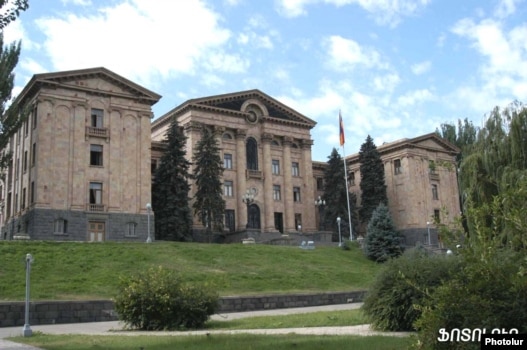
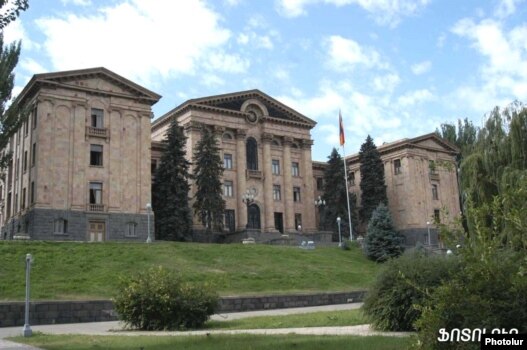
    Armenia — The parliament building in Yerevan.

    23.02.2010
    Sargis Harutyunyan, Karine Kalantarian

    The National Assembly began debating on Tuesday a government bill that would make it easier for Armenia to annul its normalization agreements with Turkey if Ankara continues to delay their ratification.

    The proposed amendments to an Armenian law on international treaties envisage the suspension or termination of agreements signed by Yerevan before their entry into force.

    President Serzh Sarkisian announced his intention to enact such amendments in December in response to Turkish leaders’ continuing statements making the ratification of the Turkish-Armenian “protocols” conditional on the resolution of the Nagorno-Karabakh. He made clear that Yerevan will walk away from the deal if Ankara fails to implement it within a “reasonable” time frame.

    Addressing the parliament, Foreign Minister Edward Nalbandian effectively admitted that the amendments were drafted on Sarkisian’s orders. “The president of the republic made a statement on and I have nothing to add to it,” he said.

    Opposition and independent lawmakers criticized the initiative, saying that Armenian law and international conventions signed by Yerevan already allow for the abrogation of international treaties.

    “I am sure that our legislation in no way restricts the president’s authority to suspend the process of terminating the ratification of any treaty,” said former parliament speaker Tigran Torosian. “I am more than convinced that there is absolutely no need to pass this bill,” he added.

    The bill was included on the parliament agenda just days after Sarkisian formally sent the two protocols to the parliament for ratification. But the National Assembly and its committee on foreign relations are in no rush to debate the documents envisaging the establishment of diplomatic relations between Armenia and Turkey and opening of their border.

    A spokesman for Sarkisian’s Republican Party of Armenia (HHK), which has a clear majority in the assembly, on Tuesday again made clear that it will not vote on the protocols before their ratification by the Turkish parliament. Like other Armenian officials, Eduard Sharmazanov again avoided setting any deadlines for Turkish ratification.

    David Harutiunian, the chairman of the parliament committee on legal affairs, said Yerevan may wait for “one or two or several months” before deciding whether to discontinue the normalization process. “It’s not possible to give a definite answer at this point. It depends on many processes,” Harutiunian told journalists when asked what the Armenian side means by a “reasonable timeframe.”

    Turkish Prime Minister Recep Tayyip Erdogan reportedly reiterated on Monday that Turkey will not implement the protocols unless there is a breakthrough in international efforts to settle the Karabakh conflict.

    https://www.azatutyun.am/a/1966347.html