| Infection control experts are scrambling to respond to outbreaks of swine flu in Mexico and the US, and suspected cases elsewhere.
HOW SWINE FLU OUTBREAK EMERGED
BACK 1 of 4 NEXT Swine flu is a respiratory disease, caused by influenza type A which infects pigs. There are many types, and the infection is constantly changing. Until now it has not normally infected humans, but the latest form clearly does, and can be spread from person to person – probably through coughing and sneezing. What is new about this type of swine flu? The World Health Organization has confirmed that at least some of the human cases are a never-before-seen version of the H1N1 strain of influenza type A.
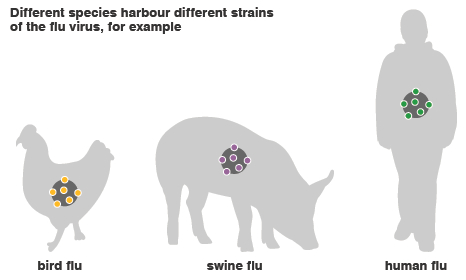
H1N1 is the same strain which causes seasonal outbreaks of flu in humans on a regular basis. But this latest version of H1N1 is different: it contains genetic material that is typically found in strains of the virus that affect humans, birds and swine. Flu viruses have the ability to swap genetic components with each other, and it seems likely that the new version of H1N1 resulted from a mixing of different versions of the virus, which may usually affect different species, in the same animal host. Pigs provide an excellent ‘melting pot’ for these viruses to mix and match with each other. How dangerous is it? Symptoms of swine flu in humans appear to be similar to those produced by standard, seasonal flu. These include fever, cough, sore throat, body aches, chills and fatigue. Most cases so far reported around the world appear to be mild, but in Mexico lives have been lost. How worried should people be? When any new strain of flu emerges that acquires the ability to pass from person to person, it is monitored very closely in case it has the potential to spark a global epidemic, or pandemic.
The World Health Organization has warned that taken together the Mexican and US cases could potentially trigger a global pandemic, and stress that the situation is serious. However, experts say it is still too early to accurately assess the situation fully. Currently, they say the world is closer to a flu pandemic than at any point since 1968 – rating the threat at three on a six-point scale. Nobody knows the full potential impact of a pandemic, but experts have warned that it could cost millions of lives worldwide. The Spanish flu pandemic, which began in 1918, and was also caused by an H1N1 strain, killed millions of people. The fact that all the cases in the US and elsewhere have so far produced mild symptoms is encouraging. It suggests that the severity of the Mexican outbreak may be due to an unusual geographically-specific factor – possibly a second unrelated virus circulating in the community – which would be unlikely to come into play in the rest of the world. Alternatively, people infected in Mexico may have sought treatment at a much later stage than those in other countries. It may also be the case that the form of the virus circulating in Mexico is subtly different to that elsewhere – although that will only be confirmed by laboratory analysis. There is also hope that, as humans are often exposed to forms of H1N1 through seasonal flu, our immune systems may have something of a head start in fighting infection. However, the fact that many of the victims are young does point to something unusual. Normal, seasonal flu tends to affect the elderly disproportionately. Can the virus be contained? The virus appears already to have started to spread around the world, and most experts believe that containment of the virus in the era of readily available air travel will be extremely difficult. Can it be treated? The US authorities say that two drugs commonly used to treat flu, Tamiflu and Relenza, seem to be effective at treating cases that have occurred there so far. However, the drugs must be administered at an early stage to be effective. Use of these drugs may also make it less likely that infected people will pass the virus on to others. The UK Government already has a stockpile of Tamiflu, ordered as a precaution against a pandemic. It is unclear how effective currently available flu vaccines would be at offering protection against the new strain, as it is genetically distinct from other flu strains. US scientists are already developing a bespoke new vaccine, but it may take some time to perfect it, and manufacture enough supplies to meet what could be huge demand. A vaccine was used to protect humans from a version of swine flu in the US in 1976. However, it caused serious side effects, including an estimated 500 cases of Guillain-Barré syndrome. There were more deaths from the vaccine than the outbreak. What should I do to stay safe? Anyone with flu-like symptoms who might have been in contact with the swine virus – such as those living or travelling in the areas of Mexico that have been affected – should seek medical advice. But patients are being asked not to go into doctors surgeries in order to minimise the risk of spreading the disease to others. Instead, they should stay at home and call their healthcare provider for advice. Although the Foreign and Commonwealth Office says people “should be aware” of the outbreak, it is not currently advising people against travelling to affected areas of Mexico and the US. What measures can I take to prevent infection? Avoid close contact with people who appear unwell and who have fever and cough. General infection control practices and good hygiene can help to reduce transmission of all viruses, including the human swine influenza. This includes covering your nose and mouth when coughing or sneezing, using a tissue when possible and disposing of it promptly. It is also important to wash your hands frequently with soap and water to reduce the spread of the virus from your hands to face or to other people and cleaning hard surfaces like door handles frequently using a normal cleaning product. If caring for someone with a flu-like illness, a mask can be worn to cover the nose and mouth to reduce the risk of transmission. The UK is looking at increasing its stockpile of masks for healthcare workers for this reason. But experts say there is no scientific evidence to support more general wearing of masks to guard against infections. Is it safe to eat pig meat? Yes. There is no evidence that swine flu can be transmitted through eating meat from infected animals. However, it is essential to cook meat properly. A temperature of 70C (158F) would be sure to kill the virus. What about bird flu? The strain of bird flu which has caused scores of human deaths in South East Asia in recent years is a different strain to that responsible for the current outbreak of swine flu. The latest form of swine flu is a new type of the H1N1 strain, while bird, or avian flu, is H5N1. Experts fear H5N1 hold the potential to trigger a pandemic because of its ability to mutate rapidly. However, up until now it has remained very much a disease of birds. Those humans who have been infected have, without exception, worked closely with birds, and cases of human-to-human transmission are extremely rare – there is no suggestion that H5N1 has gained the ability to pass easily from person to person. Where can I get further advice? Further information and advice on swine flu can be found at websites of leading health and research organisations around the world. The World Health Organisation gives background information on the virus. The UK’s Health Protection Agency advises the public about what to do if returning from an affected area. NHS Choices outlines how swine flu is different from other flu. The US government’s Centre for Disease Control is counting the number of cases in the US. You can also track the spread of swine flu reports using unofficial sources. Healthmaps maps viruses using news reports. Social media guide Mashable lists some ways to track the virus . Links to useful websites are being shared on Twitter , the micro-blogging service. Read answers from an expert to some of your questions on swine flu
Print Sponsor
|
Advertisement SWINE FLU OUTBREAK KEY STORIES ‘Too late’ to contain swine flu South Korea testing for swine flu Flu prompts UK travel warning Flu fears hit airline shares FEATURES AND ANALYSIS  Q&A Q&AWhat swine flu is, and how its spread can be prevented Life at centre of the outbreak Map: How the flu has spread Is the world ready for a pandemic? Economy braced for impact UK lab ready to analyse swine flu Lessons from Asia ‘I couldn’t get out of bed’ In pictures VIDEO AND AUDIO  Swine flu confirmed in Scotland Swine flu confirmed in Scotland
HAVE YOUR SAY RELATED INTERNET LINKS Health Protection Agency World Health Organization The BBC is not responsible for the content of external internet sites |


 Obama: Flu ‘no cause for alarm’
 WHO raises flu alert level
 UK lab prepares for swine flu samples
 Eyewitness map

The estrangement between Moscow and Washington has lately given way – with the election of Barack Obama – to a cautious sense of expectation. The apprehension is palpable in both Russia and the US. Given how much effort both countries have put into improving relations over the last 20 years, it would be a pity to lose the fruits of this difficult rapprochement.
Having said that, one cannot deal with a partner who does not value the partnership and who ignores your interests. No matter how important America is, friendship or enmity with her is not paramount in the life of the Russian people.
A new feature of American politics is the recent spate of moderately concerned pronouncements about Russia. Also the changes in personnel. Russia experts have been appointed to the National Security Council, to the State Department and to intelligence. Former ambassadors to Moscow were behind a recent report published by the Bipartisan Commission on US Policy Toward Russia.
in any case, for the first time in 20 years the American public has been told in no uncertain terms that US interests and those of Russian-border states are not one and the same thing. The commission’s report says that there is no reason to fear Russian investments outside the energy-sector in the US and the EU.
The report recommends extending the Start 1 treaty, suspending the Jackson-Vanick amendment, and making Russia a member of the World Trade Organisation. It also urges new negotiations on Russia’s participation in the planned American ABM systems in Poland and the Czech Republic.
Most revolutionary of all is the report’s idea that America should not try to build spheres of influence along Russia’s borders while counting on a “constructive response” from Moscow.
The report’s key theme is that the US administration must stop ignoring Russia’s interests since co-operation with Russia will be important in achieving American goals such as the non-proliferation of nuclear weapons and solving the “Iran problem”.
Right after the report was made public Moscow was visited by Henry Kissinger. Dr Kissinger was accompanied by a group of Russia experts, including the authors of the report. Now that they have gone, everyone is waiting anxiously for the results…
Though some of the recommendations made informally by the Americans are encouraging, their formal proposals leave much to be desired. The Americans are trying to sell as a constructive idea a plan that would enhance their superiority of forces while forfeiting the last remnants of our former strategic parity – Russia’s only guarantee, in essence, of military-strategic security.
The American proposal does not stipulate a parallel reduction of tactical weapons of mass destruction, conventional forces and so-called geographical offensive weapons, meaning America’s new Nato bases near and around Russia.
The leitmotif of these expert recommendations is that America stop ignoring Russia’s interests. Yet US actions suggest a determination to restore America’s total strategic invulnerability. What does that have to do with Russian interests? Where is the opportunity to consider and defend them? The iron fist in the velvet glove…
I do not think that Russian diplomacy can easily return to the romantic atmosphere of Soviet-American relations under Gorbachev. “Perestroika diplomacy” was never poisoned by the bitterness of deception. It remained the diplomacy of negotiated breakthroughs.
But post-Soviet diplomacy is another matter entirely. It has been saturated with the spirit of the disappointments of the 1990s: the Nato-isation of Eastern Europe, Kosovo, poi-soned relations with Ukraine and – worst of all – the military destabilisation of Russia’s borders in the Caucasus.
To restore honest and respectful relations with the US is one thing; to accept American proposals that do not benefit Russia in order to do so is quite another. If the US is as intent on improving relations with Russia as Russia is on improving relations with the US, it must be prepared for some very tough negotiations – tougher than any since the 1980s – on a broad range of issues, including regional security.
The US is primarily interested in co-operation with Moscow over non-prolif-eration and Iran. Moscow, by contrast, is more interested in reforming the security system in Europe. We need to learn again how to link such things. The first meeting between presidents Medvedev and Obama seemed to have a generally stimulating effect on diplomats and politicians in both countries.
At the same time one must be clear: while Russia wants stable and friendly relations with America, for Russian foreign policy this is not an end itself. Rather it is an important tool for building a safer and more prosperous world. Russia will advance along this path in any case – preferably with the US, but if necessary without.
- Professor Anatoly V Torkunov, a former Washington diplomat, is rector of the Moscow State Institute of International Relations
Source: www.telegraph.co.uk, 27 Apr 2009