Month: October 2008

  • OBAMA – BİDERN LOVERS –  Here is the ANCA declaration.

    OBAMA – BİDERN LOVERS – Here is the ANCA declaration.

    From: SS Aya <[email protected]>

    Re: OBAMA – BİDERN LOVERS –  Here is the ANCA declaration.

    Question: “Is the Right Choice (for about 1 million) Armenian Americans” also “The Right Choice (for about 300 millions) non-Armenian Americans”?

    Short Turkish explanation: iki ucu boklu degnek! ( Stick with shit on both ends).

    S.S.Aya

    “ANCA” <[email protected]> 25/10/2008 05:56

    Please respond to “ANCA” <[email protected]>

    Subject


    Obama-Biden the Right Choice for Armenian Americans

    October 24, 2008

    Obama-Biden the Right Choice for Armenian Americans

    ANCA Reaffirms Earlier Primary Endorsement in January
    Expands on Nine Months of Nationwide Voter Mobilization to Secure Obama-Biden Win on November 4th

    The Armenian National Committee of America (ANCA) has formalized its longstanding support for Barack Obama with an official endorsement of the Obama-Biden campaign for the Presidency of the United States.

    “The Armenian National Committee of America is proud today to formally announce our support for Barack Obama – whom we endorsed this January in the Democratic Primary and have energetically backed with sustained, grassroots voter mobilization for the past nine months,” said ANCA Chairman Ken Hachikian. “Based on Senator Obama’s strong record in office, his bold statements as a candidate, and our judgment as to the types of policies he will pursue as President, we believe that an Obama-Biden Administration would be far better positioned than a McCain-Palin one to reflect the views and values of the Armenian American community.”

    Barack Obama: The Choice for Change

    In a powerful statement, issued on January 20th, Senator Obama voiced his strong support for passage of the Armenian Genocide Resolution and pledged that, as President, he would recognize the Armenian Genocide. The Presidential hopeful also reaffirmed his support for a strong “U.S.-Armenian relationship that advances our common security and strengthens Armenian democracy.” Unlike other Democratic candidates, he also pledged to “promote Armenian security by seeking an end to the Turkish and Azerbaijani blockades, and by working for a lasting and durable settlement of the Nagorno Karabagh conflict that is agreeable to all parties, and based upon America‘s founding commitment to the principles of democracy and self determination.”

    Additional Information

    Read Senator Obama’s pledge on Armenian American Issues

    Read a 2-page summary of Sen. Obama and Biden’s record of support for Armenian American issues

    Read a 2-page listing of Bush-Cheney’s opposition to Armenian American issues

    View/print an Obama/McCain comparison one-pager

    View Samantha Power’s YouTube video in support of Senator Obama

    Read “McCain’s Armenia Problem” in The Atlantic

    Read Sen. John McCain’s Letters to the Armenian Community

    Contact Armenians for Obama and learn more about how you can get involved.

    The key elements of the Obama record that led to the ANCA endorsement include the following:

    * Public criticism of the Bush Administration for firing former U.S. Ambassador to Armenia John Evans over his truthful remarks recognizing the Armenian Genocide. He has publicly asserted that, “An official policy that calls on diplomats to distort the historical facts is an untenable policy.”

    * Strong support for the passage of the Armenian Genocide Resolution currently before Congress, in his capacity as Chairman of the Senate Foreign Relations Subcommittee on European Affairs.

    * A written pledge to recognize the Armenian Genocide as President, clearly spelling out his “firmly held conviction that the Armenian Genocide is not an allegation, a personal opinion, or a point of view, but rather a widely documented fact supported by an overwhelming body of historical evidence. The facts are undeniable.”

    * A commitment to ending the cycle of genocide. He has said, on the record, that, “America deserves a leader who speaks truthfully about the Armenian Genocide and responds forcefully to all genocides. I intend to be that President.”

    * Letters to Pres. Bush urging him to properly recognize the Armenian Genocide and a record of defending that position, when challenged. While visiting Azerbaijan in August 2005, in response to media inquiries about why he signed these letters, Senator Obama publicly defended his decision by stating that the Armenian Genocide was a historical fact.

    * Commitment to promoting Armenia‘s security “by seeking an end to the Turkish and Azerbaijani blockades.”

    * Support for “a lasting and durable settlement of the Nagorno Karabagh conflict that is agreeable to all parties, and based upon America‘s founding commitment to the principles of democracy and self determination.”

    READ MORE. . . Sen. Biden’s Record | The McCain-Palin Record

    Urge Congressional Candidates in your area to submit an ANCA Questionnaire Send a Free ANCA WebMail

    Published by the Armenian National Committee of America
    1711 N Street NW,
    Washington, DC 20036
    Tel: (202) 775-1918, Fax: (202) 775-5648, E-mail: [email protected], Web: www.anca.org

  • Former Bush spokesman endorses Obama

    Former Bush spokesman endorses Obama

    The former press secretary of President George W. Bush says he backs Democratic presidential hopeful Barack Obama for the November election.
    25 Ekim 2008 Cumartesi 04:28
    will be voting for Barack Obama,” Scott McClellan said, according to the transcript of an interview to be broadcast on CNN’s Larry King Live on Friday.

    McClellan also said he has always planned to support a candidate that has the best chance for changing the way Washington works and getting things done.

    McClellan, who was Bush’s chief spokesman from July 2003 to April 2006, is the second former administration official to back Obama in a week after Bush’s first secretary of state Colin Powell.

    On Sunday, Powell in an interview on NBC’s Meet the Press endorsed Obama, saying ‘I think that Senator Obama brings a fresh set of eyes, fresh set of ideas to the table’.

    Earlier this year McClellan sharply criticized President Bush for the Iraq war in his book, ‘What Happened: Inside the Bush White House and Washington’s Culture of Deception’.

    The US-led invasion of Iraq has left a heavy civilian casualty.

    He wrote in his book, “History appears poised to confirm what most Americans today have decided that the decision to invade Iraq was a serious strategic blunder. The perception of this catastrophe was made worse by previous decisions President Bush had made, including, first and foremost, the failure to be open and forthright on Iraq and rushing to war with inadequate planning and preparation for its aftermath.”

    After the book released, the White House said Bush was surprised and saddened about it.

    Meanwhile, The New York Times in a Thursday editorial endorsed the Democratic presidential hopeful, saying Obama had ‘met challenge after challenge, growing as a leader and putting real flesh on his early promises of hope and change’.

    The Times posted its endorsement on its website on Thursday evening and was to publish it in Friday editions of the newspaper.

  • Sarkisian Vows Public Debate On Karabakh

    Sarkisian Vows Public Debate On Karabakh


    By Emil Danielyan and Tigran Avetisian

    President Serzh Sarkisian pledged to initiate an “active” public debate on how to resolve the conflict with Azerbaijan and accused his opponents of exploiting the issue after inspecting frontline positions of Nagorno-Karabakh’s army over the weekend.

    Sarkisian traveled to Karabakh to attend military exercises conducted by Karabakh Armenian forces. He then visited sections of the heavily militarized Armenian-Azerbaijani line of contact east of the disputed territory.

    Speaking to Armenian Public Television afterwards, a uniform-clad Sarkisian acknowledged that internationally sponsored efforts to resolve the Karabakh conflict have entered an “active phase.” “I strongly believe that we will enter a period of much more active public discussions,” he said. “Discussions are always useful but they must center only on the interests of the Armenian people. We have invested too much effort into the settlement of the Karabakh problem to turn a blind eye on or to ignore instances of exploitation [of the issue.]”

    “We are achieving an important historical objective, and if someone is trying to pursue other interests, then that is not moral,” he added.

    It was an apparent reference to opposition leader Levon Ter-Petrosian’s October 17 speech in which he accused Sarkisian of being willing to “put up Karabakh for sale” in return for earning the West’s support for his continued rule. Ter-Petrosian claimed that Sarkisian is even ready to agree to Russia’s replacement by Turkey at the OSCE Minsk Group helm. Newspapers supporting Ter-Petrosian have also seized on Turkish President Abdullah Gul’s reported claims that Sarkisian himself asked Ankara to mediate in Armenian-Azerbaijani negotiations.

    Sarkisian denied the claims attributed to Gul, insisting that he believes Turkey can only “assist” in the Karabakh peace process. “Yes, I am convinced that Turkey can assist and, I think, is now assisting in the process of the Karabakh conflict resolution,” he said. “President Gul’s [September 6] visit to Yerevan, the continuation of Turkish-Armenian negotiations is a very good example of solving very difficult problems.” Turkish contribution to Karabakh peace will be even greater if Ankara opens the Turkish-Armenian border and establishes diplomatic relations with Yerevan, he added.

    Sarkisian further described as “very legitimate” Russian President Dmitry Medvedev’s efforts to host the next, potentially decisive, meeting of his Armenian and Azerbaijani counterparts. But he would not say when that meeting could take place and what its chances of success are.

    “A resolution of the Nagorno-Karabakh conflict is possible if Azerbaijan recognizes the Nagorno-Karabakh people’s right to self-determination, if Nagorno-Karabakh has a land border with Armenia, and if international organizations and leading nations guarantee the security of the Nagorno-Karabakh people,” stated the Armenian president.

    Sarkisian’s newly reelected Azerbaijani counterpart, Ilham Aliev, repeated on Friday that Baku will never recognize Karabakh’s secession from Azerbaijan.

    The U.S., Russian and French diplomats co-chairing the OSCE Minsk Group were due to visit the conflict zone this week in line with their pledges to step up the search for Karabakh peace after the October 15 presidential election in Azerbaijan. But the group’s French co-chair, Bernard Fassier, said late last week that the trip has been postponed.

    Analysts in Yerevan were on Monday divided over possible reasons for the delay. Manvel Sargsian, a Karabakh expert at the Armenian Center for National International Studies, attributed it to Medvedev’s initiative. “It looks as though a new situation has arisen after that statement and the parties are chewing over their next steps,” he said.

    But Gagik Harutiunian, director of the Noravank Foundation, believes that the United States and France have no problem with Russia’s unilateral push for a Karabakh settlement. “The situation is such that they may have chosen not to meddle in the ongoing process to avoid disrupting it,” he said.

    Richard Giragosian, a Yerevan-based U.S. analyst, likewise saw no U.S.-Armenian disagreements on Karabakh. “Moscow and Washington have actually moved even closer to each other in the Minsk Group,” he told RFE/RL.
  • RUSSIA TAKES INITIATIVE IN INTERNATIONAL PUSH FOR KARABAKH PEACE

    RUSSIA TAKES INITIATIVE IN INTERNATIONAL PUSH FOR KARABAKH PEACE

    By Emil Danielyan


    Russia has taken the center stage in international efforts to resolve the Karabakh conflict, which could yield a breakthrough before the end of this year. President Dmitry Medvedev is expected to host a potentially decisive meeting of his Armenian and Azerbaijani counterparts next month. Moscow may thus be trying to sideline the OSCE’s so-called Minsk Group on Karabakh, which it has long co-chaired with the United States and France.

    When he paid an official visit to Yerevan on October 21, Medvedev publicly urged Presidents Serzh Sarkisian of Armenia and Ilham Aliyev of Azerbaijan to meet in his presence in Russia. The Karabakh dispute was high on the agenda. “I hope that the three presidents will meet in the very near future to continue discussions on this theme,” he told a joint news conference with Sarkisian. “I hope that the meeting will take place in Russia” (Regnum, October 21). He noted that the Karabakh peace process now seemed to be “in an advanced stage.”

    Medvedev discussed what the Kremlin described as preparations for the Armenian-Azerbaijani summit in a phone call with Aliyev the next day (Interfax, October 22). Konstantin Zatulin, a Kremlin-linked Russian pundit, told Armenian journalists afterward that the crucial summit would likely take place in early November; but neither conflicting party has yet confirmed the meeting, let alone announced any dates for it. Aliyev’s chief foreign policy aide, Novruz Mammadov, has said only that it was “possible” (Trend news agency, October 22). Armenian officials have not commented on the matter at all.

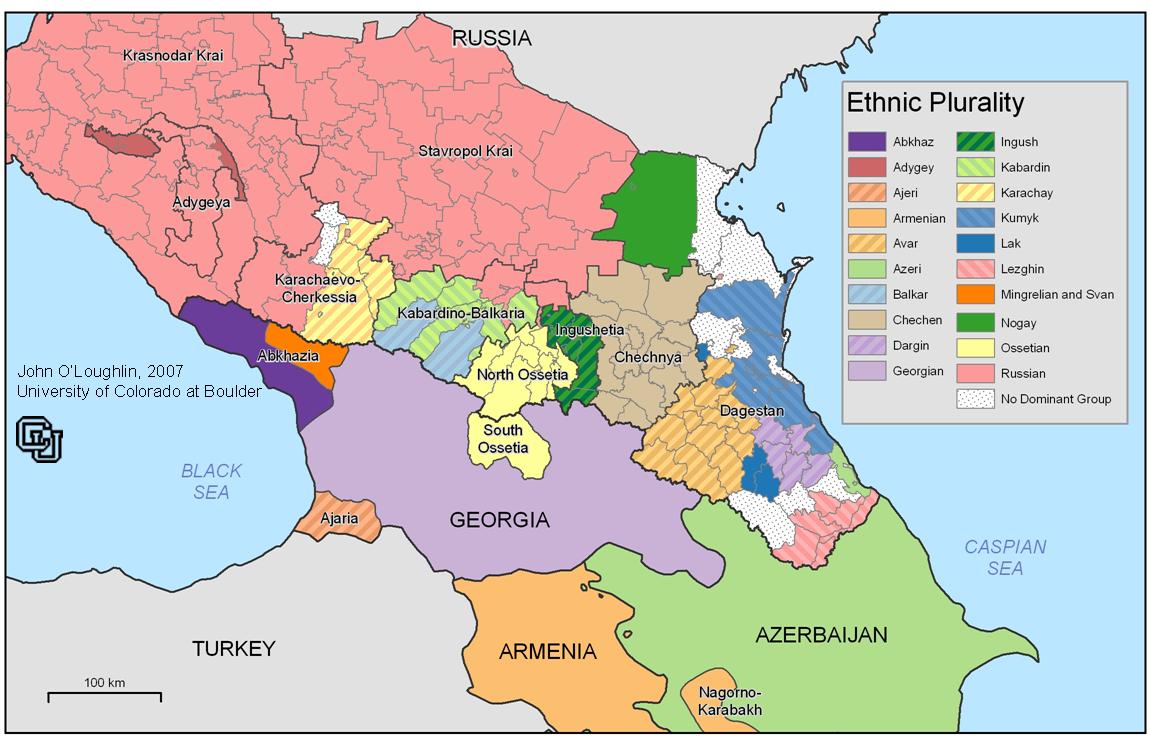
    Medvedev announced his initiative following unusually optimistic statements on Karabakh peace prospects that were made by his foreign minister, Sergei Lavrov. In an October 7 interview with Rossiiskaya Gazeta, Lavrov spoke of a “very real chance” to end the Armenian-Azerbaijani conflict in the coming weeks. “There remain two or three unresolved issues that need to be agreed upon at the next meetings of the presidents of Armenia and Azerbaijan,” he said. He added that the future of the so-called Lachin corridor, which is the shortest overland link between Armenia and Karabakh, is now the main stumbling block in the peace talks. Three days later, Lavrov held a trilateral meeting with his Armenian and Azerbaijani counterparts on the sidelines of a CIS summit in Bishkek.

    Many analysts in the South Caucasus and the West have long contended that Russia was uninterested in a Karabakh settlement, lest it lose leverage against Azerbaijan and, even more, Armenia, its main ally in the region. Peace with Azerbaijan, they have argued, would reduce the significance for Armenia of maintaining close military ties with Russia and make the Armenian economy less dependent on Russian energy supplies. Medvedev’s desire to host the crucial Aliyev-Sarkisian encounter is, however, a clear indication that Karabakh peace is not necessarily incompatible with Russian goals and interests in the region, especially if Moscow plays a key role in a multinational peace-keeping force that would have to be deployed in the conflict zone.

    Armenia is rife with speculation that Moscow is trying to cajole Azerbaijan into agreeing to a Russian troop presence and pursuing a more pro-Russian policy on other issues, notably the transportation of Caspian oil and gas to the West. “To that end [the Russians] need to force Armenia into making essentially unilateral and absolutely unacceptable concessions on the Karabakh issue,” Yerkir, a Yerevan weekly controlled by the governing Armenian Revolutionary Federation party, wrote on October 24, reflecting the growing opinion among local observers.

    Sarkisian appeared to rule out such concessions when he said after his talks with Medvedev that the peace process had to proceed on the basis of the framework peace agreement that was formally put forward by the Minsk Group’s U.S., Russian, and French co-chairs in November 2007. The document calls for a phased settlement of the conflict that would start with the liberation of at least six of the seven Azerbaijani districts around Karabakh that were fully or partly occupied by Armenian forces during the 1991-1994 war. In return, Karabakh’s predominantly Armenian population would be allowed to determine the disputed territory’s status in a future referendum.

    According to U.S. officials privy to the talks, Baku and Yerevan essentially agreed to this peace formula as of late last year and only needed to work out some of its details. Political turmoil in Armenia that followed the February 2008 presidential election and the ensuing toughening of Azerbaijani leaders’ Karabakh rhetoric, however, have dealt a serious blow to the mediators’ efforts to negotiate a peace deal. Those efforts gained new momentum after the Russian-Georgian war, with all three mediating powers stressing the danger posed by unresolved ethnic disputes in the region.

    However, the sharp deterioration of U.S.-Russian relations resulting from the Georgia crisis called into question Moscow’s and Washington’s ability to continue to work together on Karabakh. Medvedev’s seemingly unilateral initiative raised more such questions. Washington has yet to react officially to the move. Incidentally, U.S. Assistant Secretary of State Daniel Fried flew to Yerevan ahead of the Russian’ president’s visit. Fried said after talks with Sarkisian on October 17 that the signing of a Karabakh peace accord before the end of the year was “possible” but “not inevitable” (RFE/RL Armenia Report, October 20).

    Meanwhile, Bernard Fassier, the Minsk Group’s French co-chair, told the Azerbaijani APA news agency on October 21 that he and his American and Russian opposite numbers planned to visit Baku and Yerevan jointly next week; but two days later he said that the trip had been postponed, ostensibly because of the co-chairs’ conflicting work schedules.

  • Turkey, the Region and U.S.-Turkey Relations: Assessing the Challenges and Prospects

    Turkey, the Region and U.S.-Turkey Relations: Assessing the Challenges and Prospects

    Event Summary

    Turkey has weathered exceptionally turbulent times in recent years and continues to face serious domestic and foreign policy challenges. Following the so-called “e-coup” warning of a possible military intervention, civil-military tensions climaxed during the summer of 2007. A year later, the ruling Justice and Development Party (AKP) government was nearly shut down by the Constitutional Court. The AKP’s landslide electoral victory in July 2007 was followed by another crisis over the presidency. In addition, PKK extremist attacks have been sharply on the rise. How should the next U.S. administration manage Turkish-U.S. relations? Where is Turkish domestic politics going? What is Turkey’s foreign policy outlook?

    Event Information

    When

    Tuesday, October 28, 2008
    9:00 AM to 5:00 PM

    Where

    Multi-Purpose Room
    University of California Washington Center
    1608 Rhode Island Avenue, NW
    Washington, DC
    Map

    Contact: Brookings Office of Communications

    E-mail: [email protected]

    Phone: 202.797.6105

    On October 28, the Brookings Center on the United States and Europe and the SETA Foundation for Political, Economic and Social Research will host a conference to examine Turkey’s domestic and foreign policy challenges and prospects. The conference will feature a keynote address by Professor Ahmet Davutoglu, chief foreign policy advisor to Prime Minister Recep Tayyip Erdogan of Turkey. After the keynote address, Ibrahim Kalin, founding director of SETA; Nonresident Fellow Omer Taspinar, director of the Turkey Project at Brookings; Visiting Fellow Mark Parris, former U.S. ambassador to Turkey; and Talha Kose of George Mason University will moderate a series of discussions featuring a distinguished group of Turkish and American experts, officials and scholars.

    After each panel, participants will take audience questions. A buffet lunch will be served from 12:30 to 1:00 p.m.

    Participants

    9:00 am — Welcome and Opening Remarks

    Omer Taspinar

    Nonresident Fellow, Foreign Policy

    Ibrahim Kalin

    SETA

    9:15 am — Keynote Address

    Ahmet Davutoglu

    Chief Advisor to Prime Minister Recep Tayyip Erdogan, Republic of Turkey

    10:45 am — Panel One: U.S-Turkish Relations: What Will the New President Bring to the Table?

    Moderator: Mark R. Parris

    Visiting Fellow, Foreign Policy

    Cengiz Candar

    Radikal (Turkey)

    Ian Lesser

    German Marshall Fund

    Suat Kiniklioglu

    Member of Turkish Parliament

    1:00 pm — Panel Two: Turkey’s Challenges and Opportunities and Its Region: Iraq, Iran, the Caucasus and the EU Process

    Moderator: Talha Kose

    George Mason University

    Steven Cook

    Council on Foreign Relations

    Kemal Kirisci

    Bogazici University and Carleton University

    Taha Ozhan

    SETA

    3:00 pm — Panel Three: The Domestic Scene: The Continuing Battle for Turkey’s Soul

    Moderator: Ibrahim Kalin

    SETA

    Mustafa Akyol

    Turkish Daily News

    Bulent Ali Riza

    Center for Strategic and International Studies

    Omer Taspinar

    Nonresident Fellow, Foreign Policy

    4:45 pm — Closing Remarks<!–

    –>

  • LECTURE- Armenia in Old Maps and Old Armenian Maps, Rouben Galichian, Oct. 29

    LECTURE- Armenia in Old Maps and Old Armenian Maps, Rouben Galichian, Oct. 29

    American University of Armenia Extension Program

    Presents

    Armenia in Old Maps and Old Armenian Maps
    Illustrated Talk in English by

    Rouben Galichian

    October 29, 18:30-20:00
    AUA, 5th floor, Small Auditorium

    Free Admission

    The presentation is prepared to give the layman an idea how
    non-Armenian mapmakers have shown Armenia in their maps, accompanied
    by the images of the important maps. Some common misconceptions
    generally used by many specialists regarding Armenia are also discussed.

    Armenia has existed for millennia and this fact is well displayed on
    the maps prepared by various mapmakers all over the world. The
    earliest map showing Armenia is in fact the oldest World Map, a
    Babylonian clay tablet displaying the known world and dating form the
    6th century BC.

    >From then on all major cartographers and mapmakers have shown Armenia
    in their maps, notwithstanding the fact that at certain times Armenia
    as an independent kingdom has not existed, but all that time the
    territory where the Armenian people lived has been entitled Armenia.
    Various maps of the Greek, Roman, early Christian, Latin, Assyrian and
    Islamic maps come to prove this fact.

    Samples of all these maps collected from major libraries and museums
    of the world are displayed, followed by maps made by Armenian authors,
    some of which are not well known.

    Speaker: Rouben Galichian has been seriously studying geography and
    cartography since 1970s. He is the author of three monographs:
    Historic Maps of Armenia: The Cartographic Heritage” (I. B. Tauris,
    London, 2004), “Armenia in World Cartography” (2005) and “Countries
    South of the Caucasus in Medieval Maps: Armenia, Georgia and
    Azerbaijan ” (2007). He represents the huge cartographical heritage
    related to Armenia not only by books and articles but also by public
    lectures
    and speeches at different scientific conferences and by media
    in the USA and in Europe.

    About AUA Extension:

    American University of Armenia Extension Department (AUA Extension)
    serves as University’s principal interface with the community. At AUA
    Extension we plan, design, develop and deliver a number of quality
    courses to target certain sectors of government, academia, private
    organizations and individuals to help them fulfill professional and/or
    career goals through flexible and innovative adult and continuing
    education and training programs. We offer a comprehensive English
    Language Training Program
    , a multitude of Computer Literacy and
    Information Technology training and a number of Leadership, Business
    and Entrepreneurial courses. Our mission is to foster individual,
    organizational, and community growth and transformation, through
    accessible, high-quality programs.  Our Vision is to become the
    Education and Training Organization of choice to meet the changing
    needs of those seeking the best in lifelong learning.