Tag: headscarf ban

  • Austria: Headscarf Ban for Girls Under 14: A Necessary Step Against Religious Instrumentalization

    Austria: Headscarf Ban for Girls Under 14: A Necessary Step Against Religious Instrumentalization

    The Austrian federal government has once again called for a ban on headscarves for girls under the age of 14 – a proposal that regularly meets resistance from certain political and religious interest groups. Critics frequently invoke the right to religious freedom, enshrined in the Austrian Constitution and the European Convention on Human Rights. However, the legal argument that wearing a headscarf is a protected religious act does not hold up under theological scrutiny – and it overlooks the state’s responsibility to protect children.

    No Theological Basis in the Quran

    At the heart of the debate is the question of whether wearing a headscarf is truly a religious obligation. A close reading of the Quran reveals: the word headscarf does not appear anywhere. In the often-cited verses – such as Surah 24, Verse 31 – only a “veil” or “cloth” is mentioned, which should be drawn over the neckline. Nowhere in these passages is there an explicit reference to covering the head. The context clearly refers to adult women and their relationship to their “adornment” – a term that is frequently interpreted as physical charms or attractions.

    Even Surah 33, Verse 59 – often cited to justify veiling – only recommends that women draw their outer garments around them to avoid harassment. These verses cannot be used to justify headscarves for children or young girls. Rather, they reflect context-specific cultural norms of the time, not a binding divine commandment.

    The Political Function of the Headscarf

    In Turkey – a predominantly Muslim country – headscarves were banned in public schools and institutions until 2014. This ban was only lifted under the Islamist-conservative government of the AKP. This example illustrates a key point: the headscarf is not primarily a religious issue, but a political one. It is about visibility, control of interpretation, and the imposition of societal norms under the guise of faith.

    In Austria, religious organizations such as the Islamic Religious Authority (IGGÖ) often act as extensions of foreign, Islamic-influenced governments. Their insistence on defending the headscarf, even for children, stems not from theological necessity, but from a political agenda.

    The Responsibility of the State

    Children are among the most vulnerable members of society. It is the duty of the state to protect them from religious or ideological misuse – especially when they are not yet able to make informed decisions. A ban on headscarves for those under 14 is not an attack on religious freedom, but a protective measure against political instrumentalization.

    In an open and democratic society, one thing must be clear: tolerance must not be extended to practices that impose symbolic gender roles and norms on children who neither understand them nor choose them freely. A religious symbol with no theological foundation should not be misused as an educational tool under the pretext of freedom of religion.

    Conclusion

    A headscarf ban for girls under 14 is not an expression of intolerance, but a step toward protection, empowerment, and individual autonomy. Political leaders must be willing to challenge false narratives – even when they come from legal or religious institutions. Because freedom also means protecting children from ideological appropriation – whether politically, culturally, or religiously motivated.
  • In Turkey, from headscarf to ‘immorality’ ban

    In Turkey, from headscarf to ‘immorality’ ban

    For many in the West, the Islamic headscarf (hijab) that many conservative Muslim women wear is a symbol of oppression. They assume that these women must be wearing this unusual headdress because their husbands, fathers, brothers and others must be forcing them to do so. Even when the headscarf is worn willingly, it is taken by some feminists as the sign of an internalized misogyny — a “false consciousness” into which Muslim women were drawn by patriarchal men.

    Summary⎙ Print The headscarf, once a symbol of Turkey’s struggle for freedom, is now normalized, but other symbols appear in its stead.
    Author Mustafa AkyolPosted November 7, 2013

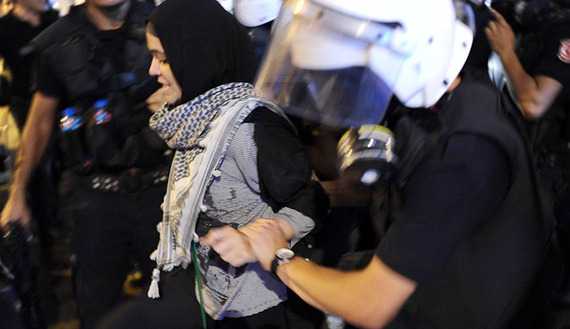
    Police arrest a demonstrator during clashes in Istanbul, Sept. 10, 2013. (photo by BULENT KILIC/AFP/Getty Images) Read more: https://www.al-monitor.com/originals/2013/11/headscarf-turkey-history-parliament-protest.html#ixzz2k60dRa3S
    Police arrest a demonstrator during clashes in Istanbul, Sept. 10, 2013. (photo by BULENT KILIC/AFP/Getty Images)
    Read more: http://www.al-monitor.com/pulse/originals/2013/11/headscarf-turkey-history-parliament-protest.html#ixzz2k60dRa3S


    While both of these arguments might have some merit in certain contexts, in the Turkish context, the headscarf has rather become the symbol of something that most Westerners would hardly associate it with: freedom.

    The simple reason is that unlike in “Islamic” states such as Saudi Arabia and Iran, where the headscarf is praised and imposed by the authorities, in “secular” Turkey the authorities have rather ridiculed and banned the headscarf for decades. Wearing it in Turkey’s passionately secular republic, therefore, has become an act of opposing state authority to claim individual liberty.

    This uniquely Turkish meaning of the headscarf comes from Turkey’s self-styled secularism called laiklik. Imported from the French laicite, this has always been an illiberal idea, which gave the state almost unlimited powers to “enlighten” society by banning institutions and practices that it deemed “backward.” The 1989 decision by the Turkish Constitutional Court — then a strong ally of the super-strong military — had clearly affirmed this view by arguing that the state has the duty to “protect society from dogmatism.” Therefore, practices that the state considered “dogmatic” could be easily banned. (Where the state’s own dogmas such as the “Six Arrows” of Ataturk would of course be untouched.)

    The headscarf ban, which former President Ahmet Necdet Sezer (2000-07) declared to be valid across the whole “public square,” was the most controversial example of this authoritarian secularism. With the active encouragement by the military, which used to put its nose into every aspect of Turkish society, the headscarf was banned in all schools, universities and public institutions.

    Hence, when female politician Merve Kavakci tried to enter parliament with her head covered, she caused a political storm. The moment she walked into the national assembly on May 2, 1999, for the first time after her election, hundreds of secularist deputies were enraged and yelled at her. Prime Minister Ecevit, who was otherwise a polite man, called on his party “to show this woman her limits.” In the face of minutes-long protests, Kavakci had to leave the parliament building. The seat her voters gave her was taken away by those who hated the way she looked.

    But this was only the beginning. As academic Richard Peres explains in his book, The Day Turkey Stood Still: Merve Kavakci’s Walk into the Turkish Parliament (2012), the whole secular establishment went after Kavakci with zeal. President Suleyman Demirel condemned her as an “agent provocateur.” Soon, police raided her home, while secularist media portrayed her as a criminal. Finally, she was stripped of Turkish citizenship and had to find a safe haven in the United States, where she today teaches at Georgetown University. In 2007, the European Court of Human Rights found this political attack on Kavakci a violation of human rights.

    In that controversial Kavakci affair, Ecevit — who led the protest against the covered deputy — was terribly wrong, but he got something right: The headscarf, as he put it, was an act of “defiance to the state.” In other words, since this individual right was banned by an authoritarian state, it had become the symbol of freedom from that state. This is also why “freedom for the headscarf” would became one of the prominent themes in the political agenda of Turkey’s liberals.

    Luckily, this liberal cause has gradually triumphed in the past two years. First, Turkish universities welcomed the headscarf, due to new instructions by the Higher Education Institution, which in the past issued instructions that banned the practice. Then in September 2012, Prime Minister Recep Tayyip Erdogan announced a “democratization package” that included a reform allowing public servants to wear the headscarf. On Oct. 31, four members of parliament walked into the general assembly with their heads covered. Unlike Kavakci, they were neither protested nor expelled.

    Therefore, it is fair to say that the headscarf, which had become a symbol of freedom because of the state’s ban, is not a symbol of freedom anymore. It is just a common religious practice in a diverse society.

    Ironically, however, Erdogan, who set the headscarf free, is creating new symbols of freedom these days. Because, like his secularist predecessors who wanted to save society from “dogma,” he seems willing to save society from “immorality.” His recent outburst against student houses “where girls and boys mingle,” and his promise to have them monitored by the police, created a huge controversy and led to the Twitter campaign, “Kizli erkekli ders calisiyoruz” (“We are studying mixed as girls and boys”). Similarly, one of Erdogan’s senior party member’s recent criticism of the “decolletage” of a TV host, which cost her her job, sparked a campaign to wear more decolletage. Erdogan’s limitations on alcohol sales also resulted in similar reactions in the previous months.

    I will not be too surprised, therefore, if the new freedom symbols in Turkey become revealing blouses, alcohol or “houses where boys and girls mingle” — which are now acts of defiance to the new state. I will just regret that the religious conservatives, who once used to call for “freedom,” will prove to have learned no lessons from their own history.

    Read more: http://www.al-monitor.com/pulse/originals/2013/11/headscarf-turkey-history-parliament-protest.html#ixzz2k60TL9GS

  • Turkish MPs enter parliament with headscarves

    Turkish MPs enter parliament with headscarves

    By DESMOND BUTLER — Associated Press

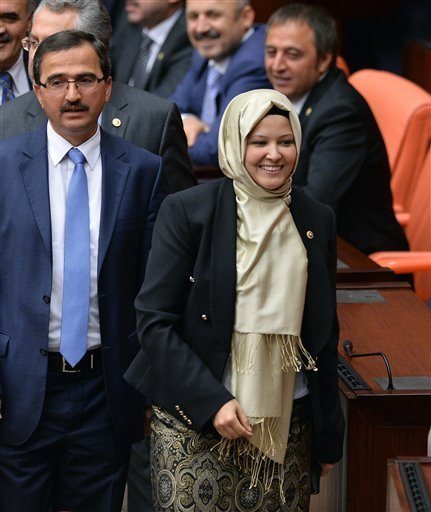
    Nurcan Dalbudaki, one of four ruling Justice and Development Party lawmakers wearing headscarves, who walked into Turkey’s parliament, arrives with other lawmakers in Ankara Thursday, Oct. 31, 2013, marking the end of a longstanding ban in the chamber. The female members of parliament had announced their intentions after restrictions that were imposed in the early days of the Turkish Republic were recently lifted. The issue is highly charged in a country founded in 1923 under strict secular principles. AP PHOTO Read more here:
    Nurcan Dalbudaki, one of four ruling Justice and Development Party lawmakers wearing headscarves, who walked into Turkey’s parliament, arrives with other lawmakers in Ankara Thursday, Oct. 31, 2013, marking the end of a longstanding ban in the chamber. The female members of parliament had announced their intentions after restrictions that were imposed in the early days of the Turkish Republic were recently lifted. The issue is highly charged in a country founded in 1923 under strict secular principles.
    AP PHOTO
    Read more here: http://www.islandpacket.com/2013/10/31/2765986/turkish-mps-enter-parliament-with.html#storylink=cpy

    ISTANBUL — Four female lawmakers wearing headscarves walked into Turkey’s parliament in Ankara on Thursday, marking an end to the ban on the Muslim symbol in the chamber that was imposed in the early days of the Turkish Republic.

    Still, the issue of where women can wear headscarves remains a highly charged on this in Muslim-majority country, which was founded in 1923 under strict secular principles, but where a desire for public religious expression has spread in recent years.

    The restrictions on headscarves in government buildings were loosened as part of reforms aimed at boosting democracy unveiled by Prime Minister Recep Tayyip Erdogan in September. The ban remains in place for judges, prosecutors and military and security personnel.

    The four lawmakers — Sevde Beyazit Kacar, Gulay Samanci, Nurcan Dalbudak and Gonul Bekin Sahkulubey — are members of Erdogan’s Justice and Development Party, abbreviated as AKP, which has Islamist roots and has gained a strong following in this nation of 74 million.

    The AKP’s reform package has been criticized by Turks fearing the rise of Islam in the official sphere, but lawmakers from the main secular opposition party, CHP, said it had decided not to react to the four lawmakers’ actions Thursday, although some of its members accused the ruling party of trying to exploit the issue for political gain.

    The CHP was formed by Turkey’s founding father, Mustafa Kemal Ataturk, who championed headscarf bans in the 1920s.

    The secularists’ relatively cool reaction Thursday contrasted with outrage at an earlier incident involving headscarves in parliament.

    In 1999, a newly elected member of parliament, Merve Kavakci, tried to take her oath while wearing a headscarf. The left-leaning prime minister at the time, Bulent Ecevit, told lawmakers to “put this woman in her place.” Kavakci left the building while some of her colleagues chanted for her to “get out.” Kavakci lost her seat in 2001.

    AKP lawmakers cast the ban on headscarves as a civil rights issue that had prevented religious women from expressing themselves freely in Turkish politics.

    “I have always said that we overlooked the problem of equality between men and women, but today I think we are finally solving this problem,” said Oznur Calik, a member of the ruling party.

    What women can wear has been a political battleground in both Muslim and non-Muslim countries.

    Women are required to cover their hair in public in Iran, which is overwhelmingly Muslim, a rule many of them detest. France, meanwhile, in 2011 became the first European nation to ban the public use of face veils, infuriating many Muslims who felt their religious community was being singled out for discrimination.

    Follow Desmond Butler on Twitter at: www.twitter.com/desmondbutler

    via ISTANBUL: Turkish MPs enter parliament with headscarves | World | The Island Packet.

  • Head Scarves in Turkey – NYTimes.com

    Head Scarves in Turkey – NYTimes.com

    To the Editor:

    The Turkish government’s lifting of the ban on head scarves in government offices (news article, Oct. 9) should not be taken as a sign of democracy, despite what Prime Minister Recep Tayyip Erdogan claims.

    Instead, it is another insidious step toward the Islamist state he desires and against the secular republic founded by Mustafa Kemal Ataturk. Don’t forget that Mr. Erdogan is the man who declared: “Democracy is like a streetcar. When you come to your stop, you get off.”

    Furthermore, this step diminishes rather than promotes the equal rights of women in that country. The wearing of Islamic head scarves in Turkey is quite a different thing from what it is in the United States, and American citizens and politicians should not so easily be deceived.

    CAROL DELANEY

    Providence, R.I., Oct. 9, 2013

    The writer, emerita professor of anthropology at Stanford University, has spent years doing research in Turkey.

    A version of this letter appears in print on October 14, 2013, on page A24 of the New York edition with the headline: Head Scarves in Turkey.

    via Head Scarves in Turkey – NYTimes.com.

  • Turkey Cracks Down on Cleavage

    Turkey Cracks Down on Cleavage

    Turkey Cracks Down on Cleavage

    By Marc Champion Oct 9, 2013 5:29 PM GMT+0200

    i3HR5V4MGB38

    How do you know whether a regime that frees women to wear Islamic headscarves at work is liberal and furthering democracy, or Islamist and restricting it?

    The question concerns Turkey’s government, which in the space of a few days has ended a headscarf ban for civil servants (except in the judiciary and security services), but also caused a female TV music-show presenter to be fired for showing too much cleavage.

    The headscarf ban was a piece of unabashed social engineering introduced in the 1920s to make Turkey, the rump of the former Ottoman Empire and Islamic Caliphate, secular. If you are liberal and not Islamophobic, ending the ban is a good thing: Women should not be excluded from the workplace just because they are devout and believe this requires covering their hair, period.

    But what if the change — which Prime Minister Recep Tayyip Erdogan introduced as part of a broad “democratization” package — is part of a wider plan of social re-engineering, this time designed to impinge on the liberties of non-religious conservatives? If so, the numerous cases in which women were discriminated against, fired or passed over for promotion for wearing a headscarf even outside of work would now be repeated in reverse: Women who don’t wear headscarves to work, and men whose wives don’t cover their hair, will be discriminated against, fired and passed over for promotion.

    Turkey’s secularists say this is already happening to men whose wives show their locks. That’s hard to prove, but the real issue is trust — secularists believe the worst of Erdogan’s intentions. Are they right?

    The firing of a TV presenter, Gozde Kansu, this week is indicative. Huseyin Celik, spokesman for the ruling Justice and Development Party attacked Kansu (without actually naming her) for wearing a dress with a plunging neckline while on the air. A few days later, she was fired. There are a few points to make.

    First, Celik should watch more Italian TV — he would then understand that Kansu is a model of shy decorum. Second, Celik’s words were as follows: “We don’t intervene against anyone, but this is too much. It is unacceptable,” according to Hurriyet Daily News. He later complained that it wasn’t his fault that she was fired, and he had a right to express his opinions.

    None of this is credible. Celik knows what “unacceptable” means; he knew that Kansu was on ATV television, which belongs to a company called Calik Holding; and he knew that Calik’s chief executive officer is Erdogan’s son-in-law, Berat Albayrak. There is no coincidence or unintended consequence here. Celik wants to re-engineer Turkish TV.

    There are plenty of other pointers about the depth of the government’s commitment to “democratization,” such as the repeated tightening of restrictions on the sale of alcohol, frowned upon by devout Muslims; the routine prosecuting and jailing of journalists; and the crushing of dissent in the Gezi Park protests earlier this year.

    One last piece of evidence: A Turkish appeals court today upheld the convictions 237 Turkish military officers convicted of plotting a coup against the government in 2003. The case, called Sledgehammer, has been thoroughly discredited. Forensic examination showed that the evidence on which the conviction rested was forged: The documents involved were on a CD-ROM date-stamped 2003, yet were written using a 2007 Microsoft program.

    Again, a case first hailed abroad as good for democracy — an effort to hold the country’s generals accountable after decades of impunity — turns out to be something else. The Sledgehammer case shows only continuity in Turkish governments’ use of politicized courts against their enemies: In the old days the military and secularists abused the law to suppress Islamists; now the Islamists are returning the favor.

    (Marc Champion is a Bloomberg View editorial board member. Follow him on Twitter.)

    via Turkey Cracks Down on Cleavage – Bloomberg.

  • Turkey lifts decades-old ban on Islamic head scarf

    Turkey lifts decades-old ban on Islamic head scarf

    ANKARA | Tue Oct 8, 2013 5:28am EDT

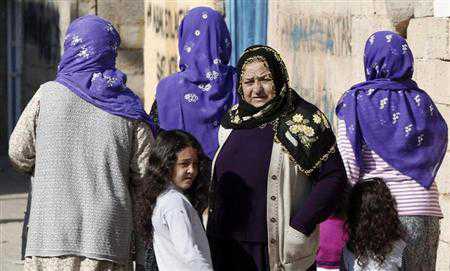
    Turkish women stand near their homes in the Turkish border town of Ceylanpinar, Sanliurfa province

    (Reuters) – Turkey lifted a ban on women wearing the Islamic head scarf in state institutions on Tuesday, ending a decades-old restriction as part of a package of reforms meant to bolster democracy.

    The ban, whose roots date back almost 90 years to the early days of the Turkish Republic, has kept many women from joining the public work force, but secularists see its abolition as evidence of the government pushing an Islamic agenda.

    The new rules, which will not apply to the judiciary or the military, were published in the Official Gazette and take immediate effect in the majority Muslim but constitutionally secular nation.

    “A regulation that formally intervened in freedom of clothing and lifestyle – a source of inequality, discrimination and injustice among our people – has become history,” Deputy Prime Minister Bekir Bozdag said on his Twitter account.

    The debate around the head scarf goes to the heart of tensions between religious and secular elites, a major fault line in Turkish public life.

    Critics of Prime Minister Tayyip Erdogan see his Islamist-rooted AK Party as seeking to erode the secular foundations of the republic founded on the ruins of an Ottoman theocracy by Mustafa Kemal Ataturk in 1923.

    Erdogan’s supporters, particularly in the country’s conservative Anatolian heartlands, say he is simply redressing the balance and restoring freedom of religious expression to a Muslim majority.

    The lifting of the ban, based on a cabinet decree from 1925 when Ataturk introduced a series of clothing reforms meant to banish overt symbols of religious affiliation for civil servants, is part of a “democratization package” unveiled by Erdogan last week.

    The reform program – in large part aimed at bolstering the rights of Turkey’s Kurdish community – included changes to the electoral system, the broadening of language rights and permission for villages to use their original Kurdish names.

    An end to state primary school children reciting the oath of national allegiance at the start of each week, a deeply nationalistic vow, also took effect on Tuesday.

    (Reporting by Humeyra Pamuk; Editing by Nick Tattersall and Mike Collett-White)

    via Turkey lifts decades-old ban on Islamic head scarf | Reuters.