Tag: Greek Orthodox Christians

  • Greek Orthodox Archdiocese of America “constantinople”

    Greek Orthodox Archdiocese of America “constantinople”

    His Eminence Archbishop Elpidophoros
    Greek Orthodox Archdiocese of America
    8-10 East 79th Street
    New York, NY 10075

    March 14, 2025 

    Your Eminence,

    I write to you with deep concern regarding a statement you made while presenting a cross to His Excellency Archbishop Gregory Michael Aymond during your visit to New Orleans on March 14, 2025. You described the cross as having been made in “constantinople.”

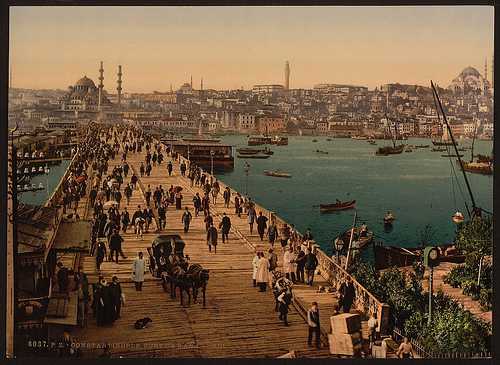
    For many years, I have studied maps from every possible source, yet I have never been able to locate a place on Earth by that name. It is profoundly disheartening that someone of your esteemed position—born and raised in the great city of Istanbul—would choose to use such an anachronistic term to refer to the modern, thriving metropolis that has been known as Istanbul since May 29,1453.

    Such references are not mere words; they are part of a broader and troubling pattern aimed at undermining the sovereignty and legitimacy of the Republic of Türkiye and diminishing the identity of Istanbul, a city of over 15 million people. The continued use of the term “constantinople” in international discourse serves no constructive purpose and, instead, feeds into a deliberate campaign to delegitimize the Turkish state, discredit its people, and weaponize history for political agendas. I must strongly and respectfully emphasize that there is no city in the world today called “constantinople.” To suggest otherwise is to engage in an insidious form of historical revisionism that disregards the reality of modern Türkiye, a nation built on sovereignty, progress, and coexistence. This narrative does not serve the interests of peace, mutual respect, or interfaith relations.

    Demonizing Türkiye is not the answer. If the goal is to foster dialogue and understanding, I urge you to show the same respect for Türkiye’s territorial and historical integrity that you would expect for your own church or cities in Greece. The city is Istanbul. It has been, and it will remain so.

    With due respect, I trust you will reflect on the weight of such statements and choose words that foster unity rather than division.

    Sincerely,

    Ibrahim Kurtulus
  • U.S. Veep Biden Meets Patriarch Bartholomew in Turkey

    U.S. Veep Biden Meets Patriarch Bartholomew in Turkey

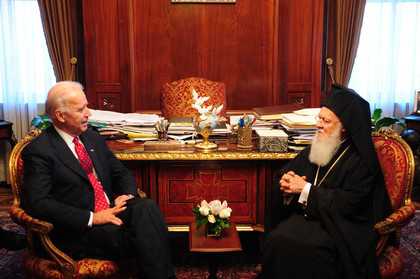
    NEW YORK — U.S. Vice President Joe Biden met Ecumenical Patriarch Bartholomew I of Constantinople, the spiritual leader of the world’s Orthodox Christians, in Istanbul on Saturday.

    Nicholas Magginas U.S. Vice President Joe Biden met Ecumenical Patriarch Bartholomew I of Constantinople, the spiritual leader of the world's Orthodox Christians, in Istanbul on Saturday.
    Nicholas Magginas U.S. Vice President Joe Biden met Ecumenical Patriarch Bartholomew I of Constantinople, the spiritual leader of the world's Orthodox Christians, in Istanbul on Saturday.

    Vice President Biden was greeted at the entrance to the Patriarchal compound by His Eminence Archbishop Demetrios of America, together with the Chancellor, the Chief Secretary of the Holy and Sacred Synod, and the Patriarchal Court.

    His All-Holiness met with the Vice President in his personal office for a private conversation. Among the issues discussed were religious freedom in Turkey, the reopening of the Theological School of Halki, Turkey’s accession to the European Union, and the ecological initiatives of the Ecumenical Patriarchate.

    via U.S. Veep Biden Meets Patriarch Bartholomew in Turkey – Udated.

  • Topkapı Palace welcomes works from Istanbul Greek painters

    Topkapı Palace welcomes works from Istanbul Greek painters

    ISTANBUL – Daily News with wires

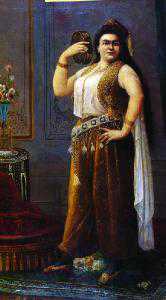
    'Cabaret Singer Peruz Hanım' from the Zeynep Sabancı Collection is one of the pieces from the exhibition
    'Cabaret Singer Peruz Hanım' from the Zeynep Sabancı Collection is one of the pieces from the exhibition

    The Greek Painters of Istanbul at the Topkapı Palace, a new exhibition at the famous Istanbul landmark, is bringing to light close to 100 works by Greek painters from the city. Although the native-born artists contributed greatly to culture in the late Ottoman era, there is little information on them in either the Ottoman or present-day sources

    Istanbul’s Topkapı Palace is hosting a new exhibition featuring 100 pieces of art by Istanbul Greek painters who were influential in the late Ottoman artistic world.

    “People from different faith groups have created very important works on Anatolian land. It is our mission to exhibit these works to the current generations,” Turkish Culture Minister Ertuğrul Günay, who is helping to organize the Greek Painters of Istanbul at Topkapı Palace show, said Monday during the show’s opening ceremony.

    Günay also said his ministry had established very close relations with the leaders of various faith groups and that the exhibition was one of the results of those relations.

    The works of the Greek painters are a part of Turkish culture, said Fener Greek Patriarch Bartholomew, who attended the show’s opening ceremony Monday. “We, as the Greek community and the Greek Patriarchate, are a part of this country, too.”

    The exhibition, which is based on the book “Istanbullu Rum Ressamlar” (Greek Painters of Istanbul” by Mayda Sari, who is also the curator of the exhibition, features Greek painters who were born or raised in Istanbul. It brings together selected works from Greek Orthodox churches and private collections, as well as the collections of the Topkapı Palace, the Greek Orthodox Patriarchate and the Halki Theological School.

    The minister also expressed his objection to the translation of the term “Rum,” which is used in Turkish to refer to the Greek Orthodox Christians living in Anatolia but often rendered simply as “Greek” in English, providing no differentiation between the group and the Greeks from Greece proper.

    “‘Rum’ is the name of the [Greek Orthodox Christian] Anatolian population who lived on Ottoman lands. It is a part of Turkish culture, not a separate population,” Günay said.

    The exhibition brings to light the works of painters who contributed greatly to Ottoman culture but on whom little can be found in Ottoman and present-day sources. Visitors will have the chance to see works by 19th- and early-20th-century painters and iconographers, such as Armenopoulos, Andreades, Andoniades, Flora-Karavia, İgum (Igoumenides), Economides, Xanthopoulos, Michelidakes, Petridou, Platonides, Savvides, Scarlatos, Sofroniades, Stavrakes, Vakalopoulos, as well as Konstantinos Kyzikinos (Kapıdağlı Konstantin).

    Divided along thematic and chronological lines, the exhibition is comprised of approximately 100 works and includes portraits of sultans and high-ranking Ottoman officials, portraits of high-ranking clergy from the collection of the Halki Theological School, icons selected from churches, as well as views of Istanbul.

    The event is being organized by the Directorate of the Topkapı Palace Museum and the Consulate General of Greece in Istanbul under the auspices of Günay’s ministry.

    The exhibition will continue at the Topkapı Palace Museum Imperial Stables until June 30.

    via Topkapı Palace welcomes works from Istanbul Greek painters – Hurriyet Daily News and Economic Review.