Why does the Turkish Cultural Community (TKG) even exist in Austria? And why do its members contribute so much to our society on a voluntary basis? What does all this have to do with religion, politics, and our society?
The Turkish Cultural Community is a critical and independent think tank that is committed to secular, humanistic, and enlightened values. The TKG organizes small discussion groups with selected guests, provides advice and mediation to political decision-makers and companies, and publishes numerous articles on socially and politically relevant topics related to Europe, Turkey, the Middle East, and Austria.
At the heart of the TKG’s activities lies the connection between people, not their background, religion, or ethnicity. Its foundation rests on enlightenment values, the legacy of Mustafa Kemal Atatürk, and the progressive Islamic theology of thinkers such as Dr. Yaşar Nuri Öztürk and many others.
I am honored to be a participating and advisory member of the TKG – to build bridges, to provide impulses for social discourse, to raise awareness of problems, and to contribute to possible solutions. Like all other members, I do this work voluntarily, driven by the idea and metaphor famously expressed by Immanuel Kant:
To seek to understand “things in themselves.”
A Dangerous Shift: Salafism and Political Islam
The YouTube documentary “Turkey is Redrawing the Middle East” raises explosive questions. Particularly relevant is its focus on Salafism and Wahhabism—religio-political ideologies that originated in part in Qatar, were embraced by the AKP government in Turkey, and are now gaining increasing influence in Europe.
Islam as a Tool – The Political Abuse of Religion
What is being imported into Europe under the guise of “freedom of religion” and “equality with the Catholic Church” is, in reality, an ideological campaign against secularism. Religious movements, backed by powerful states like Qatar and Turkey, are conducting targeted influence operations. They masquerade as religious communities or mosque associations but operate de facto as politically motivated parallel structures—often with mafia-like characteristics.
In countries like Austria, these organizations now enjoy privileges that make them a “state within the state.” This is a dangerous development, threatening not only social cohesion, but also the foundations of liberal democratic constitutionalism.
The Silence of the Churches – A Quiet Pact?
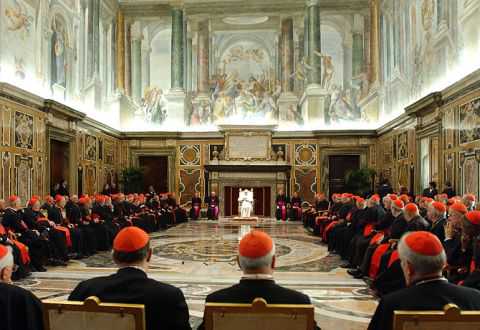
The role of the Catholic Church and the Vatican is particularly troubling. According to various observations, they either ignore criticism of these developments or actively resist it—through media, networks, and political allies. Their support for organizations like IHH and other regressive actors often comes under the cover of tolerance and religious freedom.
But where does this understanding of “tolerance” lead us?
The Roots of Reason – and the Forgotten Enlightenment
The philosopher Immanuel Kant called for enlightenment with his famous maxim:
“Have the courage to use your own reason!”
A message more relevant today than ever. The quote itself goes back to the Roman poet Horace:
“Well begun is half done. Dare to be wise – begin!”
But where should we begin? In a time when critical voices are systematically discredited, those who encourage reflection are often labeled troublemakers. And yet, without criticism, without enlightenment, without the courage to confront the truth, we risk falling into societal regression.
Is Europe Retreating?
Has Europe really learned from its religious wars of the 17th century? Or has it not?
In 2025, we are witnessing a dangerous relapse—a combination of naivety, political correctness, and strategic hypocrisy. The liberal-secular order is not only being attacked from outside, but increasingly from within.
Reactionary movements rooted in Salafism, jihadism, and sectarian groups like the Naqshbandi-Halidi sects and their offshoots are already deeply entrenched on European soil—financially well-endowed, strategically connected, and ideologically rigid.
The West’s Co-responsibility
But the blame does not lie solely with actors from the Middle East. The West bears responsibility as well—through decades of ambivalence, by tolerating or even supporting radical groups, whether for geopolitical calculation or economic opportunism.
Cooperation with Salafist networks, IS-linked factions, or the HTS Golani group (formerly the Al-Nusra terror organization) raises pressing questions that governments in the U.S. and Europe must confront.
Final Thought: Speak Up – or Lose It All
IF WE FAIL TO DEFEND OUR DEMOCRATIC, SECULAR VALUES TODAY, WE RISK LOSING THEM PIECE BY PIECE.
Now is the time to stop being silent out of fear or false tolerance—and to start acting with clear minds and open eyes.