|
|
||||||||||||||||||||||||||||||||||||||||||||||||||||||||||||||||||
Month: June 2010
-
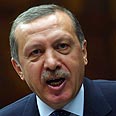
Erdogan: Turkey still friend to Israel
-
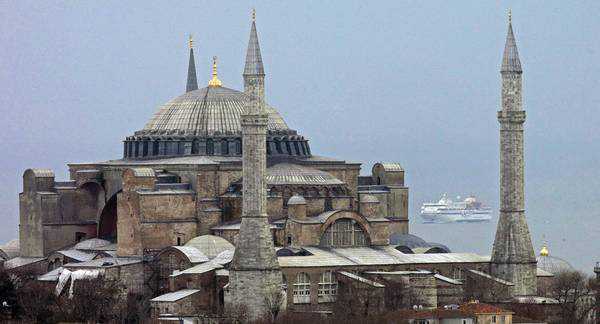
Holocaust: A Huge Word Made Small
Rabbi Hier’s Op/Ed in LA Times:
The Holocaust was a horrific atrocity and watershed event in human history. The meaning of the word is being distorted and demeaned in political rhetoric and casual comparisons.
Marvin Hier
June 29, 2010Over the last few years, U.S. political discourse has been saturated with opponents accusing each other of Nazi-like policies or behavior.
Most recently, it was California Atty. Gen. Jerry Brown who likened the attack ads of Meg Whitman, his Republican opponent in the race for governor, to the tactics employed by Nazi propaganda chief Josef Goebbels.Brown later called me to say he regretted citing Goebbels. But most of the comparisons are made without apology.
Last week, Sarah Palin criticized President Obama’s handling of the BP crisis in a tweet to followers recommending they read an article by Thomas Sowell that compared Adolph Hitler’s use of a financial crisis to give himself dictatorial powers to Obama’s role in creating the BP escrow fund.
A few months ago, speaking about the controversial Arizona immigration bill (a bill that the Wiesenthal Center criticized), Lillian Rodriguez Lopez of the Hispanic Federation reportedly compared the measure to tactics used by the Nazis in Germany.
The Holocaust was a watershed event in the history of mankind, in which
6 million Jews — one-third of the world’s Jewish population — were exterminated. But today the word is used in ways that cheapen it.Last fall, Democratic Rep. Alan Grayson of Florida spoke on the House floor about the need for universal healthcare, saying Americans die every year because they lack insurance. “I apologize to the dead and their families,” he said, “that we haven’t voted sooner to end this holocaust in America.”
In 2007, former Arkansas governor and Republican presidential candidate Mike Huckabee used the word in speaking out against abortion. “For the last 35 years we have aborted more than 1 million people who would have otherwise been in our workforce,” he said, “had we not had the holocaust of liberalized abortions under a flawed Supreme Court ruling in 1973.”
And syndicated columnist David Sirota recently applied the term to the BP gulf oil disaster, saying, “Every American who uses oil — which is to say, every American — is incriminated in this ecological holocaust.”
The continued misuse and trivialization of the word prompted Elie Wiesel, Nobel laureate and chronicler of the Holocaust, to discontinue using it. “Whatever mishap occurs now, they call it ‘holocaust,'” Wiesel said. “I have seen it myself in television in the country in which I live. A commentator describing the defeat of a sports team, somewhere, called it a ‘holocaust.'”
Wiesel is right. There are many injustices and manifestations of evil in our world, even in our own country, the greatest of democracies.
Standing up to them is not only our right but our obligation. But that obligation does not include distorting and demeaning the word that has come to stand for the great evil that was the Holocaust.The Holocaust was a total eclipse of humanity. It was not about going to the back of the line or eating in a different part of the restaurant or being escorted to the border without recourse. The Holocaust had one
purpose: the total annihilation and extinction of a race.The Holocaust was the story of ordinary Germans: students, doctors, men and women of culture, who were not demented, who listened to Bach and Beethoven, who loved their families, who were not diagnosed as psychopaths, but who, nonetheless for six years, rounded up men, women and children and escorted them to the gas chambers.
As the commandant of Auschwitz, Rudolf Höss, wrote in his confession before he was tried and executed in Poland: “Up to this point, it was not clear to me, nor to Eichmann, how the killing of the expected masses was to be done — perhaps by gas, but how and what kind of gas. I was always horrified of death by firing squads, especially when I thought of the large numbers of women and children who would have to be killed. Now I was at ease, we were all saved from these blood baths and the victims would be spared until the last moment…. I also watched how some women, who suspected or knew what was happening, even with the fear of death all over their faces, still managed enough strength to play with their children and talk to them lovingly. Once, a woman with four children, all holding each other by the hand to help the smallest ones, passed by me. She stepped very close to me and whispered, pointing to her four children, ‘How can you murder these beautiful, darling children? Don’t you have any heart?'”
That was the Holocaust. It is not the BP oil disaster, it is not healthcare, it is not Arizona law, it is not the attack ads of Meg Whitman, it is not abortion, and it is not even horrific violations of civil rights.
The enormity of the crimes of the Holocaust was such that if you were to try to call out 2,000 of the names every day of the 6 million who perished, it would take more than eight years to complete the task.
That’s what a holocaust is.Rabbi Marvin Hier is the Founder and Dean of the Simon Wiesenthal Center.
-
RUSSIAN NAVY CAPTURES SOMALIAN PIRATES
RUSSIAN NAVY CAPTURES SOMALIAN PIRATES
Watch video here or download it before it’s taken off the site.
Something the ABC, SBS and the commercial TV networks won’t show
(not politically correct for them).
Vídeo https://true-turtle.livejournal.com/85315.html
This videotape shows Russian Navy commandos on a Somalian
pirate ship shortly after the pirates had captured a Russian
oil tanker. The Euro-Union navy that patrols these waters
would not interfere because they feared there could be
casualties.All explanations are in Russian with a single exception of
when a wounded pirate says something in English. All
conversations between the commandos are in Russian. If you
don’t understand Russian, the pictures speak for themselves.The soldiers freed their compatriots, moved all the pirates
to their own (pirate) ship, searched the pirate ship for
weapons and explosives, and then they left the ship and
exploded it with all remaining pirates on it.The commandos sunk the pirate ship along with the pirates
and without any court proceedings, lawyers etc. That is, theyused the anti-piracy laws of the 18th and 19th centuries wherethe captain of the rescuing ship has the right to decide what todo with the pirates. Usually, they were hanged.Russian ships will not now be targets for Somalian pirates.
Good on the Russians.
No mucking about or tip-toeing over the Tulips here etc.
These pirates have no sympathy towards the ships and their crew
(just look at their weapons they carry), it’s tit-for-tat, the only way they know.Unfortunately for them, they lost.
SCORE:
RUSSIANS = 1
PIRATES = 0
SHIPPING LANES = 1 less pirate crew to worry about!!!!
-
from UN Watch – Geneva Headquarters, June 29 201
0
Israel is under attack. Not with physical weapons, but with “lawfare”—a new form of war using the power of law to delegitimize Israel and weaken its global standing.
In this battle, UN Watch is situated at Ground Zero, directly across the street from the U.N.’s misnamed Human Rights Council.
Tragically, this international body is busy creating one sham investigation after another to slander Israel’s finest soldiers as “war criminals.” The council’s biased reports are then cited as “credible” international evidence to prosecute Israelis in courts worldwide.
Let me tell you where things stand, what we’re doing about it, and how you can help.
Please help
UN Watch speak truth to poweLawfare is dangerously moving from the U.N. into domestic courts. In a 70-page complaint filed last Wednesday in a Belgian court, former Foreign Minister Tzipi Livni and other Israeli leaders and officers stand accused of war crimes.
As we feared, the complaint cites the Human Rights Council’s notorious Goldstone Report, a deeply flawed document that falsely accuses Israeli officials of deliberately targeting Palestinian civilians in last January’s war.
Worse, the council is moving ahead on another mission—a copycat of the Goldstone probe—to investigate the May 31st flotilla incident. Once again, the guilty verdict was declared in advance: Israel was condemned “in the strongest terms” for an “outrageous attack.” First they decide, then they collect the facts…
So what are we doing in response?
UN Watch is fighting back, exposing hypocrisy, and spreading the truth. We led this year’s battle to discredit the Goldstone Report, bringing British Colonel Richard Kemp to testify.
And in the June council session that just ended, UN Watch intervened before the world’s ambassadors with 10 powerful speeches, translated into numerous languages and diffused around the globe. Consider our impact:
-
When the U.N. held an “urgent debate” on the flotilla, UN Watch was the only organization to testify about the violent Jihadists on the Mavi Marmara ship who deliberately provoked Israel. Our speech was seen throughout the world on YouTube—click here for video — and reprinted on the editorial page of the National Post.
-
UN Watch exposed the council members’ hypocrisy and double standards in ignoring this month’s real humanitarian catastrophe, in Kyrgyzstan—click for video.
-
When the Syrian delegate revived the ancient blood libel by accusing Israel of teaching its children to sing about “sucking blood” and “tearing flesh,” UN Watch was the only one at the U.N. to speak out. Following our appeal, the United States responded strongly, saying, “Such insults and slurs are deeply offensive and an affront to the dignity of all. They evoke classic anti-semitic stereotypes.”
-
When U.N. investigator Richard Falk called for a “Legitimacy war” against Israel, UN Watch exposed his support for Hamas — and for 9/11 conspiracy theories. Click here for video.
-
UN Watch itemized massacres around the world over the past 12 months that were systematically ignored by the council, which only summoned moral outrage when it came to Israel. This speech was reprinted prominently in yesterday’s Toronto Sun. Columnist Peter Worthington wrote that UN Watch “has earned lots of respect,” praising us as “one of the more interesting organizations concerned with the fate of the world and the people in it.” World leaders visiting Toronto’s G-20 summit hopefully saw the article.
Day in and day out, we expose the U.N. council’s phony veneer of credibility, by reminding the world of its membership: gross violators like Col. Qaddafi’s Libya, Cuba, China, Pakistan, Russia, and Saudi Arabia. This month alone, UN Watch’s facts and truth-telling message were quoted in such places as the Miami Herald, FOX News, and the prestigious Foreign Policy.
Our battle is non-stop. I just got back to my office now from a meeting of human rights organizations with the U.N.’s new committee of legal experts to implement the Goldstone Report. I was the only one to speak out against the report’s bias. I submitted detailed rebuttal evidence, and warned the experts of how their findings will be misused by the Arab-controlled council to the benefit of Hamas terrorists.
Selim, you can help UN Watch defend freedom, democracy and truth by supporting the work of our dedicated staff of six to battle dictatorships and double standards, and to defend the right of Israel to exist as a legitimate U.N. member state.
That’s why I am asking for your financial support. Please, Selim, send a secure online donation now so we can continue speaking truth to power. It’s wrong for human rights to be hijacked by the world’s worst abusers and their apologists. And I know you won’t tolerate it.
-
-

Why Russia’s Medvedev is blasting ally Kyrgyzstan
Russian President Dmitry Medvedev unexpectedly criticized a government reform vote in Kyrgyzstan that passed Sunday with 91 percent support.
Kyrgyzstan's interim leader Roza Otunbayeva (front l.) greets a group of ethnic Kyrgyz citizens at a polling station on the day of a referendum in the city of Osh Sunday.
Sagyn Alchiyev/Kyrgyz Presidential Press/Reuters
MoscowTurbulent Kyrgyzstan's weekend referendum on reforming its political system has won overwhelming support from the population. But Russia, Kyrgyzstan's closest ally, has unexpectedly criticized the effort. Skip to next paragraphSpeaking to journalists at the G-20 meeting in Toronto, President Dmitry Medvedev poured cold water on the referendum's goal of changing Kyrgyzstan's Constitution from a president-dominated system into one in which a popularly-elected parliament holds the lion's share of power. He also warned that the tiny central Asian country faced the "threat of breaking up" and being overrun by "extremists." The referendum passed Sunday with 91 percent of voters backing the government's reform plan. International observers, led by the Organization for Security and Cooperation in Europe, praised the polling. Others in the international community have expressed hope that the referendum, to be followed by parliamentary elections in October, would help Kyrgyzstan recover and rebuild after devastating ethnic riots killed around 2,000 people and displaced hundreds of thousands in the country's volatile south earlier this month. Experts say the vote marks a major step toward legitimizing the fractious interim government in Bishkek, which came to power in a Moscow-backed coup d'etat that was thinly disguised as a popular revolt in April. Now Moscow is expressing disenchantment with the government's big win. "Taking into account the fact that even now the authorities are unable to impose order, that the legitimacy of the authorities is low and its support creates a host of questions, I do not really understand how a parliamentary republic would look and work in Kyrgyzstan," Mr. Medvedev said. "Will this not lead to a chain of eternal problems – to reshuffles in parliament, to the rise to power of this or that political group, to authority being passed constantly from one hand to another, and, finally, will this not help those with extremist views to power?" he said. "This concerns me."Russian President Dmitry Medvedev arrive in advance of the G8 and G20 Summit at Pearson International Airport in Toronto, Thursday.
Gerry Broome/AP
EnlargeRelated Stories
- To make progress on Afghanistan and Russia, Obama must get Kyrgyzstan right
- Kyrgyzstan riots led to ethnic cleansing; government blames Bakiyev
- All Russia news coverage
Analysts confused by Russian move
Analysts say they are unsure what Medvedev might have been hoping to achieve by trashing the plan, since Russia's only hope of restoring stability in the region appears to ride with interim government head Roza Otunbayeva, whom it has supported since she came to power in April. But Russia dithered while riots shook Kyrgyzstan this month, and then decided against intervening in the turmoil, despite Kremlin assertions that the former Soviet Union constitutes a Russian "sphere of influence." Some analysts say Medvedev was voicing his frustration with what Moscow sees as a deteriorating situation in central Asia, which it seems increasingly incapable of dealing with. "In Moscow they are deeply disappointed with the interim government in Bishkek, which they had hoped would be stronger," says Alexei Malshenko, an expert with the Carnegie Center in Moscow. "But Russia's inaction reveals it as impotent to affect events in the region. It's a tragedy for Russian foreign policy, and this appearance of helplessness will encourage all of Moscow's enemies to be more active." Others argue that, while Medvedev's remarks may have been unhelpful, they merely expressed the traditional Russian skepticism about parliaments, which have always been seen as too fractious and divisive to impose decisive rule. Russia's own Kremlin-centered Constitution – which leaves parliament with mostly ornamental functions – was authored by former president Boris Yeltsin, after he dispersed his freely-elected but disobedient legislature with gunfire in 1993 "In Russia there is mistrust toward the very idea of a parliamentary republic," says Leonid Gusev, an expert with the official Institute of World Economy and International relations, which trains Russian diplomats. "Medvedev just said what he was thinking."Reforms aimed at stability
Ms. Otunbayeva has championed the constitutional reform as a means of breaking Kyrgyzstan's repetitive cycle of corrupt all-powerful presidents, whose excesses have triggered two street revolts in barely five years. On Monday Otunbayeva said that popular support for the measures means that Kyrgyzstan is now on the path to "a true government of the people... this is a very important, historic day for the country. The people have put a stop to the epoch of authoritarian and nepotistic government," she said. But many analysts fear that Kyrgyzstan may face more disruptions, including attempts by supporters of former president Kurmanbek Bakiyev, who went into exile in Belarus after being deposed in April. Mr. Bakiyev is accused of stirring up the ethnic animosities that led to the deadly upheavals in southern Kyrgyzstan this month, a charge that he denies. But in an interview with the German magazine Der Spiegel today, Bakiyev pours scorn on Otunbayeva's democracy plans, saying they are "leading the country into a dead end", and warns that Kyrgyzstan's powerful political clans may soon turn against the interim president. "The referendum may be the beginning of a process of legitimizing the new authorities, and if we get to the parliamentary elections it will be strengthened," says Alexander Knyazev, a Bishkek-based analyst. "The crisis does appear to be over for the moment, but we don't know what Bakiyev and his supporters may be up to," he says. "Another crisis looks fully possible." RELATED STORIES:- To make progress on Afghanistan and Russia, Obama must get Kyrgyzstan right
- Kyrgyzstan riots led to ethnic cleansing; government blames Bakiyev
- All Russia news coverage
-
Turkey Assumes Asia Security Group Chairmanship for 2010-2012
June 29, 2010
E. Akman
Officials from nearly 40 countries gathered in Istanbul, Turkey, on June 7, 2010, for the Third Summit of the Conference on Interaction and Confidence Building Measures in Asia (CICA). During the conference, Turkey assumed the CICA presidency from Kazakhstan for the term of 2010 to 2012. It is the first time a country other than Kazakhstan, which founded CICA, will head the organization.“Turkey possesses unique historic, political and cultural experience to advance this extremely complex process of building confidence and promoting the Asian cooperation,” noted Kazakh President Nursultan Nazarbayev. “I am sure that the Republic of Turkey will add great momentum to the strengthening and further development of our Conference.”
From its inception, the founders of CICA envisioned it as an organization modeled after the Organization for Security and Cooperation in Europe but with a focus on Asia. It is, like OSCE, a multi-national forum for enhancing cooperation and promoting peace, openness, mutual trust, security and stability in Asia. The forum brings together countries from different cultural dimensions to provide for a wide variety of discussions aimed at increasing security and trust on the Asian continent.
With 23 member states representing 90 percent of the geography and population of Asia – Afghanistan, Azerbaijan, China, Egypt, India, Iran, Iraq, Israel, Jordan, Kazakhstan, Kyrgyzstan, Mongolia, Pakistan, Palestine, Republic of Korea, Russia, Tajikistan, Thailand, Turkey, Vietnam, United Arab Emirates and Uzbekistan — 10 observing states and institutions (such as the United States, United Nations, and Organization for Security and Cooperation in Europe), CICA has the potential to lay the foundation for the much needed regional stability.
At a recent forum on CICA at the Center for Strategic and International Studies in Washington, Turkish Ambassador Namik Tan and Kazakh Ambassador Erlan Idrissov both spoke of the importance of the regional cooperation organization. [A summary of the event can be found here.]
“If CICA didn’t exist, we would have to invent it,” Ambassador Tan remarked at the forum, citing the critical role the organization plays in building security in the region through economic, human and environmental initiatives and by laying a foundation for confidence building among disparate states that are themselves sometimes in conflict. Indeed, in 2004, CICA adopted The Catalogue of Confidence-Building Measures, a valuable tool to promote better understanding between member states.
“We in Asia sleep under one blanket but see different dreams,” noted Ambassador Idrissov at the CSIS event, adding that CICA is filling a security void in the Asian region that will ensure that “the dreams are benign and not nightmares.”
The theme of the Turkish CICA Chairmanship is “Enhanced Political and Security Dialogue in Asia: Key to Elaborating Cooperative Approaches to Security.” The Turkish Chair will work steadfastly to promote the concept of indivisible and cooperative security in Asia through the process of enhanced dialogue and strive for achieving consensus. Turkey will support the continuation of the existing projects of cooperation in not only military and political dimensions, but also in the fields of trade, economy, environment, disaster relief, transportation, energy and cultural exchange.
Furthermore, in the joint declaration issued at the end of their summit in Istanbul, all CICA member states agreed to work together to:
enhance co-operation through elaborating multilateral approaches towards promoting peace, security and stability in Asia;
eradicate the menace of terrorism in all its forms and manifestations;
combat illicit drug production and trafficking;
promote trade and economic cooperation for the prosperity and stability in Asia;
cooperate on all issues relating to environment;
prevent the proliferation and eventual elimination of weapons of mass destruction;
develop measures to address humanitarian issues; and
promote mutual respect, understanding and tolerance in the relations among civilizations.
CICA is still a work in progress that doesn’t intend to compete with other international, regional or sub-regional organizations. Rather, it aims to play a complementary role by providing a platform for political dialogue and encouraging clos
er cooperation in every field among its members.


