Month: April 2010

  • The real obstacle to Turkish-Armenian rapprochement (1)

    The real obstacle to Turkish-Armenian rapprochement (1)

    Mehmet Kalyoncu*

    Yerevan’s unilateral decision, as Turkish Foreign Minister Ahmet Davutoğlu describes it, to put the Turkish-Armenian rapprochement on hold should have had a cold shower effect on those who had long been fed up with the overcooked so-called Armenian genocide debate.

    On April 22, Armenian President Serzh Sarksyan signed a decree suspending the ratification of the “Protocol on Establishing Diplomatic Relations between the Republic of Armenia and the Republic of Turkey” and “Protocol on Opening the Border between the Republic of Armenia and the Republic of Turkey.”

    In his televised address to his fellow Armenians, Sarksyan said, “Our political objective for normalizing relations between Armenia and Turkey remains valid, and we shall consider moving forward when we are convinced that there is the proper environment in Turkey and the leadership in Ankara is ready to reengage in the normalization process.” Referring to Ankara’s demand for Armenia to end its occupation of the Nagorno-Karabakh region of Azerbaijan before Parliament ratifies the protocols, the Armenian president charged Ankara with causing the breakup in the normalization process by making the end of Armenian occupation a precondition to the ratification.

    While Ankara repeatedly reiterated its wish to continue the normalization of relations with Yerevan, on April 24 Armenian demonstrators burned Turkish flags as well as posters of Turkish President Abdullah Gül, Prime Minister Recep Tayyip Erdoğan and Davutoğlu during the so-called Armenian genocide commemoration ceremonies attended by President Sarksyan and other Armenian officials.

    Like the Armenian officials, some inside and outside Turkey have criticized Ankara for pushing the end of Armenian occupation in Nagorno-Karabakh as a precondition to the ratification of the protocols. Some even argued that there was no relationship between the occupation and the normalization of Turkish-Armenian relations and that Azerbaijan stood as an obstacle to normalization.

    As a matter of fact, the real obstacle to Turkish-Armenian rapprochement is Armenia’s irredentist attitude toward its neighbors. As such, Armenia’s irredentism not only constitutes a national security threat to Turkey, but also is the major obstacle to any step toward sustainable security and stability in the South Caucasus. So long as Yerevan does not irreversibly change this attitude, it is unlikely to achieve any sustainable relationship between Turkey and Armenia.

    Armenia is an irredentist country. That is, it is a country with aspirations on a part of another country’s land, over which it claims to have the political right to control. Article 11 of the Armenian Declaration of Independence reads, “The Republic of Armenia stands in support of the task of achieving international recognition of the 1915 Genocide in Ottoman Turkey and Western Armenia,” referring to contemporary eastern Turkey as Western Armenia. Article 12 reads, “This declaration serves as the basis for the development of the constitution of the Republic of Armenia and, until such time as the new constitution is approved, as the basis for the introduction of amendments to the current constitution; and for the operation of state authorities and the development of new legislation for the republic.” So obviously, the crux of the Armenian Constitution and of the guideline for the state authorities is Yerevan’s unrelenting aspirations to seize eastern Turkey as well as other possible monetary and political reparations.

    Yerevan has proven its characteristic as such by invading and occupying 20 percent of a neighboring country — Azerbaijan. Consequently, another neighboring country, Turkey, which has long been the main target of Yerevan’s irredentist aspirations, closed its common border with Armenia. Although Turkey and Azerbaijan do have deep cultural, ethnic, social, economic and political ties and as such Turkey’s closure of the border may seem and has long been portrayed as an emotional response to Armenia’s invasion of Azerbaijan’s territories, Turkey’s response to the invasion is purely a rational one.

    *Mehmet Kalyoncu is an international relations analyst
  • The real obstacle to Turkish-Armenian rapprochement

    The real obstacle to Turkish-Armenian rapprochement

    Mehmet Kalyoncu*


    It is only normal for a country to seal its common border with an irredentist neighbor to maintain its national security and territorial integrity.

    It is more so given that Armenia has never officially recognized and acknowledged its common border with Turkey, constitutionally considers part of Turkey’s lands as its own and worse, has for almost two decades been occupying 20 percent of another neighboring country. So, the reason Turkey shut its border with Armenia and why Turkey should keep it as such is not simply Turkey’s affinity with Azerbaijan, but Armenia’s irredentist nature and the security threat that it clearly poses to its neighbors. The fact that Armenia cannot dare to confront Turkey militarily neither ceases its aspirations on Turkish territories nor changes its malignant nature that has long obstructed progress toward security and stability in the South Caucasus.

    Moreover, the impunity Armenia has long enjoyed despite its continuous violations of international law, humanitarian law, Geneva conventions and United Nations Security Council resolutions during and after its invasion of Azerbaijani territory makes Yerevan even more reckless about paralyzing its peace talks with Turkey and Azerbaijan. On April 30, 1993, the UN Security Council adopted resolution S/RES/822 (1993), “noting with alarm the escalation in armed hostilities and, in particular, the latest invasion of the Kelbadjar district of the Republic of Azerbaijan by local Armenian forces, Expressing grave concern at the displacement of a large number of civilians and the humanitarian emergency in the region, Reaffirming also the inviolability of international borders and the inadmissibility of the use of force for the acquisition of territory, [and demanding] the immediate cessation of all hostilities and hostile acts with a view to establishing a durable cease-fire, as well as immediate withdrawal of all occupying forces from the Kelbadjar district and other recently occupied areas of Azerbaijan.” This resolution came after Yerevan-backed local Armenian forces killed 613 Azerbaijani civilians, including 106 women and 83 children, in the town of Khojali on Feb. 25-26, 1992. Instead of ceasing their attacks, the Armenian forces expanded their killing campaign to beyond the Nagorno-Karabakh region into surrounding districts such as Lachin, Kubatly, Jebrail, Zangelan, Aghdam and Fizuli. As Armenian forces continued to invade these districts, the UN Security Council adopted resolutions 853, 874 and 884 in the same year demanding a cease-fire and the withdrawal of Armenian forces from the occupied Azerbaijani territories.

    To this day, however, these districts, totaling 8.9 percent of Azerbaijani territory, as well as the Nagorno-Karabakh region remain under the control of Armenia. The way Sarksyan recalls the Khojali massacres is quite telling: “We don’t speak loudly about these things. But I think the main point is something different. … Before Khojali, the Azerbaijanis thought that they were joking with us, they thought that the Armenians were people who could not raise their hand against the civilian population. We were able to break that [stereotype]. And that is what happened.” (Thomas de Waal, “Black Garden: Armenia and Azerbaijan through Peace and War,” NYU Press 2004, p.172) By that, President Sarksyan also implies what they aspire to do so long as the circumstances permit.

    The way forward

    In the final analysis, the current leadership in Yerevan does not seem to be ready to acknowledge its past transgressions, let alone make due reparations to their victims. Yet it can start by revisiting Armenia’s irredentist characteristic and finding ways to get rid of it instead of asking Ankara to give up its precondition to the ratification of the protocols.

    In the meantime, Ankara should recognize that the normalization of Turkish-Armenian relations is directly contingent to not one but two preconditions: First, Armenia must end its occupation of the Azerbaijani territories in the Nagorno-Karabakh region as well as the surrounding districts, and second, it must remove from its constitution the articles that describe eastern Turkey as “Western Armenia.” In the absence of the other, satisfying one of these conditions is not enough, because while one literally certifies Yerevan’s irredentist aspirations toward Turkey, the other practically illustrates that Yerevan would seek to fulfill those aspirations once the circumstances permit. Until then, Turkey’s common border with Armenia should remain sealed.

     *Mehmet Kalyoncu is an international relations analyst

  • Bradford MP criticises ‘malicious’ flyer

    Bradford MP criticises ‘malicious’ flyer

    Parliamentary candidate for Bradford East Terry Rooney withdrew from a hustings in the constituency at the weekend because of a “malicious” leaflet campaign designed to target Muslim voters.

    The event on Saturday at the Karmand Centre,Barkerend Road, was attended by the Liberal Democrats’ David Ward and the Conservatives’ Mohammed Riaz.

    Mr Rooney, who has been an MP since 1990, told the Telegraph & Argus he became suspicious about the event after seeing the leaflets which brand him a warmonger and a Twitter campaign encouraging Muslims to vote for a Muslim candidate.

    He said: “They are trying to legitimise voting on religious grounds through third party campaigning.”

    Councillor Ward said the group had identified his record on political issues, and accused Mr Rooney of bottling it.

    Bradford Voice, an organisation which is calling for voters to be active in the forthcoming elections, organised the event. One member said the leaflets were unconnected to the event and they were disappointed that Mr Rooney felt he was unable to attend. She added that if he had contacted them, they could have clarified the position.

    The leaflets, headed Operation Muslim Vote, were written by the organisation Muslim Public Affairs Committee, who were unavailable for comment.

    Telegraph & Argus

  • Massachusetts State of the United States recognizes Khojaly tragedy as a massacre

    Massachusetts State of the United States recognizes Khojaly tragedy as a massacre

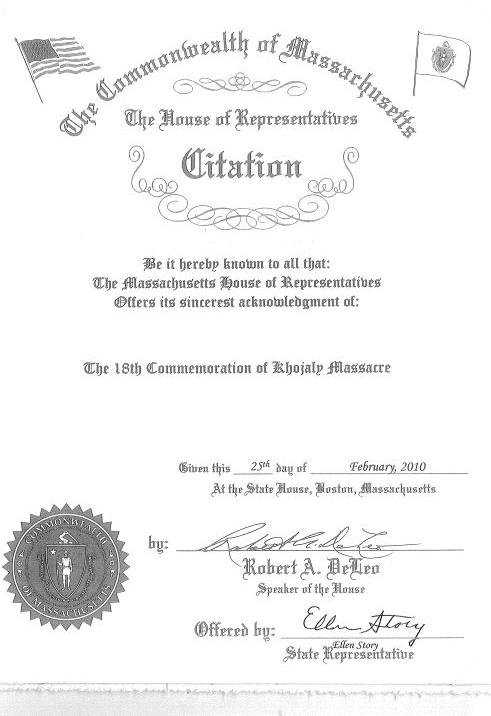
    The House of Representative of the Commonwealth of Massachusetts State (USA) has accepted relative document on the day of 18th Commemoration of Khojaly Massacre.

    The document dated on 25 February 2010 is signed by Speaker of the House Robert De Leo says: “Be it hereby known to all that: The Massachusetts House of Representatives offers its sincerest acknowledgment of: the 18th Commemoration of Khojaly Massacre”.

    Justice for Khojaly campaign expresses its gratitude for the initiative of Members of House of Representatives to commemorate the 18th anniversary of the Khojaly massacre in House’s session that took place on February 25, 2010.

    We appreciate and applaud the initiative on remembrance and recognition of Hause of Representatives this historical tragedy of humanity perpetrated against the civilian population of the Khojaly town (Azerbaijan) by Armenian military gangs and Ex-Soviet 366th regiment in February 1992. By raising this issue in legislative institutions it will be possible to make it globally heard by decision-makers around the globe and condemn crimes that are perpetrated against innocent victims of conflicts.
    We also invite the friends of Justice for Khojaly campaign to sign the petition to World leaders and call them to recognize the Khojaly massacre as a crime against humanity at the following link http://www.justiceforkhojaly.org/?p=petition. By signing the petition the one can address the drafted letter to UN, President of the US, European Union, Council of Europe, OIC Parliamentary Unit chairpersons and other decision-makers of your geographical organizations.

    If you want peace, work for justice.

    Justice for Khojaly

    on http://www.facebook.com/pages/Khojaly-town/Justice-for-Khojaly-Campaign/101823787520

  • Armenian Canadians rally to remember killings

    Armenian Canadians rally to remember killings

    Last Updated: Saturday, April 24, 2010 | 7:59 PM ET

    CBC News
    The rally on Parliament Hill Saturday was followed by a march to  Ottawa's Turkish Embassy.The rally on Parliament Hill Saturday was followed by a march to Ottawa’s Turkish Embassy. (CBC)Hundreds of Armenian Canadians rallied in Ottawa Saturday for Turkey to recognize the killing of 1.5 million Armenians nearly a century ago as a genocide.

    The mass killings by Ottoman Turks began in 1915 and continued for a decade.

    “We are not able to forget that, so we’re going to repeat that each year,” said Robert Kouyoumdjian, executive director of the Armenian National Committee of Canada, about the rally. Beginning at noon on Parliament Hill, the rally led into a march to the Turkish Embassy.

    Similar events will be held annually until Turkey stops claiming that the deaths took place during a civil conflict, Kouyoumdjian said.

    “We didn’t fight any war against Turkey. We were part of Turkey,” said Kouyoumdjian, whose grandfather fought in the Turkish army. He added that Turkey had created its own version of history — “To make [us] forget the truth and anything else.”

    Turkey has long said the estimated death toll of 1.5 million people around the time of the First World War is an inflated figure. It also maintains that those killed were victims of civil war and unrest, not genocide.

    Canada recognized genocide in 2004

    Nevertheless, Canada’s House of Commons voted in 2004 to recognize the killings as genocide. The U.S. foreign affairs committee endorsed a similar resolution this past March, even though the Obama administration had urged Congress not to offend Turkey by approving it.

    Robert Kouyoumdjian, executive director of the Armenian National  Committee of Canada, said similar events to Saturday's rally will be  held annually until Turkey recognizes the killings as a genocide.Robert Kouyoumdjian, executive director of the Armenian National Committee of Canada, said similar events to Saturday’s rally will be held annually until Turkey recognizes the killings as a genocide. (CBC)Ottawa police had expected about 1,000 people to turn out for Saturday’s rally. Speakers included Ottawa-Orleans MP Royal Galipeau and Scarborough-Agincourt MP Jim Karygiannis, who brought forward the 2004 private member’s bill leading to Canada’s recognition of the genocide.
    The crowd sang and chanted while waving the red, blue and orange Armenian flag.

    Demonstrators placed flowers around the Eternal Flame before marching to the Turkish Embassy.

    Some of the demonstrators said Armenians today are still strongly affected by the deaths and by Turkey’s refusal to recognize them as a genocide.

    “We need to fight,” said Cécile Kozadjian, who described herself as a member of the fourth Armenian generation after the war. “We need to say that it really did happen and they shouldn’t be in denial ’cause it’s the truth.”

    “We need to remember,” agreed Raffi Sarkissian. “That’s the only way we can end the cycle of genocide and prevent future cases of genocide anywhere else.”

    ————————————————————————————————–

    CBC Newsworld

    Armenian killings anniversary Vahan Kololian, chairman of the Mosaic Institute, and Demir Delen, former president of the Federation of Canadian Turkish Associations, discuss how the Turkish and Armenian communities can move forward Watch: 7:36

    From: [email protected] [mailto:[email protected]] On Behalf Of FUAT ORNARLI
    Sent: Tuesday, April 27, 2010 10:39 PM
    To: [email protected]
    Subject: RE: [SFLTURKS] CBC Newsworld

    Sayin Buyukataman.

    Bende acildi. Yayinin kaynagindan degil, belki bilgisayarinizdan dolayi bir problem yasadiniz. Tekrar tekrar baslatin. Ola ki calisir. Ben Firefox kullaniyorum.

    Kanada TV’sinin karsisina eski Turk dernegi baskani ve Ermeni Vahan Kololyan cikti. Vahan, kelimelere takilmayalim, siniri acalim, iki millet arasi munasebetler ilerlesin diyor. Demir bey ise, “her toplantinin basinda “Once Soykirimi” taniyin sonra ‘move on’ dedikce bu imkansiz. Kanada parlementosunun da henuz iki taraf arasinda henuz ispatlanmamis bir tarihi konuda karar vermesi dogru degildi” dedi. “Zaten sinirin kapanmasi Azerbeycan’in isgaliile ilgiliydi” dedi.

    Kisa bir soylesi, ama dostca konusma oldu. Yani Yigit Bulut’un acik oturumlari gibi herkesin ayni anda konustugu seviyesiz bir oturum degildi.

    Saygilar,

    Fuat ORNARLI
    Cell:(786) 251-9996

  • Turkey Accord Abrogation ‘Still An Option’ For Armenia

    Turkey Accord Abrogation ‘Still An Option’ For Armenia

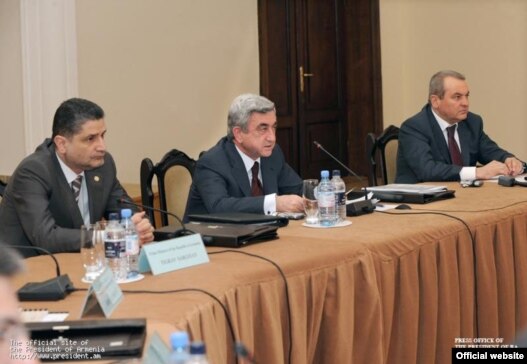
    Armenia -- President Serzh Sarkisian (C) speaks at a meeting of the Council on Atomic Energy Safety in Yerevan, 27 April 2010.Armenia — President Serzh Sarkisian (C) speaks at a meeting of the Council on Atomic Energy Safety in Yerevan, 27 April 2010.

    27.04.2010
    Ruzanna Stepanian

    President Serzh Sarkisian held out hope for Armenian electricity exports to Turkey on Tuesday just as one of his top diplomats warned that Yerevan may still formally rescind the Turkish-Armenian normalization agreements.

    Foreign Minister Edward Nalbandian, meanwhile, brushed aside continuing domestic criticism of the Sarkisian administration’s policy on Turkey and accused Armenia’s previous leadership of committing foreign policy “mistakes.”

    Sarkisian touched, in passing, upon his decision to freeze Armenian parliamentary ratification of the agreements as he chaired a regular meeting of his advisory Council on Atomic Energy Safety. He said the opening of the Turkish-Armenian frontier, which he described as “Europe’s last closed border,” would give a massive boost to energy cooperation in the region.

    “Despite the fact that the process has been suspended because of the Turkish government’s inactivity, we see a potential to export electricity to Turkey and, by transit, on to countries of the Middle East,” the president said. He did not specify whether he thinks Armenian power supplies could start before the Turkish-Armenian protocols are put into effect.

    An agreement on such deliveries was reportedly reached by Armenian and Turkish energy companies during Turkish President Abdullah Gul’s historic visit to Yerevan in September 2008. Energy Minister Armen Movsisian and other Armenian officials repeatedly said in the following months that power grids in eastern Turkey are gearing up electricity supplies from Armenia.

    Movsisian said in October last year that the energy deal has not been implemented because of “political problems in Turkey.” The effective freezing of the Turkish-Armenian protocols announced by Sarkisian on April 22 seems to have made the launch of energy cooperation between the two neighboring states even more problematic.

    Speaking to RFE/RL’s Armenian service after the meeting of the presidential council, Deputy Foreign Minister Arman Kirakosian defended Sarkisian’s decision not to walk away from the protocols despite Ankara’s refusal to unconditionally ratify them.

    “Let us not forget that we too have an option to withdraw our signatures [from the protocols,]” Kirakosian said. “That is a variant. Depending on further developments in the process, we may use that variant.”

    The diplomat added that such a scenario will be “definitely possible” if the normalization process remains deadlocked. But he could not say just how long Yerevan is ready to wait.

    “If there are credible statements and actions by the Turkish leadership, there will be adequate steps on our part,” Nalbandian told Armenian Public Television late on Monday. “But I see no need whatsoever to start new negotiations [with Ankara.]”

    Nalbandian also hit out at domestic critics of the Sarkisian administration’s policy on Turkey. He said recent resolutions approved by U.S. and Swedish lawmakers disproved their claims that the Turkish-Armenian rapprochement will halt broader international recognition of the Armenian genocide.

    And in an apparent jibe at former President Robert Kocharian, Nalbandian said: “You know, when it comes to ensuring the continuity of foreign policy, that doesn’t mean we should continue mistakes. We must not repeat mistakes, and it is this logic that led the president of the republic to start this process.” He did not elaborate.

    Earlier on Monday, a key member of the Kocharian administration, former Foreign Minister Vartan Oskanian, renewed his strong criticism of the protocols and said Sarkisian has opted for the worst possible response to the Turkish delay tactic. “If there were half a dozen possible exit strategies from this situation – from doing nothing to revoking Armenia’s signature – the government has chosen the option least beneficial to us,” Oskanian said in a statement.

    Kirakosian, who served as deputy foreign minister also under Oskanian, disagreed with the claim, arguing that Sarkisian’s move has been praised by the United States and other foreign powers. “I think it was the right decision,” he said. “Right now we are waiting to see what developments will occur in Turkey in relation to the ratification process.”

    https://www.azatutyun.am/a/2026203.html