Month: December 2009

  • Headquarters of Turkish campaign for EU membership is… a confiscated Christian building

    Headquarters of Turkish campaign for EU membership is… a confiscated Christian building

    Damian Thompson

    Damian Thompson is Blogs Editor of the Telegraph Media Group.

    Turkey’s political elite is obsessed with joining the European Union. But senior players in the EU – in a rare moment of clarity amid their delusional fantasies of a federal Europe – are reluctant to let in a country which is increasingly hard to distinguish from the rest of the Islamic world. Here’s a tip for Turkish campaigners for EU membership: if you want to win over Herman Van Rompuy, best not set up your headquarters in a building confiscated from your country’s oppressed Orthodox Christian minority.

    This how the Un:dhimmi website reports the controversy:

    Unbelievable but true: the headquarters of the Secretariat for the entry of Turkey into the European Union is a building confiscated from the Orthodox Christian community in the 90s. The building is located in Istanbul, in the well-known area of Ortakoy, under the first bridge over the Bosphorus.

    Before the seizure, the building was used as a primary school for children of the minority Orthodox in Ortakoy. Here once lived a thriving Orthodox community, now non-existent because of past purges against minorities, executed by the “secular” Turkish State.

    And some background:

    Turkey is often portrayed as a “secular” modern Muslim state. This was indeed the founding vision of the Republic’s “Father”, Mustafa Kemal Atatürk, when he created the republic out of the ashes of the Ottoman Empire in the 1920s.

    However, since late 2002, when Erdoğan’s AK Party came to power, a creeping Islamisation of Turkey has been embarked upon – and the small Christian community has been subjected to increasing harassment and persecution (a social norm in Muslim countries – ask any Christian in Egypt or Pakistan, for example).

    And it’s not just the government. A recent survey of Turks revealed:

    More than half of Turks oppose non-Muslim religious meetings

    59 percent of those surveyed said non-Muslims either “should not” or “absolutely should not” be allowed to hold open meetings where they can discuss their ideas.

    54 percent said non-Muslims either “should not” or “absolutely should not” be allowed to publish literature that describes their faith.

    49 percent of those surveyed said they would either “absolutely” or “most likely” not support a political party that accepted people from another religion.

    The theory that these prejudices will melt away once Turkey is admitted to the EU strikes me as quite fatuous. Ask yourself: has the protective generosity of the welfare state made Islamic immigrants to Britain any more accommodating to our liberal traditions?

    Tags: european union, Ortakoy, Turkey

  • One World Government? Globe may not be big enough.

    One World Government? Globe may not be big enough.

    By Dana Milbank

    Wednesday, November 11, 2009

    The Washington Post

    It arrived at the Capitol, until that moment the seat of American government, in the form of the stooped and bespectacled figure of Ban Ki-moon, who as U.N. secretary general is the de facto leader of what conspiracy theorists call the One World Government. One floor beneath the Senate chamber, Ban, a South Korean national, took his place behind a lectern bearing the Senate seal and spelled out his demands.

    “I would certainly expect the Senate to take the necessary action; that’s what I have encouraged the senators,” he told reporters as a trio of lawmakers stood at his side. He added an admonition for the chamber to deliver “as soon as possible.”

    The One World Government has specific requirements, Ban added, namely a “legally binding” commitment to “25 to 40 percent greenhouse gas reduction . . . as recommended by the IPCC, the Intergovernmental Panel on Climate Change.”

    Uh-oh. A U.N. official standing in the Capitol telling U.S. lawmakers what binding commitments intergovernmental authorities expect from them? Glenn Beck was going to burst a blood vessel.

    But the man who orchestrated this putsch by the New World Order, Senate Foreign Relations Chairman John Kerry (D-Switzerland), did not appear concerned by the imagery. He called the secretary general “Your Excellency.” Sen. Richard Lugar of Indiana (a Republican, but he drives a Prius) was equally deferential as he spoke of “the privilege of this distinguished visitor.”
    And Sen. Joe Lieberman (I-Conn.) hailed Ban for “the accelerated leadership role” that the United Nations has taken. “Your vision, that in Copenhagen there can be a politically binding agreement that will lead to a legally binding agreement to follow . . . is a very reasonable, sensible and hopeful course.”
    Somewhere in Manhattan, Sean Hannity was tearing up his script for the night’s broadcast.
    Kerry invited Ban to lecture the Foreign Relations Committee, but it’s not clear what the chairman hoped to gain from the photos of him standing with Ban in the Capitol’s Brumidi Corridors. Indeed, it seemed quite possible that a U.N. endorsement of Kerry’s climate efforts would embolden its foes, who like the world body even less than they like cap-and-trade. In the pantheon of conspiracy theories, the United Nations is right up there with the Illuminati, the Trilateral Commission, the Federal Reserve and the Council on Foreign Relations — which, as it happens, Kerry addressed a couple of weeks ago.
    Even Americans who don’t come from the grassy-knoll tradition tend not to regard the United Nations with great confidence. A Gallup poll earlier this year found that 65 percent of respondents thought it was doing a bad job, compared with 26 percent who think it is doing a good job. Ban himself is not terribly nefarious, if only because he is unknown. A Wall Street Journal poll found that 81 percent of those surveyed didn’t know who he was. The others may have confused him with the Unification Church’s Rev. Sun Myung Moon.
    Ban’s profile could become much higher, and not in a good way, if Americans start to perceive him as meddling in Senate consideration of climate legislation. Even before he stormed the Capitol, Fox News was drawing a connection between global warming talks in Copenhagen next month and One World Government.
    “America, if you believe this country is great but you’re not really into that whole One World Government thing, watch out,” Fox News Channel’s Beck warned a couple of weeks ago. His guest, Lord Christopher Monckton of Britain, told Beck that “at Copenhagen, a treaty will be signed that will, for the first time, create a world government with powers to intervene directly in the economy and in the environmental affairs of individual nations.” Earlier on Fox News, Dick Morris informed Hannity that President Obama “believes in One World Government.” And author Jerome Corsi went on Hannity’s show to warn about a One World Government in which “our sovereignty would be subject to the dictates” of the United Nations and other international organizations.
    The One World Government was on open display at the Capitol on Tuesday, as international U.N. staffers waited outside the room where Ban spoke to the senators. The secretary general had come with his own world government (armed?) security detail, who stood alongside the Capitol police.
    Ban, wearing a gold U.N. lapel pin, unfolded his speech. “Less than a month from now, the leaders of the world will gather in Copenhagen,” he said. “They must conclude a robust global agreement,” that is “comprehensive, binding, equitable and fair.”
    Speaking softly but firmly, the South Korean cautioned the Americans that “the world is not standing still,” and that “all the eyes of the world are looking to the United States.”
    After a few minutes, Kerry cut off questioning. “Folks, the secretary general has to get to the airport.”
    Ban needed to catch the U.S. Airways shuttle to New York. The One World Government Air Force isn’t what it’s cracked up to be.
    The Washington Post

  • Italy’s PM Silvio Berlusconi is bloodied by attack

    Italy’s PM Silvio Berlusconi is bloodied by attack

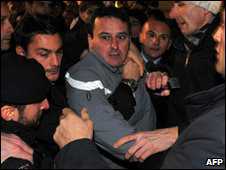
    Prime Minister Silvio Berlusconi of Italy is recovering in hospital after an assault left his face covered in blood following a rally in Milan.

    He suffered two broken teeth, a minor nose fracture and cuts to his lip after being struck by a man wielding a souvenir model of the city’s cathedral.

    Mr Berlusconi, 73, tried to assure supporters afterwards he was OK.

    The alleged attacker, who has a history of mental illness, has been charged with throwing the souvenir.

    Alleged attacker Massimo Tartaglia was detained at the scene
    Alleged attacker Massimo Tartaglia was detained at the scene

    Massimo Tartaglia, 42, had no previous criminal record, police were quoted as saying.

    After the attack on Sunday evening the prime minister, looking dazed, was helped to his feet by aides and put in a car. He got out and tried to climb on the car to show he was all right, before being driven away.

    It was a typical show of defiance by a political fighter, says the BBC’s Duncan Kennedy in Rome.

    Mr Berlusconi insisted he was well at the hospital.

    ‘Metal or plaster’

    Mr Berlusconi had been greeting supporters in a square in Milan when the assault took place.

    There are said to have been scuffles between hecklers and security staff during the rally.

    At one point in his speech, Mr Berlusconi responded to his critics in Italy by declaring himself to be “good-looking” and “a decent chap”.

    The Italian leader was apparently signing autographs when he was struck with the souvenir.

    Video of the assault shows Mr Berlusconi suddenly grimacing in pain.

    It is not clear from the footage what happened but the object appears to have been thrown at his face.

    Police charged Mr Tartaglia with aggravated assault for hurling the miniature replica at Mr Berlusconi.

    The replica of the cathedral, famous for its gothic spires, was initially said to be made of metal but later reports suggested it was plaster.

    Under pressure

    The Italian prime minister was previously assaulted in the street on New Year’s Eve 2004, when a tourist visiting Rome struck him with a camera at a rally in the capital’s Piazza Navona.

    His attacker, a bricklayer from northern Italy, reportedly told police he had attacked Mr Berlusconi because he hated him. The politician suffered a bruise.

    Mr Berlusconi has been under pressure in recent months.

    His private life has been in the spotlight, amid allegations that he slept with prostitutes, and after his wife filed for divorce.

    He has dismissed accusations of ties to the Mafia, and criminal cases against him have resumed after a law giving him immunity was overturned.

    A week ago tens of thousands of people attended an anti-Berlusconi rally in Rome.

    http://news.bbc.co.uk/2/hi/europe/8410946.stm

  • Israel police ‘arrest Mossad spy on training exercise’

    Israel police ‘arrest Mossad spy on training exercise’


    Mossad does not give uniformed police advance notice of training sessions
    Mossad does not give uniformed police advance notice of training sessions

    A trainee spy for Israel’s secret service agency Mossad was arrested by Tel Aviv police while taking part in a training operation, media reports say.

    The young trainee was spotted by a female passer-by as he planted a fake bomb under a vehicle in the city.

    He was only able to persuade police he was a spy after being taken in by an officer for questioning on Monday.

    The authorities have refused to comment on the story although Israeli media outlets have expressed their surprise.

    ‘Just a drill’

    Mossad does not tell local uniformed police about its training exercises.

    The country’s commercial Channel 10 said it hoped the agency’s operatives were “more effective abroad”, AFP news agency reported.

    Niva Ben-Harush, the woman who reported the novice’s suspicious behaviour to police, told Ynet News that 15 minutes after she made the call, Tel Aviv’s port was closed and people evacuated.

    She said police initially asked her to come with them and identify the suspect.

    “But after a few minutes, they told me it was just a drill,” she said.

    Up to three agency employees were believed to have been suspended following the incident, Ynet reported.

    It quoted the prime minister’s office as saying it did “not respond to information about such activities undertaken by security agencies or attributed to them”.

    Source:  news.bbc.co.uk24 November 2009

    A trainee spy for Israel’s secret service agency Mossad was arrested by Tel Aviv police while taking part in a training operation, media reports say.
    The young trainee was spotted by a female passer-by as he planted a fake bomb under a vehicle in the city.
    He was only able to persuade police he was a spy after being taken in by an officer for questioning on Monday.
    The authorities have refused to comment on the story although Israeli media outlets have expressed their surprise.
    ‘Just a drill’
    Mossad does not tell local uniformed police about its training exercises.
    The country’s commercial Channel 10 said it hoped the agency’s operatives were “more effective abroad”, AFP news agency reported.
    Niva Ben-Harush, the woman who reported the novice’s suspicious behaviour to police, told Ynet News that 15 minutes after she made the call, Tel Aviv’s port was closed and people evacuated.
    She said police initially asked her to come with them and identify the suspect.
    “But after a few minutes, they told me it was just a drill,” she said.
    Up to three agency employees were believed to have been suspended following the incident, Ynet reported.
    It quoted the prime minister’s office as saying it did “not respond to information about such activities undertaken by security agencies or attributed to them”A trainee spy for Israel’s secret service agency Mossad was arrested by Tel Aviv police while taking part in a training operation, media reports say.
    The young trainee was spotted by a female passer-by as he planted a fake bomb under a vehicle in the city.
    He was only able to persuade police he was a spy after being taken in by an officer for questioning on Monday.
    The authorities have refused to comment on the story although Israeli media outlets have expressed their surprise.
    ‘Just a drill’
    Mossad does not tell local uniformed police about its training exercises.
    The country’s commercial Channel 10 said it hoped the agency’s operatives were “more effective abroad”, AFP news agency reported.
    Niva Ben-Harush, the woman who reported the novice’s suspicious behaviour to police, told Ynet News that 15 minutes after she made the call, Tel Aviv’s port was closed and people evacuated.
    She said police initially asked her to come with them and identify the suspect.
    “But after a few minutes, they told me it was just a drill,” she said.
    Up to three agency employees were believed to have been suspended following the incident, Ynet reported.
    It quoted the prime minister’s office as saying it did “not respond to information about such activities undertaken by security agencies or attributed to them”.

  • Exploring the Gülen Movement – Conference

    Exploring the Gülen Movement – Conference

    University of Texas-Pan American
    Edinburg, TX
    
    March 27, 2010
    
    Peace through Faith-based Grassroots Organization?  Exploring the Gülen
    Movement
    
    The University of Texas - Pan American College of Arts and Humanities, in
    cooperation with the Institute of Interfaith Dialog, is hosting a conference
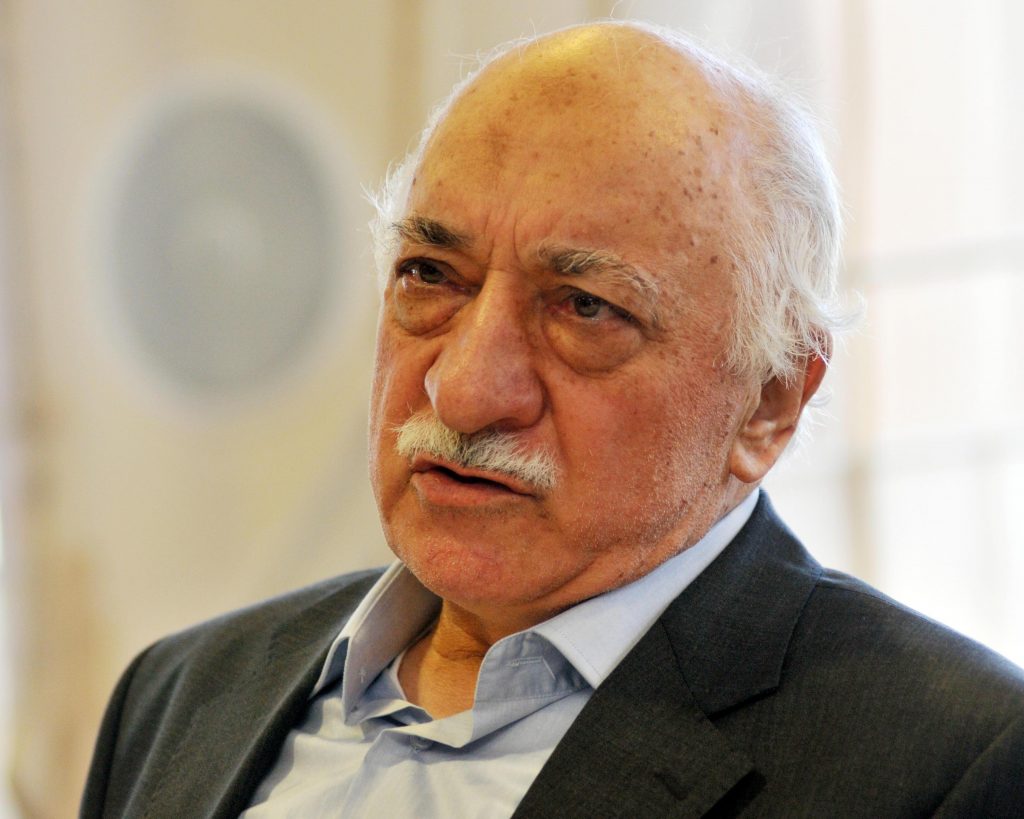
    on the ideas of Fethullah Gülen and the faith-based civil society movement
    inspired by his discourse: the Hizmet or Gülen Movement.  The main goal of
    this conference is to examine the Gülen Movement from a multi-disciplinary
    and comparative perspective in an attempt to understand in what ways the
    participants of the Gülen Movement promote global peace through educational
    activities and interfaith dialogue. At the heart of this lies the question
    of whether such dialogue can overcome or avert the "clash of civilizations,"
    predicted by such scholars as Samuel P. Huntington, which has become a
    rallying cry for many on both sides of the perceived East/West ideological
    divide. The activities of the Gülen Movement vary from education to health
    services to disaster relief work. The chief concern for this conference is
    to determine how the interfaith dialogue that occurs within these activities
    may serve to ease the pressures of globalization.
    
    Possible themes and questions for the conference may include but are not
    limited to:
    
    * Would Gülen's thought contribute to the advancement of the modern society
    that would embrace a peaceful coexistence of multi-ethnic, multi-religious
    groups in a democratic state structure?
    * Was it the pragmatic needs of the social mobilization or a modern
    interpretation of Islam that shaped the ideas of Gülen?
    * How does Gülen view the compatibility of democracy and Islam in modern
    society?
    * How does pluralism emerge in Gülen's thought?
    * How do the interfaith dialog activities of the Gülen Movement bring
    Gülen's thought from theory into practice?
    * Do the educational activities of the Gülen Movement contribute to global
    peace?
    * Gülen's ideas in the practice of the Gülen Movement: Educational,
    healthcare and financial institutions and NGOs,
    * Financial resources of the Gülen Movement,
    * Gülen's thought on capitalism,
    * A comparative analysis of Gülen and other philosophers,
    * A comparative analysis of the Gülen Movement and other faith-based groups,
    * Pluralism and democracy in Gülen's thought and in the Gülen Movement's
    practice,
    * Interfaith dialog activities of the Gülen Movement,
    * Gülen's thought on different versions of secularism
    
    All abstracts must be submitted electronically to [email protected]
    <mailto:[email protected]>  by January 8, 2010. Abstracts should be no more
    than 300 words and written in MS Word or similar rich text format.
    
    Please include (GM 2010-last name, first name) on the subject line of your
    email.
    
    All submitted abstracts will be reviewed on a double-blind review basis. All
    applicants will be notified by February 5, 2010. The organization committee
    will select the best papers with the intention of seeking publication with
    an academic press.
    
    Full papers are due by Friday, March 12, 2010. Papers should be between
    5,000 and 10,000 words including a 300 word abstract and notes. Chicago
    Manual of Style should be followed.
    
    Travel Grant:
    
    A limited number of travel grants are available for no more than $500.00 for
    presenters only.
    
    Applicants for the travel grant should include a 500 word summary explaining
    the reason for their request.
    
    Date: Saturday, March 27, 2010
    Place: University of Texas-Pan American, Edinburg, Texas.
    University Ballroom
    
    Contact: [email protected] <mailto:[email protected]>
    
    Sponsors:
    IID, Institute of Interfaith Dialog
    UTPA, College of Arts and Humanities
    
    --
    Tamer Balci, Ph.D.
    Assistant Professor of History
    The University of Texas-Pan American
    Department of History and Philosophy
    COAS, 346 B
    1201 W. University Drive,
    Edinburg, TX, 78539
    Tel (956) 380-8785
    Fax (956) 384-5096
  • Israel: Turkey’s hostility is ‘strategic’ move

    Israel: Turkey’s hostility is ‘strategic’ move

    By HAVIV RETTIG GUR

    Turkish Prime Minister Recep Tayyip Erdogan’s continuing statements against Israel are a sign that his government views its anti-Israel stance as a strategic move, Israeli diplomatic officials believe.

    Iranian President Mahmoud Ahmadinejad, left, welcomes Turkish Prime Minister Recep Tayyip Erdogan for a meeting in Teheran.
    Photo: AP [file]

    These views are being expressed by Israeli officials in the wake of the latest comment by Erdogan, published Thursday, in which the Turkish premier, on a visit to Washington, said any Israeli attempt to use Turkish airspace for espionage against neighboring countries – of which Iran is the largest – would “receive a response equal to that of an earthquake.”

    Erdogan cautioned Israel’s leaders to refrain from “using the relationship they have with [Turkey] as a card to wage aggression on a third party.”

    The cooperation agreements between the Israeli and Turkish militaries allow Israeli pilots to train in Turkish airspace, a fact that may be the source of rumors of Israeli spying from Turkish airspace to which Erdogan was responding.

    According to Erdogan, in comments made to Egyptian journalist Fahmi Huwaidi, such spying has never happened, but would have dire consequences if it were to occur.

    Ankara would not be a neutral party in such a situation, he said.

    “The impression [in Israel] is that Turkey’s prime minister is constantly attacking Israel and working to bring Turkey closer to the extreme wing of the Middle East,” said Foreign Ministry spokesman Yossi Levy over the weekend.

    “The string of statements [by Erdogan] and the line he has consistently taken bring us to the conclusion that this is a strategic move” on the part of Turkey’s government, Levy added.

    Meanwhile, a senior Israeli diplomatic official gave voice to Israeli misgivings and confusion over Erdogan’s policies.

    “Erdogan is trying to have it all – to satisfy the Islamist appetite of his voting bloc and turn extremist, but also to preserve the stature of Turkey as a moderate Western state that resolves regional conflicts. But it’s clear that these two goals contradict each other,” the official said.

    In particular, Israeli officials are mystified at Turkey’s apparent embrace of the regime in Teheran, whose president has denied the Holocaust and called for Israel’s destruction. Erdogan has reportedly called Iranian President Mahmoud Ahmadinejad a “friend” and insisted Iran’s nuclear program is for peaceful purposes.

    “Turkey should be as worried as Israel about the dangers of Iranian nuclear weaponization, because it would directly threaten Turkey’s regional and international standing in the long term,” the Israeli official said.

    Relations between Israel and Turkey have suffered since Operation Cast Lead in January 2009, during which Erdogan lashed out repeatedly at Israel over Palestinian casualties, accusing it of intentionally targeting civilians.

    Israel is not alone in its concern over Turkey’s geopolitical future. During Erdogan’s visit to Washington last week, 10 United States senators, ranging from liberal Democrat Russ Feingold to conservative Republican Jim Inhofe, sent a letter to the Turkish ambassador in Washington saying that “we have grown increasingly concerned about the downward trend of relations between Turkey and Israel this past year.”

    Citing Israel’s exclusion from the Anatolian Eagle military exercise in October, which led to its cancellation by NATO and American forces, the senators urged Turkey to resume its “longstanding strategic cooperation with Israel and its positive role as an honest broker in the Middle East.”