Month: June 2009

  • CALIFORNIA ACTION ALERT

    CALIFORNIA ACTION ALERT

    We need more emails sent please!

    Kindly circulate this message as widely as possible!

    Thank you.

    Ergün KIRLIKOVALI,

    TURKISH FORUM


    *****

    To:  All Turkish-Americans and Friends

    Step 1 – Please select one of the 17 sample letters below (or create your own wording)

    Step 2-  Add your name, address, and day phone

    Step 3-  E-mail the Assembly Members below today!

    California State Assembly / Committee on Education / Phone

    (916) 319-2087

    Committee Members

    District

    Phone / Fax

    E-mail

    Julia Brownley – Chair

    Dem-41

    (916) 319-2041

    Fax: (916) 319-2141

    [email protected]

    Brian Nestande – Vice Chair

    Rep-64

    (916) 319-2064

    Fax: 916-319-2164

    [email protected]

    Tom Ammiano

    Dem-13

    (916) 319-2013

    Fax: (916) 319-2113

    [email protected]

    Juan Arambula

    Dem-31

    (916) 319-2031

    Fax: (916) 319-2131

    [email protected]

    Joan Buchanan

    Dem-15

    (916) 319-2015

    Fax: (916) 319-2115

    [email protected]

    Wilmer Amina Carter

    Dem-62

    (916) 319-2062

    Fax: (916) 319-2162

    [email protected]

    Mike Eng

    Dem-49

    (916) 319-2049

    Fax: (916) 319-2149

    [email protected]

    Martin Garrick

    Rep-74

    (916) 319-2074

    Fax: 916-319-2174

    [email protected]

    Jeff Miller

    Rep-71

    (916) 319-2071

    Fax: 916-319-2171

    [email protected]

    Jose Solorio

    Dem-69

    (916) 319-2069

    Fax: (916) 319-2169

    [email protected]

    Tom Torlakson

    Dem-11

    (916) 319-2011

    Fax: (916) 319-2111

    [email protected]

    =================================================================================================================================================

    Letter 1

    No to  SB 234

    Dear Assembly Member,

    Senate Bill No. 234 will cause division, polarization, and isolation among our children simply because it attempts to teach scholarly contested political controversies and views as routine, settled history.

    Case in point:  Rwanda was declared “genocide” by the International Court of Justice under the rules of the UN Genocide Convention, but, Darfur/Sudan was not; the latter was charged with crimes against humanity and other war crimes.  If you cannot see the difference, that SB 234 deceives you, too.

    Another case in point:  The Jewish Holocaust is a court-tested verdict (Nuremberg, 1945), whereas Armenian allegations of genocide have not yet seen the inside of a “competent tribunal” because of fears that Armenian hearsay and forgeries may not stand the scrutiny.

    If we choose to declare any event in history anything we want, just by the number of votes cast by legislators, what kind of message are really sending our children about scholarship in history or other social sciences?  Forget education, think legislation?

    Dear Assembly Member, whatever happened to the time honored dictum:  “Teach the children well?”

    I urge you to vote NO on SB 234 !

    Sincerely,

    (name, address, day phone)

    Letter 2

    Please  vote  No on SB 234 !

    Dear Assembly Member

    In these economic hard times, California is paying huge sums to Armenians who have been brought here on false documentations as “relatives” just to campaign and act against Turkish Americans and Azeris.

    This, in addition to these representatives of Armenian origin debasing the properly court-recognized genocide victims and wasting our public state resources in time, money and energy year after year for hate campaigns.

    Proof?  Simple:  Just take out the reference to Armenian mythical genocide and let’s see if they still are sponsoring these bills.

    Please do not be a party to advancing Armenian interests which run against the American interests.

    California first !

    I urge you to vote No on SB 234 !

    Sincerely,

    (Name, address, day phone)

    Letter 3

    No on SB 234 !

    Dear Assembly Member

    Make no mistake: this is an Armenian bill against Turkey and Turks, thinly camouflaged by other, more proper human tragedies.   We live in California, America, not Armenia.

    Turkey and Armenia should be allowed to settle their differences over sensitive historical subjects via appropriate local and international research institutions, as Turkey offered in 2005 and Armenia refused.

    If the allegations of crimes against humanity were to withstand the cross examinations and scrutiny of the court room, as described in the 1948 UN Genocide Convention, then it is declared a genocide.  Without such impartial investigation followed by judicial proceedings, like Nuremberg Trial, it is inappropriate for the California legislature to label the massive suffering of multiethnic society in Eastern Anatolia in the course of World War I as a solely “Armenian genocide”, totally ignoring the Muslim (mostly Turkish) victims of Armenian revolutionaries and irregulars, Armenian rebellions, treason, and territorial demands.  Senate is not the place to sort historical debates.

    Please do not be a party to advancing Armenian interests which run against the American interests.

    California first !

    I urge you to vote No on SB 234 !

    Sincerely,

    (Name, address, day phone)

    Letter 4

    No on SB 234 !

    Dear Assembly Member

    This is a bill by the Armenian lobby against Turkey and Turks. We live in California, America, not Armenia.

    Teaching students such a one-sided, politically-loaded and unprofessionally-legislated version of history is inappropriate for the State of California, which is committed to ethnic diversity.

    If the learning objective of oral histories is to give students a glimpse of past, we should not uphold only one interpretation of history falling prey to political interest groups. Thousands of Turkish-Americans in California have a family history connecting to sad events of World War I, and it would be absolutely un-American for our education system to isolate and discriminate against them by imposing a legislated interpretation of history.

    Please do not be a party to advancing Armenian interests which run against the American interests.

    California first !

    I urge you to vote No on SB 234 !

    Sincerely,

    (Name, address, day phone)

    Letter 5

    No on SB 234 !

    Dear Assembly Member

    I respectfully oppose this bill, basically by the Armenian lobby against Turkey and Turks, and agree with the sentiments voiced by the Turkish-American Legal Defense Fund on it:

    “ An act to… (require) oral history indoctrination of public school students in a single, disputed thesis of an historical controversy …”

    This bill would result in the further indoctrination of California’s public school students in the Armenian genocide thesis of World War I, despite the genuine historical dispute over how to properly characterize these events.

    This bill is both educationally wrongheaded and unconstitutional under the First Amendment and

    the exclusive foreign relations power of the federal government.  Any Member who votes for SB 234 would be flouting his or her oath or affirmation to support the Constitution.

    I urge you to vote No on SB 234 !

    Sincerely,

    (Name, address, day phone)

    Letter 6

    No on SB 234 !

    Dear Assembly Member

    I respectfully oppose this bill, which attempts to teach a hotly debated controversy as settled history, at taxpayer’s expense.

    The Turkish-Armenian conflict is a genuine historic controversy because the human tragedy and its characterization singly as Armenian genocide are disputed among reputable scholars of the era and region.  SB 234’s advocacy of a single viewpoint constitutes nothing less than educational malpractice.

    Reputable experts either take issue with the genocide characterization, or provide an historical narrative which clashes with the California model curriculum on human rights and genocide. A recently launched website lists these scholars and excerpts of their works.   They include: Arend Jan Boekestijn, Youssef Courbage, Bertil Duner, Gwynne Dyer, Edward J. Erickson, Philippe Fargues, Michael M. Gunter, Eberhard Jäckel, Yitzchak Kerem, Bernard Lewis, Guenter Lewy, Heath W. Lowry, Andrew Mango, Michael E. Meeker, Justin Mccarthy, Stephen Pope, Michael Radu, Jeremy Salt, Stanford Shaw, Norman Stone, Hew Strachan, Elizabeth-Anne Wheal, Brian G. Williams, Gilles Veinstein, And Malcolm Yapp. please visit:

    Please, let’s all strive to teach the children well.

    I urge you to vote No on SB 234 !

    Sincerely,

    (Name, address, day phone)

    Letter 7

    No on SB 234 !

    Dear Assembly Member

    I respectfully oppose this bill, which attempts to teach a hotly debated controversy as settled history, at taxpayer’s expense.

    Contrary to popular belief in California, the genocide thesis for the Armenian tragedy does not command a consensus in the community of Middle East and Ottoman scholars.

    The United Nations has refused to endorse it. And both the governments of Great Britain and Sweden have in recent years chosen not to endorse Armenian genocide resolutions after careful consideration.

    Consider for example a central figure routinely summoned in favor of the Armenian thesis: United States Ambassador Henry Morgenthau. His reports were based on hearsay, not personal eyewitness evidence. He never strayed beyond Istanbul during his 26 months as U.S. Ambassador to the Ottoman Empire. He never visited the regions where he said great crimes were committed. He could not speak Turkish, Greek, French or Armenian, the four languages used in the Ottoman capital. He reported events selectively for political impact. On November 26, 1917, Morgenthau confessed in a letter to President Wilson that he intended to write a book vilifying Turks and Germans to, “win a victory for the war policy of the government.”  Moreover, he admitted that his works were edited and sometimes changed by his Armenian assistants: Arshag K. Schmavonian and Hagop S. Andonian, neither of which, the historical record has shown, visited the areas in rebellion.

    Please, let’s not stray from the truth.  Let’s all strive to teach the children well.

    I urge you to vote No on SB 234 !

    Sincerely,

    (Name, address, day phone)

    Letter 8

    No on SB 234 !

    Dear Assembly Member

    I respectfully oppose this bill, which attempts to teach a hotly debated controversy as settled history, at taxpayer’s expense.

    The genocide claim for the Armenian tragedy does not command a consensus in the community of Middle East and Ottoman scholars. The United Nations has also refused to endorse it. Governments of Great Britain and Sweden have in recent years chosen not to endorse Armenian genocide resolutions after careful consideration. No countries in Asia or Africa have recognized it.  Only a handful of countries where Armenian Diaspora exerted political pressure recogniexd Armenian claims.

    Moreover,  while the Ottoman Archives are fully open, key Armenian archives remain closed.  All of the relevant evidence is has not yet been made available. There has never been an impartial, independent tribunal or commission that has evaluated the Armenian genocide thesis, in contrast to judicial affirmations of the Holocaust or the Rwandan genocide. That glaring omission is not for the absence of an available judicial forum. The International Court of Justice enjoys jurisdiction to determine genocide accusations under the United Nations Genocide Convention of 1948. The ICJ recently adjudicated Bosnia’s claim of genocide against Serbia and Montenegro (February 26, 2007).

    I urge you to vote No on SB 234 !

    Sincerely,

    (Name, address, day phone)

    Letter 9

    No on SB 234 !

    Dear Assembly Member

    I respectfully oppose this bill, which attempts to teach a hotly debated controversy as settled history, at California taxpayer’s expense and at a time of financial crisis.

    The Ottoman Armenian tragedy is matched by the Ottoman Muslim tragedy that left 2.4 million corpses in Anatolia alone, yet the former is exhaustively taught in California while the latter is completely ignored. To teach the mutual tragedies and sorrows as an episode the precursor of Holocaust-like wickedness is educationally preposterous.

    Indeed, SB 234 betrays a Christian bigotry that traces back to the Crusades and it dishonors President George Washington’s celebration of the United States as  “giving to bigotry no sanction, to persecution no assistance.”

    I urge you to vote No on SB 234 !

    Sincerely,

    (Name, address, day phone)

    Letter 10

    No on SB 234 !

    Dear Assembly Member

    I respectfully oppose this bill, which attempts to teach a hotly debated controversy as settled history, at California taxpayer’s expense and at a time of financial crisis.

    I note for the Committee’s reference that the Republic of Turkey has proposed to the Republic of Armenia an international commission of experts to determine the facts and characterizations relevant to the Armenian thesis and to accept its findings as authoritative and conclusive.  The Armenian government appears to have now endorsed at least some sort of historical reckoning with Turkey in the recently announced rapprochement roadmap unveiled on April 23. Many U.S. Armenians have criticized this approach, preferring history to be written by politicians, swayed by voting clout, rather than by truth.

    I  would respectfully suggest that most Assembly Members are poorly equipped by scholarship or otherwise to make an educated assessment of the Armenian thesis. Accordingly, to vote in support of SB 234 would be more an act of religious faith than of secular knowledge.

    I urge you to vote No on SB 234 !

    Sincerely,

    (Name, address, day phone)

    Letter 11

    No on SB 234 !

    Dear Assembly Member

    The First Amendment prohibits government from compelling its citizens to endorse or promote speech that they dispute.  Justice Robert Jackson, chief prosecutor before the Nuremberg Tribunal, wrote that the First Amendment prohibits government from stipulating what is orthodox in politics or otherwise by majority vote.

    The Supreme Court has strictly policed the public school environment where the need for freedom of inquiry and thought to develop citizens fit for self-government are at their zenith. Thus, school authorities were prohibited from removing books from school libraries because of antagonism towards their viewpoints.  The Court elaborated on the importance of academic freedom in teaching  social studies.

    “…No one should underestimate the vital role in a democracy that is played by those who guide and train our youth… No field of education is so thoroughly comprehended by man that new discoveries cannot yet be made. Particularly is that true in the social sciences, where few, if any, principles are accepted as absolutes. Scholarship cannot flourish in an atmosphere of suspicion and distrust. Teachers

    and students must always remain free to inquire, to study and to evaluate, to gain new maturity and understanding; otherwise our civilization will stagnate and die.”

    I urge you to vote No on SB 234 !

    Sincerely,

    (Name, address, day phone)

    Letter 12

    No on SB 234 !

    Dear Assembly Member

    The Supreme Court rejected state to impose ideological conformity on teachers through loyalty oaths or

    otherwise.  Justice William Brennan explained:

    “Our Nation is deeply committed to safeguarding academic freedom, which is of transcendent value to all of us and not merely to the teachers concerned. That freedom is therefore a special concern of the First Amendment, which does not tolerate laws that cast a pall of orthodoxy over the classroom. “

    And then there is this:   “ …The classroom is peculiarly the ‘marketplace of ideas.’ The Nation’s future depends upon leaders trained through wide exposure to that robust exchange of ideas which discovers truth ‘out of a multitude of tongues, [rather] than through any kind of authoritative selection’….”

    I urge you to vote No on SB 234 !

    Sincerely,

    (Name, address, day phone)

    Letter 14

    No on SB 234 !

    Dear Assembly Member

    Honorable Assembly Member,

    I  respectfully oppose SB 234, which facially concerns a new oral history component in the teaching of social studies in California.  While oral histories are an important educational tool in engaging young people to have a better understanding of our past, SB 234 is inappropriate because we believe oral histories should not be a mandated component of this curriculum and we are concerned about the required expenditures assumed by this bill.

    SB 234 is classic pork barrel politics, adding a new requirement to a subject that is already required to be taught in order to graduate and adding a new cost to California taxpayers, all to please a particular constituency.  I am also concerned that the potential costs of this bill are poorly defined.  California is facing unprecedented budgetary pressures and making cuts to basic educational programs and services.

    No on SB 234 !

    Sincerely,

    (Name, address, day phone)

    Letter 15

    No on SB 234 !

    Dear Assembly Member,

    I note that the California Model Curriculum on Human Rights and Genocide asks that students be taught critical thinking especially on controversial subjects.  The Armenian case cries out for a multiplicity of viewpoints to be heard so that students can judge for themselves and draw their own lessons from the events.  I recommend that if an oral history component is to be mandated, that it not be limited to victims of just one side of the Turkish Armenian controversy, but also to Muslim victims as well.

    SB 234 has no clear measurement or accountability tools. It does not provide sufficiently clear guidelines to ensure that history is accurately represented in all cases.  Case in point:   the use of the term Armenian genocide is simply disrespectful of the widespread suffering and loss felt by all communities during WWI at the fall of the Ottoman Empire. During that time Muslims and Christians suffered alike from a variety of causes, tragedy was mutual, and Armenian complicity was wide and deep.

    No on SB 234 !

    Sincerely,

    (Name, address, day phone)

    Letter 16

    No on SB 234 !

    Dear Assembly Member,

    The desired educational outcome of this mandate is unclear. If it is to help students to understand past transgressions in international politics and societies, then there is ample support in the existing curriculum, which, though I disagree on its one-sidedness in addressing the Armenian-Turkish conflict, is certainly substantial.  Then the terms of this bill need to be broadened to include oral histories from various wartime victims. California is too diverse to allow such an important issue as oral histories to be provided by  only five communities.  The scope of voices heard by students should include other key historical events such as the Iraq War, El Salvador, Guatemala, Vietnam and Korean history as well as many others.

    No on SB 234 !

    Sincerely,

    (Name, address, day phone)

    Letter 17

    No on SB 234 !

    Dear Assembly Member,

    Turkey and Armenia should be allowed to settle their history in the judicial arena and diplomatically; not by California legislation.  We ask you to remove the explicit focus on the “Armenian genocide”. Unlike the Jewish Holocaust, which was a horrific event, documented and proven at court (Nuremburg Trial), the large scale suffering of the Armenian people during a time of war has not been adjudged to have constituted the crime of genocide.

    Furthermore, to teach it, labeled as such, creates a bias in the curricula and will not allow for a honest dialogue to take place.  If the learning objective of oral histories is to give students a glimpse into the past, let’s give them the chance to see all sides of this past. Turkish Americans should also be encouraged to explain how their grandparents’ villages were razed and their relatives were put on a train, alone, to Istanbul to be raised in an orphanage or by other family members.

    No on SB 234 !

    Sincerely,

    (Name, address, day phone)

    ===============================================================

    Dear _____________:

    I am deeply concerned by the recent possibility of consideration and passage of  State Resolution No. SB-234, which seals a one-sided approach to a genuine historical controversy to which the United States is not a party.

    The resolution in question is based on a spurious historical allegation that has not been historically or legally substantiated to this date. As such, it is not only without foundation, it is also inconsiderate, to the extent that it defames Turkish people as genocide perpetrators.

    Numerous American scholars, all experts in the history of the Ottoman Empire, dispute the majority of the findings in the resolution, leading to the conclusion that although Armenian civilian losses during World War I were tragic, the events of 1915 were not tantamount to genocide. Armenians did not suffer alone and that millions of Turks also lost their lives during the same period from similar causes, including massacres by Armenian rebel bands.

    I note that the resolution highlights the need to eliminate hatred. Yet I must question why this resolution, which embodies a festering enmity by certain extremist Armenian Americans toward Turks should be put to the vote. I cannot imagine how the passage of the said resolution, promoted by the same ethnic constituency, fosters peace, tolerance and dialogue among the many ethnic communities represented in California or in the USA.

    The above notwithstanding, Turkey has no fear of its past and is willing to examine it, wherever that may lead.  On April 10, 2005, Turkey ’s Prime Minister Recep Tayyip Erdogan invited Armenian President Robert Kocharian and the people of Armenia to establish a Joint Historical Commission to study the events of 1915 and share its findings with the general public.   Turkey ’s Foreign Minister at the time Abdullah Gül added that historians from other countries, including the United States , would be welcome to take part.

    Our past President Bush has acknowledged the wisdom of this approach, stating, “We look to a future of freedom, peace, and prosperity in Armenia and Turkey and hope that Prime Minister Erdogan’s recent proposal for a joint Turkish-Armenian commission can help advance these processes.”  Our last  Secretary of States Ms.Rice  has also urged Turkey and Armenia to study their past together, saying, “These historical circumstances require a very detailed and sober look from historians. And what we’ve encouraged the Turks and the Armenians to do is to have joint historical commissions that can look at this, to have efforts to examine their past and, in examining their past, to get over their past.”

    SB Res 252 will jeopardize American national interests and security, as it will damage US-Turkish relations. Turkey is a key ally of the United
    States . In 2007, the last time such a Resolution in US Congress was introduced, former Secretaries of State Alexander Haig, Henry Kissinger, George Shultz, James Baker, Lawrence Eagleburger, Warren Christopher, Madeleine Albright and Colin Powell stated: “We must recognize the important contributions Turkey is making to U.S. national security, including security and stability in the Middle East and Europe. The United States continues to rely on Turkey for its geo-strategic importance. Turkey is an indispensable partner to our efforts in Iraq and Afghanistan , helping U.S. troops to combat terrorism and build security.”
    And, the leader of the Armenian Church in Turkey , Archbishop Mesrob II has unequivocally stated, “Our children should grow up in friendship and brotherhood and not be poisoned by the seeds of hatred. … The proper platform to discuss this subject could only be a forum composed of Turkish and Armenian historians, and under conditions of equality and freedom.”

    Ultimately, the message is clear: history ought not to be legislated. Only through genuine dialogue can Turks and Armenians reconcile their diametrically opposed narratives in a mutually acceptable manner.

    In light of the above, I  would respectfully urge you not to support this resolution SB-234, which not only defeats the goal of ethnic harmony but also runs counter to the policy of the current and pasted US-Administration.
    Sincerely,
    NAME ADDRESS &PHONE
  • Turkey’s TurKcell, The Hariri Family and The Armenian Lebanese Community

    Turkey’s TurKcell, The Hariri Family and The Armenian Lebanese Community

    By Appo Jabarian                                   
    Executive Publisher / Managing Editor USA Armenian Life Magazine
    Friday,  June  26, 2009
    Lebanon is not a vast country. It does not have a mighty army. Its air force has modest capabilities. Its soldiers are still not capable to liberate the Sha’aba farms forcibly occupied by Turkey’s ally Israel.

    But Lebanon is an integral part of the world commerce and politics thanks to its strategically important position on the eastern Mediterranean basin.

    It is a small country that has given so much to the world civilization. It is believed that the scriptures were written on papyrus from Lebanon’s ancient Phoenician seaport city Byblos (today’s Jubeil), hence the word Bible came to be. It is also credited for having introduced the color magenta (al-urjuan al-ahmar).

    Lebanon’s importance is further enhanced by several other factors, including centuries-old Armenian ties and presence.

    The relations between Lebanon and the Armenians go back several centuries. Under King Tigran II, Lebanon/Phoenicia, was a part of the Armenian Empire 95-55 B.C. Even though the empire receded, the tiny Armenian presence continued to exist.

    During the Ottoman years, in order to bring an end to the decades-old inter-ethnic violence between the Maronites and the Druze, Lebanon was placed under the administration of the “Mutasarrifieh” system (special government status) from 1864-1918. With the consent of various Lebanese leaders, it was served by succeeding neutral governors of which the first, Dawud Pasha Al-Ermeni (David Pasha The Armenian), and the last, Ohannes Pasha Kouyoumjian, were Armenians.

    During the Armenian Genocide at the hands of Turkey (1915-1923), waves of orphaned and uprooted Armenians arrived in various hospitable Arab countries and Lebanon. During the 1930’s introduction of the Lebanese nationality identification system, the Armenian-Lebanese were officially recognized as an integral part of Lebanon. They were granted Lebanese nationality.

    According to the 1943 intra-Lebanese National Pact (al-mysaqh alwatani), the Armenian Lebanese were officially recognized as one of the key ethnic groups that was granted its proportional share of seats in the Parliament of Lebanon.

    According to the Pact, during many decades before 2000, every four years the Armenian Lebanese along with the rest of other ethnic denominations directly elected its representatives thanks to fair districting and understanding with other communities not to interfere in or influence the process of intra-Armenian Lebanese democratic process. At that time the districting system accurately reflected the prevailing demographics.

    However, during the 1975-89’s civil war, both a population shift and migration occurred. Several families relocated in Metn’s Antelias, Zalka, Beit Koko, Rabieh, Bikfaya, Muzher and many nearby localities. As a direct result, the districts of Beirut I, II and III no longer reflect accurate demographics.

    With the ending of the civil war in the 1980’s, several new political forces entered Lebanon’s political arena. One of the new forces was the late Prime Minister Rafik Hariri. Mr. Hariri had just returned from Saudi Arabia with an impressive financial accomplishment under his belt. Through his very controversial yet attractive Solidere project, he eventually gained political clout that helped him secure the post of the Prime Minister.

    According to several reliable sources, soon after he became PM, Mr. Hariri accelerated his relations with Turkey on both economic and political levels.

    On May 2008, The (Gulf) Khaleej Times reported that in 2005, “Oger Telecom (Rafik Hariri’s Saudi Arabia-based company) bought a 55 per cent controlling stake in Turk Telecom, beating out consortia that included Carlyle – KOC and Etisalat Dubai Islamic Bank. Yet Saudi Oger valuation in 2005 was $12 billion, meaning that the Turkish government is taking no premium for its stake in the current IPO even though the company has paid dividends, shed a third of its payrolls, added millions of new subs, entered the GSM/data traffic businesses and totally restructured its IT, billing, network architecture and marketing divisions. A useful comparative data point in this context is that Turkcell has soared 120 per cent since Saudi Oger bought its stake in Turk Telecom three years ago.”

    One wonders, what did Sr. Hariri promise to the anti-Armenian Ankara leaders in order to receive such Turkish co-operation facilitating his acquisition of the Turkish fat cash cow called Turkcell?

    Ironically, parallel to developing the 2000 anti-Armenian parliamentary election laws in Lebanon, Hariri was laying the foundations for a silky takeover of Turkcell. And the laws of the year 2000 paved the way for his 2005 massive hijacking of the majority of the Armenian seats in the Lebanese Parliament.

    The result was disastrous both for Lebanon and the Armenian Lebanese.

    One also wonders, did Mr. Hariri, independently of any Turkish influence, chose to amass gigantic political power, and in the process, overstepped his boundaries? In this regard, one factor is certain that he attempted to subordinate the most popular Armenian Lebanese Tashnag party to him “offering” in “exchange,” the “preservation” of the traditional Armenian Lebanese Parliamentary Bloc.

    Remaining truthful to its role as an independent force in the Lebanese political landscape, the Tashnag party refused to surrender. Such surrender would have put an end to the viability of the Bloc as an independent entity.

    During the 1970’s, the consistently popular Armenian Lebanese Tashnag party reached out to the minority Armenian Lebanese groupings by including a Ramgavar and a Hunchak candidate in its party list thus fostering intra-Armenian Lebanese consensus and  the formation of the traditional unity list.

    The parliamentarians, elected on that list, were completely accountable to the Armenian Lebanese community. But currently, four out of six are controlled by Hariri. And as such, they are accountable only to him.

    Now, the burning question is that, “how much longer, the Hariri family, under the leadership of the late PM’s son Saad, will continue to usurp the rights of the Armenian Lebanese majority?”

    The right of the majority in the Armenian Lebanese community to direct representation must not be tempered with by Hariri or anyone else in favor of a foreign deal such as Turkcell; or for any other political motive.

  • Hariri Hijacks Armenian Seats  In The Lebanese Parliament

    Hariri Hijacks Armenian Seats In The Lebanese Parliament

    By Appo Jabarian

    Executive Publisher / Managing Editor

    USA Armenian Life Magazine

    Friday,  June  19, 2009

    The 2009 Lebanese parliamentary elections are over.

    But the problem caused by the 2005 election which defrauded the majority of the Armenian Lebanese of their right for true representation still lingers.

    The disastrous policy that is still haunting the Armenian Lebanese community began in 2000 when the government of the late Prime Minister Rafik Hariri changed the established parliamentary election laws, and stripped the Armenian Lebanese majority (75%) of its right to directly elect its representatives.

    During the ’09 election, the hijacking of the four out of six Armenian seats in the parliament from the Armenian Lebanese majority by Mr. Hariri’s Sunni voters in Zahlé, Beirut I, Beirut II, and Beirut III districts, has raised several eyebrows in Lebanon and around the world.

    The four Hariri-controlled seats are filled by Armenian individuals that were hand-picked by Hariri’s son Saad. These individuals received only 15%-20% of the Armenian Lebanese votes in their respective districts, yet they were able to get “elected.”

    How is this possible?

    As a result of adverse redistricting, the number of the Armenian Lebanese voters inside those districts was dwarfed by the huge number of Sunni Lebanese voters.

    During the 1970’s, the most popular Armenian Lebanese Tashnag party (with over 75% of the Armenian Lebanese votes), reached out to the minority Armenian Lebanese groupings by including a Ramgavar and a Hunchak candidate in its party list thus fostering the formation of the traditional Armenian Lebanese Parliamentary Bloc.

    The 2008 Doha agreement that ended Sunni-Shiite conflict in Beirut, only partially re-instated the Armenian Lebanese majority’s right to true representation.

    For some odd reason, the Doha agreement placed three Armenian Lebanese parliamentary seats in Beirut’s districts where a limited number of Armenian-Lebanese voters reside.

    In these districts, they were clearly outnumbered by the Sunni Lebanese and non-Armenian Christian Lebanese voters.

    In order to re-establish a truly representative government, the seats allocated for each community should be based on demographics. Seats should be allocated to districts where the majority of the members of that particular community permanently reside. In the case of Armenian Lebanese, that district would be Metn (Matn).

    The incoming parliament should facilitate that move in order to help preserve each community’s right to true representation. The Armenian-Lebanese community must study the legal options that are available in the Lebanese Judicial System and its Constitutional Council.

    No democracy is perfect. There is always room for improvements. By constantly fine-tuning its communal democracy, Lebanon can continue to maintain its position as the bastion of democracy in the entire Middle East.

    Lebanon: Communal and Parliamentary Democracy

    Recently, a Western political commentator criticized and ridiculed the Lebanese form of democracy.

    He has mistakenly compared the American form of democracy with the Lebanese form of democracy, and has deemed the American model superior.

    In my opinion, they cannot be compared. The make-up of the American and the Lebanese populations is different. The population of the United States consists of over one hundred ethnic groups, speaking over 144 languages. Lebanon’s population is made up of only ten major ethnic communities, speaking mostly four languages – Arabic, English, French and Armenian.

    Nearly 95% of the Lebanese citizens are composed mostly by the following communities: The Maronite Catholic Christians, Greek Orthodox Christians, Greek Catholic Christians, Armenian Apostolic Christians, Armenian Catholic Christians, other minority Christians; Sunni Muslims, Shiite Muslims, Druze, other minority Muslims. The remaining 5% are made up with various Christian and Muslim minorities.

    During the Lebanese civil war (1975-1989), the Lebanese people still felt relatively safe in their respective neighborhoods. Had there been a civil war in the United States it is highly doubtful that the same level of relative comfort would be the norm for the ethnically diverse American populace.

    The 128-seat parliament is divided equally between Christian Lebanese and Muslim Lebanese, and subdivided among the largest of the country’s recognized 10 ethnic/religious groups.

    On the Christian side, Maronite Catholic Lebanese get 34 seats, Greek Orthodox Lebanese 14, Greek Catholic Lebanese eight, Armenian Orthodox Lebanese five, Armenian Catholic Lebanese one, Protestant Lebanese one and another one for “minorities.” On the Muslim side, Sunni Lebanese and Shiite Lebanese each get 27 seats, the Druze Lebanese eight and the Alawite Lebanese two.

    The reason that the Communal Democracy is just right for Lebanon is because Lebanon is diverse with limited number of communities.

    So the best way to describe Lebanon’s unique form of democracy would be Communal and Parliamentary Democracy.  1) Communal, in the sense that every four years, each community is free to directly elect its representatives; 2) Parliamentary, in the sense that the country’s members of the parliament are the designated electors of the country’s President, which,  according to “al-myssaq al-watani” (The National Pact), should be a Maronite. According to the same agreement, the country’s Prime Minister must be a Sunni, and the Speaker of the Parliament, a Shiite.

    What democratic system is good for the United States or the West may not be successfully applicable to other unique democracies such as Lebanon.

    Lebanon’s communal democracy lives on. And that’s the way Lebanon has been since its independence nearly seven decades ago. It looks like it will continue to function as long as the country’s leadership practices the open door policy in its intra-national relations.

    Aside from short-changing the Armenian-Lebanese community of its right to true representation, the ’09 Lebanese Parliament is the most pluralistic elected body so far. Even the tiniest minorities are somehow represented.

  • Companies lobby (quietly) on Armenia genocide bill

    Companies lobby (quietly) on Armenia genocide bill

    By STEPHEN SINGER
    Associated Press

    Corporate America typically hires lobbyists to pressure Congress on taxes and trade rules. But in an unusual – some say risky – move, five military contractors and an energy company have stepped into a fight over whether the U.S. should label Turkey’s slaughter of a million Armenians nearly a century ago as genocide.
    The six companies have strong ties to Turkey, a key strategic ally of the U.S. in Mideast peace efforts and the fight against terrorism. None would state their position on the House resolution, but industry analysts and others said they likely lobbied against the measure to show support for Turkey, an important market for weapons and industrial products.
    “They don’t want to be seen opposing a resolution that has a very evident human rights element,” said Rouben Adalian, director of the Armenian National Institute, a Washington research organization. “It would put them on the side of denying history and denying genocide.”
    BAE Systems Inc., Goodrich Corp., Northrop Grumman Corp., Raytheon Co., United Technologies Corp. and energy producer Chevron Corp. spent $14 million to lobby Congress in the first quarter of this year. Besides the genocide resolution, the companies lobbied on Pentagon spending, climate change, taxes and more.
    United Technologies, which sells Sikorsky helicopters to Turkey, says it provided information to  lawmakers “that helped round out their understanding of the international trade and national  security interests involved.”
    But businesses lobbying against the resolution are not being “good corporate citizens,” said Rep. Adam Schiff, D-Calif., its lead sponsor.
    Lobbying on human rights issues comes with risks, said Gerry Keim, associate dean at Arizona State University’s W.P. Carey School of Business.
    Several companies halted their efforts opposing restrictions on white minority-ruled South Africa in the 1980s when anti-apartheid activists applied pressure.
    “Originally, they were concerned about markets in South Africa. Then they were concerned about markets here,” Keim said.
    Other analysts say any public backlash against companies lobbying on the Armenia genocide resolution would be minimal because the firms serve governments, not individual consumers who
    could boycott their products.
    The House Foreign Affairs Committee has not taken up the resolution and the Senate does not have a version.
    A spokeswoman for the House committee said its chairman has not decided when the resolution
    – or other pending bills – will be taken up as the House considers legislation on Pakistan, State Department funding and other matters.
    Historians estimate that up to 1.5 million mostly Christian Armenians were killed by Ottoman
    Turks around the time of World War I. Turkey denies that the deaths were genocide, saying the number of casualties is inflated and was the consequence of civil war and unrest.
    Turkey’s embassy in Washington did not return calls and e-mails seeking comment.
    President Barack Obama, before visiting a World War II-era concentration camp in Germany earlier this month, said the world has an obligation to stop genocide, even when it’s inconvenient.
    His administration is working to end the genocide in the Darfur region of Sudan, he said.

    While running for president, Obama promised to “recognize the Armenian Genocide” once in office, but he avoided the term during a speech in Turkey in April.
    Putting the U.S. on record that the killings of Armenians 94 years ago was genocide gives  credibility to the drive for international support to stop killings in Sudan, Schiff said.

    But pressure on the six companies to avoid offending Turkey is intense. Among the ventures between U.S. businesses and Turkey are a $3 billion contract from Northrop to a Turkish
    company to be a supplier for fighter jets.
    Goodrich Corp. and a Turkish firm agreed to a joint venture for maintenance and repair work on engine components.
    BAE Systems and a Turkish company jointly market and supply armored vehicles to the Turkish armed forces.
    Chevron holds a stakes in a pipeline that crosses the country. Raytheon has agreed to sell to Turkey Stinger missile launcher systems valued at $34 million and is working to sell its missile
    defense systems.
    Chevron said it lobbies on a range of interests, “including international issues that fall outside of a narrow energy policy focus.”
    Representatives of the U.S. subsid- Companies lobby (quietly) on Armenia genocide bill iary of London-based BAE Systems PLC and Northrop referred questions to the Aerospace Industries Association.
    The trade group defended Turkey as a key U.S. ally and cited “large and growing commercial ties” between the two nations.
    Raytheon and Goodrich did not respond to requests for comment. Andrew Kzirian, executive director of the Armenian National Committee’s western region in Glendale, Calif., said backers of the resolution, which has been considered before, will not quit if it fails again.
    “If you don’t call it out and call it for what it is, you have Darfur,” he said.

  • Kashgar Facing Threat Of Bulldozers

    Kashgar Facing Threat Of Bulldozers

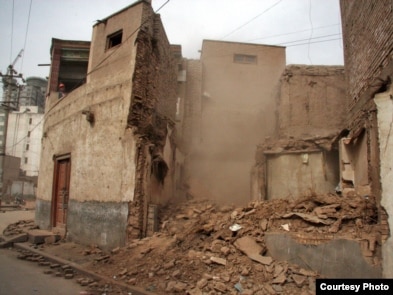
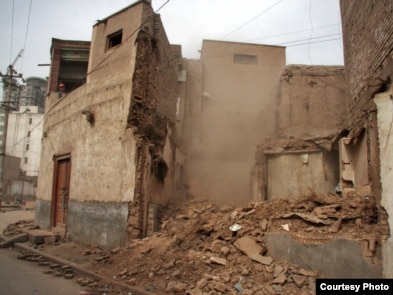
    Demolition has begun in parts of Kashgar’s Old City.

    June 30, 2009
    By Antoine Blua

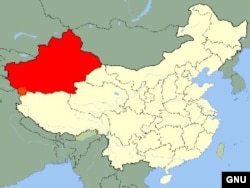
    The ancient Silk Road trading hub of Kashgar, in China’s northwest Xinjiang Uyghur Autonomous Region, is being threatened by an ambitious government redevelopment plan that some say has a hidden political agenda.

    Kashgar’s old city has survived the centuries, and remains an important Islamic cultural center for the Uyghurs, the Turkic ethnic group living in Xinjiang.

    According to Matthew Hu Xinyu, an adviser to the nongovernmental Beijing Cultural Protection Center, the densely packed houses and narrow lanes of old Kashgar are the best-preserved examples of a traditional Islamic city in all of China.

    Xinjiang Uyghur Autonomous Province in northwest China

    But the government’s reconstruction plan, Hu says, is threatening to destroy the picturesque labyrinth that makes up old Kashgar.

    “Last fall, I heard that the plan would be carried out through the next three years. I thought we would have some time to organize experts or architects to work on a constructive plan — to suggest a more conservative plan — so that the city’s heritage can be preserved,” Hu said. “But early this year the total investment for the plan has been increased to [$440 million], and the demolition of the old houses started very quickly.”

    City officials have been moving a number of families out of Kashgar’s city center, saying they need to rebuild old, dangerous houses and improve infrastructure. In total, the government says it plans to renovate or reconstruct more than 5 million square meters of old homes and resettle some 45,000 households.

    Officials say the project is necessary because an earthquake could destroy old buildings, putting residents at risk. Indeed, earthquakes frequently rock Xinjiang. In 2003, a quake killed some 270 people.

    Reports say wrecking crews razed the historic Xanliq madrasah, one of the province’s protected cultural sites, on June 15. Mahmud al-Kashgari, the 11th-century scholar, is believed to have studied at the madrasah.

    Traditional Lives

    Dominated by a gigantic statue of Mao, old Kashgar has seen many changes in recent decades, including the construction of a main street running through the old town center. Cars, buses, and trucks clog the city streets.

    Still, many residents manage to live a far more traditional life. They live in tumbledown mud-brick rentals or two-story homes that open onto courtyards. Artisans hammer metal bowls, pans, and pots, carve wood, and hone brightly decorated knives.

    Street vendors sell hand-made candy, fresh mutton, or hand-sewn skull caps. Donkey-cart drivers navigate the narrow streets.

    It’s unclear what will remain of the design and way of life of the city, which is hundreds of years old, after the reconstruction project is completed. The city says important buildings will be preserved, while many homes will be rebuilt to better withstand earthquakes while still preserving Uyghur building styles. However, several sectors are expected to be rebuilt with modern apartment buildings, public plazas, and schools.

    Officials say infrastructure such as water, electricity, and sewers systems also will be installed.

    No Details Forthcoming

    The Beijing Cultural Protection Center says nobody denies Uyghurs the right to development, modernization, and security. But the center worries that it has been unable to obtain any details of the reconstruction plan, which Hu says should ensure the preservation of the city’s unique heritage.

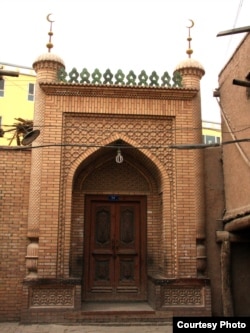
    A gate in Kashgar’s Old City

    “If we look at every single one of these Uyghur people’s homes [individually], it’s not significant, [although] some of them have very interesting carvings on the door frame or on the architecture, the wooden parts,” Hu says.

    “But this group of [homes] shows a way of life [and] a way of urban planning — how the city can be organized around different mosques. If we have the houses removed and rebuilt, then this layout will disappear, and the significance of the city will disappear,” he said.

    China and Central Asian states support a plan to propose major Silk Road sites for inclusion on the UNESCO World Heritage List, an incentive for governments to preserve areas of historical and cultural significance.

    Beijing, however, has not included old Kashgar in its list of proposed sites.

    Henryk Szadziewski, manager of the Uyghur Human Rights Project in Washington, D.C., taught for several years in Kashgar in the 1990s. He tells RFE/RL that there’s no clear indication of what is going to be done with the remaining old city.

    “As far as we understand the project, a remainder of the old city would be left, I imagine, to attract tourists. But who is going to manage that area and profit from the tourist revenue?” Szadziewski asks. “The tourist industry is worth about [$90 million] a year in Kashgar. We also have to remember that we have no indication that there was any meaningful participatory process that meant that the old city residents were party to the decision making.”

    Political Aspects Seen

    The preservation of Kashgar’s old town is facing challenges similar to those facing the preservation of other Chinese cities. But many see a political aspect to the redevelopment project in Kashgar, which Chinese officials consider a breeding ground for Uyghur separatism.

    Chinese officials in recent years have alleged that Kashgar harbors terrorist cells. Uyghur extremists were blamed for a fatal attack on border police; two of the alleged organizers were executed this spring.

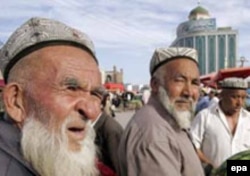
    Uyghurs at a bazaar in Kashgar

    Many see the Kashgar project as an attempt to remove the cultural roots of Uyghur separatism.

    “There’s definitely a difference between what’s happening in eastern China and in Kashgar. That’s largely due to the sensitivity over the Uyghurs and their particular concerns over human rights issues,” Szadziewski says.

    “The [Kashgar] project appears to be a tool to assimilate Uyghurs and to actually stifle peaceful dissent by putting old city residents from an organic living arrangement into a regimented, government-organized living arrangement. The [Chinese] authorities are able to monitor the activity of any peaceful dissent among Uyghurs,” he says.

    Szadziewski says the assimilation process is taking place on many different fronts.

    “One particular area is language, and we’ve seen a marginalization of Uyghur language in the economic sphere and the educational sphere,” he says. “A ‘China Daily’ report said that learning Mandarin Chinese will help fight terrorism. The statement in itself may cast a sort of aspersion on Uyghur language itself, that it was a suspect language.”

    Critics accuse Beijing of using claims of terrorism as an excuse to crack down on peaceful pro-independence sentiment and expressions of Uyghur identity.

    http://www.rferl.org/content/Chinas_Ancient_Silk_Road_City_Of_Kashgar_Facing_Chinese_Bulldozers/1765682.html 
  • Russia Angered At Armenia’s Saakashvili Award

    Russia Angered At Armenia’s Saakashvili Award


    June 30, 2009

    Armenian nationalists and members of the Russian parliament are up in arms about Armenian President Serzh Sarkisian’s awarding of the country’s Medal of Honor to Georgian President Mikheil Saakashvili last week.

    Valeri Bogomolov, a member of the Russian State Duma’s Foreign Relations Committee, called the award “very controversial.” He said countries are free to honor whomever they want, but “it is important to understand that you can’t spit into a well from which you will need to drink on more than one occasion,” Regnum news reports.

    Another senior Duma member, Viktor Ilyukhin, denounced the decision, calling it “unfriendly towards Russia.”

    Saakashvili received the medal at the start of his two-day official visit to Yerevan on June 24. Sarkisian’s office cited his contribution to “strengthening the centuries-old Georgian-Armenian friendship” in bestowing it on him.

    Armenian nationalist activists accuse the Saakashvili government of deliberately neglecting the socioeconomic woes of Georgia’s Javakheti region and violating the rights of its predominantly ethnic-Armenian population.

    Last week, dozens of nationalists gathered to protest the award outside Saakashvili’s hotel but were dispersed by the police.

    Countries in the Caucasus have to be careful choosing their friends. Iran has just recalled its envoy to Azerbaijan, after Israeli President Shimon Peres paid Baku a visit.

    — Armenian Service

    https://www.rferl.org/a/Russia_Angered_At_Armenias_Saakashvili_Award/1766103.html