Month: May 2009

  • A NEW RUSSIA: WHAT PUTIN LEFT TO MEDVEDEV

    A NEW RUSSIA: WHAT PUTIN LEFT TO MEDVEDEV

    A NEW RUSSIA: WHAT PUTIN LEFT TO MEDVEDEV: Putin, Russia, Medvedev
    From Memet Aydemir

    “NEW CZARS AND THE RUSSIAN FOREIGN POLICY”

    Russian President Vladimir Putin has been elected for the presidency 2 times after 2000 when he officially took office. According to the Russian Constitution, Putin’s term of office will expire in 2008. Since Putin took office, the macro indicators of the Russian economy increased approximately 6 times. And this depends on the fact that Russia is a petroleum exporting country. Because, in 1998, a barrel of petroleum costed around 10 dollars; but today the price approached to 60 dollars. This is reflected on the Russian economy, which shows changeability depending upon the exportation, with 6 times increase. In his presidential term, Putin went to war demanding Jewish oligarches to pay taxes. Jewish Khodorkovsky, whose fortune was 8 billions, was also the head of the Yukos and he tried to bankrupt Russian economy. At first Putin warned Khodorkovsky and told him not to keep on evading tax; but as he could not get a favourable result, he got Khodorkovsky arrested. Also in 2006, foreign capital tripled; and reached to 30 billion dollars in Putin’s Russia. Thanks to the stability he gained in the country and the progress he brought to the economy, Russian public esteem Putin as the new Czar and love him.

  • Musicians demand BNP stop selling their songs

    Musicians demand BNP stop selling their songs

    Blur and Pink Floyd among artists objecting to songs being on compilation CDs sold to fund party

    guardian.co.uk, Thursday 28 May 2009

    Lee Glendinning

    Billy Bragg

    Billy Bragg and other British artists want the BNP to stop marketing their music on fundraising CDs. Photograph: Hannah Johnston/Getty Images

    Musicians from bands including Blur and Pink Floyd have launched a campaign demanding that the British National party stop selling their music to raise campaign funds.

    The BNP is selling folk albums on its website featuring artists who claim they have no control over the fact that the far-right party is using their songs.

    The BNP’s commercial partner Excalibur sells compilation CDs with titles including Proud Heritage, Rule Britannia and The White Cliffs of Dover.

    An album called West Wind, written by the party leader, Nick Griffin, and featuring songs including Nothing Bloody Works and Colour, is among those being sold. It claims “to incorporate folk and more upbeat tempos to deliver a powerful message of how British people have been dispossessed”.

    Billy Bragg, along with Dave Rowntree from Blur and Nick Mason from Pink Floyd, have joined with the Musicians’ Union and Featured Artists’ Coalition in objecting to the BNP’s “politics and morals”.

    “In the lead up to the European elections, it has come to our attention that the BNP is selling compilation CDs through its website in order to raise funds for campaigning,” they wrote in a letter published in the Times.

    “Many of the musicians featured on these … have no legal right to object to their music being used in this way. We would, on behalf of our joint membership of over 31,000 members, like to have our opposition to the BNP’s politics and morals formally noted.”

    Musical performers or composers have little or no ability to prevent retailers selling their work once it is sold by a wholesaler to a particular distributor.

    Nigel McCune, a national organiser at the Musicians’ Union, told the Times that musicians needed a safeguard against these sorts of associations.

    “There is nothing as it stands to stop the BNP from acting in this way and there is nothing that the performers can do to prevent it. If a moral right came in you would then be able to test how far you could stretch it,” he said.

    “Billy Bragg, for example, could find his track New England for sale on a BNP website raising money for something that he has spent his entire musical life campaigning against. We would like to think that there should be a framework in this country sufficient to prevent something like that happening.”

    A BNP spokesman said the party had no plans to remove any of the music.

    Source:  www.guardian.co.uk, 28 May 2009

  • Davutoglu signals Turkey’s growing agenda-setting role within the Islamic world

    Davutoglu signals Turkey’s growing agenda-setting role within the Islamic world

    Davutoglu signals Turkey’s growing agenda-setting role within the Islamic world

    Turkey Calls for OIC Involvement in Conflict Resolution

    Publication: Eurasia Daily Monitor Volume: 6 Issue: 102
    May 28, 2009
    By: Saban Kardas
    On May 23-25 the Turkish Foreign Minister Ahmet Davutoglu participated in the thirty sixth session of the Organization of the Islamic Conference (OIC) Foreign Ministers Council in Damascus. As well as marking Turkey’s increased profile within regional diplomacy, the event provided an opportunity for Davutoglu to hold several bilateral meetings with his counterparts.

    Envoys from Muslim states discussed a wide range of issues, and considered proposals for mitigating Western Islamophobia, increasing the OIC’s role in conflict resolution, and raising its visibility in humanitarian affairs. The Turkish Secretary-General of the OIC, Professor Ekmeleddin Ihsanoglu, also organized a brainstorming session on the organization’s role in promoting peace and security. Reminding its members of the numerous conflicts taking place within the Muslim world, he called on them to consider developing OIC’s mechanisms for conflict resolution, including establishing future peacekeeping capabilities (www.oic-oci.org).

    Since his election in 2005, Ihsanoglu has launched several initiatives to reform the organization, and his recent proposal is consistent with such efforts. Turkey has welcomed his appointment and praised the subsequent activities of the OIC under his leadership, as evidence of the country’s increased profile in international diplomacy.

    Commenting on his discussions during the conference, Davutoglu told reporters that Turkey supported Ihsanoglu’s initiatives to reform the institution, and added that the proposal for greater OIC involvement in conflict resolution was developed in coordination with Ankara. He said “We cannot expect others to solve our problems… This [conflict resolution] is its [OIC’s] founding mission. Although everyone acknowledges this mission, there is no mechanism to realize it.” Davutoglu added that the formation of peacekeeping forces might be considered at a later stage, but it is urgently required to develop conflict prevention mechanisms which address the crises within the Islamic world (www.cnnturk.com, May 24).

    Davutoglu said that all participating countries respected Turkey’s recent initiatives and Ankara’s leading role in regional diplomacy, while having high expectations from Turkey. Davutoglu argued that Turkey is no longer a country that is merely a passive recipient of an agenda from international organizations. He called the country’s new role as surukleyici (pioneer or leader) and added that Turkey is now acting as an agenda-setter within international organizations (Anadolu Ajansi, May 25).

    In his address, Davutoglu touched on several issues facing Muslim communities, including the plight of Palestine, the instability in Afghanistan and Pakistan, the denial of minority rights to the Turkish community living in Western Thrace and the frozen conflict in Karabakh. He highlighted Ankara’s constructive policies and effective use of its soft power toward the resolution of these issues. Emphasizing an urgent need for “peace, dialogue, communication and stability,” Davutoglu called on Muslim countries to respond to their contemporary challenges: “There is a new geostrategic, geopolitical and geoeconomic culture within the Islamic world. We need to develop a new vision according to the expectations, traditions and values of our era” (Anadolu Ajansi, May 24).

    Davutoglu also held several bilateral meetings, including with the Syrian President Bashar al-Assad, the Arab League Secretary-General Amr Musa and the foreign ministers from other OIC countries, including his Iranian, Iraqi and Azeri counterparts (Cihan Haber Ajansi, May 24). The statements emerging from these discussions emphasized the new sense of cooperation that exists between Turkey and its eastern neighbors, which the Justice and Development Party (AKP) government has fostered since coming to power in 2002.

    Davutoglu demonstrated a constructive attitude toward Baghdad and Damascus. Following his meeting with Iraq’s foreign minister Hoshyar Zebari, Davutoglu told reporters that Turkey will release more water from its dams on the Euphrates to meet the needs of Iraqi farmers threatened by a drought. Earlier, an Iraqi delegation composed of Sunni leaders visited Ankara and submitted similar proposals. Turkey has now officially opened the dams and increased the water flow to Syria and Iraq (Yeni Safak, May 24; Hurriyet Daily News, May 25).

    As the former chief advisor to the Turkish prime minister and now in his role as foreign minister, Davutoglu has been the architect of the new Turkish foreign policy (EDM, March 25, May 4, 8). Davutoglu’s geopolitical approach to international relations has been complemented by his understanding of the role played by civilizations in world history. In Davutoglu’s weltanschauung, the Islamic civilization faces a major challenge and needs to transform itself in the fields of economics, politics, culture and education to meet its contemporary challenges. He links the transformation in Turkish domestic and foreign policies to this broader trend, and assigns the country a “special mission” in this process. He does not want to enforce Turkish leadership on other Islamic countries, but he believes that Turkey can set an example. In his view, other OIC countries will naturally come to recognize Turkey’s leadership if it can develop constructive policies within the Islamic world.

    His efforts to boost Turkish ties within the Islamic world have led some analysts to criticize his policies, by representing them as a drift away from the West -making Turkey more Islamic or Middle Eastern. However, though the Islamic world has been increasingly more central in Turkish foreign policy priorities, such initiatives are not necessarily at the expense of the country’s Western orientation. Since his appointment as foreign minister, Davutoglu has pursued an active agenda aimed at revitalizing stalled Turkish-European relations, improving ties with the United States, and refocusing Ankara’s attention on Central Asia. This reflects Davutoglu’s emergence as a major geopolitical thinker, advocating a more proactive and multi-dimensional foreign policy -balancing Ankara’s interests within several regions simultaneously along Turkey’s fragile Eurasian periphery.

    The real question may not be ideological -whether Turkish foreign policy is drifting away from its traditional Western orientation- but a practical consideration. Davutoglu faces the challenge as to whether Turkey can sustain this ambitious, multi-dimensional foreign policy agenda, and fulfil the many expectations this creates without overstretching its resources.

    https://jamestown.org/program/turkey-calls-for-oic-involvement-in-conflict-resolution/
  • Armenians support the anti American Hezbollah in Lebanon

    Armenians support the anti American Hezbollah in Lebanon

    In Lebanon’s Patchwork, a Focus on Armenians’ Political Might

    Bryan Denton for The New York Times

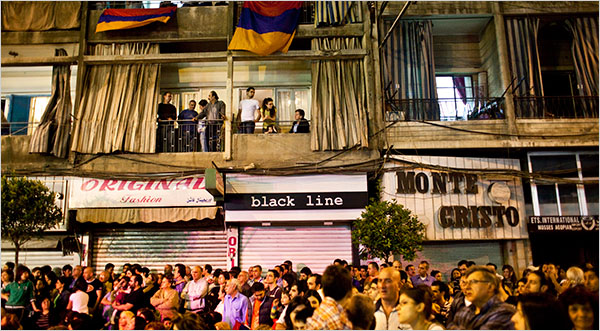
    Supporters watched a speech by Hagop Pakradounian, a politician from the main party of the Armenians, Tashnaq, on May 9 in Beirut, Lebanon.

    By ROBERT F. WORTH Published: May 25, 2009

    BEIRUT, Lebanon – Their political apparatus is a model of discipline. Their vast array of social services is a virtual state within a state. Their enemies accuse them of being pawns of Syria and Iran.


    Bryan Denton for The New York Times

    Hagop Havatian, a Tashnaq official, under a portrait of the party’s founders. The party operates in 35 nations.

    They are the Armenian Christians of Lebanon, one of the Middle East’s most singular and least-understood communities. And if they sound a bit like Hezbollah, the Shiite militant group based here, that is no accident.

    Last month, the main Armenian political bloc decided to support Hezbollah’s alliance in the coming parliamentary elections in Lebanon against the pro-American parliamentary majority. Because of their role as a crucial swing vote, the Armenians could end up deciding who wins and who loses in what is often described as a proxy battle between Iran, Hezbollah’s patron, and the West.

    That fact has brought new attention to the Armenians, a distinct and borderless ethnic group that is spread throughout the region much as the Jews once were. In Lebanon, they have their own schools, hospitals and newspapers. They speak their own language, with its own alphabet. Their main political party, Tashnaq, operates in 35 countries and has a secretive world committee that meets four times a year. Their collective memory of the genocide carried out against them in Turkey from 1915 to 1918 helps maintain their identity in a far-flung diaspora.

    “There is a sense of invisible nationhood across borders,” said Paul Haidostian, the president of Haigazian University, the Armenian university in Beirut.

    In fact, their political enemies here accuse the Armenians of siding with Hezbollah in order to protect the substantial Armenian populations in Syria and Iran. But the Armenian political leadership says it is fully independent and has no ideological sympathy for either of Lebanon’s two main political camps.

    Instead, the Armenians say, they are voting with the opposition for reasons that are entirely local and pragmatic: it offered them full control over the parliamentary seats in Armenian-dominated districts. The other side did not, said Hovig Mekhitarian, the chairman of the Lebanese branch of Tashnaq.

    “We want candidates who represent our community,” Mr. Mekhitarian said. “We are not with the opposition, and not with the majority.”

    That dynamic is common enough in Lebanon, a checkerboard of mutually suspicious sectarian groups that are usually more concerned with protecting their own interests than with advancing any broader national or regional agenda.

    But even in Lebanon, the Armenians stand out for their independence. During the 1975-1990 civil war, the Armenians refused to take sides. Tashnaq discouraged its members from leaving the country (though many Armenians did leave), in deference to Lebanese patriotism. Officially, the party is socialist, but its only real credo is survival.

    Mr. Haidostian said: “I remember when I used to get stopped at a checkpoint, they would ask, ‘Are you Christian or Muslim?’ I would say ‘Armenian,’ and it was like a third category. They didn’t know what to do.”

    Despite the risks, many Armenians say they find Lebanon a uniquely accommodating place, largely because its weak state allows them to live almost as a separate nation. “There is something tentative about Lebanese identity, and in that questioning Armenians have found a comfortable space,” Mr. Haidostian said.

    Although there have been Armenians here for centuries, they first came in large numbers after the genocide. Later wars and crises led to more migration, increasing the size of the Lebanese Armenian community to 240,000 by the 1970s. The creation of the independent state of Armenia in 1918 had provided refuge to some, but its small size and role as a Soviet client state after 1920 set limits on its role as an Armenian homeland.

    In Lebanon, the Armenians had an unusual mix of freedom and insecurity, allowing them to practice their religion and culture, but also limiting their assimilation into the general culture. In the United States, Armenians often marry outside their group and are less likely to speak their own language; here, they remain far more distinct.

    The Beirut neighborhood of Bourj Hamoud is a kind of miniature Armenia, with shop signs written in Armenian script and a dense, familial culture of working-class shops, homes and restaurants. The Lebanese branch of Tashnaq is based there, flying the party’s distinctive banner bearing a pen, a shovel and a dagger – representing ideology, work and struggle. There is also a rich network of schools, orphanages, retirement homes and hospitals. Schoolchildren learn three languages (and three different alphabets), and start on a fourth language in the fourth grade.

    Maintaining this independence requires political skill. During the civil war, Bourj Hamoud was trapped geographically between Christian and Palestinian areas, and its leaders had to work hard to avoid becoming a target for either side.

    Recently, that neutrality has been difficult to preserve. Tashnaq has long been a de facto Syrian ally, partly because of Syria’s former military domination of Lebanon. After the Syrian withdrawal in 2005, it remained in the Syrian political camp, mainly because it blamed the other side for an electoral law that divided Armenian districts and reduced its power.

    This spring, Saad Hariri, the leader of the pro-American parliamentary majority, tried to mend fences with Tashnaq, which controls the vast majority of Armenian votes. He had good reason: last year the electoral law was revised in a way that restored the Armenians’ power.

    Lebanese Christians represent the swing vote in this election, and the 160,000-strong Armenian community is by far the most unified subgroup of those votes. If Mr. Hariri could have persuaded Tashnaq to vote with him, the balance might have tipped in his favor to defeat Hezbollah and its allies.

    He did not succeed. Mr. Mekhitarian said Mr. Hariri had not offered enough. “He was really only offering one seat, and he wanted our support in 15 other seats,” Mr. Mekhitarian said.

    Members of Mr. Hariri’s party who took part in the negotiations offered a slightly different account. They said Mr. Hariri offered to satisfy Tashnaq’s demands on parliamentary seats, but only if the party would commit firmly to supporting him before and after the elections. It would not do so, they said.

    That is not surprising. In a sense, the Armenians cannot afford to make such political commitments. Like the Druse and other minorities in Lebanon, they believe they must subordinate all ideological principles to a nimble defense of their community.

    “In politics, you can’t always be neutral,” said Hagop Pakradounian, a Tashnaq member of Parliament. “But we try to maintain links to all sides.”
  • DEBKA file’s Exclusives for Week Ending May 28, 2009

    DEBKA file’s Exclusives for Week Ending May 28, 2009

    Summary of
    Lebanon’s election at center of US-Russian tug of war
    DEBKAfile Special report
    22 May: Shortly after visiting US Vice President Joseph Biden stated in Beirut Friday, May 22, that his government would “evaluate the shape of its assistance program based on the policies of the new government,” elected on June 7, Moscow announced that foreign minister Sergei Lavrov would visit Damascus and Beirut on May 23-25. He would be meeting Syrian president Bashar Assad as well as the Lebanese president Michel Suleiman.

    Biden urged “those who think about standing with the spoilers of peace not to miss this opportunity to walk away.” This was an apparent reference to Hizballah and its pro-Syrian allies, who are fighting to displace the pro-Western coalition. DEBKAfile’s Middle East sources report that Lavrov’s trip is mean to convey that, unlike Washington, Moscow is well-connected on both sides of Lebanon’s political spectrum, the pro-Western majority March 14 bloc fighting for survival as well as its challenger, the pro-Syrian, pro-Iranian Hizballah-led March 8 alliance.

    Since the race between them is close, Biden was sent to Beirut to try and tip the scales with a promise of tanks, helicopters, drones and artillery.


    DEBKAfile lifts fog from the Obama-Netanyahu balance sheet
    DEBKAfile Exclusive Analysis
    23 May: For the sake of warding off a surprise Israel attack on Iran, US president Barack Obama accepted a six-month deadline for testing Tehran by diplomacy – without pressing Israeli prime minister Binyamin Netanyahu to endorse a Palestinian state. Both gave ground in their first ice-breaking encounter.

    Three days later, the White House rebuffed claims that Obama would use his June 4 speech to launch a new Middle East initiative? That tale was planted by Jordan’s Abdullah II’s advisers and picked up by Israel’s often anti-Netanyahu media, although its source was dubious.

    Once that misapprehension was removed, some of the real subjects of discussed emerged.

    For instance, Obama did not demand the repartition of Jerusalem; neither was he keen to pursue the Palestinian issue at all at this time. Most of all, he was after space to engage in negotiation with Tehran without the threat of a surprise Israeli military strike against Iran’s nuclear sites hanging over the talks.
    Obama and Netanyahu set up two working groups for continuous discussion between them:

    One, headed by US national security adviser James Jones, will track of progress in the bilateral US-Iranian negotiations and report back to the White House and Jerusalem.

    The second team, headed by Middle East envoy George Mitchell, will be in charge of the Palestinian issue.

    Netanyahu may find it hard to explain at home why he promised no Israeli surprise attacks against Iran for six months – even though major disruptions loom: Lebanon’s pro-Western government may be overthrown by its June 7 election or thereafter, Iranian long-range missiles introduced to the Gaza Strip, Mahmoud Abbas’ new Palestinian government in Ramallah collapse, and Tehran will continue its shock tactics.

    To shift the focus, Netanyahu spoke passionately about Jerusalem, although its status was not under assault in his White House talks.

    “The flag that flies over the Kotel is the Israeli flag… Our holy places, the Temple Mount — will remain under Israeli sovereignty forever,” he told yeshiva students.

    And “Jerusalem was always ours, will always be ours, and will never again be divided,” he vowed at the annual Jerusalem Day state ceremony on Ammunition Hill, Jerusalem, honoring the soldiers who fell in the Six-Day War in 1967.


    US army chief: Narrow space left for dialogue to stop Iran attaining nuke 24 May: Adm. Mike Mullen, Chairman of the US Joint Chiefs of Staff, issued his most serious warning yet about the approach of a nuclear-armed Iran: “Most of us believe that “Iran is one to three years” from developing a nuclear weapon…depending on where they are right now. But they are moving closer, clearly, and they continue to do that.” He told ABC’s “This Week” Sunday, May 24. He indicated that an Iran could develop a nuke at any time from one to three years hence.

    At the same time, Mullen said a military strike against Iran’s nuclear facilities could have grave consequences – but so too would a nuclear-armed Iran.

    In talks with Israeli prime minister Binyamin Netanyahu on May 18, US president Barack Obama said the talks with Iran he is seeking cannot “go on forever” and agreed that at the end of the year, progress would be evaluated.


    May 24 Briefs

    • Presidents of Iran, Pakistan, Afghanistan hold first summit in Tehran on ways to end Pak/Afghan wars.
    • Lavrov says Hamas should be part of Middle East peace process.

    He calls on Assad, Meshaal in Damascus.
    • Iranian presidential hopeful Rezai: I would stop Israel with “one strike.”
    • Lieberman: Israel’s withdrawal to pre-1967 borders would not end conflict but transfer it to Israeli heartland.
    • Demolition of outposts must be part of comprehensive approach.


    Israel to drill missile attack from many directions 25 May: Deputy defense minister Matan Vilnai outlined the nationwide civil defense exercise to be staged next week in a briefing to the Knesset foreign affairs and security committee Monday, May 25. Next Tuesday, he said, sirens would send the entire population heading for the nearest shelters or protected sites.

    Vilnai explained the exercise was configured on the presumption of a missile assault from three or four directions synchronized with large-scale terrorist attacks up and down the country. He stressed that this was no fantastic scenario divorced from reality but highly credible in the event of a war.

    Drills conducted in the last two years and the lessons of the 2006 Lebanon war and 209 Gaza conflict had been factored into the coming exercise, said the deputy minister. In both, Israel’s population had come under heavy missile bombardment.

    Upgraded “gas masks” would be redistributed to the population later this year.


    North Korea test-fires two more short-range missiles amid escalating NE Asian tensions 26 May: Seoul reports North Korea test fired two short-range missiles Tuesday, May 26, its fourth and fifth since carrying out an underground nuclear test Monday. The test was unanimously condemned by the UN Security Council Monday night.

    DEBKAfile’s military sources note that North Korea and Iran are closely and secretly coordinated on their military nuclear and missile programs. Most of the guidance technology which gave the long-range Seijl 2 surface missile tested by Iran Wednesday, May 20, its bull’s-eye accuracy came from Pyongyang. Iran’s long-range missile test was carried out less than a month after North Korea’s own internationally condemned missile test launch on April 5. Tehran may also be expected to be not far behind its nuclear partner in conducting its own first nuclear test.

    Cont. Next Column

    Not surprisingly, therefore, Iran’s president Mahmoud Ahmadinejad told a news conference Monday, May 25, that while all international issues are open for discussion, “Iran’s nuclear issue is closed.”


    Netanyahu’s backing for outpost removals unrelated to his Iran deal with Obama
    DEBKAfile Exclusive Report
    26 May: A high-ranking Israeli delegation is to meet US officials in London with a defense ministry plan for evacuating some 24 unauthorized outposts on the West Bank. This plan was prepared ahead of defense minister Ehud Barak’s visit to Washington next week and backed solidly by prime minister Binyamin Netanyahu and foreign minister Avigdor Lieberman.

    The first 10 warnings of impending demolitions were distributed Monday, May 25. They dropped Netanyahu in hot water in his own Likud faction.
    To persuade the critics, Netanyahu implied without saying so outright that he had won US backing or cooperation for an Israeli offensive against Iran and that the price tag was the removal of West Bank outposts.

    He stressed the importance of “our relations with the United States” for “the future of the state.”
    This implied link was disingenuous since DEBKAfile’s Washington sources contradict Netanyahu’s interpretation of his understanding with US president Barack Obama about the need to prevent Iran from attaining a nuclear capability. This understanding, they say, was confined purely to diplomatic efforts (for which the two leaders set a six-month limit). A unilateral military attack by Israel was no part of it. In fact, an Israeli strike would spark a serious crisis between Jerusalem and Washington.

    The bottom line here, say DEBKAfile’s military sources, is that however many outposts are evacuated, whether authorized or not, it will not bring the Obama administration around to backing an Israeli strike against Iran.


    First Russian warships enter Persian Gulf ports
    DEBKAfile Exclusive Report
    26 May: Russian warships are due to call Wednesday, May 27, at the Bahrain port of Manama, seat of the US Fifth Fleet in the Persian Gulf, DEBKAfile’s military sources reveal. They will be following in the wake of the Russian vessels docked at the Omani port of Salalah, the first to avail themselves of facilities at Gulf ports.

    Their arrival is fully coordinated between the Russian and Iranian naval commands.

    According to our sources, this is the first time a Russian flotilla will have taken on provisions and fuel at the same Gulf ports which services the US Navy. Moscow has thus gained its first maritime foothold in the Persian Gulf.

    Our military analysts find Russia and Iran seizing the moment to take advantage of two developments:
    1. President Obama quietly reduced the number of US warships maintained in the Gulf to its lowest level in two years to generate a positive atmosphere for the coming US dialogue with Tehran. Not a single US aircraft carrier is anywhere in the Gulf region.

    2. Monday, May 25, President Nicolas Sarkozy inaugurated France’s first naval facility in the Gulf in Abu Dhabi. Russian and Iranian policy-makers see no reason why if Paris can set up a military presence, Moscow can’t.


    North Korea warns South of military strike, no longer bound by 1953 Truce27 May: Pyongyang announced early Wednesday, May 27, that its withdrawal from the truce that ended the Korean War in 1953 means that “the Korean peninsulas will go back to a state of war.” Thousands of US troops are deployed in the buffer zone since the war ended.

    US spy planes reported that the plutonium separation plant at Yongbyon had been reactivated.
    North Korea repeated that Seoul’s decision to joint the US-led Proliferation Security Initiative was tantamount to a declaration of war. “Any hostile acts against our republic, including the stopping and searching of our peaceful vessels… will face an immediate and strong military strike in response,” the North Korean statement said.

    Firing another short-range missile in Japan’s direction, its sixth since conducting a nuclear test Monday, May 25, Pyongyang said it could not guarantee the safety of shipping off its west coast. The test was unanimously condemned by the UN Security Council.

    The White House then announced that US president Barack Obama and South Korean president Lee Myung-bak and Japanese prime minister Taro Aso had agreed to work together to support the Security Council resolution with concrete measures to curtail North Korea’s nuclear and missile activities.


    May 27 Briefs:

    • West Bank rabbis call on Israeli soldiers and police to defy orders to evacuate settlements.
      Police question FM Lieberman again on suspicion of money laundering and obstructing their inquiry.
      French Egyptian Culture Minister appointed head of UNESCO apologizes for anti-Israel remarks.
      Israel’s unemployed figure rises to 228,000 – 7.6 pc.
      Moscow announces undefined “preventive measures” after North Korean nuclear test.
      High terror alert declared in Islamabad, Karachi, Rawalpindi after massive bomb blast kills at least 40 in Lahore, e. Pakistan.
      Pakistan claims capture of two assailants.
      Interior minister said attack reprisal for Pakistani military Swat operation.
      Suicide bomber flattened 15 buildings, damaging ISI and police station in city center.
      Attackers opened fire on police from wrecked station.

    Abbas will find Obama puts Syrian peace track ahead of Palestinians
    DEBKAfile Exclusive Report
    28 May: Palestinian Authority chairman Mahmoud Abbas will put before US president Barack Obama when they meet at the White House Thursday, May 28 a thick sheaf of pre-conditions for talks with Israel, primarily heavy US pressure to force the Netanyahu government to stop all construction activity in the West Bank and Jerusalem and remove 200 West Bank roadblocks.

    US secretary of state Hillary Clinton has come forward to declare that the president objects to any form of Israeli settlement activity whether for “natural growth” or any other purpose.

    But for now, the administration is more interested in advancing the Syrian than the Palestinian peace track.

    In any case, Obama is advised by his Middle East envoy George Mitchell that focusing on the Palestinian issue in its present strife-ridden state would be a waste of time and better go for the Syrian track. He and his aides are planning an early visit to Damascus to test the ground for resumed peace talks.

  • Turkish-Armenian Talks Not In Deadlock, Says U.S. Envoy

    Turkish-Armenian Talks Not In Deadlock, Says U.S. Envoy

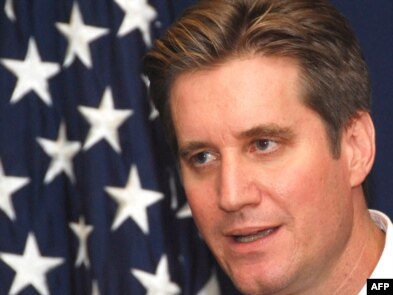
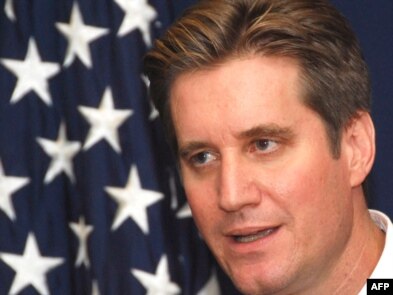
    U.S. — Deputy Assistant Secretary of State Matthew Bryza, 12Aug2008

    28.05.2009
    Emil Danielyan

    Armenia’s rapprochement with Turkey has not reached an impasse despite Ankara’s renewed linkage between the normalization of bilateral relations and a Nagorno-Karabakh settlement, a senior U.S. official said on Thursday.

    Deputy Assistant Secretary of State Matthew Bryza also dismissed mounting domestic criticism of President Serzh Sarkisian’s conciliatory line on Turkey.

    In an interview with RFE/RL, Bryza insisted that recent statements by Turkish Prime Minister Recep Tayyip do not preclude the implementation of a U.S.-backed “roadmap” to improving Turkish-Armenian relations that was announced by the two governments in late April. “Stay tuned, keep watching for additional statements by top officials in both Turkey and Armenia which hopefully will show the implementation is moving forward,” he told RFE/RL.

    But Bryza acknowledged that there is at least some connection between Karabakh peace and the success of the Turkish-Armenian dialogue. “As we make progress, let’s say, on Nagorno-Karabakh, it’s easier to make progress on Turkey-Armenia,” he said. “As we make progress on Turkey-Armenia, it’s easier to make progress on Nagorno-Karabakh.

    “It’s not that there are preconditions. There are no preconditions. There are commitments by the countries to do one or another set of issues.”

    The Armenian leadership maintains that it has been discussing with Ankara only an unconditional normalization of relations and that the agreed roadmap makes no references to the unresolved Karabakh conflict. Erdogan has repeatedly stated, however, that Turkey will not establish diplomatic relations and open its border with Armenia unless the latter makes peace with Azerbaijan.

    Neither side has publicized the “roadmap” yet. Bryza also declined to divulge its details. “I hope that it will be publicized soon,” he said.

    The Turkish-Armenian deal was announced on the eve of the April 24 annual commemoration of more than one million Armenians massacred in the Ottoman Empire during World War One. Many in Armenia and its worldwide Diaspora believe the timing helped for U.S. President Barack Obama backtrack on his pledges to recognize the mass killings as genocide. Sarkisian’s critics also say the year-long rapprochement has earned Armenia no tangible benefits.

    “Those people don’t understand what’s happening,” countered Bryza. “That is a mischaracterization of reality.”

    “Armenia has neither won nor lost anything, Turkey has neither won nor lost anything, because the Turkey-Armenia agreement has not been implemented yet,” he said. “The sides are in the process of implementing the roadmap. Only then will there be benefits.”

    “It’s time for the process to move forward,” he added. “I strongly agree with those critics who say the agreement needs to be implemented.”

    https://www.azatutyun.am/a/1741892.html