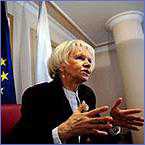
SANLIURFA (A.A) – 30.05.2009 – The senior Czech diplomat in Turkey saw on Saturday Turkey’s geopolitic importance as a reason for European Union (EU) membership.
Eva Filipi, the ambassadress of the Czech Republic to Turkey, said that there were many reasons to make Turkey a full member of the EU.
Filipi enumerated these reasons as Turkey’s geopolitic and strategic importance and location.
The Czech Republic has been holding the rotating presidency of the EU since the beginning of 2009, and will hand over the presidency to Sweden as of July 1, 2009.
The ambassadress expressed her country’s full support for Turkey’s EU membership bid, and said both Turkey and the EU should be fair as much as they could and fulfil their obligations.
Filipi said that the EU was not a Christian club, and had many universal principles and values that were not related with religion.
Turkey became an EU candidate country in December 1999. The union launched accession talks with Turkey on October 3, 2005. (BRC)
Muslims in the UK, France and Germany feel more loyalty towards the country they live in than the general public, according to a Gallup poll published on May 7.
The Gallup Coexist Survey charting the attitudes of Muslims and the wider public shows that religion and national identity are complementary rather than competing and dispels the myth that Muslims do not feel loyalty to their country. British Muslims identify with Britain far more than the general public and have more confidence in the country’s institutions.
The survey found that 77% of British Muslims were loyal to Britain compared to only 36% of the general public. However, nearly half of the British public (49%) said British Muslims were not loyal to Britain.
Contrary to the prevailing stereotype, more British Muslims (67%) prefer to live in mixed neighbourhoods than the British public (58%).
British Muslims have more confidence in democratic institutions than the general public: judicial system (76% against 55%), financial institutions (62% against 56%), honesty of elections (83% against 57%) and national government (40% against 32%). However Muslims have less confidence in the military than the general public (52% against 86%).
A larger proportion of the non-Muslim British public said attacks on civilian targets are justified compared to the British Muslim populace. The Executive Director of the Gallup Center for Muslim Studies, Dalia Mogahed, called for a renewed debate about the views of the majority of Muslims, suggesting the report had broken down many of the stereotypes about Muslim attitudes.
On moral issues, Muslims are more conservative than the general public. 58% of British public view homosexuality as morally acceptable, whilst none of the British Muslims polled accepted this (0%). 35% of British public believe that viewing pornography is morally acceptable whilst only 1% of British Muslims accepted this.
“What I found most surprising in the survey is the low level of thriving among British Muslims. They are less likely to be employed than other members of the British public. Thriving does correlate strongly with employment, income and physical health. This is the key issue where British Muslims are lagging behind, as well as with regards to their citizenship,” Executive Director of the Gallup Center for Muslim Studies, Dalia Mogahed, who was recently appointed to President Obama’s Advisory Council on Faith-Based and Neighborhood Partnerships told The Muslim News.
Source: www.muslimnews.co.uk, Issue 241, Friday 29 May 2009
The Turkish government drafted a bill on a proposed de-mining project on the Syrian border, which sparked controversy among neo-nationalists and Islamists (EDM, May 21). The Justice and Development Party (AKP) government proposed to lease the de-mined area for 44 years to a foreign company. The area was first mined when the Turkish-Syrian border was determined in 1956. The mined area consists of 216,000 decares of land along a 510 kilometer long and 350 meter wide area of the border. It has an estimated value of around $500 million. Around 80 percent of the area is available for agricultural use, while 70 percent is suitable for irrigation. “It is believed that there are 650,000 landmines in the territory: approximately one landmine every 500 meters. The mines have claimed 3,000 lives in the past 50 years while crippling 7,000. The mines were marked on a map while they were being laid” (Hurriyet Daily News, May 29).
The opposition parties argued that the AKP government wanted to lease the area to an Israeli company. Prime Minister Tayyip Erdogan replied to the opposition concerns saying: “Money has no religion, nationality, ethnicity or color. No matter who invests, it is not Israeli’s who will work in this area, only Turkish citizens will be working there and it will help reduce unemployment within our country” (Hurriyet, May 23).
The Republican People’s Party (CHP) leader Deniz Baykal stated that “we cannot give a 510-kilometer long border area to a foreign country. The Arabs are on one side and the Turks are on the other, while Israelis will be in the middle framing the area. Is there any meaning to this? We will not allow this to happen” (Hurriyet, May 27). Moreover, the CHP parliamentarian, Gurol Ergin, previously criticized the AKP government’s attempt to lease this land, alleging that it might create a “second Gaza” in the region (Anadolu Ajansi, May 15).
Baykal draw a parallel between the AKP’s attempt to lease the land to a foreign company and the U.S. military requesting transit rights through Turkish territory prior to the Iraq war in 2003. Baykal said that the opposition did not permit this to happen, and now the government had to be stopped in its efforts to “lease this land to a foreigner” (Hurriyet, May 27).
The opposition parties demanded that the Turkish armed forces (TSK) should be given the sole responsibility for the mine-clearing. Moreover, they alleged that the TSK also harbored reservations over the bill (EDM, May 21). Yet, the Turkish Chief of the General Staff Army-General Ilker Basbug, stated that NATO’s Maintenance and Supply Agency (NAMSA) must clear the mines (Vatan, May 22).
The opposition is not alone in criticizing the AKP government: Islamist intellectuals have also voiced concern. One well respected Islamist intellectual Ahmet Tasgetiren criticized the government in the Bugun daily, asking whether it was paying tribute to Israel because Prime Minister Erdogan had harshly criticized Israel in Davos in January (Bugun, May 28). Fehmi Koru, a childhood friend of President Abdullah Gul and Prime Minister Tayyip Erdogan, and another influential intellectual, also opposed the idea of leasing the land to an Israeli firm (Yeni Safak, May 28).
It appears that some APK parliamentarians shared these concerns. For instance, Sadik Yakut said “I am against leasing this land to an Israeli company. AKP parliamentarians are very sensitive about this issue” (Milliyet, May 29). Due to the passive resistance by AKP parliamentarians opposed to the government proposal, it was subsequently withdrawn.
The opposition and the AKP government agreed to work together to find a compromise on how to proceed to clear the mines. It was also reported that NAMSA might be permitted to visit the region to conduct de-mining operations. However, the Minister of Defense Vecdi Gonul, alleged that “the cost of clearing the mines varies at between $700 million to $3.5 billion. The government simply cannot invest that amount of money into this land. In 1992 such proposals emerged, but were abandoned due to insufficient funds” (Zaman, May 29).
Despite attracting a significant level of foreign investment to the Kurdish region, which would reduce local unemployment, suspicions toward Israel on the part of the Islamists and neo-nationalists forced the government to withdraw the proposal. Such a coalition of Islamist and nationalists also emerged during the March 1, 2003 vote to resist the AKP government over allowing U.S. troops to conduct operations in Iraq from Turkish territory.
The latest controversy between the opposition and AKP government once again exposed the depth of anti-Israeli sentiment among many segments of the Turkish population. Even AKP parliamentarians, who have had a tendency to vote in sympathy with Erdogan’s initiatives, refused to support the government over this sensitive issue.
Exclusive: Defense Department investigators subpoena records from Google, Microsoft, and Yahoo in connection with ongoing probe.
Paul McDougall
InformationWeek
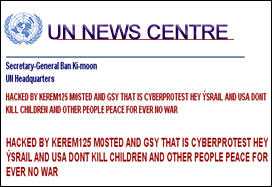
A known computer hacking clan with anti-American leanings has successfully broken into at least two sensitive Web servers maintained by the U.S. Army, InformationWeek has learned exclusively.
Department of Defense and other investigators are currently probing the breaches, which have not been publicly disclosed.
The hackers, who collectively go by the name “m0sted” and are based in Turkey, penetrated servers at the Army’s McAlester Ammunition Plant in McAlester, Okla., and at the U.S. Army Corps of Engineers’ Transatlantic Center in Winchester, Va.
The breach at the McAlester munitions plant occurred on Jan. 26, according to records of the investigation obtained by InformationWeek. On that date, Web users attempting to access the plant’s site were redirected to a Web page that featured a protest against climate change.
On Sept. 19, 2007, the same hackers electronically broke into Army Corps of Engineers’ servers. That hack sent Web users to www.m0sted.net. The page, at the time, contained anti-American and anti-Israeli rhetoric and images, records show. It currently appears to be an Internet landing spot that features airline reservation links.
Beyond the redirects, it’s not clear whether the group was able to obtain sensitive information from the Army’s servers.
The hacks are the subject of an ongoing criminal investigation by Defense Department officials and members of the U.S. Army’s Judge Advocate General’s Office and Computer Emergency Response Team. Investigators have executed records search warrants against Microsoft (NSDQ: MSFT), Yahoo (NSDQ: YHOO), Google (NSDQ: GOOG), and other Internet service and e-mail providers as part of their efforts to unmask the hackers’ true identities.
Investigators believe the hackers used a technique called SQL injection to exploit a security vulnerability in Microsoft’s SQL Server database to gain entry to the Web servers. “m0sted” is known to have carried out similar attacks on a number of other Web sites in the past — including against a site maintained by Internet security company Kaspersky Lab.
The hacks are troubling in that they appear to have rendered useless supposedly sophisticated Defense Department tools and procedures designed to prevent such breaches. The department and its branches spend millions of dollars each year on pricey security and antivirus software and employ legions of experts to deploy and manage the tools.
Equally troubling is the fact that the hacks appear to have originated outside the United States. Turkey is known to harbor significant elements of the al-Qaida network. (!) It was not clear if “m0sted” has links to the terrorist group.
Defense Department officials did not immediately return calls seeking comment on the case.
InformationWeek Analytics has published an independent analysis on what executives really think about security. Download the report [on the website] (registration required).
The American Turkish Council will convene for it’s 28th Annual Conference on US-Turkish Relations to bring together leaders from Turkey and the US at the Gaylord Resort and Convention Center at the National Harbor, Washington, DC May 31-June, 2009. We will also be tweeting live at the event using the Twitter account @AmericanTurkish.
The theme of this year’s Conference is “U.S.-Turkey: Overcoming Challenges in an Era of Change.”
The conference is hosted by the Chairman of the Board of the American-Turkish Council, Lt. General Brent Scowcroft (USAF, Ret.), and Chairman of the Turkish U.S. Business Council, Haluk Dinçer.
Key speakers include:
H.E. Ahmet Davutoğlu – Minister of Foreign Affairs
Senator John F. Kerry – Chairman, Senate Foreign Relations Committee
General İlker Başbuğ – Chief, Turkish General Staff
Admiral Mike Mullen – Chairman, U.S. Joint Staff
Murad Bayar – Undersecretary for Defense Industries, Ministry of Defense
Muhtar Kent – Chairman of the Board & CEO, The Coca-Cola Company
Dr. Kemal Derviş – Vice President and Director, Global Economic and Dev, Brookings Institution
Ambassador Marc Grossman (Ret.) – Vice Chairman, The Cohen Group
You may register to attend the conference at .
Further information regarding the American-Turkish Council can be found at: https://www.uschamber.com/program/international-affairs/middle-east-and-turkey-affairs/us-turkey-business-council
Join the ATC Facebook group: https://www.facebook.com/group.php?gid=95819402387&ref=ts and follow ATC on Twitter:
German-Turkish Week 2009 aims to raise awareness amongst the German public of the history and development of the German-Turkish Community and its contributions to German society, while celebrating the richness of German-Turkish culture.
German-Turkish Week 2009 will consist of informative components such as panel discussions, speeches, and interviews, which provide insights and perspectives.
Artistic presentations including live literary readings, films, music and dance performances, artistic exhibitions, in addition to local Turkish cuisine, will showcase elements of German-Turkish culture and ensure a fun, celebratory atmosphere.
The series will be targeted at the general public in Berlin, and will be documented online through photography, written reviews, and videos, which will allow the wider international community access to the program and provide up-to-date information on recent events.
 SANLIURFA (A.A) – 30.05.2009 – The senior Czech diplomat in Turkey saw on Saturday Turkey’s geopolitic importance as a reason for European Union (EU) membership.



 German-Turkish Week 2009 aims to raise awareness amongst the German public of the history and development of the German-Turkish Community and its contributions to German society, while celebrating the richness of German-Turkish culture.